




Abstract

The alpinists were reached after 12 hours of difficult rescue team progression in poor conditions [external temperature −15°C (5°F), moderate snowfall, and winds of up to 50 km h−1 (30 miles h−1)]. The alpinists were physically exhausted, and a 51-year-old, previously healthy man complained of frostbite injuries to both hands. A closed, uninhabited mountain refuge (3100 m, 10,170 ft) was reached after a 2-hour walk, and the decision was made to rest overnight due to safety considerations. Both hands showed frostbite of all distal phalanges with numbness, paleness, and cyanosis of the finger tips. Re-warming was begun in a 40°C (104°F) water bath with povidone-iodine, which caused intolerable pain after about 10 min. The physician decided to perform a bilateral regional anesthesia with wrist blocks. The area was disinfected, and the nerve block was performed as described by Chandran et al. (2010) with three injections of 5 mL of 0.5% ropivacaine for the median, ulnar, and radial nerves, about 3–4 cm proximally to the wrist.
Pain in both hands was completely relieved within 10 min. Hyperemia in both hands developed, following both water bath re-warming and wrist blocks. A sterile bandage was applied, and systemic analgesia was initiated orally with acetaminophen and an NSAID (dexketoprofen), in anticipation of the end of the effect of the block, which followed about 2 h later and brought moderate pain. Six hours after arrival in the mountain refuge, improved weather conditions enabled descent to an altitude of 2400 m (7874 ft) where helicopter evacuation to a regional hospital was possible. After 24 hours of hospitalization (Fig. 1), the patient was discharged and followed on an outpatient basis. After transient loss of a nail and superficial skin, the fingers recovered within 8 weeks. A mild cold intolerance persisted.
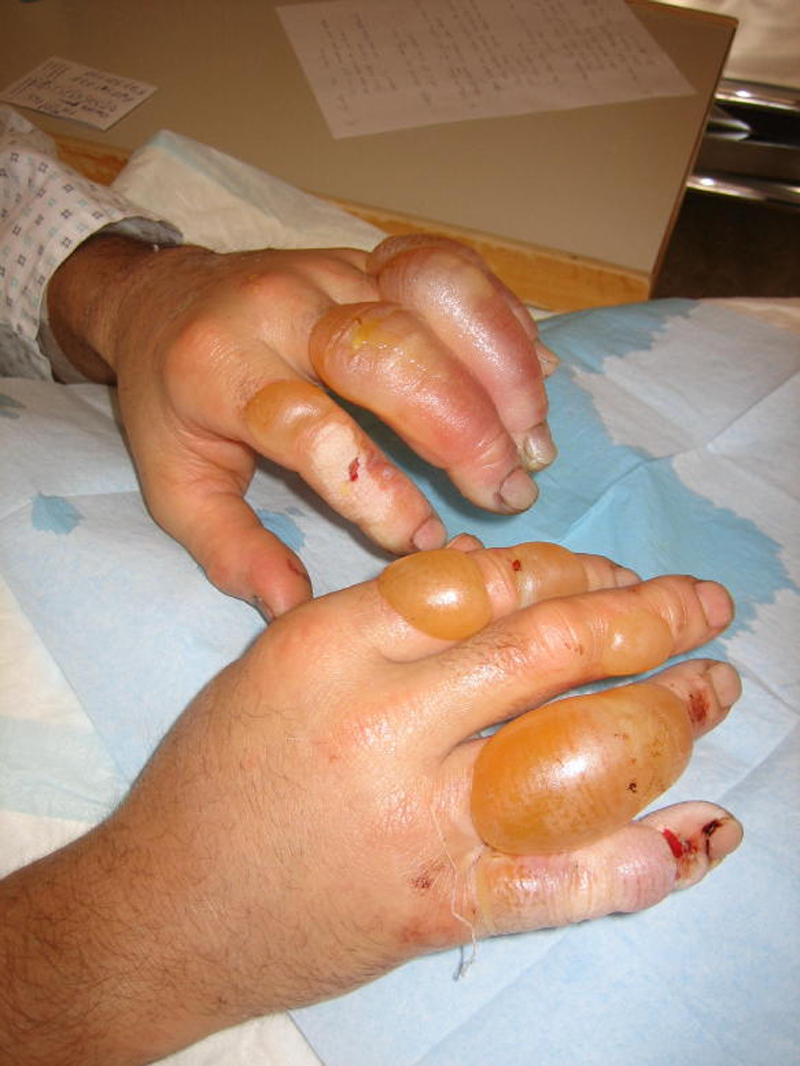
Superficial frostbite injuries affecting both hands, 24 hours after initial frostbite.
Discussion
Pre-hospital management of frostbite is a challenging condition, especially when there are long transfer times. Consensus exists as to immediate administration of analgesics and anti-platelet drugs, but no effective and long-lasting antalgic or vasodilating therapy has been recommended for the pre-hospital environment. Although re-warming of an extremity has a vasodilating effect, it may be painful and should only be commenced when subsequent cold exposure and refreezing can be excluded.
Regional anesthesia is currently used both in-hospital and pre-hospital for pain control in trauma (Gregoretti et al., 2007). Long ago, regional anesthesia was recognized to enhance peripheral vasodilation in the management of frostbite injuries using continuous epidural anesthesia (Taylor, 1999), block of the stellate ganglion (Ali et al., 1982), axillary blocks or as a combination of these techniques through medical sympathicolysis (Köster et al., 1987). Re-warming and the aforementioned regional anesthesia procedures have to be administered early as the benefits are greater in the initial hours of frostbite (Snider et al., 1974; Snider et al., 1975), most likely by limiting the deleterious effects of peripheral vasoconstriction and thrombosis. Recently, an in-hospital wrist block has been proposed in the management of frostbite to the phalanges (Chandran et al., 2010). The wrist block is simple and feasible in the pre-hospital management of a frostbite injury of the hand. The affected region should be disinfected before applying regional anesthesia, and afterwards dressed, and the extremity should be splinted. When performing regional anesthesia, side effects have to be considered, including infection, bleeding, allergic reaction, nerve injury, and intravascular injection of local anesthetics with potentially lethal systemic intoxication (Weinberg, 2010).
In conclusion, we report the pre-hospital management of frostbite injuries of both distal digital phalanges with warm water bathing and wrist blocks. With frostbite injuries to the hands, a pre-hospital wrist block may be a useful adjunct because it achieves fast and complete pain control and enhances peripheral vasodilation; its role in influencing outcome remains to be determined.
Footnotes
Acknowledgments
We thank Emily Procter for assistance in editing the manuscript. We thank Danielle Wyss for proofreading and final translation.
Author Disclosure Statement
No competing financial interests exist.