




Abstract

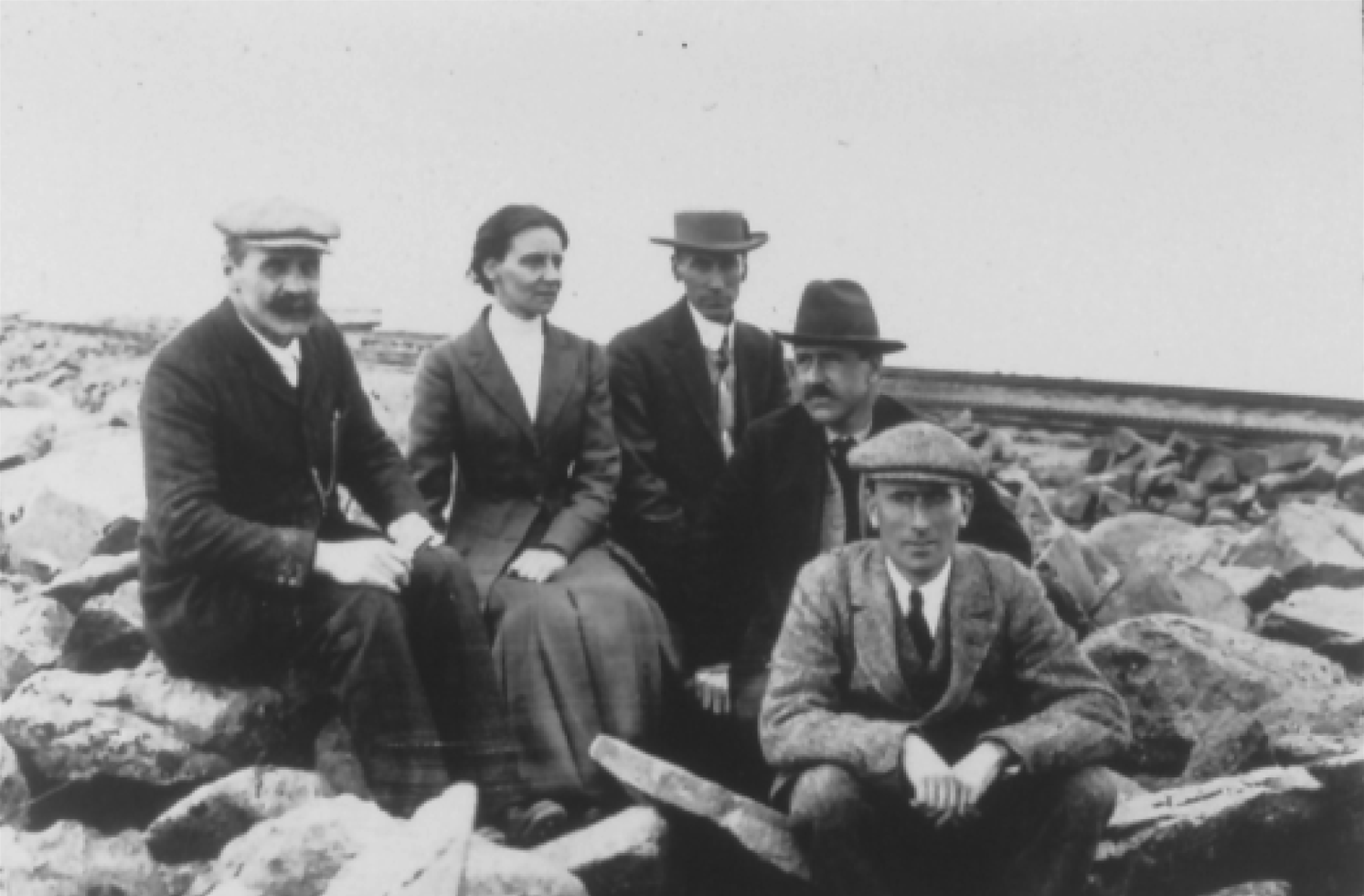
Members of the Anglo-American Pikes Peak Expedition of 1911. The cog railway line can be seen in the background.
The choice of Pikes Peak as the venue had an amusing twist. When Haldane from Oxford met Henderson from Yale during the International Congress of Physiology in Vienna in 1910, Haldane stated that what he needed was “a nice comfortable mountain.” This whimsical statement probably followed from the fact that the only two high altitude stations in existence at the time, the Observatoire Vallot on Mont Blanc at 4350 m and the Capanna Margherita on a peak of the Monte Rosa at 4559 m, were both remote, had primitive living conditions, and were very difficult to reach over snow and ice. Haldane's point was that he needed a site where the living conditions were congenial, the temperature was acceptable, adequate food was available, and the only difference compared with sea level was the low barometric pressure. The Summit Hotel on Pikes Peak fulfilled these criteria well. Ascent by rail was easy, several rooms were set aside for the expedition, the laboratory was comfortably warmed, the cuisine was judged excellent, and in addition they were only 14 miles from Colorado College in Colorado Springs where Schneider had a laboratory and supplies were available.
The design of the expedition was classical. First, many physiological measurements were made at sea level and a few at the low altitude of Colorado Springs. The team then ascended rapidly to the summit, altitude 4300 m, where they remained for 5 weeks. Finally, they descended to Colorado Springs and then to New Haven. An important feature of the expedition was that extensive measurements were made during the deacclimatization period. Little information was available at the time about this, and indeed this is still the case to some extent.
The extensive report of the expedition (Douglas et al. 1913) is downloadable from JSTOR and still makes good reading. At 133 pages, the style is relaxed and is in great contrast to some of today's reports which read a bit like falling down stairs. The investigations covered a wide area. All four subjects who remained at the summit developed acute mountain sickness initially, but reported that most of the symptoms had disappeared after 2 to 3 days. A major interest was the arterial
A colorful feature of the expedition was the involvement of Mabel FitzGerald. As shown in Figure 1, she accompanied the men to the summit, but she did not stay there for reasons that are not completely clear. One story is that this was because she was not chaperoned, but it is more likely that the men thought that the presence of a woman would have complicated the living conditions. So instead of joining the men, she carried out a related study in which she visited various Colorado mining camps alone, accompanied only by a mule. It is difficult to imagine a more hazardous environment for a single woman. Nevertheless, she obtained a large amount of data on alveolar P
A postscript took place in Oxford in 1961 when the Haldane Centenary Symposium was organized to celebrate Haldane's birth in 1860. Suddenly people wondered what had happened to Mabel FitzGerald, someone looked in the Oxford telephone directory, and there she was living near the site of the symposium. She was able to attend and, having surfaced, was given an honorary M.A. degree by Oxford University when she was 100 years old.
The Pikes Peak Expedition was an important landmark in the development of high altitude physiology and medicine. The conclusion on oxygen secretion was erroneous, but the other findings have stood the test of time and if you did not raise a glass on July 12 I invite you to do this now.