




Abstract
Abstract
Lara, Beatriz, Juan Jose Salinero, and Juan Del Coso. Altitude is positively correlated to race time during the marathon. High Alt Med Biol. 15:64—69, 2014.—Completing a marathon (42.2 km) is one of the more challenging sports activities. Besides the distance, the ambient conditions of the race (altitude, temperature, etc) can increase the physiological demands of the event. The purpose of this study was to investigate the relation between the altitude of the city in which the marathon is held and the marathon race time. For this purpose, we sought the race times of 16 popular marathons performed at different altitudes above sea level (range from ≈0 to 2800 meters above sea level). In these competitions, we analyzed the race times of the female and male runners who finished from 21st to 100th position. We excluded the top 20 male and female finishers from the analysis because elite athletes usually compete in marathons held at low altitudes above sea level. Ambient temperature, the positive cumulative elevation gain, and the number of participants were used as control variables. Finishing time in the marathon was positively correlated with the altitude of the competition for both male (r=0.78; p<0.05) and female participants (r=0.73; p<0.05). On average, each increase of 1000 meters above sea level augmented marathon race time by 10.8±0.6% in men and 12.3±0.7% in women. Compared to race times in the Rotterdam marathon (held at 0 meters above sea level), the time taken to complete the marathon was significantly higher in competitions held at an altitude of over 700 meters. In conclusion, the time taken to complete a marathon strongly depends on the altitude of the city in which the marathon is held. Selecting marathon competitions close to 0 m above sea level is a good strategy to maximize marathon performance.
Introduction
M
Elevation in altitude is associated with a progressive reduction in barometric pressure and consequently a reduction in air density and partial pressure of oxygen (Mazzeo, 2008). The lower oxygen pressure in the air at altitude produces a concomitant decrease in arterial partial pressure of oxygen, a reduction of arterial saturation and hence in arterial oxygen content (Mazzeo, 2005). At rest, the human body compensates hypoxemia by increasing cardiac output, mechanical ventilation, and catecholamine and cortisol concentrations (Mazzeo, 2008), but full physiological compensation cannot be reached during intense exercise (Calbet et al., 2003; Saunders et al., 2009). The degree of arterial oxygen desaturation correlated with the decline in performance during a 3000-m race completed at altitude (Chapman et al., 2011) and with the decline of V
The main physiological determinants of marathon performance are V
Peronnet et al. (1991) presented a mathematical model to calculate the effect of altitude on running performance, based on the influence of aerobic and anaerobic metabolism on different athletic disciplines (from 60 m to the marathon). According to this theoretical analysis, altitude may benefit sprint performance since the reduction of aerodynamic resistance present at altitude is more beneficial than the reduction of maximal aerobic power. On the contrary, the reduction in maximal aerobic power with altitude is associated with a reduction in performance over middle and long distances (from 800 m to the marathon). The reduction in air density with increasing altitude would not represent an advantage for long distance runners, while altitude markedly lessens V
Nevertheless, there are no data regarding the effects of altitude on race time during a marathon competition. The aim of this investigation was to analyze the finishing times of marathon competitions held in cities situated at different altitudes. A second purpose was to examine any sex difference in marathon performance impairment related to altitude. We hypothesized that marathon competitions held in cities at an altitude of over 1000 m would produce significantly higher race times in both male and female runners.
Material and Methods
Marathon racing performances were collected from 16 competitive races held in cities located at different altitudes above sea level (Table 1). These data are in the public domain and thus, written and informed consent was not required from individual runners. We obtained data from the 100 best performances for men and women to obtain a representative sample of high performance runners in each marathon. We excluded the top 20 finishers in each marathon to eliminate the effect of elite runners who only compete in low altitude marathons. Thus, data for each marathon represent mean±SD for runners between the 21st and 100th positions. Finishing race times were obtained for all the races in their 2012 edition, except the New York marathon race (2011 edition). Female data from the Quito marathon corresponded to 13 participants. Mean ambient temperature corresponding to the race day, profile of the course of the race, and the number of participants in each marathon were collected from marathon websites or by contacting marathon organizers. These data were collected to be used as control variables during the statistical analysis. The study was revised by a Research Ethics Committee in accordance with the latest version of the Declaration of Helsinki. The Research Ethics Committee indicated that this investigation did not require approval.
Mean altitude of the races is an approximation because some marathon organizers did not have the exact data. All this information is related to the 2012 editions, except the New York marathon that corresponds to 2011 (the 2012 edition was cancelled).
One purpose of this study was to describe finishing times in marathons held in cities located at different altitudes. Simple descriptive statistics such as mean and SD were used to illustrate the effect of altitude on marathon performance. In addition, we tested the normality of each variable with the Kolgomorov-Smirnov test. A second purpose was to quantify any decrease in marathon performance associated with altitude; we performed a correlation analysis (r Pearson) between race times in the marathon and the altitude of the city in which the marathon was held. Afterwards, linear regression analysis (adjustment by least squares) was performed to model the relationship between race time and altitude. We used partial correlations to eliminate the effects of ambient temperature, the number of participants, and the total positive elevation changes during the race in the correlation between running performance and altitude. The differences in the finishing times among marathons at different altitudes were examined using two-way ANOVA (altitude×sex). All analyses were performed using the statistical package SPSS 20.0 (SPSS Inc., Chicago, IL). The significance level was set at p<0.05.
Results
The best race time in the marathon was obtained at an altitude of 0 m for men (146±5 min) and 30 m for women (174±7 min). The worst race time in the marathon was obtained at an altitude of 2800 m for both men (202±13 min) and women (295±10 min). In comparison to the race times obtained at 0 m (e.g., the Rotterdam marathon), finishing times were higher in marathon competitions conducted at 700 m or above in both male and female participants (p<0.05). Figure 1 depicts the relationship between the mean race time of male and female runners and the altitude of the city in which the marathon was held. Finishing times and altitude were positively correlated in both male (r=0.78; p<0.05) and female runners (r=0.73; p<0.05). The equation for the estimated race time with the linear regression analysis was:=0.0176×altitude+155.72 for men and 0.0247×altitude+189.17 for women. As a mean, each increase of 1000 m above sea level increased the race time in the marathon by 10.8±0.6% in men and by 12.3±0.7% in women. Race time was negatively correlated with the number of participants in male (r=−0.58; p<0.05) and female runners (r=−0.76; p<0.05). Mean ambient temperature the day of the race was also correlated to race time in male participants (r=0.64; p<0.05) but the correlation was not significant in female runners (r=0.34; p=0.19). Race time in the marathons did not correlate to total positive elevation changes (p>0.05). Race time and altitude were still correlated in men and women after eliminating the effect of ambient temperature and the number of participants by using partial correlations.
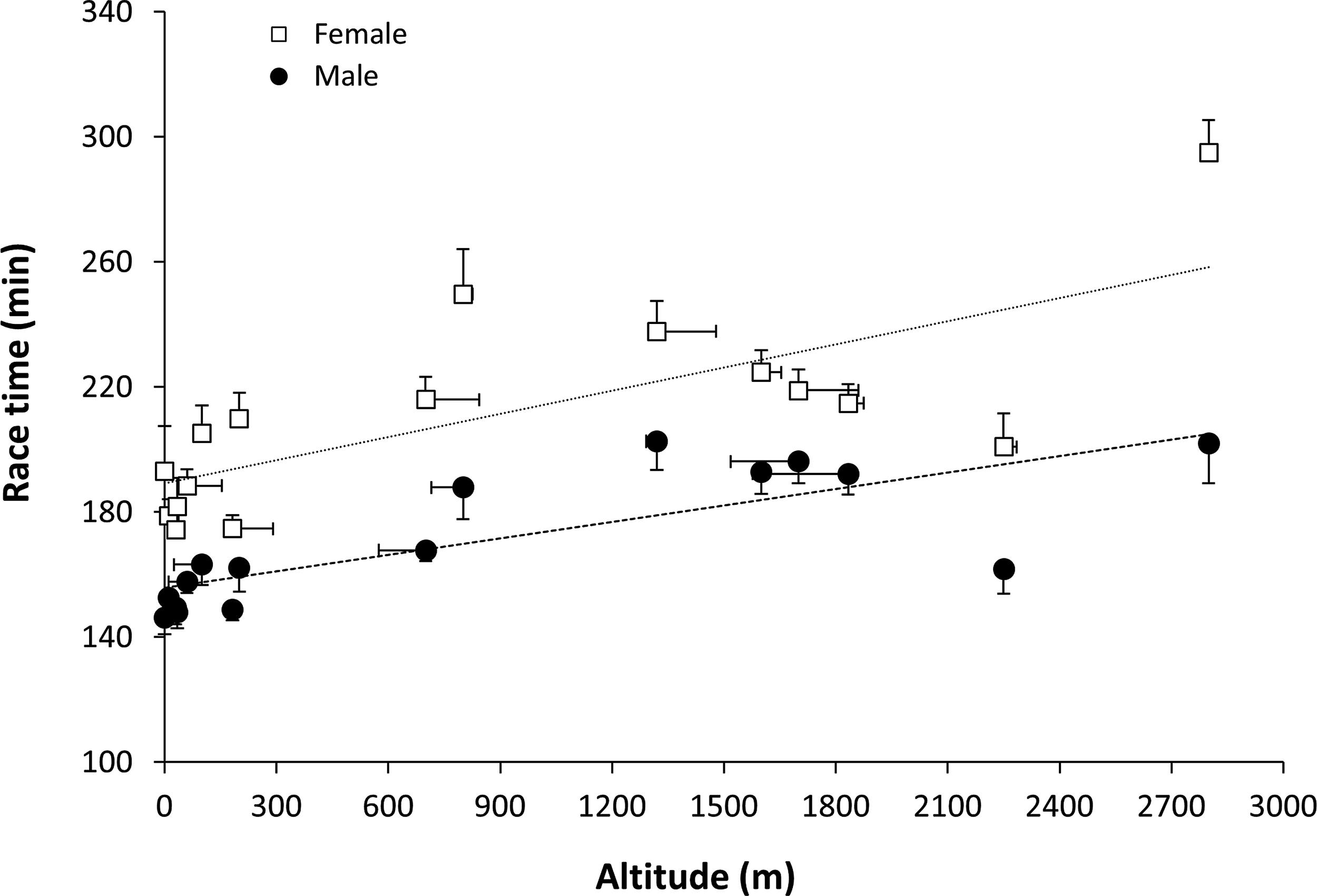
Race time for marathon races held in cities at different altitudes. Each data point represents the mean±SD for the 21st to 100th best race times for men and woman in the 2012 edition. Horizontal error bars represent maximal and minimal altitude of the course. Note: Elite runners (e.g., the top 20 finishers in each marathon) were excluded from the statistical analysis because this type of runner usually avoids races at cities located at moderate or high altitudes.
Discussion
The main finding of this investigation was that the altitude of the city in which the marathon is held was positively correlated to the marathon finishing times in both male and female endurance runners. Elevation in altitude reduces barometric and partial pressure of oxygen in the air and thus oxygen diffusion in the lungs. The main effect of altitude on body homeostasis is the reduced arterial oxygen saturation (Mazzeo, 2005), while a number of essential physiological (e.g., increased heart rate and ventilation) and metabolic adjustments are required to maintain proper tissue oxygenation at rest (Mazzeo, 2008). Nevertheless, when exercising at altitude, there are two different independent stresses to which the body must respond and adapt (Mazzeo, 2008). Major physiological adaptations to altitude (e.g., increased heart rate and ventilation) may be effective to maintain body functioning during submaximal exercise (Lhuissier et al., 2012), but they are insufficient to maintain maximal aerobic capacity (Chapman et al., 2011; Ferretti et al., 1997). Although marathon races are not completed at maximal aerobic capacity, the present investigation demonstrates that altitude greatly influences performance during endurance events.
One potential limitation of this study is that the ambient temperature the day of the race and the number of participants also correlated to the marathon finishing time, as has been found in previous publications (Ely et al., 2008; Hunter et al., 2013). For this reason, we performed a partial correlation analysis that measured the degree of association between race time and altitude without the effect of these variables. With this control, marathon finishing times and the altitude of the city were still significantly correlated (r=0.74 for men and 0.72 for women; p<0.05). This suggests that race time and altitude were associated even without the influence of ambient temperature or the number of participants. Another limitation was related to the experimental design, since different marathoners participated in each competition. To avoid this effect, we selected the top-100 finishers in each marathon, but there was still the possibility that the results of this study could be affected by the different levels of the competitors in each race. To minimize this effect, elite runners (e.g., the top 20 finishers in each marathon) were excluded from the statistical analysis because this type of runner usually avoids races at cities located at moderate or high altitudes. Finally, it is possible that some race participants were high-altitude residents and they could be naturally acclimatized to altitude, improving their exercise capacity for races held at altitude (Brutsaert, 2008; Muza et al., 2010).
Several investigations have demonstrated that altitude or simulated altitude (by setting hypobaric or hypoxic environments) reduces maximal cardiac output (Fukuda et al., 2010), V
The majority of the most popular marathons are held at very low altitudes, which in turn adds to the attractiveness of the races, because finishing times are typically lower. For example, among the 100 best all-time records in the marathon (International Associantion of Athletic Federations 2013), the city with the highest altitude is Prague (≈200 m above sea level) for men and Chicago for women (≈200 m). In addition, most of the best all-time records have been obtained in cities at altitudes lower than 100 m above sea level. Thus, the altitude of the city seems an important factor for obtaining personal best marathon times and this is carefully considered by elite distance runners.
In the present investigation, finishing times were considerable higher in all the marathons conducted above 700 m in both male and female participants (p<0.05), in comparison to the mean race times obtained at 0 m. Although the deleterious effects of altitude on performance are typically related with locations at over 1500 m above sea level (Wilmore et al., 2008) this investigation indicates that competing in a marathon held at over 700 m above sea level can significantly reduce endurance running performance. This information agrees with investigations that found that even a moderate altitude (700–800 m above sea level) can produce a reduction in V
The effects of altitude on physical performance during large-muscle exercise (e.g., bicycle ergometer or treadmill) are of a similar magnitude in both men and women (Fulco et al., 1998). In fact, sex is the least related factor to the changes in maximal and submaximal exercise performance that occur at different altitudes, when compared to the athlete's fitness level, pre-exposure to altitude, and duration of altitude exposure (Fulco et al., 1998). In the present study, male and female race times were similarly affected by altitude (see slopes of Fig. 1). As a mean, each increase of 1000 m above sea level increased the race time in the marathon by 10.8±0.6% in men and by 12.3±0.7% in women. The slightly higher increase in running time/1000 m of altitude in the female population may be related to lower participation rates and a lower level of talent among women competitors (Hunter et al., 2013). In both male and female runners, the increase in the finishing time per 1000 m of altitude is higher than previously calculated by a mathematical model (e.g., 3.1%; (Peronnet et al., 1991) but similar to the one found during a real competition held at 4300 m above sea level (8.1% per 1000 m increase (Ely et al., 2008)). Figure 2 represents race time for the marathon finishers (from 21st to 100th position) in the marathons held at 0, 700, 1600, and 2800 m above sea level. Interestingly, women marathoners at 0 m above sea level obtained similar race times to their male counterparts when competing at 1600 above sea level. Thus, the sex differences in the marathon performance could be offset when male runners participate in competitions at over 1600 m above sea level.
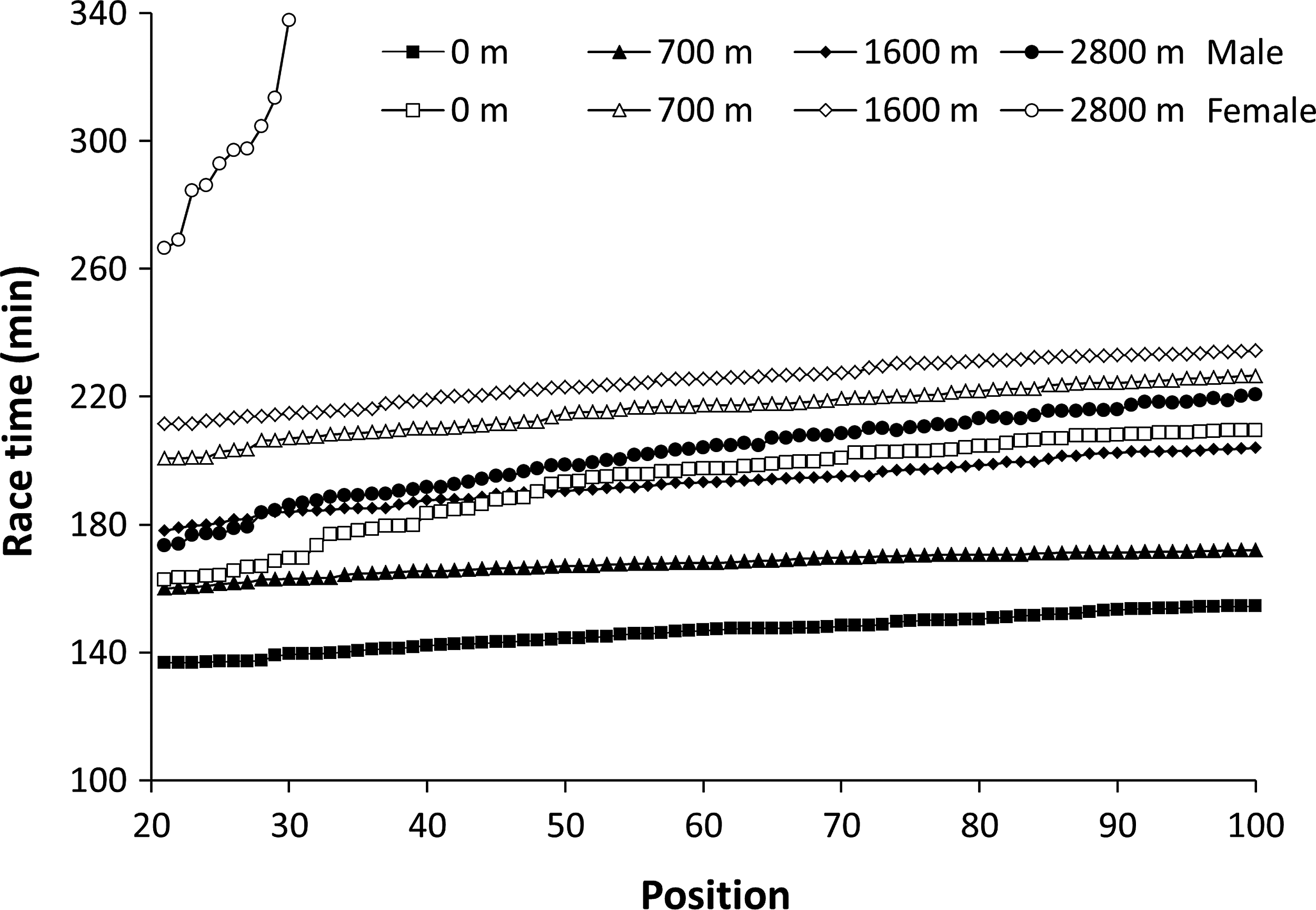
Performance of the 21st to 100th best race times in marathons held at 0 m (Rotterdam), 700 m (Madrid), 1600 m (Denver), and 2800 m above sea level (Quito). Black-filled shapes represent race times for male runners and white-filled shapes represent race time for female runners. Note: Elite runners (e.g., the top 20 finishers in each marathon) were excluded from the statistical analysis because this type of runner usually avoids races at cities located at moderate or high altitudes.
Conclusion
In summary, marathon race performance strongly depended on the altitude of the city in which the marathon was held. On average, each increase of 1000 m above sea level extended the race time by 10.8±0.6% in men and 12.3±0.7% in women. In comparison to race times of the marathon held at 0 m (Rotterdam), the finishing times in competitions run above 700 m were significantly higher. The magnitude of the deleterious effect of altitude on performance was similar in male and female participants. Selecting marathon competitions close to 0 m is a good strategy for maximizing marathon performance.
Footnotes
Author Disclosure Statement
The authors declare that they have no conflict of interest derived from the outcomes of this study. This study did not receive any funding.
Beatriz Lara was supported by a grant from the Camilo Jose Cela University.