




Abstract
Abstract
Zaccagni, Luciana, Davide Barbieri, Annalisa Cogo, and Emanuela Gualdi-Russo. Anthropometric and body composition changes during expeditions at high altitude. High Alt Med Biol. 15:176–182, 2014.—The purpose of this study is to investigate separately in the two sexes the physical adaptations associated to exposure to high altitude in a sample of 18 nonacclimatized Caucasian subjects (10 males and 8 females, 22–59 years) who participated to scientific expeditions to Himalaya up to the Pyramid Laboratory (5050 m, Nepal) or Everest North Base Camp (5300 m, Tibet). Anthropometric traits (body height and weight, eight girths and six skinfolds) were collected according to standard procedures, before departure at sea level, during ascent (at altitude>4000 m above sea level), and after return to low altitude. Body composition was assessed by means of the skinfold method. Both sexes lost on average 4.0% of initial body mass, corresponding to 7.6% of fat mass and 3.5% of fat free mass in males, and to 5.0% of fat mass and 3.6% of fat free mass in females. Average fat mass loss was greater in males than in females. Initial fat mass percentage was positively correlated to fat mass loss and negatively to FFM loss in males only, thus at HA leanest subjects lost more FFM and less FM than the fattest ones. Adaptations were faster in males than in females. In conclusion, the present research describes significant adaptations to high altitude, in terms of body weight reduction, regardless of the amount of performed physical activity.
Introduction
M
BW loss depends on many factors, the main factor being the marked difference between energy intake and energy expenditure, which is increased by hypoxia. It has been suggested that the rate and magnitude of BW loss is related to the achieved altitude (Martin et al., 2010), to the duration of the exposure to HA (Hamad and Travis, 2006; Krzywicki et al., 1969; Zamboni et al, 1996), to the presence or absence of altitude-related illness, to the level of physical activity and food consumption (Fulco et al., 1992), and possibly to gender, women losing less (Boyer and Blume, 1984; Kayser, 1994).
However, the components of BW loss at HA are not clear. Some investigators have attributed BW loss primarily to fat mass (FM) reduction (Armellini et al., 1997; Boyer and Blume, 1984; Butterfield et al., 1992; Ermolao et al., 2011; Guilland and Klepping, 1985; Krzywicki et al., 1969; Surks et al., 1966), others to loss of body fluid (Consolazio et al., 1968), or more generically to fat free mass (FFM) reduction (Fulco et al., 1985). Rose et al. (1988) reported that BW loss was from both FM and FFM, in a simulated ascent conducted inside a hypobaric chamber, where temperature was kept constant. Bales et al. (1993) and Westerterp et al. (1992) came to similar conclusions in an actual climbing expedition.
The source of BW loss may also depend on the extent of physical activity performed by the subjects. Studies reporting a high percentage of muscle mass loss involved subjects who were relatively sedentary during the observation period (Tanner and Stager, 1998). In fact, loss of muscle mass has been associated to lack of physical exercise or direct effects of hypoxia on protein synthesis (Kayser, 1994). Further, some anthropometric and body composition characteristics are more suitable for sport practice at high altitude, as in mountain climbing (Barbieri et al., 2012).
The purposes of the present study are to investigate the changes in body composition in sea level-resident individuals, staying for long periods at HA, and to test the interaction of exposure to HA with endogenous (sex) and exogenous (practice of trekking) factors.
Materials and Methods
The study was carried out on 20 (12 males and 8 females) healthy volunteers, all Caucasians, aged 22–59 years. They were sea-level residents and were not acclimatized to HA at the beginning of the expedition. Ten subjects (6 males and 4 females) participated in the scientific expedition to the Pyramid laboratory (5050 m, in Nepal), and 10 subjects (6 males and 4 females) participated in the scientific expedition to Mount Everest Base Camp North (5300 m, in Tibet) in support of the “K2 2004—50 years later” mountaineering expedition to the north face of Mt. Everest. Two male subjects (one per each group) were excluded from the study because they did not complete the three measurements. Data for the remaining 18 subjects were used for the analysis. Because the characteristics of the two expeditions were similar in altitude and duration (4 weeks), it was decided to analyze members of both expeditions jointly. Part of the subjects, 10 males and 5 females (trekking group, TG), were recreational mountaineers and performed some trekking during the expedition, while the remaining 2 males and 3 females (nontrekking group, NTG) did not. TG and NTG of both sexes were similar at baseline in terms of FFM, FM, and relative body fat (%F) (comparisons by t-test). The subjects' diet was not regulated during the study, but an adequate amount of palatable food was always available during HA exposure.
The study was conducted in three subsequent experimental phases: at sea level (SL, Phase I: pre-altitude), at HA (Phase II: >4000 m above sea level), and post-altitude (PA, Phase III: 1300 m) in Kathmandu. Subjects gave their written informed consent to the study, which was approved by the scientific board of the Italian National Mountain Institute (Istituto Nazionale della Montagna, Rome, Italy).
Subjects were evaluated by means of standardized anthropometric procedures (Lohman et al., 1988) prior to, during, and post expedition. All measurements were taken in the morning and the subjects did no trekking the day before. In particular, measures included height (H), BW, eight girths (upper arm flexed and tensed, maximum, minimum, and normal thoracic, waist, hip, thigh, and calf), and six skinfold thicknesses (triceps, subscapular, suprailiac, horizontal abdominal, thigh, and calf).
Standing H was recorded to the nearest 0.1 cm by an anthropometer, and BW was measured using a calibrated electronic scale. Body Mass Index (BMI) was calculated as BW/H2 [kg/m2]. Upper arm girth was taken at mid-point between the acromion and olecranon processes. Thoracic girths were taken at the level of the mesosternale and the maximum, minimum, and normal thoracic girths refer to the torso at inhalation, exhalation, and mid-inspiration, respectively. Waist girth was taken at the level of the narrowest point, between ribs and iliac crest. Hip girth was taken at maximum posterior extension of buttocks. Girths were measured by means of a nonstretch spring-loaded tape and they were taken in duplicate; the means of the trials were entered into the anthropometric datasheet. Skinfold thicknesses were obtained on the left side of the body by means of a Lange skinfold caliper (Cambridge Scientific Industries; Cambridge, MD) with a pressure of 10 g/mm2. Each skinfold thickness assessment was the average of two site-specific values within 10% of each other.
All measurements were taken by two trained operators (one for each expedition) and the anthropometrists' TEMs (assessed prior to the project) were <5% for skinfolds and <1% for other measurements. The triceps, subscapular, and suprailiac skinfolds were used in the equations derived by Durnin and Womersley (1974) according to sex and age, to calculate body density. Body density was then converted to percentage of fat (%F) by means of the Siri's equation (1956), as its applicability at HA was tested by Bharadwaj et al. (1977). FM was calculated as (%F * BW)/100 and FFM as BW – FM.
The values, expressed as mean±standard deviation, were analyzed by the repeated-measures analysis of variance. The Bonferroni post-hoc test was used to determine whether the statistical differences occurred among multiple comparisons. Pearson correlation was adopted to assess the significance of body composition changes at different phases of the expedition. All analyses were performed using Statistica (ver. 11.0; StatSoft Italia srl, Padua, Italy). Statistical significance was set at p≤0.05.
Results
The mean values of the anthropometric characteristics at various stages of the expedition are shown in Table 1 for males and in Table 2 for females. According to BMI, among males 75% was normal weight and 25% overweight. All females were normal weight except one, who was obese (initial BMI=33.7 kg/m2). Despite the practice of trekking, she reduced her BW minimally and thus maintained her obese status during the entire expedition (final BMI=31.2 kg/m2).
HA, high altitude; PA, post altitude; SL, sea level.
Values are means±SD; *level of significance p<0.05; a1st vs. 2nd ; b1st vs. 3rd; c2nd vs. 3rd.
HA, high altitude; PA, post altitude; SL, sea level.
Values are means±SD; *level of significance p<0.05; a1st vs. 3rd; b2nd vs. 3rd.
In males, BW decreased significantly between the first and the second measurement and between the first and the last measurement, but not between the second and the last one. The mean loss was 3.1±1.7 kg over the duration of the expedition. This loss was equivalent to 4.0±2.1% of initial BW. The 3.1 kg BW loss was partitioned in a 1.0 kg decrease in FM (corresponding to a 7.6% decrease of starting FM) and a 2.1 kg decrease in FFM (corresponding to a 3.5% decrease of starting FFM). We can therefore estimate that about one-third of the BW loss was from fat stores and two-thirds was from FFM. Percentage reduction was therefore greater in FM than in FFM, actually more than double. All girths, except waist, decreased. Hip, thigh, and calf girths decreased significantly. Skinfold measurements at trunk sites decreased, while those at limb sites increased but statistical significance was never reached.
During the expedition, females lost an average of 2.4±2.6 kg, equivalent to 4.1±3.6% of the starting BW. Body composition analysis showed that BW reduction was partitioned in 0.7 kg of FM (corresponding to a 5.0% decrease of starting FM) and 1.6 kg of FFM (corresponding to a 3.6% decrease of starting FFM). These data represent the same proportions of BW loss as in males. Percentage reduction was greater in FM than in FFM, but less than in males, since the percentage reduction ratio FM/FFM was 1.4.
Significant changes in males are evident between the first and the second measurement, and are confirmed by the third, as showed by post-hoc Bonferroni test. In females instead, changes are significant between the first and third measurement.
The influence of initial %F on body composition changes has been explored by correlation analysis. In males, initial %F was positively correlated to FM loss between the first and the second measurement (r=0.712, p=0.02, Fig. 1), and negatively to FFM loss between the first and the third measurement (r=−0.697, p=0.02, Fig. 2). Thus, at HA leanest subjects lost more FFM and less FM than the fattest ones. In females, no significant correlation was found.

Scatterplot of FM reduction as a function of initial %F (1st SL) in males.
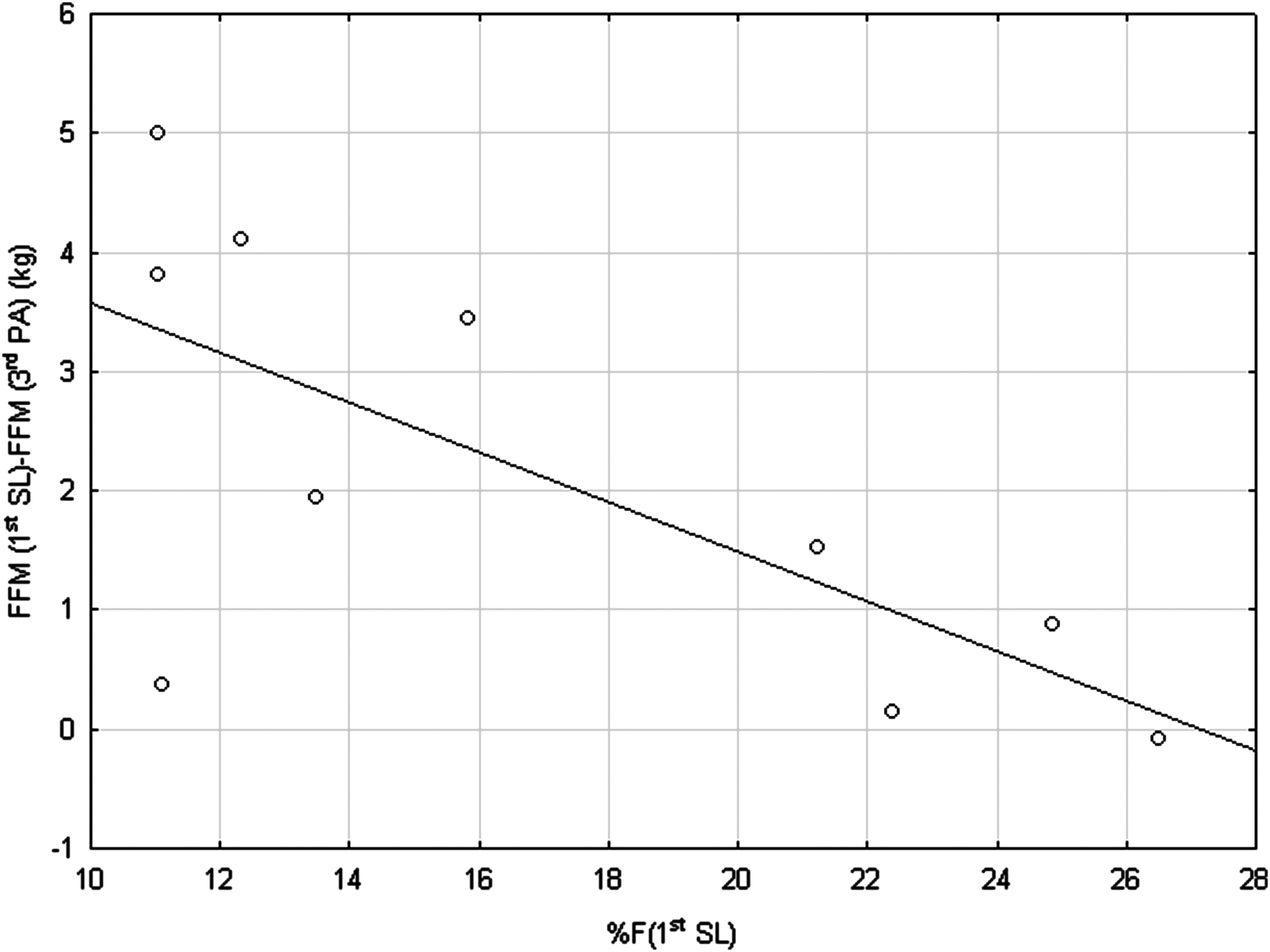
Scatterplot of FFM reduction as a function of initial %F (1st SL) in males.
On average, in males (Table 3) TG and NTG both lost 1 kg of FM, but TG lost 2 kg of FFM, while NTG lost 3 kg of FFM. Therefore, BW loss proportions were one-third FM and two-thirds FFM in TG, and one-quarter FM and three-quarters FFM in NTG, suggesting that physical activity helped preserving FFM.
NTG: No Trekking Group; TG: Trekking Group. Values are means±SD.
On average, in females (Table 4) TG lost 1 kg of FM and 2 kg of FFM, while NTG lost 0.4 kg of FM and 1.3 kg of FFM. BW loss was therefore partitioned similarly as in males.
NTG: No Trekking Group; TG: Trekking Group; Values are means±SD.
TG lost less BW than NTG in males (respectively, 3 kg vs. 4 kg), while the opposite happened in females (respectively, 3 kg vs. 1.7 kg).
BW loss was predominantly due to a reduction in FFM, in both TG and NTG, males and females. Body composition changes showed a greater percentage reduction of FM compared to FFM in males, both TG and NTG, and females TG. Only in females NTG percentage reduction was similar in both FM and FFM.
Discussion
Subjects lost BW during the expedition and adaptive responses were quicker in males than in females, as in males the differences were already significant between the first and the second measurement, while in females only between the first measurement and the third one. This fact supports the hypothesis of greater eco-sensitivity in the male sex and a generally higher resistance of the female sex to adverse environmental conditions (Semproli and Gualdi-Russo, 2007; Wolanski, 1975). In males, TG lost less BW than NTG, in spite of the fact that a higher caloric expenditure may be supposed. Trekking at HA seems to have a more intense BW reduction effect in females than in males, even if this result must be taken with caution because of the limited number of individuals in NTGs.
The average BW loss was about 4.0% of the starting BW and was partitioned into two-thirds FFM and one-third FM on average in both males and females. These values are not different from changes in body composition observed by Boyer and Blume (1984) in males. In a study by Wagner (2010), climbers lost BW in two different expeditions, but the loss was more pronounced on the longer and higher Everest expedition. It has therefore been suggested that humans cannot maintain BW above 5000 m and the magnitude of BW loss is dependent on the amount of time spent at HA.
BW loss at HA may be related to the amount of FM before the expedition as suggested by the present study. A relationship between initial body fat content and degree of BW loss was observed by Surks et al. (1966). The clarification of mechanisms leading to BW loss at HA might provide new tools for future treatment of obesity (Lippl et al., 2010).
Loss in BW has been attributed in varying proportions to reduced FM and FFM (Ermolao et al., 2011). The same results as the present study, that is, one-third FM loss and two-thirds FFM loss, were found by Rose et al. (1988) in male subjects. In their study, experienced mountain climbers have reported severe loss of muscle mass during expeditions. A review by Kayser (1994) confirms that BW loss at altitude is due to an initial loss of water and subsequently to loss of FM and muscle mass, probably because of malnutrition. If fat stores are reduced due to extensive precedent physical exercise, exposure to HA might cause loss of lean BW, including muscle (Hoppeler et al., 1990; Tschöp and Morrison, 2001). Since HA exposure can lead to losses of muscle mass, these losses may also negatively influence exercise capacity. Tanner and Stager (1998) noted that BW loss appears to be predominately from FFM in studies conducted in laboratory chambers, but in field-based studies BW loss is largely due to a reduction in FM. Contrary to Ermolao et al. (2011), who took into consideration only female subjects and assessed body composition by means of DEXA, the females of the present study lost more FFM than FM.
The methodology used to assess body composition is likely to influence the results. The applicability of the adopted equations at high altitude may require further approval. Still, we consider the skinfold method better than multiple frequency bioelectric impedance analysis because of the variability of body impedance in different measurement conditions (Gualdi-Russo and Toselli, 2002). The hydration status of the subject affects multifrequency bioimpedance analysis accuracy, but it may also affect skinfold measurements because, with dehydration, the tissues become more compressible and so less thick. Unfortunately no information about hydration status of the subjects were available.
Precise evaluation of body composition changes utilizing laboratory methods such as hydrostatic weighing or radiographic techniques is not always practical or possible in field conditions at HA (Fulco et al., 1985). Due to alterations in BW, water, and protein balances, the use of predictive equations to describe body composition changes during and after a HA sojourn may not be valid, since subjects may be dissimilar from the population from which the equation were derived. This may be considered a limitation of the present research, as of similar ones, at HA.
During a mountain expedition, unlike a simulated ascent in hypobaric chamber, it is difficult to determine whether BW loss is due to increased energy expenditure because of intense physical activity, cold environment, limited availability or palatability of food, dehydration, malabsorption, acute mountain sickness, or a combination of these stresses (Rose et al., 1988).
More research is needed to determine the influence of hypoxia on BW loss independent of physical effort, as suggested also by PD Wagner (2010).
The present study shows a similar pattern of fat mobilization from adipose tissue at HA as in Bharadwaj (1972), since the sample had an increase in average triceps skinfold thickness and a reduction at trunk sites. While the cited study observed only males, the present one verified the same pattern in both males and females, even if in our sample changes were not significant.
The present study included female subjects and three repeated measurements: before, during, and after expedition. These facts contributed to improve the current knowledge on body composition modifications and adaptations occurring during long exposures to HA in females, since most of the studies to date mainly included male subjects and consisted of follow-ups. The present article highlights the importance of repeated measures, by means of which we could observe the different behavior in the two sexes. Accurate repeated measures were needed to track changes during stay at HA.
In conclusion, this study confirms that exposure at HA reduces BW—relatively more in terms of FM than FFM—and suggests different adaptation patterns in the two sexes.
Footnotes
Acknowledgments
The authors want to thank L. Argnani, L. Pomidori, and C. Domeniconi for their valuable help during the data collection process, and the participants who volunteered for the research.
Author Disclosure Statement
The authors have no conflicts of interest, financial or otherwise.