




Abstract
I
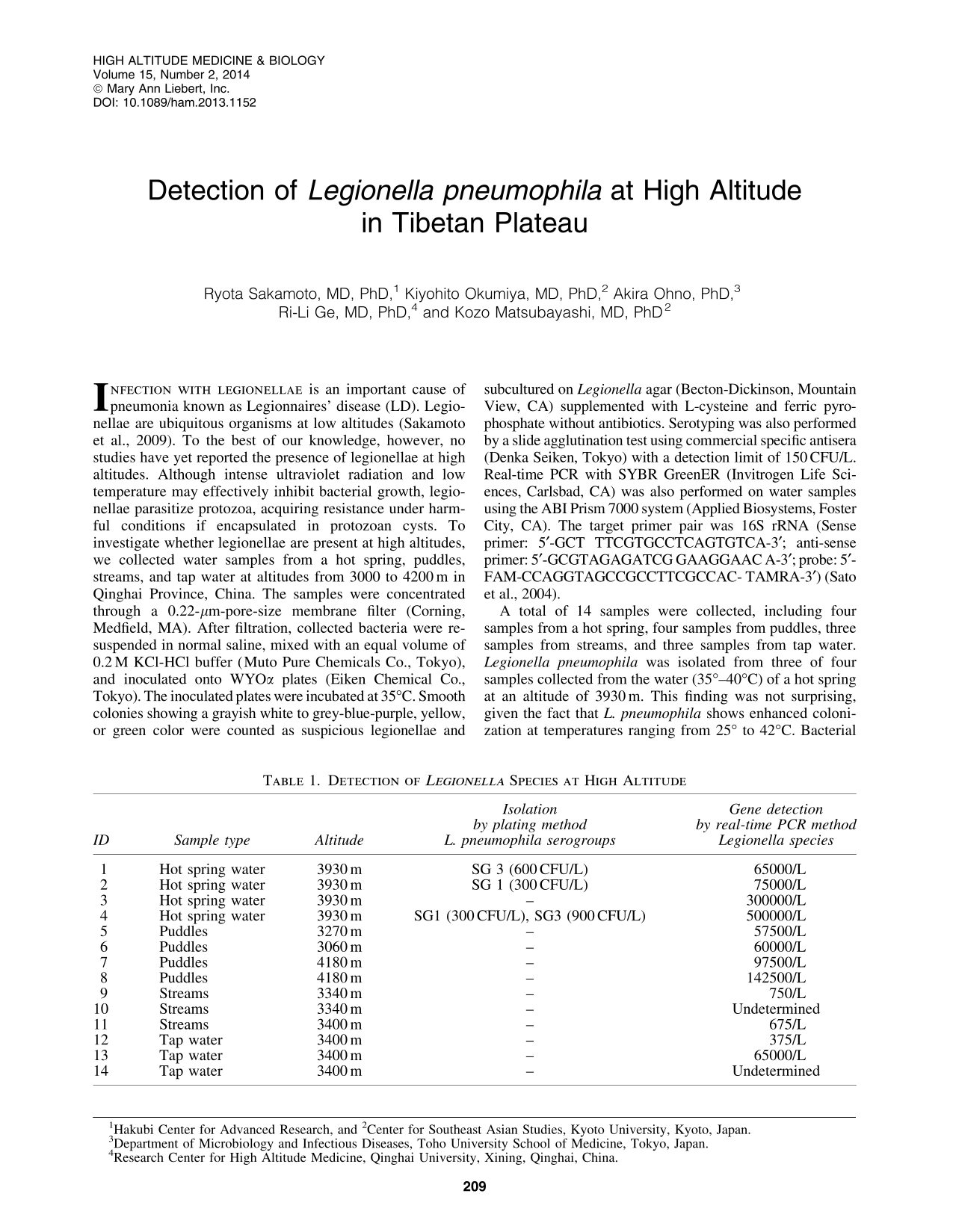
A total of 14 samples were collected, including four samples from a hot spring, four samples from puddles, three samples from streams, and three samples from tap water. Legionella pneumophila was isolated from three of four samples collected from the water (35°–40°C) of a hot spring at an altitude of 3930 m. This finding was not surprising, given the fact that L. pneumophila shows enhanced colonization at temperatures ranging from 25° to 42°C. Bacterial counts of the three samples were 1200 CFU/L, 600 CFU/L, and 300 CFU/L, respectively. Serotyping revealed that the samples contained L. pneumophila serogroups 1 and 3 (i.e., the major etiologic agents of LD) (Table 1).
L. pneumophila was not isolated from puddle, stream, or tap water samples; however, this does not confirm the absence of legionellae, as these species can exist in a viable but nonculturable state depending on the condition, re-entering a culturable state once subjected to an appropriate condition (Hussong et al., 1987). In fact, real-time PCR detected Legionella DNA in 12 of the 14 samples. Our results suggest a possibility that legionellae may be commonly present at high altitudes as well.
Although the presence of legionellae may not be directly linked to occurrence of LD, chronic obstructive pulmonary disease, a significant risk factor for acquiring LD, is highly prevalent among high altitude populations, possibly due to indoor air pollution caused by burning biomass fuels in confined spaces, occupational dusts, and oxidative stress (Roig et al., 1991; Basnyat et al., 2001). In travelers, differentiation between LD and high altitude pulmonary edema can be difficult, given that common symptoms of LD include fever, cough, and tachypnea. These symptoms may be exacerbated under hypoxic conditions. While early treatment with macrolides and quinolones is crucial in patients with LD, specific tests for LD are not available in most places. It is important to keep in mind that LD can occur even at high altitudes.
Footnotes
Author Disclosure Statement
No competing financial interests exist.
This study was mainly supported by Grant-in-Aid of Research Institute of Humanity and Nature: Human Life, Aging, and Disease in High-Altitude Environments: Physio-medical, Ecological and Cultural Adaptation in Highland Civilizations.