




Abstract
Abstract
Milledge, James S. Stanhope Speer, physician and alpinist: In 1853, first to describe mountain sickness? High Alt Med Biol 16:358–362, 2015.—In 1853, Stanhope Templeman Speer published a two-part paper in The Association Medical Journal on Mountain Sickness. Speer was a physician who had worked at the Brompton Hospital for Chest Diseases in London and had been Professor of Medicine in Dublin. He was also an Alpine climber and had made the first ascent of one of the Wetterhorn peaks. His article ran to ten and a half pages in the Journal and to 50 pages in a reprint. It consists of anecdotal accounts of symptoms suffered at altitude from the literature and from his own experiences in the European Alps. He asks three pertinent questions. Is there a condition of mountain sickness? Are these symptoms felt by all persons alike and at the same height? What are the causes, and whence the explanation of such phenomena?
In the course of the article, he answers the first two questions but, like us, 162 years later, is unable to answer the third. This article seeks to present Speer's original work and such facts about his life as I have been able to discover.
Introduction
B
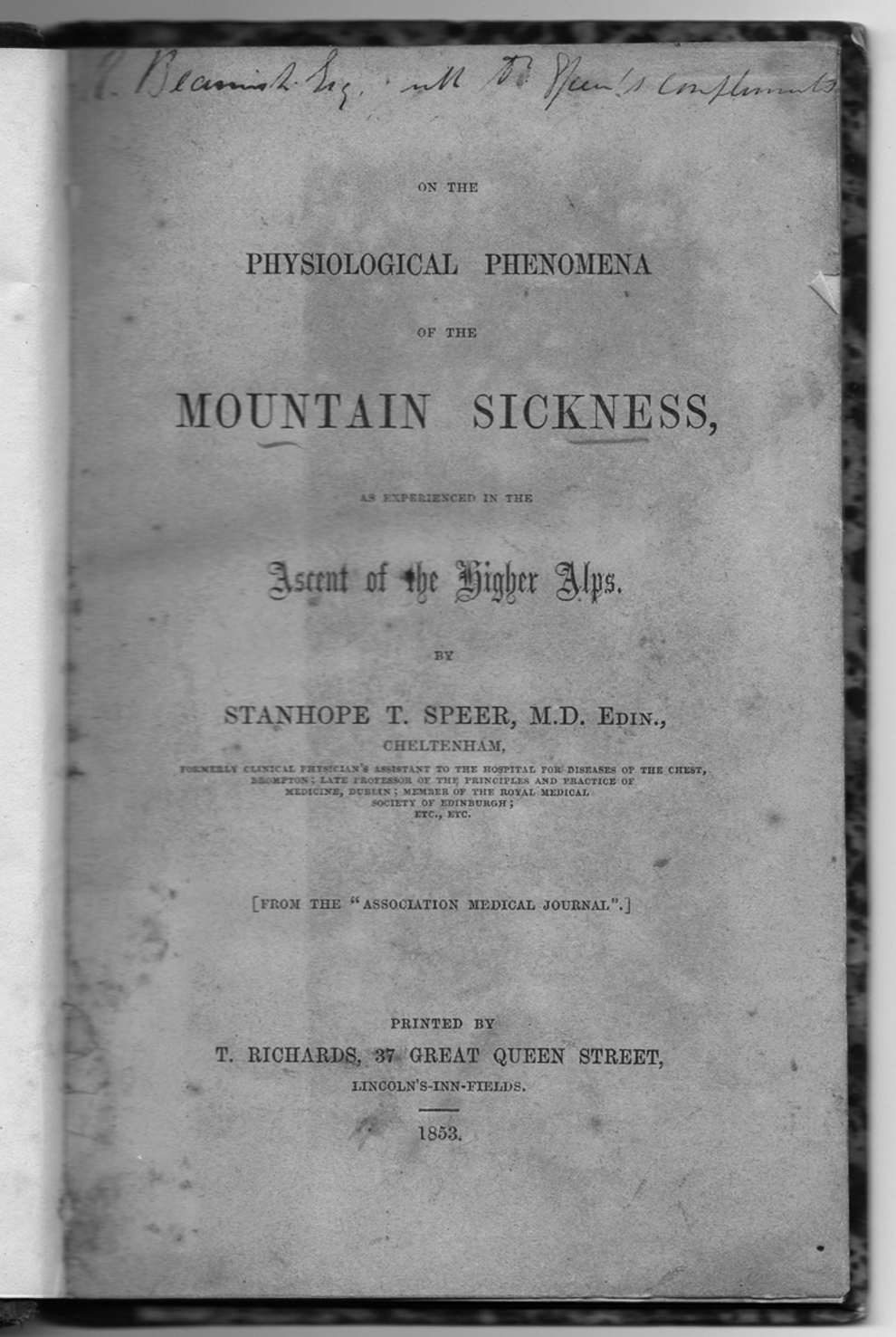
Title page of the reprint of Speer's paper on mountain sickness.
That publication, therefore, predates the book by the Zurich physician, Conrad Meyer-Ahrens, “Die Bergkrankheit; oder Der Einfluss des Ersteigens grosser Höhen auf den thierischen Organismus.” (Mountain Sickness, or the Influence of Climbing Great Heights on the Animal Organism), 1854. It also predates accounts by Douglas et al. (1913) and Ravenhill (1913), by 60 years.
The Paper
The full title is: “On the physiological phenomenon of the MOUNTAIN SICKNESS as experienced in the Ascent of the Higher Alps” (Fig. 1)
Overview and style
The paper runs to 10 pages in the Association Medical Journal and to 50 pages in the reprint. It is written in the style of its time, that is to say, very florid and full of circumlocutions, with long sentences and many clauses. Here is the opening paragraph, also the opening sentence: “It is, I believe, very generally admitted, that when an individual habitually residing at a moderate elevation above the level of the sea, attains, in a short space of time, a considerable altitude above such level, he will, in all probability, experience a state of indisposition, if not of disorder.”
This was very much the accepted style of the period. For instance, the article following Part 1 of Speer’ paper is a case report by a R.R. Robinson FRCS. It starts, “In October 1840, I was requested to attend a tradesman's wife, aet. 40, in her third confinement. I learnt that she had recently moved into her present residence, and that she had greatly exerted herself in cleaning it; that all through her pregnancy she had been much oppressed with flatulency, and had had misgivings about the result, having felt differently from what she had done on previous occasions; that four days previously she had slipped down four stairs, from which she had experienced no inconvenience and that on the same day she had caught her foot against a chair which caused pain in her left hip, which she had at times felt since.”
Anecdotes
After the introduction and posting the three questions, Speer sets about answering the first question, “As to the occurrence and nature of the physiological phenomena alleged to be experienced at great height?” This he does first by recounting the experiences of the few travelers who have gone to high altitude in the great ranges. But before that he points out that some travelers and climbers may not make much of any symptoms of mountain sickness because such symptoms clear on descending. This is especially true in the European Alps where typically the climber, having reached the summit, descends to the valley the same day.
Also, he alleges, the climber is so enthralled with the mountain experience that he dismisses the memory of symptoms and fails to report them. He graphically describes, “The succession of wonder-striking scenes which they now behold…the rapidity with which marvel succeeds marvel….the glaciers, the feeling of dread occasioned by the ghastly aspect of the gaping crevices…the dreaded sound of the falling avalanche” and so on. These novel and exciting experiences may push the memory of symptoms of mountain sickness out of his mind.
He does not mention earlier accounts that have been suggested as possibly indicating recognition of mountain sickness, such as that of deAcosta (1590) or in Chinese documents dating from 32–92 C.E. He might have been unaware of Acosta's work, though there was an English translation of his book in 1604. Or he may not have considered his experience as being mountain sickness. He would not have been aware of the Chinese reference since it was not translated into English until 1881 and not generally recognized as referring to mountain sickness until 1983 (Gilbert, 1983; West, 1998).
Speer says that the accounts from travelers such as (Von) Humboldt, Boussingault, d'Orbigny, Zumstein, Saussure, Pictet, and others are to be more trusted. They traveled in the Andes and Himalayas and would have spent days at altitude. Humboldt experienced the desire to vomit and vertigo, which were more trying than the difficulty in breathing, which he also suffered. One companion was more afflicted. Also “blood started from his lips and gums in each of us the conjunctiva was distended with blood”. This was at an altitude of 16,724 ft. He eventually reached a height of 17,634 ft.
Humboldt does not report headache, but d'Orbigny, a French traveler also in the Andes, does complain of violent headache when crossing a pass at over 13,500 ft. d'Orbigny also mentions that his guides use the term “soroche” for the symptoms suffered at altitude. He states that this word was used because his guides considered that the symptoms were due to “emanations arising from mines of antimony which they believed exist in the neighbourhood: the Spanish term for antimony being soroche.” In La Paz, d'Orbigny also complained that he had the sensation of suffocation. This problem remained for the entire residence in the city.
Other Andean travelers were very little affected. For instance, La Condamine and Bouguer did not suffer much at an altitude of 14,750 ft, apart from slight bleeding from the gums, which they attributed to “a scorbutic condition of the blood due to the cold.”
Many accounts emphasize the need for hyperventilation, which we would not class as a symptom of mountain sickness, since it continues after acclimatization when all other symptoms have cleared and affects all persons including those with no other symptoms of mountain sickness (i.e., is physiological rather than pathological). Another symptom common in these early accounts is the feeling of fatigue, of having to rest every few steps.
Finally, Speer comes to De Saussure and his attempts to climb Mont Blanc. He considered De Saussure to have “described with accuracy, the phenomena attendant upon considerable elevation above the level of the sea.” He wrote about these experiences in his book Voyages dans les Alps. As part of his training for Mt Blanc, De Saussure made the ascent of the Buet (3096 m) in 1778. But having said that De Saussure is such a reliable witness, his symptoms consist of only a degree of muscular weakness and exhaustion, which were rapidly relieved when he stopped. His companion Pictet was affected at the low height of 7000 ft with indisposition and nausea.
Speer then goes on to recount De Saussure's experiences on Mt. Blanc and symptoms in his guides/porters. Fatigue was a principle symptom, together with anxiety, uneasiness, and in some guides, nausea and vomiting. As they climbed, shortness of breath was the main symptom. He then adds accounts of various other climbers on Mt Blanc. Aldejo and his party began to suffer at 12,000 ft with constriction in the chest, rapid pulse, fullness in the head, and thirst. Later, violent headache and palpitations were the main symptoms. Other climbers reported “a dry rugoes condition of the integuments,” and one party with a dog noticed that it also appeared to suffer the same problems, including vomiting, but never the less reached the summit. A French physician, Dr. Le Pileur, is quoted at length describing how one of his guides suffered from syncope as soon as he stood up.
Speer's Own Experiences in the Alps
On a climb on Mt. Blanc at 9000 ft, Speer began to feel a fullness in the head, throbbing of the carotids, and palpitations of the heart. He lost his appetite for food but had considerable thirst. At 10,000 ft he noticed increased respirations and the taste of blood in the mouth due to oozing from the gums. He then discusses the relative nonsusceptibility to mountain sickness of those of his guides who lived at a moderate altitude of around 6000 ft. He cites his experience in climbing one of the Wetterhorn peaks, a first ascent (Speer 1856). One of his guides, an inhabitant of the plains, the other two lived at 6000–7000 ft. The latter two had no sign of mountain sickness, though they were breathless and needed to halt frequently near the summit. The plains man showed signs of distress at quite an early stage of the climb with nausea and headache. On this climb, two of the guides, who omitted to wear sunglasses, got snow blindness, which lasted 2 days.
Speer concludes the first part of his publication with the statement that “I conclude from these observations that, as a tolerably satisfactory answer to the first question proposed, it may be stated that at great elevations there actually do occur certain manifestations in the natural functions of the body, in no way to be accounted for by admitting the existence of influences to which at an ordinary level it is not exposed.”
Part 2 of the publication, published in the next number of the Journal a week later, starts by listing the symptoms of mountain sickness in tabular form, classified into five bodily systems: the Nervous system, Cardio/respiratory, Digestive, Locomotive, and Tegumentary system (Table 1).
He points out that not all symptoms will be present in every case but he alleges that each and every one has been noticed in climbing Mt. Blanc. These he attributes to mountain sickness, which he compares with sea sickness. Like sea sickness, some individuals are more susceptible than others. Some have nausea and no vomiting, others the opposite. Others complain of headache with or without vomiting. He returns to this comparison later in the article and also compares mountain sickness to “Ephemeral fever.” This condition is characterized by languor, distaste for motion, muscular pains, nausea, anorexia, headache, thirst, white tongue, and acceleration of pulse and respiration.
Speer then explores possible mechanisms underlying the cause of mountain sickness, to answer his third question. The language in this long section is hard to follow and therefore to summarize. It is difficult for us to appreciate the limits of early 19th century physiology available to Speer. The circulation of the blood and the importance of oxygen for muscular exercise were known, as was the effect of altitude on barometric pressure. But nowhere does he mention hypoxia or reduction in PO2. Altitude results in “rarefaction of the atmosphere.” But X-rays were not yet discovered and measurement of blood pressure, by Korotkoff sounds, was still 50 years into the future, not to mention the many other advances in all branches in physiology and pathology.
In discussing the possible causes of mountain sickness, Speer first refers to what he says is the first attempt to explain them, that of De Saussure. He quotes De Saussure as suggesting that, “The (symptoms of mountain sickness) are due, not to the difficulty of breathing in such an atmosphere but to
However, since vessels are filled with a fluid, which is virtually noncompressible, and the effect of reducing the barometric pressure slowly, by even half an atmosphere on bubble formation is negligible, there is no increase in trans-mural pressure in the vessels. Also, we now know that the plasma volume is quite quickly reduced negating any slight rise in intravascular pressure even if the circulation was a perfectly closed system.
He also quotes De Saussure as saying, “The respiration is inevitably accelerated in a rarefied atmosphere, by the necessity of supplying the lungs with the same quantity of air in a given time.” In one sense this is quite true, in that minute ventilation expressed as STPD in unchanged at altitude even on exercise below the anaerobic threshold. However, we are quite correct in using BTPS as the standard as that is the actual flow of air in and out of the lungs. This measure correlates with the sensation of hyperventilation felt on exercise at altitude.
Speer then has a long section comparing the relative heights at which mountain sickness is reported as between the European Alps compared with the Andes and Himalayas and concludes that it seems to come on at higher altitude in the latter two areas compared with the Alps because the snow line (he calls it, “perpetual congelation”) is lower in the Alps. There is then a section of comparing mountain sickness with “Ephemeral fever” whatever that is. He finds similarities in symptoms between the two conditions.
So he considers if the rapid drop in temperature on ascent from valley to summit is a factor in inducing mountain sickness. He says, “The idea suggests itself that, were it was desired to produce such a pathological condition [mountain sickness] there could scarcely be a more efficacious way of doing it than by suddenly removing him from a temperature of between 70 and 80 degrees Fahrenheit to one in which he would be surrounded by fields of snow and masses of ice…This leads to a consideration of the singular fact that the mountain sickness commences only at the limit of perpetual congelation, whatever that limit may chance to be.”
He does not seem to consider that climbers in the great ranges usually have to spend more time in getting to high altitude because of the geography and logistics of such areas and therefore usually have time to acclimatize, although he had noted that people in the Alps who lived or spent time in the higher villages were less susceptible to mountain sickness.
Most of the rest of the article is taken up with reporting results of measuring pulse rates at frequent intervals, with dates and times whilst ascending to altitude, together with comments on symptoms. We must remember that the pulse rate was one of the few physiological measurements that could be made and recorded. These are reported in six tables by various observers.
The report ends with a resume in seven points. The first point being: “That in mountainous districts and upon attaining a certain elevation, a series of physiological phenomena manifest themselves, which differ solely from the standard of health, and exist as long only as the exciting causes are in activity: disappearing upon a return to the ordinary level of human habitation”.
The remaining six points may be summarized as: There is great individual variation in susceptibility to the condition and in the actual phenomena suffered.
Speer's Life
The facts that I have been able to discover about Speer's life are: He was born on October 20, 1823, in Boulogne-Sur-Mar, a fishing port and tourist town on the English Channel coast of France, north of Calais. He was baptized at the nonconformist British Chapel there. His parents were Thomas and Catherine Speer. (Ref. Roots Web site). I could find no information about his boyhood or schooling.
He went to Edinburgh and was a member of the Royal Medical Society of Edinburgh (see title page of the reprint). This is a student society (the only one to have a “Royal” appellation) and so we know that Edinburgh was his medical school. There is a record of his attending a session of the society in 1847 when he would have been about 23 and presumably qualified in medicine. The record implies he was from Boulonge-sur-Mer (where he was born), though whether he was resident there at the time is not clear.
There is a letter of recommendation from Alexander Peddie (1810–1907) of the Minto House Hospital and Dispensary in Edinburgh, dated Aug 1, 1848, starting, ‘“Speer has been an assistant at Minto House since the previous 1 May” (Ford web catalogue). Presumably this period might have been equivalent to his Intern year after qualifying in medicine.
His climbing career must have started as a student. His Wetterhorn ascent was in 1845 when his age would be about 21. He mentions climbing on Mt. Blanc also in 1845, trying to get as high as he could in one day from the valley. He mentions spending “some months” in 1846 in the Bernese Oberland, but I could find no further information about this climbing career. There is no record of his being a member of the Alpine Club. This was founded, only in 1857, and possibly Speer had by then stopped Alpine climbing.
At some time he obtained an MD, from Edinburgh (Entry in Medical Directory 1863). He mentions, on the title page of the reprint of his article, that he was “Formerly Clinical Physician's Assistant to the Hospital for Diseases of the Chest, Brompton, London.” The Hospital is still a leading Respiratory Diseases Institution. He also states that he was, “Late Professor of the Principles and Practice of Medicine, Dublin.”
I have had confirmation that he was Professor of Medicine at St. Cecilia Street School of Medicine in 1853 (entry in the Medical Dictionary of 1853). He would have been about 29 then. This was one of a number of private medical schools in Dublin at that time. In 1853, this school became part of a newly formed Catholic University. The main incentive behind this foundation was to provide university education for Catholic students and it would have had an overtly Catholic bias. Possibly this prospect was the reason for Speer, who was presumably a Protestant, to resign his chair in Medicine. He married Maria Eves in 1850.
His publication list, from the Med. Directory 1863, included a translation from the French of Becquerel and Rodiers, Pathological Chemistry and Its Application to the Practice of Medicine; “On the Auscultatory Signs of Incipient Phthisis” Med Gaz 1851; “On Diffuse Pulmonary Apoplexy” Lond J Med 1851.
E. T. Bennet in his book, The Physical Phenomena Popularly Classed Under the Head of Spiritualism (1907) says, “Dr. Speer has had unusual advantages in having been at the medical schools, not only of London and Edinburgh, but of Paris and Montpellier, and he has availed himself of these advantages with extraordinary diligence and talent. He ranks among our most distinguished rising physicians. Dr. Speer practised as a physician at Cheltenham and in London, and at different times held various important hospital posts. He had scientific and artistic tastes, and being possessed of private means, he quitted professional work at the age of thirty-four, and spent his subsequent life in studious retirement.” That would have been in about 1857.
His studious retirement included an interest in spiritualism, then quite popular amongst the professional classes. He was introduced to this by William Stainton Moses, who had been a Church of England clergyman and later a school teacher. He was first a patient of Speers', and became a family friend in Cheltenham. Speers' wife asked him if he believed in spiritualism, and he was at first sceptical but later became convinced of it. He became quite a leading figure in the movement and convinced Speers, who was also at first a sceptic. The Speers' house became, for some time, a venue for séances in which Moses was the medium. Moses then became tutor to Speer's son Charlton, who later published a biography of his tutor.
I have been able to discover little about Speers in his retirement. He was in Douglas, Isle of Man in 1863, and in Hampstead, London in the census of 1871. He died on Feb 9, 1889 in Cheltenham, Gloucestershire, England, aged 65. I have not been able to find any image of the man.
Conclusion
It would seem that this paper gives the first account of mountain sickness (which we would now call acute mountain sickness) by a physician and a climber. It is the first attempt to provide evidence of the reality of this condition, to systematically define the symptoms, and to speculate on the causes. Although he inevitably fails in the latter endeavor, his achievements in his article deserve to be recognized.