




Abstract
Abstract
Miele, Catherine H., Alan R. Schwartz, Robert H. Gilman, Luu Pham, Robert A. Wise, Victor G. Davila-Roman, Jonathan C. Jun, Vsevolod Y. Polotsky, J. Jaime Miranda, Fabiola Leon-Velarde, and William Checkley. Increased cardiometabolic risk and worsening hypoxemia at high altitude. High Alt Med Biol. 17:93–100, 2016.—Metabolic syndrome, insulin resistance, diabetes, and dyslipidemia are associated with an increased risk of cardiovascular disease. While excessive erythrocytosis is associated with cardiovascular complications, it is unclear how worsening hypoxemia of any degree affects cardiometabolic risk factors in high-altitude populations. We studied the relationship between daytime resting oxyhemoglobin saturation and cardiometabolic risk factors in adult participants living in Puno, Peru (3825 m above sea level). We used multivariable logistic regression models to study the relationship between having a lower oxyhemoglobin saturation and markers of cardiometabolic risk. Nine hundred and fifty-four participants (mean age 55 years, 52% male) had information available on pulse oximetry and markers of cardiometabolic risk. Average oxyhemoglobin saturation was 90% (interquartile range 88%–92%) and 43 (4.5%) had excessive erythrocytosis. Older age, decreased height-adjusted lung function, and higher body mass index (BMI) were associated with having an oxyhemoglobin saturation ≤85%. When adjusting for age, sex, socioeconomic status, having excessive erythrocytosis, and site, we found that each 5% decrease in oxyhemoglobin saturation was associated with a higher adjusted odds of metabolic syndrome (OR = 1.35, 95% CI: 1.07–1.72, p < 0.04), insulin resistance as defined by homeostasis model assessment-insulin resistance (HOMA-IR) >2 mass units (OR = 1.29, 95% CI: 1.00–1.67, p < 0.05), hemoglobin A1c ≥6.5% (OR = 1.66, 95% CI: 1.09–2.51, p < 0.04), and high sensitivity C-reactive protein (hs-CRP) ≥3 mg/L (OR = 1.46, 95% CI: 1.09–1.96, p < 0.01). In high-altitude populations in Puno, Peru, a higher BMI and lower pulmonary function were associated with lower resting daytime oxyhemoglobin saturation. Lower resting oxyhemoglobin saturation, in turn, was associated with higher odds of having multiple unfavorable cardiometabolic factors. Worsening hypoxia of any degree in high-altitude dwellers may be an independent risk factor for cardiovascular disease.
Introduction
C
High altitude provides a natural laboratory to study the association between worsening hypoxemia and cardiometabolic risk. The partial pressure of oxygen at high altitudes (>2500 m above sea level) is reduced when compared to that at sea level, resulting in chronic hypoxemia of varying degrees in highlanders. In some, hypoxemia may be exaggerated and lead to the development of chronic mountain sickness, a prevalent condition in the Peruvian Andes that leads to cardiovascular decompensation, stroke, and heart failure (Monge, 1942; Whayne, 2004; León-Velarde et al., 2005; Vargas and Spielvogel, 2006).
There is conflicting evidence that high-altitude dwellers may have either increased (Baracco et al., 2007; Malaga et al., 2010) or decreased odds of having metabolic syndrome (Woolcott et al., 2014) when compared with sea-level counterparts. Laboratory studies have demonstrated that intermittent hypoxemia leads to insulin resistance (Polotsky et al., 2004) and low-grade systemic inflammation (Ryan et al., 2005), likely contributing to the development of cardiovascular disease; however, a better understanding of underlying mechanisms of hypoxemia-associated cardiometabolic disease risk is lacking. Current evidence has focused on the role of intermittent hypoxemia on cardiometabolic disease and not on the role of chronic hypoxemia. Therefore, high-altitude research could provide relevant epidemiological data to more clearly elicit the link between chronic hypoxemia and cardiometabolic risk.
In a prior study, we found that excessive erythrocytosis, the hallmark of Chronic Mountain Sickness, was associated with higher odds of having metabolic syndrome (De Ferrari et al., 2014). The overall prevalence of excessive erythrocytosis was 4.5%, but our earlier analyses did not explore the relationship between oxyhemoglobin saturation of varying degrees and cardiometabolic risk profiles. We hypothesize that worsening hypoxemia of any degree, even before the development of excessive erythrocytosis or Chronic Mountain Sickness, contributes to increased cardiometabolic risk and thus it may be a marker of increased cardiometabolic disease risk.
Methods
Setting and design
We leveraged data from an existing cohort of adult participants living at high altitude to evaluate the relationship between degree of hypoxemia and cardiometabolic risk. The CRONICAS study is a longitudinal, population-based study aimed to determine the prevalence and risk factors for chronic pulmonary and cardiovascular disease across four disparate regions in Peru. The study protocol has been described in detail elsewhere (Miranda et al., 2012). Data for our study were taken from the high-altitude population in Puno, Peru. Puno is a southwestern city in the Andes, located on the shores of Lake Titicaca at 3825 m above sea level. A large proportion of participants were of Aymara and Quechua ethnicity, the second and third largest ethnic group in Peru after mestizos (i.e., mixed Amerindian and European ancestry). Within Puno, there are two separate sites: an urban setting located at the city center (population 120,000) and a rural setting made up of inhabitants from the surrounding farming communities.
Study participants
We identified a sex- and age-stratified random sample of adults aged ≥35 years. We aimed to enroll 1000 subjects in Puno and stratified recruitment to include ∼500 participants each from the urban and rural settings (Miranda et al., 2012). We recorded oxyhemoglobin saturations during baseline evaluation in 95% of participants (489 urban and 465 rural participants). Exclusion criteria were pregnancy, inability to participate in questionnaires or spirometer due to physical disability, and active pulmonary tuberculosis. Fieldworkers obtained verbal consent from study participants before enrollment. The study was approved by the Institutional Review Boards at Universidad Peruana Cayetano Heredia and A.B. PRISMA in Lima, Peru, and the Johns Hopkins Bloomberg School of Public Health in Baltimore.
Data collection
Trained technicians measured weight, height, and blood pressure. Data collected include several factors potentially associated with chronic disease, such as age, sex, years of education, occupation, demographic information, other socioeconomic variables, smoking habits, biomass fuel use, and self-reported medical conditions and self-reported family medical conditions (Miranda et al., 2012). All interviews were conducted in Spanish, Aymara, or Quechua according to the participant's primary language of preference. We used a modified version of WHO STEPS approach questionnaire for surveillance of noncommunicable disease (World Health Organization, 2014). Pulse oximetry was measured using a handheld device (Rad-5v, Masimo, Irvine, CA) while participants were awake, upright, and resting comfortably (Luks and Swenson, 2011). Oxyhemoglobin saturation was recorded after the reading stabilized for more than 10 seconds. The Rad-5v has an oxyhemoglobin saturation accuracy range of 70%–100% with ±3%. Fasting blood samples were obtained and analyzed in a single facility using a standardized approach. Hemoglobin was determined by the automated sodium lauryl sulfate method for the detection of methemoglobin. All tests were processed in a centralized testing facility (Miranda et al., 2012). Plasma glucose was measured using an enzymatic colorimetric method (GOD-PAP; Modular P-E/Roche-Cobas). Trained technicians measured pre- and post-bronchodilator spirometry with the Easy-On-PC spirometer (ndd Medizintechnik AG) following standard guidelines (Miller et al., 2005).
Definitions
We defined oxyhemoglobin saturation as low if pulse oximetry reading was ≤85% and acceptable if >85%; excessive erythrocytosis as having a hemoglobin ≥21 g/dL in men and ≥19 g/dL in women (León-Velarde et al., 2005); and metabolic syndrome following the 2009 harmonized definition that incorporated the following region-specific cutoffs (Alberti et al., 2009): elevated waist circumference (≥90 cm in men and ≥80 in cm women); elevated triglycerides (≥150 mg/dL) or drug treatment; reduced high-density lipoprotein (HDL)-cholesterol (<40 mg/dL in males and <50 mg/dL in females) or drug treatment; elevated blood pressure (systolic ≥130 mmHg or diastolic ≥85 mmHg) or antihypertensive drug treatment; and elevated fasting glucose (≥100 mg/dL) or drug treatment. Insulin resistance was defined using homeostasis model assessment (HOMA-IR) and was calculated from fasting glucose and insulin values using the following equation:
Biostatistical methods
The primary aim of this analysis was to evaluate the relationship between resting oxyhemoglobin saturation and cardiometabolic risk factors at high altitude. We first evaluated participant characteristics related to low oxyhemoglobin saturation in single and multivariable regression, and identified that BMI was likely in the causal pathway of the relationship between exaggerated hypoxemia and cardiometabolic risk factors. We based our further analyses on this assumption (Supplementary Fig. S1; Supplementary Data are available online at www.liebertpub.com/ham).
We performed multivariate logistic regressions for metabolic syndrome, for each of its components, and for other select cardiometabolic, lipid, and inflammatory markers, including systolic and diastolic blood pressure, low-density lipoprotein (LDL)-cholesterol, high sensitivity C-reactive protein (hs-CRP), fasting insulin, fasting glucose, HOMA-IR, elevated HbA1c, and diabetes to estimate the increase odds for each 5% decrease in oxyhemoglobin saturation adjusted for age, sex, excessive erythrocytosis, wealth index, and site. Given that metabolic syndrome and its components are strongly related to BMI, and that BMI is likely in the causal pathway linking hypoxemia to other cardiometabolic risk factors (Supplementary Fig. S1), we conducted a second multivariable regression in which we included the component of BMI that was orthogonal to oxyhemoglobin saturation in a sensitivity analysis. We first calculated residuals of a linear model in which we regressed oxyhemoglobin saturation on BMI. We then added the calculated residuals of BMI to the above multivariable logistic regression. We describe these methods in further detail in the Supplementary Data. We performed analyses in STATA 12 (StataCorp LP, College Station, Texas, USA) and R (www.r-project.org).
Results
Participant characteristics
A total of 954 participants had information available on pulse oximetry and markers of cardiometabolic risk. There were no significant differences in age (p = 0.86), sex (p = 0.89), daily smoking (p = 0.82), or prevalence of metabolic syndrome (p = 0.17) among participants included in this analysis and those who were not. Daily smoking (≥1 cigarette per day) was low at both sites (1.3%), whereas daily biomass fuel use was pervasive in the rural setting when compared to the urban setting (p < 0.001). A total of 43 participants (4.5%) had excessive erythrocytosis. We found that urban participants had a higher BMI, increased prevalence of metabolic syndrome and its components (increased waist circumference, blood pressure, triglycerides, fasting glucose, and reduced HDL-cholesterol), elevated LDL-cholesterol, hs-CRP, fasting insulin, fasting glucose, HbA1c, and increased prevalence of insulin resistance (HOMA-IR) than did participants in rural Puno (Table 1).
BMI, body mass index; HOMA-IR, homeostasis model assessment-insulin resistance; HDL, high-density lipoprotein; hs-CRP, high sensitivity C-reactive protein; LDL, low-density lipoprotein.
Risk factors for low oxyhemoglobin saturation
Higher BMI, lower lung function (either height-corrected as FEV1/height2 and FVC/height2, or as percent predicted FEV1 and FVC), and a lower post-bronchodilator FEV1/FVC ratio were all associated with having a lower oxyhemoglobin saturation (Table 2). Elevated hemoglobin, resting heart rate, and hs-CRP were also seen in individuals with low oxyhemoglobin saturation. Oxyhemoglobin saturation was lower with older age and higher BMI in both men and women (Fig. 1) independent of percent predicted FVC (Supplementary Table S2). In multivariable regression, factors associated with a low oxyhemoglobin saturation were age (OR = 1.37 per 5 years of age, 95% CI: 1.20–1.56, p < 0.001), BMI (OR = 2.08 per 5 kg/m2 increase, 95% CI: 1.47–2.94, p < 0.001), and having a percent predicted post-bronchodilator FVC <80% (OR = 3.62, 95% CI: 1.35–12.76, p = 0.01) (Supplementary Table S2).
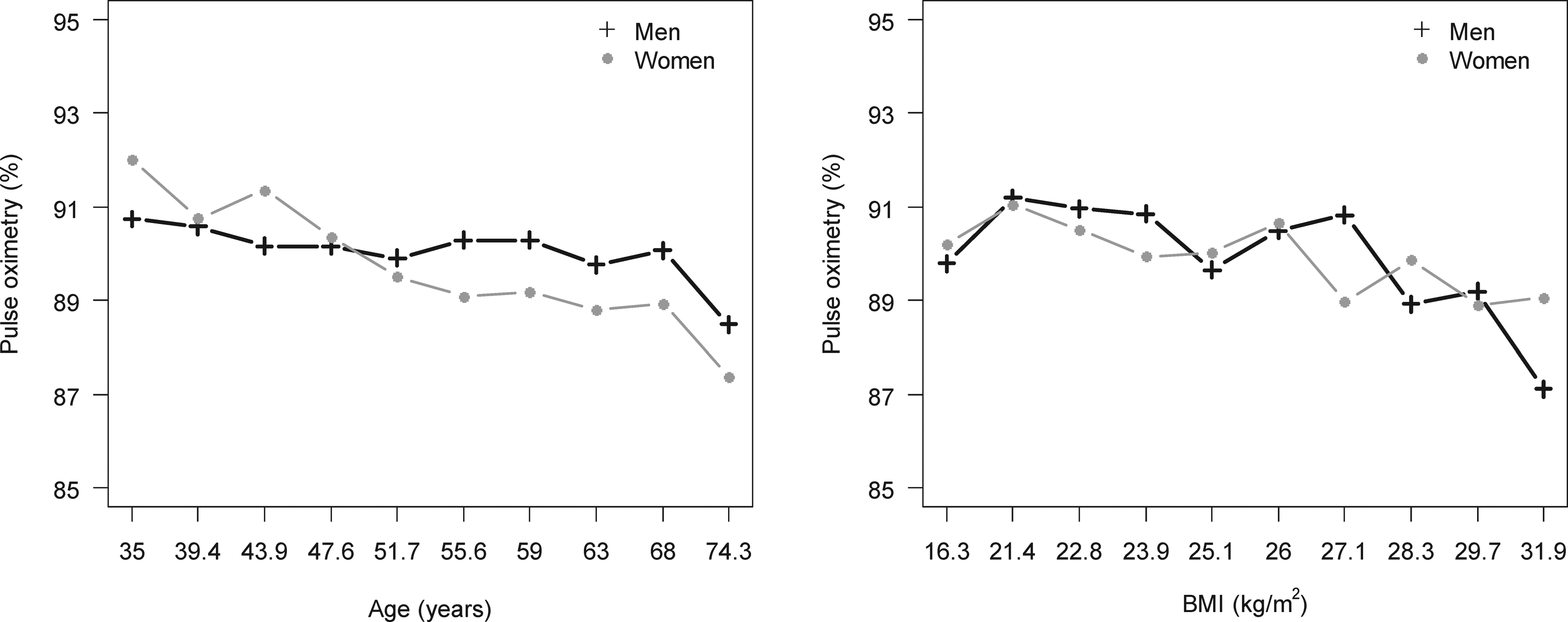
Relationship between oxyhemoglobin saturation and either age or BMI. We plotted the mean oxyhemoglobin saturation by deciles of age and BMI, respectively, and stratified by sex. Numbers in the x-axis represent the starting value of each decile. The graphs show a dose-response relationship with age or BMI corresponding to an incrementally lower oxyhemoglobin saturation, in both men and women. BMI, body mass index.
Sp
Cardiometabolic risk factors associated with lower resting daytime oxygen saturation
We found higher odds of having metabolic syndrome for each 5% decrease in oxyhemoglobin saturation (Fig. 2 and Supplementary Table S1). We performed adjusted analysis (Table 3) to further evaluate the relationship of a 5% change in oxyhemoglobin saturation and various cardiometabolic factors. In analyses adjusted for age, sex, excessive erythrocytosis, wealth index, and setting, a 5% decrease in oxyhemoglobin saturation was strongly related to higher odds of having a metabolic syndrome, a higher waist circumference, HbA1c ≥6.5%, HOMA-IR >2 mass units, and hs-CRP ≥3 mg/L.

Odds ratio of metabolic syndrome based on 5% decrease in oxyhemoglobin saturation. We plotted the odds ratios and 95% confidence intervals for every 5% increase in oxyhemoglobin saturation. Relationship between oxyhemoglobin saturation and age and BMI in men and women. We plotted the mean oxyhemoglobin saturation for each 1 year or 1 kg/m2 increased in age and BMI, respectively. This was done for men and woman independently. The graphs show a dose–response with increased age and BMI corresponding to incremental decreased oxyhemoglobin saturation. BMI, body mass index.
Sensitivity analyses
As previously mentioned, given that BMI is likely in the assumed causal pathway linking hypoxemia to other cardiometabolic risk factors (Supplementary Fig. S1), we used residuals of BMI as a sensitivity analysis. In a model adjusted for age, sex, excessive erythrocytosis, wealth index, and residuals of BMI, lower oxyhemoglobin saturation maintained associations with HbA1c ≥6.5% and hs-CRP ≥3 mg/L, while the association between oxyhemoglobin saturation and HOMA-IR >2 mass units was no longer significant (Table 3). When stratified by sex, although not having sufficient power for adequate stratification, we found that the relationship between oxyhemoglobin saturation and HbA1c showed similar trends in men (OR = 1.50, 95% CI: 0.76–3.12, p = 0.23) and in women (OR = 1.65, 95% CI: 0.95–2.87, p = 0.08). Effect sizes were in a similar direction and magnitude for regressions stratified by site (Supplementary Tables S3 and S4).
Discussion
In this high-altitude population-based study of 954 residents of Puno, Peru, we found that older age, lower lung function, and higher BMI were associated with a lower resting daytime oxyhemoglobin saturation. In turn, a lower oxyhemoglobin saturation was associated with higher odds of having cardiometabolic risk factors such as metabolic syndrome, HbA1c (≥6.5%), and hs-CRP (≥3 mg/L) even when accounting for age, sex, excessive erythrocytosis, wealth index, site, and BMI. A higher BMI did not appear to fully account for the cardiometabolic risk suggesting that low oxyhemoglobin saturation itself plays an independent role in augmenting cardiometabolic risk factors at high altitude.
Several findings reported in our study are largely consistent with the literature and confirm established physiological principles. First, in this high-altitude cohort, the prevalence of metabolic syndrome and elevated fasting glucose (>100 mg/dL) was 36.5% and 16.6%, respectively, which is similar to previous findings among Andean populations (Chirinos et al., 2013). Second, we found obesity to be linked with worsening hypoxemia, likely, in part, due to its effects on lung volume (Jones, 2006). Finally, it is well established that obesity is a major causal factor in the development of metabolic disorders. In particular, central adiposity, more common among urban residents of Puno (Medina-Lezama et al., 2010), was accompanied by dyslipidemia, fasting hyperglycemia, and insulin resistance. In light of the effects of obesity, it was not surprising that adjusting for residuals of BMI in our sensitivity analysis attenuated some of the associations between oxyhemoglobin saturation and metabolism. At face value, our results differ from some studies that have shown decreased prevalence of cardiovascular risk factors in high-altitude dwellers (Sherpa et al., 2010, 2013; Woolcott et al., 2014). However, these studies did not examine oxyhemoglobin saturation, which can vary greatly between subjects at the same altitude (Luks and Swenson, 2011) and which reflects true hypoxemia at high altitudes.
An important and novel finding of our study is that exaggerated hypoxemia in its own right was associated with cardiometabolic risk in our study setting. We found that participants in urban Puno had a higher mean BMI compared to those in rural Puno, but both cohorts had a similar prevalence of elevated fasting glucose, HbA1c, and diabetes and implicating a factor other than BMI may explain observed differences in metabolic risk factors. In addition, our multivariable regression model adjusted for BMI also showed a strong inverse relationship between oxyhemoglobin saturation and prevalence of metabolic syndrome, HbA1c ≥6.5%, and hs-CRP ≥3 mg/L. Elevated hs-CRP in individuals with lower resting daytime oxyhemoglobin saturation may serve as a marker of increased cardiovascular risk at high altitude (Grundy et al., 2004).
While not the primary focus of this study, there are several plausible mechanisms by which hypoxemia may affect glucose metabolism and inflammation. First, hypoxemia activates the sympathetic nervous system, chiefly through arterial chemoreceptors. In humans and animals, various forms of hypoxia-induced glucose intolerance may be significantly attenuated by sympathetic blockade or by chemoreceptor denervation (Peltonen et al., 2012; Jun et al., 2014; Shin et al., 2014). Chronic activation of the sympathetic nervous system may be a pathway toward the development of metabolic syndrome (Brotman et al., 2002). Alternatively, new findings suggest that hypoglycemia stimulates and hyperglycemia inhibits peripheral chemoreceptor responsiveness, and may imply that serum glucose is a driver for sympathetic tone thereby affecting oxygenation through respiratory drive (Ortega-Saenz et al., 2013).
Second, hypoxemia in tissues may cause systemic inflammation by activation of hypoxia-inducible factor 1-alpha in hypertrophied obese adipose tissue (He et al., 2011) and through the inhibition of adipocytokines (Hosogai et al., 2007). Interestingly, many adaptations to tissue hypoxia in muscle theoretically facilitate glucose disposal, an effect witnessed both in vivo (Mackenzie et al., 2011, 2012) and in vitro (Azevedo et al., 1995). Hypoxia facilitates angiogenesis (Iyer et al., 1998), which increases tissue glucose delivery; facilitates glucose transport through upregulation of GLUT1 and GLUT4 (Chou et al., 2004; Sakagami et al., 2014); upregulates AMP-activated protein kinase, which increases insulin sensitivity (Kahn et al., 2005); and shunts glucose toward glycolysis and lactate pathways rather than mitochondrial oxidation (Wheaton et al., 2011), resulting in higher total body glucose flux (Roberts et al., 1985; Palmer et al., 2014). Many of these changes are facilitated, in whole or in part, by HIF-1α (Semenza, 1999).
Our finding that, at altitude, hypoxemia was associated with insulin resistance suggests that sympathetic activation and adipose tissue hypoxia may prevail over metabolic adaptations occurring in muscle. This physiology may explain how the synergy of obesity and hypoxemia may lead to metabolic complications, as demonstrated in a mouse model of sleep apnea (Polotsky et al., 2004). In terms of lipid metabolism, hypoxemia may increase adipose tissue lipolysis, upregulate hepatic lipoprotein secretion, and/or suppress lipoprotein clearance (Drager et al., 2010). It is also possible that the presence of hypoxemia is a marker of lung disease, which in turn may increase the risk of cardiovascular disease (Schroeder et al., 2003; Lee et al., 2011). In our study, we found that participants with lower oxyhemoglobin saturations also had lower height-corrected forced expiratory volumes independent of BMI.
Our study has several strengths. First, our study is a population-based sample derived in a high-altitude setting in two disparate socioeconomic settings, allowing for increased environmental, dietary, and lifestyle variability. Second, we have a large sample size and collected extensive anthropometric, clinical, social, and laboratory data to best characterize cardiovascular risk factors. Limitations to our study include the cross-sectional nature and inability to determine if these cardiometabolic risk factors correlate to increased mortality in this population. We also relied on a single pulse oximetry spot-check for oxyhemoglobin saturation values, which may affect the accuracy of an individual's true value. However, we believe that a large sample size may have helped to minimize the effects of a spot-check accuracy on our inferences. Finally, the validity of our results depends on the assumptions made in our directed acyclic graph (Supplementary Data) demonstrating the multiple collinear risk factors that influence both oxygen saturation and increased cardiometabolic risk.
Conclusion
Among high-altitude dwellers in Peru, a lower oxyhemoglobin saturation was associated with higher odds of having metabolic syndrome, elevated HbA1c, and elevated hs-CRP even after accounting for those who had excessive erythrocytosis. Therefore, our findings suggest that any degree of hypoxemia may play a role in the development of diabetes, dyslipidemia, and systemic inflammation in high-altitude populations. It is likely that although obesity may be less prevalent at high altitude, individuals with a lower oxyhemoglobin saturation have a higher risk for cardiometabolic disease. High-altitude settings provide a natural laboratory to better understand the effects of worsening hypoxemia on cardiometabolic health.
Footnotes
Acknowledgments
The authors are indebted to all participants who kindly agreed to participate in the study. Special thanks to all field teams for their commitment and hard work, especially to Lilia Cabrera, Rosa Salirrosas, Viterbo Aybar, Sergio Mimbela, and David Danz for their leadership in each of the study sites, as well as Marco Varela for data coordination. This project was funded in whole with Federal funds from the United States National Heart, Lung, and Blood Institute, National Institutes of Health, Department of Health and Human Services, under Contract No. HHSN268200900033C. C.H.M. was further supported by the National institute of Health Fogarty International Center (5R25TW009340) and the University North Carolina Center for AIDS Research. W.C. was further supported by a Pathway to Independence Award (R00HL096955) from the National Heart, Lung, and Blood Institute.
Author Disclosure Statement
No competing financial interests exist.
References
Supplementary Material
Please find the following supplemental material available below.
For Open Access articles published under a Creative Commons License, all supplemental material carries the same license as the article it is associated with.
For non-Open Access articles published, all supplemental material carries a non-exclusive license, and permission requests for re-use of supplemental material or any part of supplemental material shall be sent directly to the copyright owner as specified in the copyright notice associated with the article.
