




Abstract

E
Seven subjects climbed for 13 days in an acclimatization trek to the Manaslu base camp at 5050 m above sea level. All climbers spent 22 days at high altitude and returned to Katmandu within 8 days (Mariggiò et al., 2010; Pelliccione et al., 2011; Verratti et al., 2011). The data concerning the hormonal and seminal response of our experimental subjects were presented and discussed in a previous article published (Pelliccione et al., 2011). Here we report additional information related to the testicular morphology of males undergoing chronic exposure to high-altitude-induced hypoxia. Before and after the high-altitude exposure, total testis volume of all individuals was recorded by functional magnetic resonance imaging at the Institute for Advanced Biomedical Technologies, in Chieti, Italy. Statistical differences were evaluated using two-way analysis of variance (2 × 2) for repeated measures, followed by a Sidak post hoc test.
Hypoxic high-altitude trekking reduced testicular volumes of both left (−14.8%, p < 0.0001) and right (−15.4%, p < 0.0001) testes. This, in turn, reduced the average testicular volume (between left and right) [F (1, 12) = 232.3, p < 0.0001] (Fig. 1).
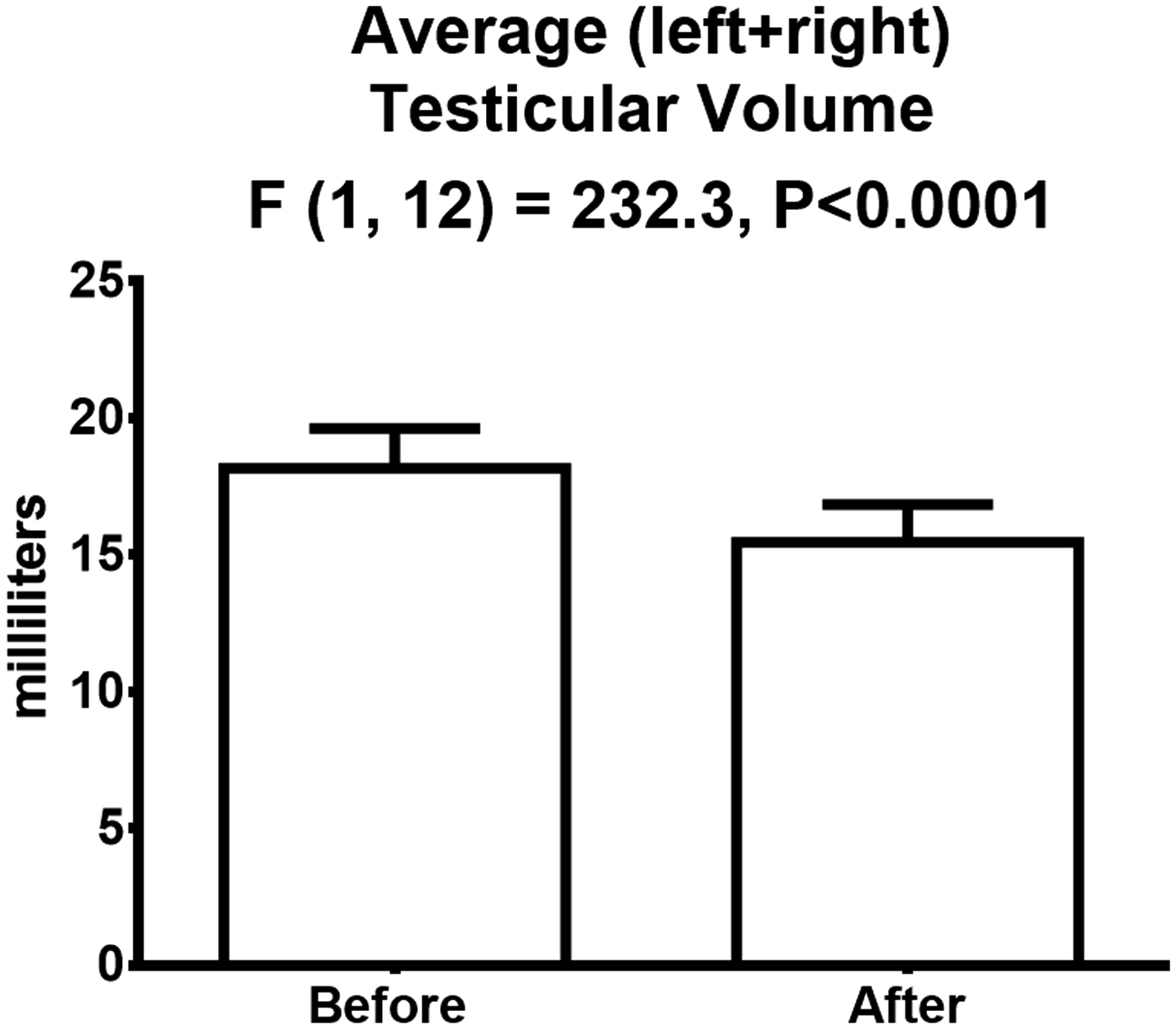
After the high-altitude experience, the average testicular volume (between left and right) was also reduced [F (1, 12) = 232.3, p < 0.0001].
Our results in humans confirm data from animal-based studies, suggesting a negative hypoxia-related effect on male reproduction, through changes in semen characteristics, together with an increase in plasma follicle stimulating hormone level and a reduction of total testicular volume.
Footnotes
Author Disclosure Statement
No competing financial interests exist.