




Abstract
Abstract
Nuñez, Denisse, Paola Olavegoya, Gustavo F. Gonzales, and Cynthia Gonzales-Castañeda. Red maca (Lepidium meyenii), a plant from the Peruvian highlands, promotes skin wound healing at sea level and at high altitude in adult male mice. High Alt Med Biol 18:373–383, 2017.—Wound healing consists of three simultaneous phases: inflammation, proliferation, and remodeling. Previous studies suggest that there is a delay in the healing process in high altitude, mainly due to alterations in the inflammatory phase. Maca (Lepidium meyenii) is a Peruvian plant with diverse biological properties, such as the ability to protect the skin from inflammatory lesions caused by ultraviolet radiation, as well as its antioxidant and immunomodulatory properties. The aim of this study was to determine the effect of high altitude on tissue repair and the effect of the topical administration of the spray-dried extract of red maca (RM) in tissue repair. Studies were conducted in male Balb/c mice at sea level and high altitude. Lesions were inflicted through a 10 mm-diameter excisional wound in the skin dorsal surface. Treatments consisted of either (1) spray-dried RM extract or (2) vehicle (VH). Animals wounded at high altitude had a delayed healing rate and an increased wound width compared with those at sea level. Moreover, wounding at high altitude was associated with an increase in inflammatory cells. Treatment with RM accelerated wound closure, decreased the level of epidermal hyperplasia, and decreased the number of inflammatory cells at the wound site. In conclusion, RM at high altitude generate a positive effect on wound healing, decreasing the number of neutrophils and increasing the number of macrophages in the wound healing at day 7 postwounding. This phenomenon is not observed at sea level.
Introduction
W
Neutrophils are the first cells to migrate to the area to phagocyte bacteria or foreign particles. After completion of their purpose, neutrophils are phagocytosed by macrophages and eliminated through the debris (Martin and Leibovich, 2005). Macrophages, which are highly phagocytic, release reactive oxygen species (ROS), proteases, proinflammatory cytokines, such as interleukin (IL)-6 and the tumor necrosis factor (TNF)-α, and growth factors, such as the transforming growth factor (TGF)-β, whose main role is to act as chemotactic agents and to promote the formation of the granulose tissue (Kaplanski et al., 2003; Sindrilaru and Scharffetter-Kochanek, 2013).
The decrease of the number of neutrophils together with the increase of the number of macrophages in the lesion area is an indicator of the end of the inflammatory phase and the beginning of the proliferative phase. The main purpose of the second phase is to restore the layers of the skin through the proliferation of keratinocytes to allow reepithelialization and, through the activation of fibroblasts and migration of macrophages, to allow the formation of the granulation tissue (Singer and Clark, 1999; Gurtner et al., 2008).
This phase ends with the synthesis of collagen by the fibroblasts. During the third phase, the new collagen fibers are reorganized, while fibroblasts differentiate into myofibroblasts to give strength to the newly formed skin and restore the skin aesthetics (Braiman-Wiksman et al., 2007; Thangapazham et al., 2014). Any disturbance in any of the wound healing phases can alter the integrity of the repair, either delaying it or creating excessive scarring (Elliott and Hamilton, 2011).
The exposure to high altitude is associated with an increase of inflammatory markers (Stadelmann et al., 1998; Ermolao et al., 2009), one of them being the proinflammatory cytokine IL-6 (Hartmann et al., 2000). In a model of craniocerebral injury in mice, the injury characteristics at simulated high altitude of 4000 m were more serious, rapid, and prolonged than those in the normobaric group (Yu et al., 2014). Outdoor trekkers in the highlands are more susceptible to severe dermatological problems due to the harsh conditions present at high altitude (Hug et al., 2001; Basnyat and Starling, 2015), thus increasing the susceptibility to infection and injury (Mishra and Ganju, 2010; Basnyat and Starling, 2015).
The alteration of the inflammatory process together with the harsh environmental stressors at high altitude suggest that both, the exposure to the harsh environmental stressors at high altitude and the alteration of the inflammatory process, might be delaying the process of wound healing.
Hypoxia and the activation of the hypoxia inducible factor-1 (HIF-1) are required for normal wound repair. However, chronic hypoxia as observed at high altitudes settlements, the hypoxia pathway may compromise the wound healing process (Darby and Hewitson, 2016)
Maca is a Peruvian plant that grows over 4000 m above sea level (m.a.s.l.) and that has been used traditionally for its nutritional value and fertility properties (Gonzales et al., 2009). One of its varieties, red maca (RM), has the effect of protecting the skin against ultraviolet radiation damage (Gonzales-Castaneda and Gonzales, 2008), preventing epidermal hyperplasia and the appearance of sunburn cells, which are signs of inflammation. Moreover, it has an immunomodulatory property, avoiding the overstimulation of proinflammatory cytokines (Gonzales et al., 2013; Gasco, 2014) and the increase of inflammatory cells in situ, therefore allowing a rapid skin recovery (Gonzales-Castaneda et al., 2011).
Impairment of wound healing creates a burden on public health, not only because of the economic cost but also mainly because impaired healing can cause a lifelong disability (Gurtner et al., 2008). Therefore, it is of clinical relevance to understand the mechanisms affecting the normal tissue repair. Currently there are no studies that describe the evolution of wound closure through time at high altitude. Our hypothesis is that exposure to high altitude delays the process of wound healing by increasing inflammation and that RM reverses this process.
Materials and Methods
Study design
All experimental procedures were approved by the Ethics Institutional Committee for Animal Care of the Universidad Peruana Cayetano Heredia (Lima, Perú; CIEA-63592) and conformed to the Animal Welfare Act 1990, the United States and the Australian Code of Practice for the Care and Use of Animals for Scientific Purposes. Male Balb/c mice were obtained from the Animal House at Universidad Peruana Cayetano Heredia.
Animals were randomly housed (three mice per cage) under standard laboratory conditions with a 12-hour light–dark cycle and were maintained on standard pellet diet and water ad libitum. Experiments conducted at high altitude required animals to be transported by car from Lima to Cerro de Pasco 3 weeks before the commencement of the experiments to allow proper acclimatization. Travel lasted 6 hours.
Two experiments were conducted (1) to evaluate the dose-response effect of the RM treatment at sea level (Lima) and (2) to compare the healing pattern at sea level (Lima, Perú) and high altitude (Cerro de Pasco, Perú) with and without treatment. The first experiment consisted of five groups of treatment: (1) vehicle (neutral cream), (2) dose 1 RM, (3) dose 2 RM, (4) dose 3 RM, and (5) Silverdiazine-
For all experiments the wounds were evaluated macroscopically on days 0, 3, 5, 7, and 14 postwounding. Histological evaluations were made on days 3, 7, and 14 for the first experiment and on days 7 and 14 for the second experiment. For each experiment, each group of study consisted of six animals per time-point, which is the minimum number to achieve statistical differences.
Preparation of Lepidium meyenii (RM) extract
Dried hypocotyls of RM were obtained from Carhuamayo (Junin, Peru) at 4100 m altitude. After grinding the hypocotyls, the maca flour was macerated with ethanol 70%. Hydroalcoholic extract of RM was spray-dried to obtain a powder.
Spray-dried RM powder, locally purchased (Lima, Peru) was diluted in distilled water to the desired concentrations.
Animals received RM in three concentrations: (1) 1.6 μg RM extract/200 mg cream, (2) 16 μg/200 mg cream, and (3) 160 μg/200 mg cream. These concentrations were determined according to the dose-response study of the topical application of maca in an animal model (Gonzales-Castaneda et al., 2011). Previous studies have determined the efficiency of the topical treatment of maca without using a solid vehicle.
To determine the stability of the topical treatment of RM in open wounds, a neutral cream was used as vehicle. The use of maca as topical application has not been described traditionally, and it is a contribution of science.
Excision wound experiments
Nine-week old mice were anesthetized through an intraperitoneal injection of sodium pentobarbital (0.07 mg/mL/g body weight). Levels of anesthesia were checked by tail-pinch and pedal reflex. The skin was carefully shaved, and the exposed area was disinfected with 70% v/v ethanol. Two full-thickness round skin wounds (10-mm diameter) were created at the dorsal flank of each animal.
The two wounds were separated from each other and left open without any dressing material for the duration of the study. Postoperatively, all animals were allowed to recover on a heated pad and then housed in groups of three animals per cage. All animals were monitored daily. Excisions were assessed on days 0, 3, 5, 7, and 14 postwounding.
Treatments
For the first experiment (dose-response), animals were distributed into five treatment groups as previously described. For the preparation of the maca treatment, the spray-dried extract of RM was mixed with the neutral commercial cream as vehicle in a concentration of 8, 80, and 800 μg-RM/g-vehicle. This concentration was based on a previous study using the neutral cream as vehicle (Mikus et al., 2001).
Silver sulfadiazine cream was used as positive control acting locally. One of the wounds in each animal received 200 mg of neutral cream containing vehicle, RM, or positive control, which was applied uniformly once a day for 3 consecutive days, starting on the day of wounding.
After finishing the first experiment, it was determined the dose of RM to be used in further experiments. For the second experiment, at sea level and high altitude, animals were divided into five groups as previously described. One of the wounds in each animal received the vehicle, while the other wound received RM. RM was applied using the best concentration assessed on the first experiment (160 μg/200 mg neutral cream).
Macroscopic evaluation of wounds
Digital images of each dorsal skin wound were obtained using a DSLR camera (Nikon, Tokyo, Japan) with a standardized focal distance, aperture, and exposure time immediately after the initial incision (day 0) and at days 3, 5, 7, and 14 postwounding. Wound areas were measured within the wound margins, and the pixel areas were calculated using Adobe Photoshop CS6 (Adobe Systems, Inc.).
The percentage of wound closure was calculated using the following formula:
where A0 corresponds to the wound area at d0, and Ad corresponds to the wound area measured either on day 3, 5, 7, or 14 postwounding (Yates et al., 2007).
Tissue collection and processing
Animals were anesthetized and killed by cervical dislocation. Specimens of the wounds, consisting of the widest part of the wound, surrounded by a 4-mm border, were excised and processed for histology. This allowed for only the most disrupted part of the wound to be considered for the tissue repair assessments. Unwounded skin was obtained from the dorsum of the trunk near the tail of each animal to assess healthy tissue.
Histological analysis
Tissue biopsies were fixed in paraformaldehyde for further histological processing. Transverse histological sections (5 μm) from paraffin-embedded wounds were stained with hematoxylin and eosin and analyzed using a Leica DM light microscope. All histological analyses were performed blind without knowledge of the identity of each specimen. Measurements were performed using the software Leica Application Suite (v 4.8.0).
Wound width was measured to evaluate wound closure. To assess wound width, the wound gap was measured between the two healthy dermis margins at the dermo–epidermal junction, at 2.5 × magnification.
Epidermal hyperplasia was determined per field of skin tissue by calculating the average distance between the granular layer of the epidermis and the dermo–epidermal junction. Three fields per skin sample were assessed at 10 × magnification.
Neutrophils were stained with a soft pink color and were characterized by a segmented, multilobulated compact chromatin (two to five lobes), while macrophages showed a soft pink coloration and were characterized by having a kidney-shaped nucleus and a strongly granulated cytoplasm.
Quantification was performed in random sections within the laceration area, with the Leica DM microscope at a 40 × magnification. Two fields were evaluated by histological section using the “count” tool of the Leica Application Suite (version 4.8.0).
Statistical analysis
Results are expressed as mean ± standard error of the mean. Data collected were subjected to standard statistical analysis using the statistical software package SPSS. Comparisons between groups were performed using one-way analysis of variance with Tukey post-hoc. Frequencies were assessed by chi square test. Differences were considered significant with a p < 0.05.
Results
Dose-response effect of RM on wound closure at sea level
Wounds from male mice at sea level were assessed macroscopically at days 3, 5, 7, and 14 postwounding. Wounds treated with vehicle and the positive control reached almost 50% of wound closure by day 3 postwounding. However, wounds treated with the three doses of RM had a higher closure rate compared with the vehicle (p < 0.05) (Fig. 1A) and the positive control (p < 0.05) (Data not shown) with no difference between the three doses.
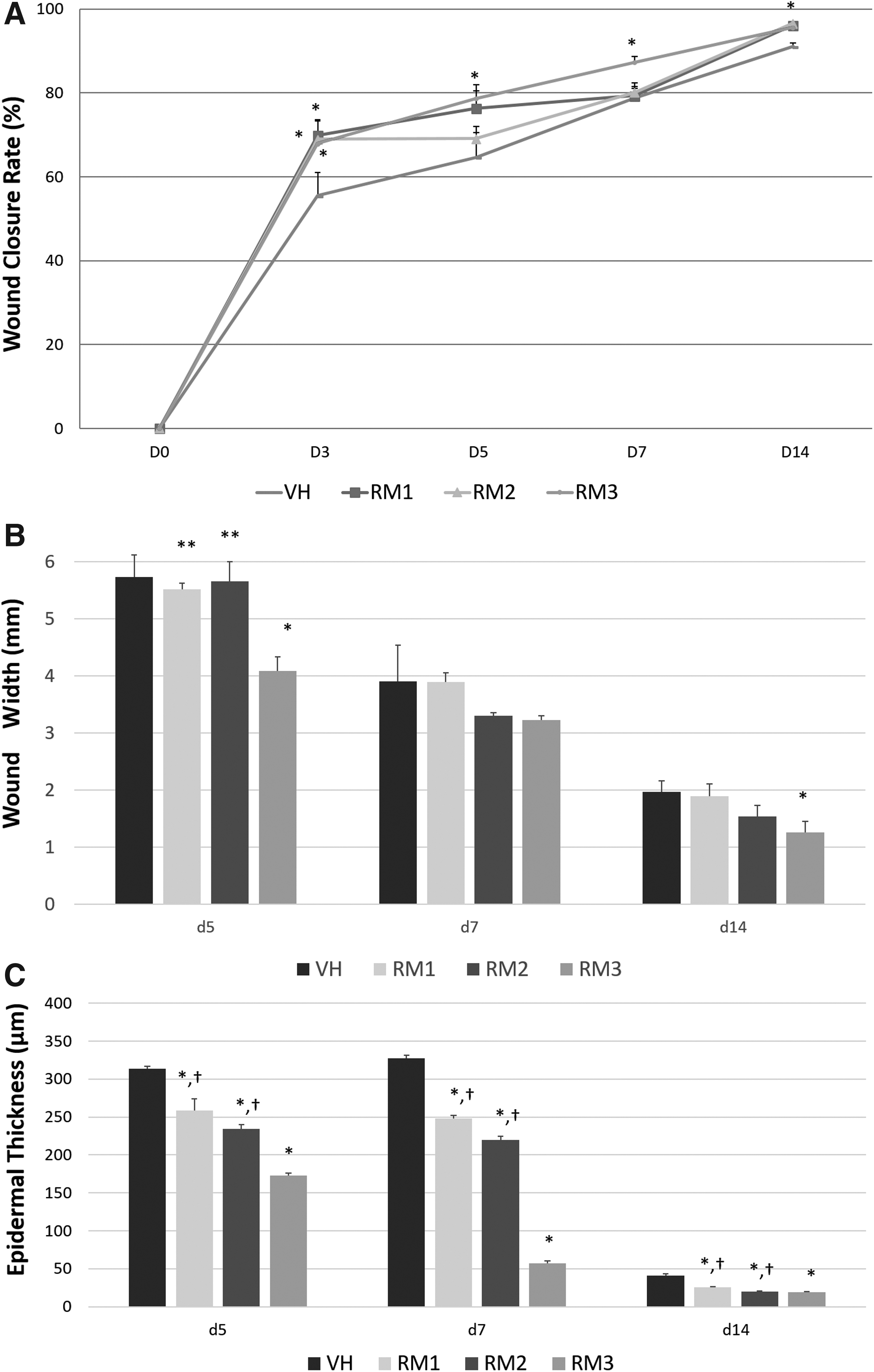
By day 5, wounds treated with the higher dose of RM (RM3) presented a higher wound closure rate compared with the vehicle (p < 0.05) and the positive control (p < 0.05) (data not shown).
By day 7, wounds treated with the RM3 presented the highest wound closure rate (p < 0.05). By day 14, wounds treated with the three different doses of RM presented a higher wound closure rate compared with vehicle (p < 0.05) and positive control (p < 0.05) (data not shown) with no differences between the three doses (Fig. 1A).
Microscopic analyses of wounds (Fig. 1B, C) confirm the results obtained from the macroscopic analysis. At day 5 postwounding, wounds treated with RM3 had a smaller wound width (p < 0.01), indicating a faster wound closure (Fig. 2).

Macroscopic appearance of the wounds at days 0, 3, 5, 7, and 14 postwounding. Ten millimeters diameter excisional wound inflicted on the flank of each mouse at SL and HA, treated with either VH or RM. HA, high altitude.
By day 7, all groups had a reduced wound width compared with day 5, with no significant differences between treatments.
By day 14, all groups had a reduced wound width compared with day 7. Furthermore, wounds treated with RM2 had a significantly smaller width compared with the positive control (p < 0.05) (data not shown), whereas wounds treated with RM3 had a significantly smaller width compared with the vehicle (p < 0.01) (Fig. 1B) and the positive control (p < 0.05) (data not shown). Data on epidermal thickness showed a dose-dependent reduction with increasing doses of RM (Fig. 1C).
Considering these data, the highest dose of RM was used for the following experiments. For all cases, the results obtained from the wounds left untreated were similar to those obtained with the vehicle (data not shown). Considering that with the silver sulfadiazine cream we could not find an improvement on the parameters measured, to reduce the number of animals, the positive control was no longer used as a treatment group.
RM improves impaired wound healing at high altitude
Macroscopic photographs of excisional wounds at day 0 and posterior healing at days 3, 5, 7, and 14 postwounding are shown in Figure 2.
The wound area was recorded and the rate of wound closure was calculated. At sea level, all wounds had a closure rate of more than 50% at day 3 postwounding. Treatment with RM had a higher closure rate compared with the vehicle at days 3 (70.6% vs. 57.8%, p < 0.005) and 14 postwounding (96.3% vs. 91.2%, p < 0.001).
At high altitude, only wounds treated with RM had a closure rate of more than 50% at day 3 postwounding (60.3%). The wound closure rate with RM was significantly higher compared with the vehicle at days 5 (75.2% vs. 51.5%), 7 (87.1% vs. 63.5%), and 14 postwounding (96.9% vs. 89.6%, p < 0.05) (Fig. 3A).
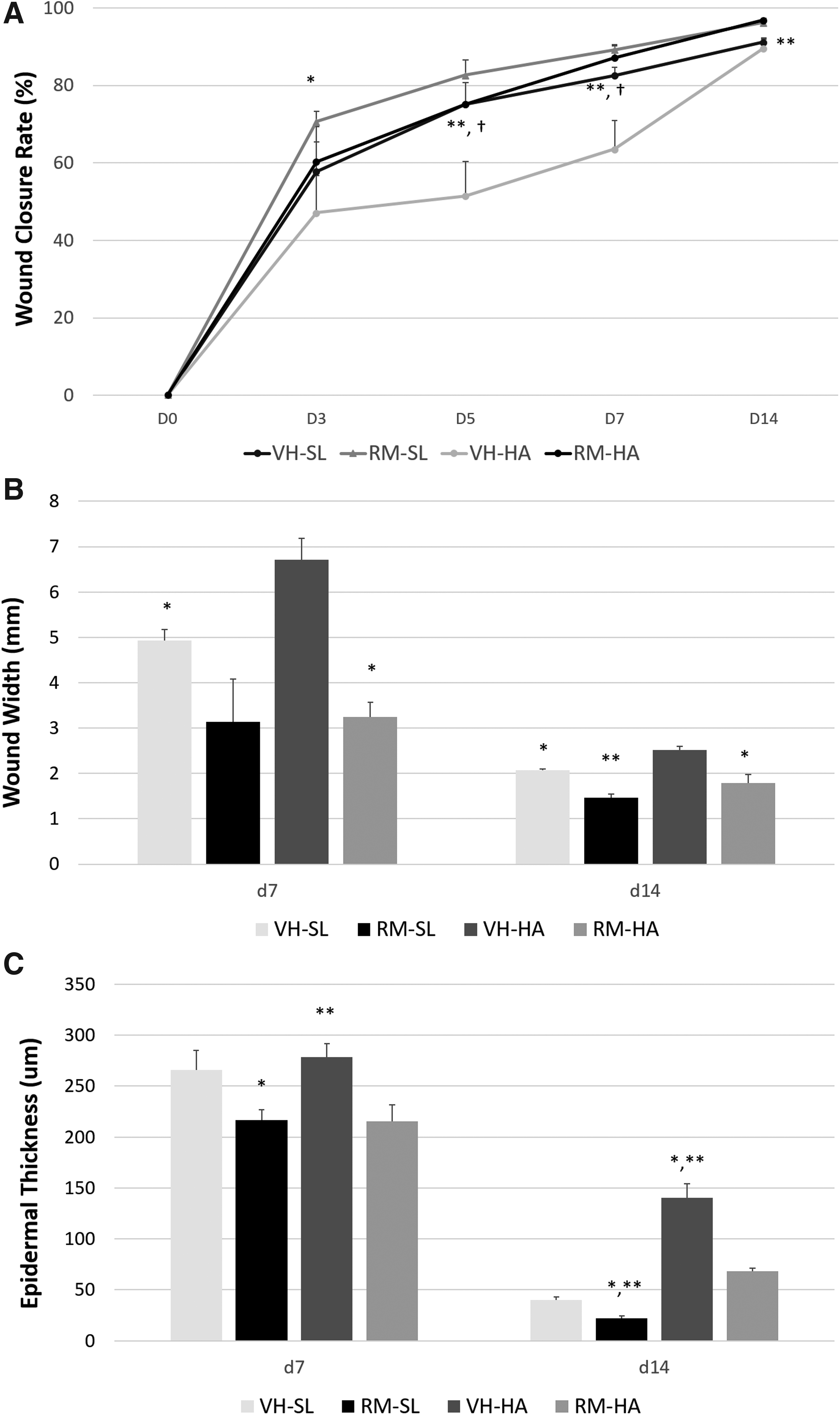
Between sea level and high altitude, wounds treated with vehicle at sea level had a higher wound closure rate than those treated with VH at high altitude at days 5 (75.2% vs. 51.5%, p < 0.05) and 7 postwounding (82.6% vs. 63.5%, p < 0.05). There were no significant differences between wounds treated with RM at sea level and high altitude (Fig. 3A).
Microscopic evaluations of the wounds were assessed in all groups. At day 7 postwounding, reepithelialization was complete in all groups at sea level and high altitude. However, granulation tissue was only completed in wounds treated with RM at sea level at day 7 postwounding. Wounds treated with vehicle at high altitude displayed signs of edema compared with the other groups. The distance between the two wound margins (wound width) was greater in wounds at high altitude when treated with vehicle (Supplementary Fig. S1; Supplementary Data are available online at www.liebertpub.com/ham).
The quantitative data on the wound widths were assessed in all groups (Fig. 3B). At sea level, there were no differences in wound width between treatment with RM and vehicle at day 7 postwounding. However, wounds treated with RM had a smaller width compared with those treated with vehicle at day 14 postwounding (p < 0.001). At high altitude, wounds treated with vehicle had a greater width compared with treatment with RM at days 7 and 14 postwounding (p < 0.005).
Between sea level and high altitude, wounds had a greater wound width when treated with vehicle at high altitude at both days 7 and 14 postwounding (p < 0.005). There were no significant differences between wounds treated with RM at sea level and high altitude.
The epidermal hyperplasia, noted as the thickness of the epidermis, was assessed histologically at days 7 and 14 postwounding (Fig. 3C). Wounding of the skin produces epidermal hyperplasia, as noted in all groups, and compared with healthy skin (13 ± 1.19 μm).
At sea level, wounds treated with vehicle at day 7 postwounding had a thicker epidermis compared with those treated with RM (p < 0.001). By day 14, both treatment groups showed a decreased in the epidermal thickness. However, wounds treated with vehicle still presented a thicker epidermis compared with RM (p < 0.001).
At high altitude, wounds treated with vehicle had a thicker epidermis compared with RM at both days 7 and 14 postwounding (p < 0.001).
Wounds treated with vehicle at sea level had a smaller thickness compared with VH-treated wounds at high altitude at day 14 postwounding (p < 0.001). Similarly, wounds treated with RM at sea level had a smaller thickness compared with RM-treated wounds at high altitude at day 14 postwounding (p < 0.001).
Wounds at high altitude presented a thicker epidermis compared with those at sea level (p < 0.001). Treatment with RM decreased the epidermal thickness compared with those that received vehicle at both sea level and high altitude (p < 0.001).
The number of the inflammatory cells, neutrophils and macrophages, were counted in sections of healthy skin and sections of the wound area at days 7 and 14 postwounding. Healthy skin had 5 ± 0.56 neutrophils and 5 ± 0.18 macrophages per section at sea level and 4 ± 0.26 neutrophils and 12 ± 1.29 macrophages per section at high altitude.
Compared with healthy skin, at day 7 postwounding, there was a significant increase in the number of neutrophils at the wound site in all groups (Fig. 4A). At sea level, there were no significant differences between treatment with vehicle and RM at day 7 postwounding. However, at high altitude, treatment with RM showed a lower number of neutrophils compared with its vehicle (p < 0.005).
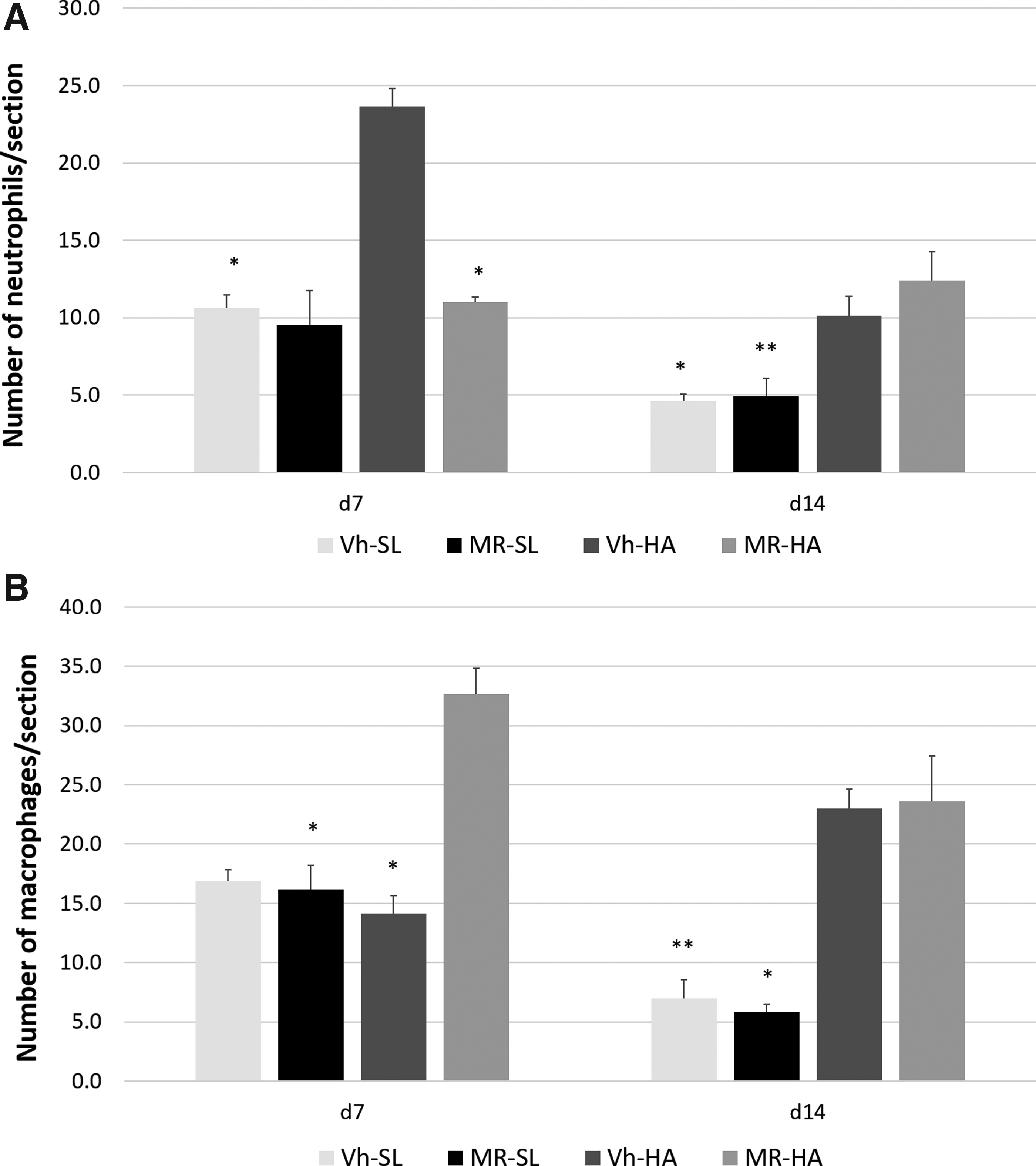
By day 14, the number of neutrophils decreased in wounds treated with vehicle at sea level and high altitude. There were no differences between the number of neutrophils at day 7 and 14 postwounding when wounds were treated with RM. There were no differences between treatments with vehicle and RM at day 14, at both sea level and high altitude.
Between both altitudes, when treated with the vehicle, there were an increased number of neutrophils at the wound site at high altitude compared with those at sea level at both time-points (p < 0.005). When wounds were treated with RM, a reduction in neutrophil counts was observed at high altitude (Supplementary Fig. S2). By day 14 postwounding, wounds at high altitude reduced number of neutrophils, and it was similar to the group treated with RM. In the groups at sea level, values were similar (treated with vehicle or RM) but lower than at day 7.
The number of macrophages was increased at day 7 postwounding in all groups except in those treated with vehicle at high altitude (Fig. 4B). At sea level, there were no significant differences between treatment with vehicle and RM at day 7 postwounding. At high altitude, wounds treated with RM had an increased number of macrophages compared with those treated with vehicle (p < 0.001).
By day 14, the number of macrophages at the wound site decreased in groups treated with vehicle and RM at sea level (p < 0.05) and in the group treated with RM at high altitude (p < 0.05). In contrast, the group treated with vehicle at high altitude had an increase in the number of macrophages compared with day 7 postwounding (p < 0.01). At both sea level and high altitude, there were no differences between treatment with vehicle and RM.
Between both altitudes, at day 7 postwounding, there were no differences in the number of macrophages between wounds treated with vehicle at sea level and high altitude. Wounds treated with RM at sea level had a lower number of macrophages compared with those at high altitude (p < 0.005).
At day 14 postwounding, treatment with vehicle at sea level presented a lower number of macrophages compared with those treated at high altitude (p < 0.001). Likewise, treatment with RM at sea level presented a lower number of macrophages compared with those treated at high altitude (p < 0.005).
Since day 7, we observed that the groups at sea level had a lower number of neutrophils with a higher number of macrophages, compared with the vehicle-treated group at high altitude, which displayed a higher number of neutrophils in comparison to the number of macrophages, we calculated the ratio of neutrophils-to-macrophages (N:M) for each group at both time-points (Table 1).
Data are mean ± standard error the mean. p = statistical significance.
p < 0.005; bp < 0.05 versus group receiving vehicle at high altitude.
We observed that the N:M ratio at day 7 postwounding was significantly increased in wounds at high altitude treated with vehicle, compared with the other groups (p < 0.005). The increase in the ratio was more than 50%. No significant differences were observed at day 14 postwounding, except to the vehicle group at sea level, in which values were higher than in the group at high altitude (p < 0.05).
Discussion
This study has demonstrated that exposure to high altitude (4380 m.a.s.l.) delays the process of cutaneous tissue repair through a 14-day period, and it increases the number of neutrophils at the wound site in an animal model. These results are consistent with previous observations where the exposure to high altitude alters the count and function of white blood cells, compared with sea level (Ermolao et al., 2009; Goel et al., 2013). Moreover, the topical application of the spray-dried extract of RM reduces the signs of inflammation, such as epidermal hyperplasia and the number of neutrophils at the wound site, and accelerates the tissue repair process at sea level and high altitude in male mice.
The skin can promote autoregeneration of the tissue after a laceration has occurred. However, this ability could be compromised under certain conditions such as hormonal effects or environmental conditions, which could lead to the generation of nonhealing wounds. It has been widely described that male mice have a delayed wound healing with an impaired inflammatory response compared with female mice, mainly due to the action of testosterone and its metabolite 5α-dihydrotestosterone (Ashcroft and Mills, 2002; Gilliver et al., 2006).
On the contrary, the exposure to high altitude is an environmental stressor eliciting neuroendocrine responses, such as an increase in levels of testosterone (Gonzales et al., 2009) and an alteration of the immune system (Mazzeo, 2005). Interestingly, at high altitude, the count of leukocytes is higher in males than in females (Kaya et al., 2000).
In the present study, we used male mice as an animal model of delayed healing, at sea level and high altitude, which allowed us to determine the physiopathology of wound healing and to further test the effect of the topical treatment of a medicinal plant, RM, in the improvement of cutaneous tissue repair.
A previous observational study suggests that at a hypoxic high altitude environment (>2500 m.a.s.l.) wounds may heal slower (Basnyat et al., 2001). However, the study is anecdotical, and it lacked a proper wound healing design, with no monitoring of the repair process through time. Therefore, for the present study, we decided to evaluate the evolution of the cutaneous tissue repair following a 10-mm diameter excision, through the course of 14 days in a male mice model at sea level and high altitude.
The results obtained show a delayed wound healing pattern in male mice at high altitude compared with those at sea level. Moreover, these wounds showed more signs of infection during the length of the study, which is consistent with previous observations where bacterial infections are one of the most common problems at high altitude (Meehan, 1987).
The presence of signs of infection could be explained by the hypoxic environment at high altitude, since the lack of oxygen has been related to a higher infection incidence (Sen, 2009). Although during the wound healing process, hypoxia is considered to be beneficial for angiogenesis, it delays wound closure by decreasing the amount of granulation tissue (Sano et al., 2012). This is mainly because oxygen is required for the reepithelialization and collagen synthesis (Fries et al., 2005; Said et al., 2005; Sano et al., 2012).
Furthermore, the exposure to a hypoxic environment increases the levels of proinflammatory markers such as IL-6 (Mazzeo, 2005). IL-6 is a cytokine secreted by neutrophils and macrophages, which can act as a chemoattractant for an influx of more inflammatory cells from the circulation (Scheller et al., 2011; Arango Duque and Descoteaux, 2014), and has been associated with delayed healing.
Our macroscopic observations showed that male mice at high altitude presented an increased number of neutrophils at day 7 postwounding, compared with sea level. Although neutrophils are abundant at the early inflammatory phase to decontaminate the wound area (Kirsner and Eaglstein, 1993), its overexpression can also impair repair due to the presence of proteases and free oxygen radicals, which can avoid migration of cells and degrade most components of the extracellular matrix, delaying the repair process (Dovi et al., 2003; Diegelmann and Evans, 2004).
These observations were consistent with our results, where wounds at high altitude showed also a delayed formation of granulation tissue, and a greater wound width in comparison with those at sea level, thus showing a delayed healing pattern. Neutrophils are normally removed from the wound site by apoptosis and by the action of macrophages (Khanna et al., 2010). However, failure to remove neutrophils is a critical factor in the pathogenesis of nonhealing wounds, such as diabetes (Khanna et al., 2010) and aging (Swift et al., 2001).
Interestingly, at day 7 postwounding the number of neutrophils was increased whereas the number of macrophages was decreased. Moreover, we did not observe a decrease in the number of neutrophils until day 14 postwounding, which was consistent with a further increase in the number of macrophages at the wound site in male mice at high altitude.
Based on this imbalance between neutrophils and macrophages we decided to calculate the N:M ratio. Our results showed an increased N:M ratio in wounds at high altitude at day 7 postwounding, compared with those at sea level. The increased N:M ratio observed at a late stage of the wound healing process indicates an increase in the rate of production of neutrophils together with a decrease action of macrophages. Thus, these results suggest that at high altitude there is an alteration of the inflammatory process, with a failure to remove neutrophils from the wound area during the early inflammatory phase.
Neutrophils then might be playing an important role in the pathogenesis of impaired healing, with an alteration of reepithelialization and formation of granulation tissue and delaying wound closure. Therefore, the inflammatory phase, specifically the accumulation of neutrophils, needs to be tightly regulated to prevent tissue damage, chronic inflammation, and the development of nonhealing wounds (Tidball, 2002; Lam et al., 2012).
The alteration of the wound healing processes needs special attention, and an appropriate treatment can restore the skin physiology and prevent further damage. L. meyenii (maca) is a cruciferous plant (Brassicaceae family) cultivated exclusively at an altitude of 4000–4500 m in the Peruvian Central Andes (Gonzales et al., 2009). Among its components, maca contains alkaloids, macaenes, glucosinolates, sterols, and polyphenols, as well as other secondary metabolites (Piacente et al., 2002; Yi et al., 2016).
Recently, we have published data related to composition of spray-dried extract of red and black maca screened using nuclear magnetic resonance (Gonzales-Arimborgo et al., 2016). According to this analysis, gamma-aminobutyric acid (GABA) predominated in RM. GABA may improve wound healing activity by its anti-inflammatory and fibroblast cell proliferation properties (Han et al., 2007).
The main amounts of polyphenols in maca are represented by catechins and gallocatechins (Campos et al., 2013). Catechin derivatives improve in vitro wound healing properties (Schmidt et al., 2010). Quercetin, another phenolic compound in maca, is an antifibrotic agent and diminishes scar formation (Doersch and Newell-Rogers, 2017).
Other compounds reported in RM extract by Gonzales-Arimborgo et al. (2016) as glucosinolates (Mazumder et al., 2016), malic acid (Lloyd et al., 1989), bioactive lipid mediators (Farahani, 2008; Kendall and Nicolaou, 2013), phytosterols (Ramazanov et al., 2017), and choline (Egleton et al., 2009; Martin et al., 2009) have properties improving wound healing.
Currently there are compounds from natural plants such as triterpenes, alkaloids, and flavonoids that can promote tissue repair by influencing one or more phases of the healing process (Phillipson, 2001; Shetty et al., 2006). Our results confirm that the topical application of the spray-dried extract of RM can increase the wound closure rate (>50%) as early as day 3 postwounding, with no signs of infection in male mice at sea level and high altitude.
A neutral cream was used as vehicle, which facilitated its application on the cutaneous wounds. The use of the neutral cream did not affect the efficacy of the RM extract, as we can observe from the results obtained in this study. As the dose of RM in vehicle increased, the response obtained in the different parameters evaluated was better. Moreover, the application of RM in the neutral cream obtained better results compared with the application of the neutral cream by itself (vehicle), confirming that the use of the latter as a vehicle does not affect the efficacy of RM on skin.
Histopathological analysis of wound healing is required to evaluate the efficacy of pharmacological products on skin (Hajiaghaalipour et al., 2013). Our histological analyses demonstrated that RM not only accelerated wound closure at sea level and high altitude but it also decreased the number of neutrophils at the wound site compared with the vehicle-treated wounds at high altitude.
This is consistent with previous reports where maca is shown to have antioxidant and anti-inflammatory properties (Gonzales-Castaneda and Gonzales, 2008; Gonzales and Gonzales-Castaneda, 2009; Gonzales-Castaneda et al., 2011).
Even though RM improves wound healing at sea and high altitude level, the mechanisms used by RM under these two environmental conditions seem to be different. According to the results showed in this study, RM at high altitude could generate its positive effect decreasing the number of neutrophils and increasing the number of macrophages in the wound site at day 7 postwounding. This phenomenon is not observed at sea level.
Moreover, at high altitude, RM can revert the N:M ratio at day 7 postwounding compared with vehicle-treated wounds, indicating that RM allows an appropriate removal of apoptotic neutrophils and regenerates the macrophage phenotype, which can then lead to a rapid reepithelialization and formation of the granulation tissue.
The mechanisms through which RM is enhancing wound healing are not fully understood but we suggest that maca might be acting through the targeting of free radicals and through the decrease of the inflammatory markers.
ROS, produced by neutrophils and macrophages, inhibit the wound healing process due to their harmful effects on cells and tissues (Foschi et al., 1988). Moreover, several studies indicate that exposure to high altitude increases the formation of ROS (Bakonyi and Radak, 2004), produces lipid peroxidation (Radak et al., 1994), and decreases the effectiveness of the antioxidant enzymatic system (Bakonyi and Radak, 2004). Furthermore, a study on expert alpinists demonstrated that during high mountain expeditions, neutrophils displayed an increased level of malondialdehyde and a lower catalase activity in expert alpinists (Carrera-Quintanar et al., 2012).
RM is a free-radical scavenger, preventing the decrease of the catalase activity following UV-induced skin damage, and avoiding lipid peroxidation (Gonzales-Castaneda et al., 2011). Moreover, its consumption avoids the overstimulation of proinflammatory cytokines such as IL-6 and TNF-α in humans (Gonzales et al., 2013) and in an animal model (Gasco, 2014) and inhibits nitrite production, an indicator of nitric oxide synthesis, which is produced in dermal inflammatory reactions (Garle et al., 1996; Bai et al., 2015).
Taking together our results, where the topical application of RM decreases the leukocyte infiltration, allowing the regeneration of the epithelial and connective tissue suggests that RM could be used as a natural treatment for injuries. Thus, it could be also beneficial in situations of environmental stress, such as injuries occurring at high altitude.
In conclusion, RM at high altitude generate a positive effect on wound healing, decreasing the number of neutrophils and increasing the number of macrophages in the wound healing at day 7 postwounding. This phenomenon is not observed at sea level.
Footnotes
Acknowledgments
The authors acknowledge the support of the technical team at the High Altitude Institute (Cerro de Pasco, Peru), and the collaboration of the Pathology Department at Hospital Nacional Cayetano Heredia for their support with the histological process and staining. This study was supported by a Grant from Consejo Nacional de Ciencia, Tecnología e Innovación/Fondo Nacional de Ciencia y Tecnología (CONCYTEC/FONDECYT), Peru, named “Research Circles” (Grant No. 010-2014-FONDECYT). The sponsor has not participated in the study design, in the collection, analysis, or interpretation of data; neither in the writing of the report nor in the decision to submit the article for publication.
Authors' Contributions
Experiments were performed in the Endocrinology and Reproductive Laboratory in the Universidad Peruana Cayetano Heredia and in the High Altitude Institute. C.G.-C., D.N., and G.F.G. designed the experiments. D.N. and P.O. performed the experiments and recollected and analyzed the data. C.G.-C. interpreted the data and wrote the article. All authors revised and approved the article.
Author Disclosure Statement
No competing financial interests exist.
References
Supplementary Material
Please find the following supplemental material available below.
For Open Access articles published under a Creative Commons License, all supplemental material carries the same license as the article it is associated with.
For non-Open Access articles published, all supplemental material carries a non-exclusive license, and permission requests for re-use of supplemental material or any part of supplemental material shall be sent directly to the copyright owner as specified in the copyright notice associated with the article.
