




Abstract
Abstract
Frostbite is a common injury in high altitude medicine. Intravenous vasodilators have a proven efficacy and, recently, have been proposed as a safe outpatient treatment. Nevertheless, the lack of availability and consequently delayed application of this treatment option can result in poor clinical outcomes for patients. We present the case of a 60-year-old Chilean man with severe frostbite injuries suffered while climbing Mount Everest. The patient was initially given field treatment to the extent permitted by conditions and consensus guidelines. Unfortunately, advanced management was delayed, with iloprost administered 75 hours after the initial injury. The patient also underwent 5 days of hyperbaric and analgesic/antibiotic therapies. An early bone scan predicted a poor clinical outcome, and five of the patient's fingers, between both hands, were incompletely amputated. We present this case to exemplify the importance of advanced in-field management of frostbite injuries.
Introduction
F
One of the main breakthroughs in frostbite treatment is the use of intravenous prostacyclin analogs (Groechenig, 1994). In a small controlled trial, intravenous iloprost decreased the rate of amputation (Cauchy et al., 2011). Unfortunately, intravenous prostacyclin analogs are not widely available. Compliance with guidelines is also difficult, as most recommend use only with advanced hospital-based monitoring (McIntosh et al., 2014). These requirements tend to delay vasodilator administration, worsening patient outcomes.
We present the case of a climber who suffered severe frostbite and for whom there was a significant delay in receiving iloprost, with a poor clinical outcome. We propose using iloprost in out-of-hospital environments (i.e., field administration) to minimize treatment delay while also maintaining patient safety.
Case Report
A 60-year-old Chilean man was making his final ascent to the summit of Mount Everest along the Northeast Ridge (Tibet) at 8560 masl, 6 hours en route from the last camp and an estimated 4 hours from the summit. Conditions at the time were a temperature of −47°C and 35 km/h wind speed. The climber was wearing full climbing equipment. He began to feel numbness and tingling in his left hand and alerted one of the expedition guides. Signs of ischemia, including pallor, anesthesia, and capillary nail refill >2 seconds were found in fingers of both hands during initial examination by the guide.
The ascent was stopped, and passive rewarming and protection from the cold began, placing both affected hands in the armpits of one of the guides and protecting them from the wind. The patient was wearing a ring on the left ring finger, which couldn't be removed because of finger edema. The patient and two guides immediately initiated descent, which took 3 hours to Camp 4 (8300 m) and another 9 hours to Camp 3 (7100 m). At Camp 4 rapid rewarming for both hands began with warm water (37°C–39°C) for 15 minutes. Supplemental oxygen (4 L/min) and pharmacological support was given (i.e., ibuprofen, sildenafil, and aspirin). Patient descended to Camp 3 assisted with two guides, using supplemental oxygen (4 L/min) and cold protection for the hands. Then, considering signs of persistent frostbite, another rewarming procedure for both hands was administered by the medical staff, using warm water (37°C–39°C) for 30 minutes. Superficial frostbite, without blisters, was initially diagnosed, but at least four left fingers and one right finger were compromised between the proximal and distal interphalangeal joints (Grade 3 frostbite) (Cauchy et al., 2001) (Fig. 1).

Frostbite at 3 hours, with initial ischemic features.
Air evacuation is not possible from Everest's Northeast Ridge, because of the altitude and restrictions on helicopters for the Tibetan side of the mountain. Therefore, the patient was first evacuated by ground to base camp, then traveled by car to Lhasa. As iloprost was not available in Tibet, the patient was flown to Kathmandu, Nepal, where treatment with iloprost finally began at 75 hours after initial symptoms (Fig. 2). The patient received iloprost (2 ng/kg/min) 6 hours a day for 4 days. The patient received ibuprofen and cephalexin during iloprost treatment. The patient's wedding ring, which couldn't be removed due to the edema, was removed before the first dose of iloprost using a specific tool for this procedure. Dressings were changed daily. Blisters during this treatment were hemorrhagic, confirming grade 3 frostbite (Cauchy et al., 2001).
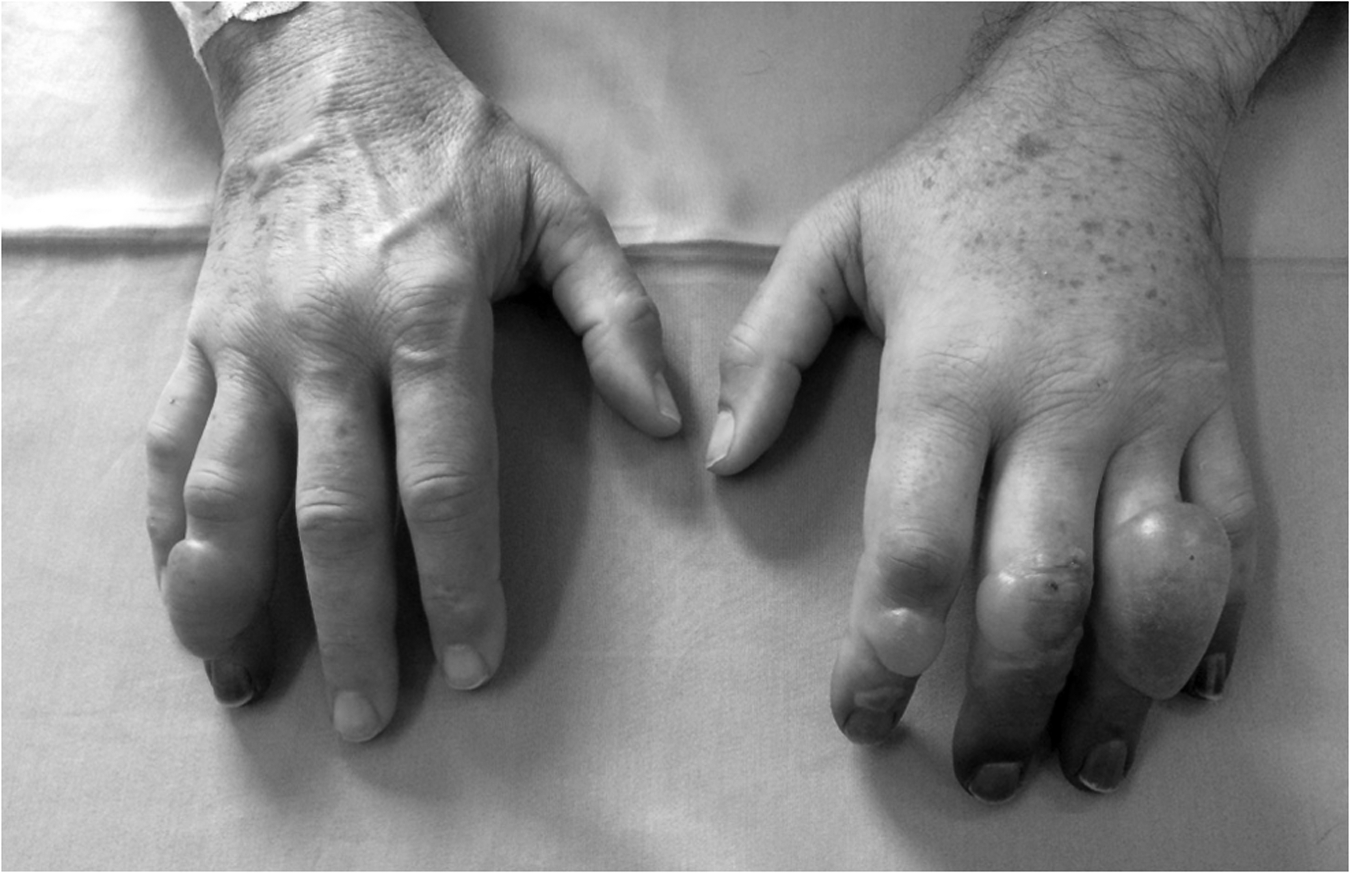
Frostbite at 75 hours, with advanced changes.
After inpatient treatment for 5 days in Kathmandu, the patient was referred to Chamonix, France for further evaluation and treatment. On arrival, the patient underwent hyperbaric-chamber treatment for 5 days. A prognostic bone scan was performed, which showed severe necrosis in the left hand and right ring finger (Fig. 3). This exam confirmed a grade 3 frostbite of almost all left fingers and the right ring finger (Cauchy et al., 2001).

Bone scan taken at 7 days postinjury.
Considering that the distal part of the right ring finger showed severe necrosis, it required amputation at the midpoint of the middle phalanx on day 29 (Figs. 4 and 5). On day 36, most fingers of the patient's left hand required amputations at different levels: midpoint of the distal phalanx of the index finger; midpoint of the middle phalanx of the middle finger; midpoint of the proximal phalanx of the ring finger; and midpoint of the middle phalanx of the little finger. On day 50, the index finger on the left hand required amputation of the distal phalanx (Figs. 6 and 7).

Frostbite at 29 days, before surgery of the right hand.
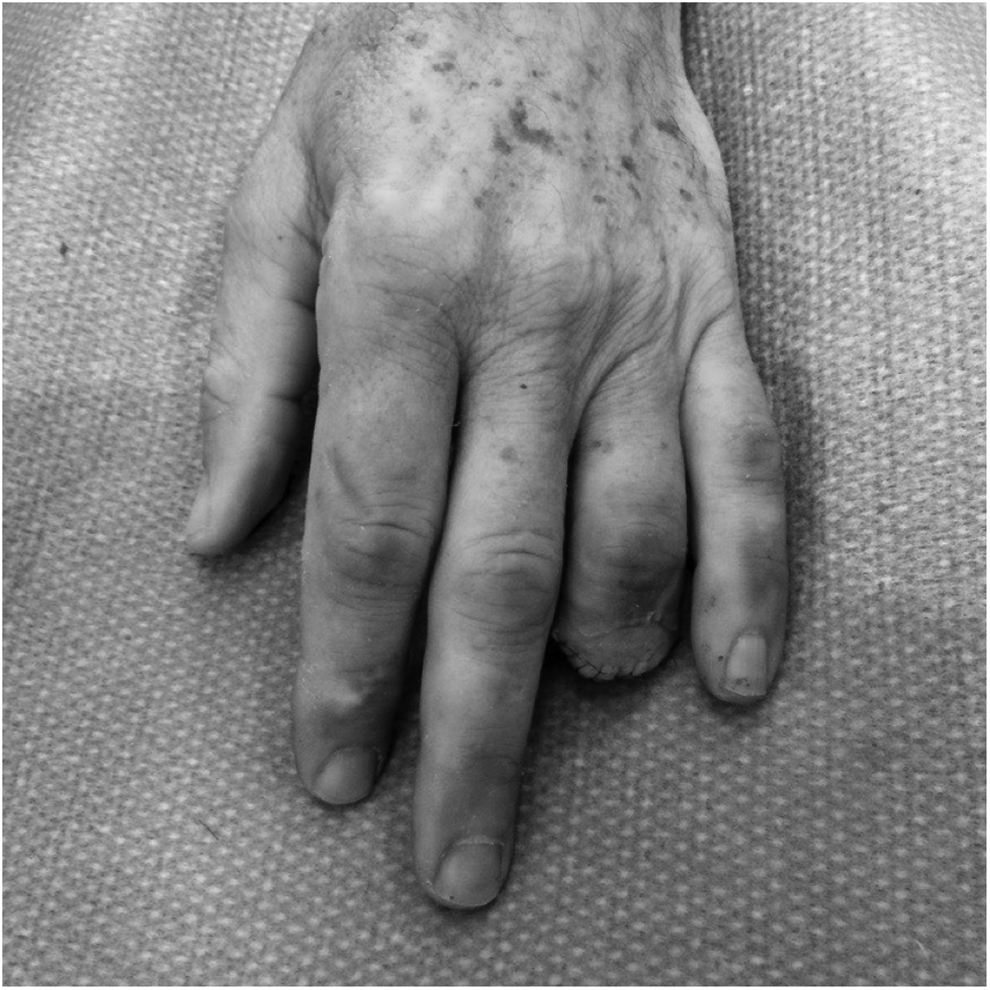
Final amputation results in patient's right hand.

Frostbite at 36 days, before surgery of the left hand.
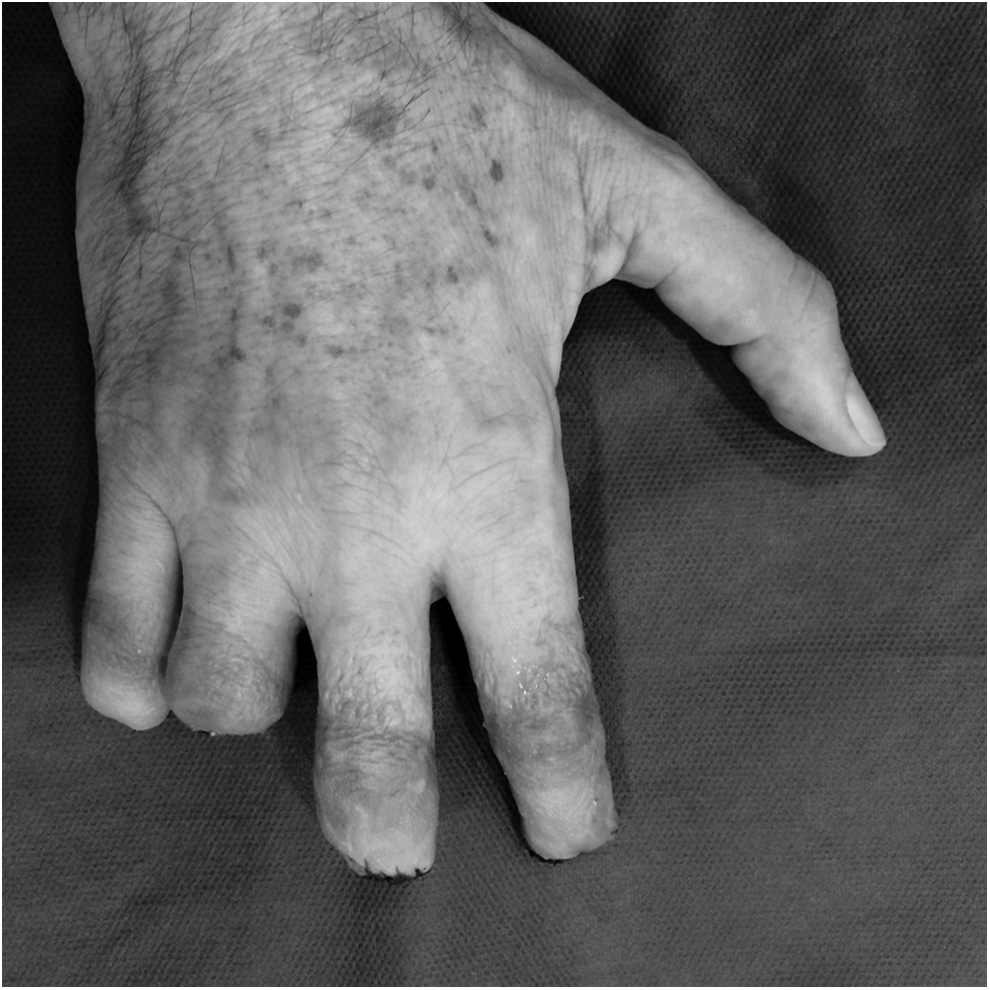
Final amputation results in the patient's left hand.
Discussion
In the early 1940s, Lewis (1941) described the effects of cold temperatures on deep tissues and described the early appearance of symptoms such as tingling and numbness. This report established the necessity of being alert to early frostbite symptoms, in addition to describing field management practices to avoid low temperatures that can induce tissue necrosis. Current prevention, early-diagnosis, and management procedures are based on numerous studies and specific guidelines (McIntosh et al., 2014; Zafren and Giesbrecht, 2014).
Early diagnosis and management
Because field diagnosis is not very accurate in the diagnosis, treatment should be based on the worst-case scenario (Cauchy et al., 2001). Imaging exams are not practical in the field (Nygaard et al., 2016). When frostbite is suspected, all possible measures should be taken to avert or treat hypothermia, prevent further cooling of the extremity, and initiate rapid rewarming as soon as possible, but only after hypothermia, if present, has been treated. In many cases, the patient must be transferred to a safe location where the rapid rewarming process using warm water between 37°C and 39°C can begin. Importantly, patient transport should provide additional protection from cold to at-risk extremities, which might be partially thawed. If the thawed tissues refreeze, necrosis and loss are guaranteed (Nygaard et al., 2016). In the presented case, the patient was transferred to the closest camp as this was the safest location to start the rewarming process using warm water in the recommended temperature range.
Field treatment remains a challenge, particularly when considering the difficulty of assessing injury severity, which dictates the final management plan. Under appropriate circumstances, rapid rewarming in the field is the first step in frostbite treatment (Nygaard et al., 2016). Indeed, rapid rewarming with a water bath (37°C to 39°C for 30 minutes or until color fully returns) results in better outcomes than slow rewarming (Zafren and Giesbrecht, 2014). While initial rapid rewarming in the field is an improvement over previous approaches (e.g., slow rewarming), a new challenge arises–the management of associated thrombosis and vasospasms (Cauchy et al., 2001; Zafren and Giesbrecht, 2014). Therefore, rewarming should only begin if the proper equipment is available and if there is no chance of refreezing. In this clinical case, the patient received a limited field treatment with rapid rewarming and nonsteroidal anti-inflammatories (NSAIDs), considering the austere and high altitude environment at which he was located.
Another potential way to accelerate initial rewarming and improve tissue oxygen availability at high altitude is to increase the inspired fraction of oxygen through supplemental oxygen, or increase the atmospheric pressure at high altitude exposure. This can be achieved by decreasing descent time from a high altitude or using a portable hyperbaric chamber if the patient is unable to descend (Nygaard et al., 2016). To decrease the dermal and deep-tissue ischemia caused by freezing and rewarming, oral hydration and supplementary oxygen can be complemented by pharmacological aids, including NSAIDs (Mohr et al., 2009).
Most recommendations for initial frostbite treatment are based on animal studies (McIntosh et al., 2014) or on experiences taken from burn-injury research (Heggers et al., 1987). To our knowledge, no clinical trials support the use of ibuprofen or aspirin, but some clinical guidelines recommend them (Heggers et al., 1987). In this clinical case, the combination of aspirin, ibuprofen, and sildenafil was used because each of these drugs can modulate or prevent, at least in theory, vascular inflammation, vasoconstriction, platelet aggregation, and microvascular thrombosis during the rewarming process (Robson et al., 1980). Nevertheless, the most recent Wilderness Medical Society practice guidelines recommend only using ibuprofen in the field at a dose of 12 mg/kg per day to a maximum of 2400 mg/d (recommendation grade: 2C -benefits and risks closely balanced and/or uncertain-) (McIntosh et al., 2014). It should be considered that when ibuprofen and aspirin are given together, aspirin outcompetes ibuprofen for binding at cell receptors that bind NSAIDs. This increases the side effects and risks of both medications without having additional benefit over giving ibuprofen alone.
Advanced management
After evacuation, patients with superficial frostbite can usually be managed as outpatients or by brief inpatient stays with specific wound care. Deep frostbite injuries should normally be managed by inpatient care. Advanced frostbite treatment primarily consists of a rapid rewarming of frozen tissues if thawing has not yet occurred; volume replacement; administration of systemic analgesics; tetanus prophylaxis; thrombolytic and/or vasodilator therapy, as indicated; and imaging assessments (McIntosh et al., 2014). Systemic antibiotics, either oral or parenteral, should be administered in cases with significant trauma, other potential infectious sources, or signs and symptoms of active infection (McIntosh et al., 2014). Blister debridement should be performed using a sterile method if there is a high risk of rupture or infection (McIntosh et al., 2014). In this case, the patient was hospitalized and received volume replacement, systemic analgesics, tetanus prophylaxis, and systemic antibiotics.
For deep frostbite injuries with potential significant morbidity, retrospective studies suggest that thrombolytic therapy reduces the rate of digit amputations if given within 24 hours of thawing (McIntosh et al., 2014). When considering thrombolytics, a risk-benefit analysis should be performed to consider the secondary effects of this therapy.(Bruen and Gowski, 2009; Mohr et al., 2009; Sheridan et al., 2009 The potential risks of using the tissue plasminogen activator include systemic bleeding and compartment syndrome. For these reasons, use of the tissue plasminogen activator in the field is not recommended.
Vasodilators, such as prostaglandin E1, (Twomey et al., 2005) iloprost (prostacyclin analog), (Yeager et al., 1983) pentoxifylline, (Yeager et al., 1983; Groechenig, 1994) nitroglycerin, (Hayes et al., 2000; Roche-Nagle et al., 2008), and buflomedil, (Miller and Koltai, 1995) have been used as primary and adjunctive therapies in the treatment of frostbite injuries. Considering that rapid evacuation to hospitals remains impractical in many remote areas, various experts have proposed advanced in-field management of frostbite (Daum et al., 1989; Sheridan et al., 2009). Iloprost is currently the best emerging therapy for field treatment of severe frostbite. This drug is the only vasodilator with reasonable scientific evidence supporting its use, and presents fewer risks than thrombolytics. Additionally, iloprost can be used for grade 2–4 frostbite cases within 48–72 hours of rewarming, (Foray et al., 1980; Mohr et al., 2009) while thrombolytics can only be used to treat grade 4 frostbite cases within the first 24 hours (Groechenig, 1994; Cauchy et al., 2016). In this case the patient received iloprost 75 hours after the initial symptoms as a result of delayed evacuation due to difficulty of transportation from Tibet, where this drug was unavailable. Some studies have reported a significant decrease of digit amputation rates in severe frostbite cases when iloprost is used within the first 48 hours after initial injury (Groechenig, 1994; Bruen et al., 2007; Mohr et al., 2009).
Some authors support the safety of using iloprost outside of the hospital environment (Twomey et al., 2005). This paradigm shift could allow advanced frostbite management in extreme environments, which would likely decrease the need for amputations. Unfortunately, iloprost is not currently available in many countries.
More studies are needed to confirm the efficacy and safety of iloprost use in the field. Furthermore, measures should be taken to ensure that areas with a high prevalence of frostbite cases, such as Mount Everest, have aerial evacuation systems independent of the chosen climbing route.
Conclusion
Frostbite is preventable. When frostbite does occur, field treatment should be administered according to Wilderness Medical Society guidelines. The efficacy of new therapies, such as iloprost, in managing severe frostbite is dependent on treatment availability and timely use. Therefore, future research should assess the field safety of iloprost, particularly in areas with a high prevalence of frostbite cases, such as the Himalayas. The use of iloprost in out-of-hospital environments would minimize treatment delay while maintaining patient safety.
Footnotes
Acknowledgments
The authors acknowledge support provided by Rashila Pradhan, MD, and Gerda Pohl, MD, who administered treatment to the patient at the CIWEC Hospital in Kathmandu, Nepal.
Author Disclosure Statement
No competing financial interests exist.