We investigated the effects of 4-day dietary beetroot (BR) juice supplementation on executive function assessed by color–word Stroop task (CWST) in hypoxia (fraction of inspired oxygen [FiO2] = 0.1395). Eight healthy young men performed 25-minute leg cycling exercise (target heart rate, 140 bpm) randomly with placebo (PL) juice or BR supplementation. The CWST was evaluated at resting hypoxic condition (after 30 minutes of hypoxic exposure) and at 15 minutes during exercise. During exercise, the correct response time in the CWST was significantly shortened compared with those at rest with no differences between PL and BR. The response accuracy in the CWST with BR was marginally lower than that with PL during exercise (p = 0.066). There were no significant differences in all physiological values, including pulmonary ventilation, arterial oxygen saturation, partial pressure of end-tidal carbon dioxide output, and tissue oxygenation in the left frontal lobe, assessed by near-infrared spectroscopy during exercise conditions involving PL and BR supplementation. These results suggest that moderate exercise in hypoxia partially improved executive function; however, 4-day dietary BR supplementation did not improve executive function during hypoxic exercise.
Introduction
Appropriate and effective executive function seems to be essential for successful performance in various sports including mountain climbing and skiing at high altitude (Williams and Ericsson, 2005). However, in a recent meta-analysis review, McMorris et al. (2017) concluded that hypoxia has a negative effect on executive function. A previous study demonstrated that 2 days of high-dose nitrate (\documentclass{aastex}\usepackage{amsbsy}\usepackage{amsfonts}\usepackage{amssymb}\usepackage{bm}\usepackage{mathrsfs}\usepackage{pifont}\usepackage{stmaryrd}\usepackage{textcomp}\usepackage{portland, xspace}\usepackage{amsmath, amsxtra}\usepackage{upgreek}\pagestyle{empty}\DeclareMathSizes{10}{9}{7}{6}\begin{document}
$${ \rm{NO}}_3^ -$$
\end{document}) supplementation increases cerebral blood flow to the dorsolateral prefrontal cortex or the anterior cingulate cortex in normoxia compared with same days of low-dose \documentclass{aastex}\usepackage{amsbsy}\usepackage{amsfonts}\usepackage{amssymb}\usepackage{bm}\usepackage{mathrsfs}\usepackage{pifont}\usepackage{stmaryrd}\usepackage{textcomp}\usepackage{portland, xspace}\usepackage{amsmath, amsxtra}\usepackage{upgreek}\pagestyle{empty}\DeclareMathSizes{10}{9}{7}{6}\begin{document}
$${ \rm{NO}}_3^ -$$
\end{document}supplementation (Presley et al., 2011). Dietary \documentclass{aastex}\usepackage{amsbsy}\usepackage{amsfonts}\usepackage{amssymb}\usepackage{bm}\usepackage{mathrsfs}\usepackage{pifont}\usepackage{stmaryrd}\usepackage{textcomp}\usepackage{portland, xspace}\usepackage{amsmath, amsxtra}\usepackage{upgreek}\pagestyle{empty}\DeclareMathSizes{10}{9}{7}{6}\begin{document}
$${ \rm{NO}}_3^ -$$
\end{document} supplementation enhances bioavailability of nitric oxide (NO) (Jones, 2014). NO is known to play a pivotal role in cerebral vasodilation, cerebral blood flow, and the neurovascular coupling of local neural activity (Attwell et al., 2010), which may improve executive function. Indeed, a previous study showed that a single dose of \documentclass{aastex}\usepackage{amsbsy}\usepackage{amsfonts}\usepackage{amssymb}\usepackage{bm}\usepackage{mathrsfs}\usepackage{pifont}\usepackage{stmaryrd}\usepackage{textcomp}\usepackage{portland, xspace}\usepackage{amsmath, amsxtra}\usepackage{upgreek}\pagestyle{empty}\DeclareMathSizes{10}{9}{7}{6}\begin{document}
$${ \rm{NO}}_3^ -$$
\end{document} supplementation can modulate the cerebral hemodynamics assessed by near-infrared spectroscopy (NIRS), and potentially improve executive performance in normoxia (Wightman et al., 2015). However, others have not found an improvement of executive performance with a single dose of \documentclass{aastex}\usepackage{amsbsy}\usepackage{amsfonts}\usepackage{amssymb}\usepackage{bm}\usepackage{mathrsfs}\usepackage{pifont}\usepackage{stmaryrd}\usepackage{textcomp}\usepackage{portland, xspace}\usepackage{amsmath, amsxtra}\usepackage{upgreek}\pagestyle{empty}\DeclareMathSizes{10}{9}{7}{6}\begin{document}
$${ \rm{NO}}_3^ -$$
\end{document} supplementation during exercise in normoxia (Thompson et al., 2014), and at rest and during exercise in hypoxia (Lefferts et al., 2016; Shannon et al., 2017). In addition to these previous studies that have investigated effects of a single dose of \documentclass{aastex}\usepackage{amsbsy}\usepackage{amsfonts}\usepackage{amssymb}\usepackage{bm}\usepackage{mathrsfs}\usepackage{pifont}\usepackage{stmaryrd}\usepackage{textcomp}\usepackage{portland, xspace}\usepackage{amsmath, amsxtra}\usepackage{upgreek}\pagestyle{empty}\DeclareMathSizes{10}{9}{7}{6}\begin{document}
$${ \rm{NO}}_3^ -$$
\end{document} supplementation on executive function, only in normoxia, consecutive days of \documentclass{aastex}\usepackage{amsbsy}\usepackage{amsfonts}\usepackage{amssymb}\usepackage{bm}\usepackage{mathrsfs}\usepackage{pifont}\usepackage{stmaryrd}\usepackage{textcomp}\usepackage{portland, xspace}\usepackage{amsmath, amsxtra}\usepackage{upgreek}\pagestyle{empty}\DeclareMathSizes{10}{9}{7}{6}\begin{document}
$${ \rm{NO}}_3^ -$$
\end{document} supplementation improved executive performance during exercise under normoxia (Thompson et al., 2015). As it is observed that plasma nitrite, which can covert to NO, was increased dose dependently with \documentclass{aastex}\usepackage{amsbsy}\usepackage{amsfonts}\usepackage{amssymb}\usepackage{bm}\usepackage{mathrsfs}\usepackage{pifont}\usepackage{stmaryrd}\usepackage{textcomp}\usepackage{portland, xspace}\usepackage{amsmath, amsxtra}\usepackage{upgreek}\pagestyle{empty}\DeclareMathSizes{10}{9}{7}{6}\begin{document}
$${ \rm{NO}}_3^ -$$
\end{document} supplementation (Wylie et al., 2013), consecutive days of \documentclass{aastex}\usepackage{amsbsy}\usepackage{amsfonts}\usepackage{amssymb}\usepackage{bm}\usepackage{mathrsfs}\usepackage{pifont}\usepackage{stmaryrd}\usepackage{textcomp}\usepackage{portland, xspace}\usepackage{amsmath, amsxtra}\usepackage{upgreek}\pagestyle{empty}\DeclareMathSizes{10}{9}{7}{6}\begin{document}
$${ \rm{NO}}_3^ -$$
\end{document} supplementation may improve executive function in hypoxia because of altered cerebral hemodynamics.
In this study, we hypothesized that a short-term dietary beetroot (BR) juice supplementation might improve executive function both at rest and during exercise under hypoxia. To test this, we used NIRS to assess tissue oxygenation at the frontal lobe, which has been used in previous studies (Ando et al., 2013; Komiyama et al., 2015; Wightman et al., 2015).
Materials and Methods
Participants
All experimental procedures were approved by the Human Research Ethics Committee of the Mt. Fuji Research Institute and performed in accordance with the guidelines of the Declaration of Helsinki. After the experimental protocol was fully explained and written informed consent was obtained, eight healthy young men with a mean age of 21 ± 3 years, height of 175 ± 5 cm, and body mass of 72 ± 9 kg (mean ± standard deviation [SD]) were enrolled in the study. The participants were physically active and did not have any history of cardiovascular, cerebrovascular, or respiratory disease. They were instructed to refrain from intensive physical activity and avoid drinking any alcohol and caffeinated beverages for 24 hours beforehand.
Treatments
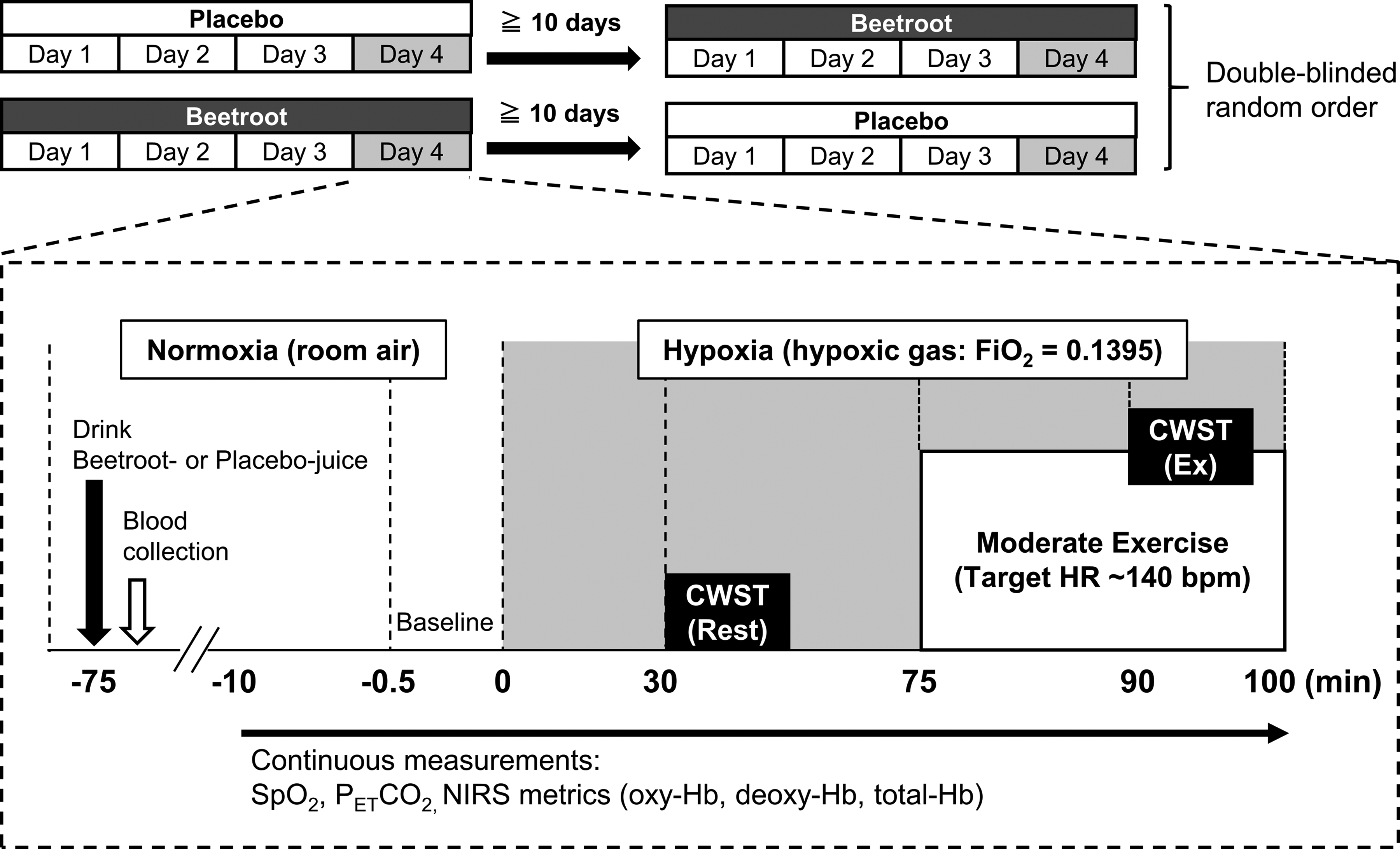
This study adopted a randomized, double-blind, and crossover design. The study protocol is given in Figure 1. In brief, two exercise trials were performed with at least 10 days of washout period in a random order. The trials consisted of hypoxic exercise (fraction inspired oxygen, fraction of inspired oxygen [FiO2] = 0.1395) with placebo (PL) or BR juice. The subjects consumed \documentclass{aastex}\usepackage{amsbsy}\usepackage{amsfonts}\usepackage{amssymb}\usepackage{bm}\usepackage{mathrsfs}\usepackage{pifont}\usepackage{stmaryrd}\usepackage{textcomp}\usepackage{portland, xspace}\usepackage{amsmath, amsxtra}\usepackage{upgreek}\pagestyle{empty}\DeclareMathSizes{10}{9}{7}{6}\begin{document}
$${ \rm{NO}}_3^ -$$
\end{document}-rich (8.4 mmol) BR (Beet it; James White Drinks Ltd., Ipswich, United Kingdom) or PL (140 mL/d, for 4 days), wherein \documentclass{aastex}\usepackage{amsbsy}\usepackage{amsfonts}\usepackage{amssymb}\usepackage{bm}\usepackage{mathrsfs}\usepackage{pifont}\usepackage{stmaryrd}\usepackage{textcomp}\usepackage{portland, xspace}\usepackage{amsmath, amsxtra}\usepackage{upgreek}\pagestyle{empty}\DeclareMathSizes{10}{9}{7}{6}\begin{document}
$${ \rm{NO}}_3^ -$$
\end{document} was depleted through the manufacturing process, for 4 days, including the main test day.
Overview of experimental procedure. Supplementation was taken at the same time each day (days 1–3) and 2.5 hours before the exercise trial (day 4). Executive function using CWST was assessed 30 minutes after the start of rest (Rest) and 15 minutes after the start of the submaximal leg cycling exercise (Ex) in hypoxia. Baseline values of the NIRS metrics were measured for 30 seconds before hypoxic exposure. CWST, color–word Stroop task; deoxy-Hb, deoxygenated hemoglobin; FiO2, fraction of inspired oxygen; NIRS, near-infrared spectroscopy; oxy-Hb, oxygenated hemoglobin; PETCO2, partial pressure of end-tidal carbon dioxide; SpO2, arterial oxygen saturation; total-Hb, total hemoglobin.
Experimental procedure
On the experimental day, the participants consumed 140 mL of BR or PL 2.5 hours before the exercise (Wylie et al., 2013). Subsequently, 10 mL blood sample was obtained from the antecubital vein of each participant and was immediately centrifuged and stored at −80°C for further analysis of plasma \documentclass{aastex}\usepackage{amsbsy}\usepackage{amsfonts}\usepackage{amssymb}\usepackage{bm}\usepackage{mathrsfs}\usepackage{pifont}\usepackage{stmaryrd}\usepackage{textcomp}\usepackage{portland, xspace}\usepackage{amsmath, amsxtra}\usepackage{upgreek}\pagestyle{empty}\DeclareMathSizes{10}{9}{7}{6}\begin{document}
$${ \rm{NO}}_3^ -$$
\end{document}.
The participants rested on a custom-made semirecumbent chair while breathing normoxic gas (room air) through a facemask for 10 minutes. Thereafter, the subjects started inspiring hypoxic gas (FiO2 = 0.1395). A hypoxic gas generator (Everest Summit II; Hypoxico, New York, NY) was used to maintain a hypoxic condition during trials, and the participants inspired the collected hypoxic gas from a commercial shield chamber (212 × 200 × 160 cm; Deluxe Altitude Tent; Hypoxico). After 75-minute exposure to hypoxia, the participants completed leg cycling for 25 minutes at the target heart rate (HR) of 140 bpm using a cycle ergometer (Ergomedic 828E; Monark, Stockholm, Sweden) in a semirecumbent position under hypoxia. The exercise intensity was manually adjusted to maintain the target HR while cycling for 25 minutes. The pedaling rate was set at 60 rpm. Executive function was assessed 30 minutes after the start of hypoxic exposure (Rest) and 15 minutes after the start of exercise trial (Ex), which indicates 105 and 165 minutes after BR or PL supplementation, respectively (Fig. 1). As a previous study demonstrated that executive performance at rest under normoxia was improved 90 minutes after single dose of BR supplementation (Wightman et al., 2015), we supposed that short-term BR supplementation may affect executive function both at Rest and Ex in hypoxia in this study. In addition, the reason why we set the FiO2 level (Ando et al., 2013; Komiyama et al., 2015) and exercise intensity and duration (Ogoh et al., 2014; Komiyama et al., 2015) is based on these previous studies that have investigated cognitive function during exercise.
Measurements
Executive function
Executive function was assessed using the color–word Stroop task (CWST), which is a well-known executive assessment paradigm, requiring attention, response inhibition, interference, and behavioral conflict resolution (Zysset et al., 2001). The participants faced the 17″ display at a viewing distance of ∼80 cm. The CWST presents the names of four colors (“RED,” “YELLOW,” “GREEN,” and “BLUE”) displayed in incongruent colors (e.g., Blue, Green, Red, and Yellow, respectively) (Ogoh et al., 2014). We prepared a portable color-labeled numeric keypad: numbers 2, 4, 5, 6, and 8 were labeled red, yellow, black, green, and blue, respectively. Before the CWST, the subjects were required to put their right index finger on the black key (No. 5) and to use only this finger. During the CWST, the subjects were required to press the button on color-labeled key (Nos. 2, 4, 6, 8) surrounding the black key, which corresponded to the color of the stimulus word as accurately and quickly as possible. One trial of CWST consisted of 64 stimulus words, and color stimuli were presented on the display until the response was obtained. The CWST continued until the subjects had completed response to 64 stimuli in each task. Mean correct response time (CRT) of each stimulus and response accuracy were measured in each task as indices of executive performances in this study. All participants completely familiarized this test before the experiments.
Physiological measurements
Plasma \documentclass{aastex}\usepackage{amsbsy}\usepackage{amsfonts}\usepackage{amssymb}\usepackage{bm}\usepackage{mathrsfs}\usepackage{pifont}\usepackage{stmaryrd}\usepackage{textcomp}\usepackage{portland, xspace}\usepackage{amsmath, amsxtra}\usepackage{upgreek}\pagestyle{empty}\DeclareMathSizes{10}{9}{7}{6}\begin{document}
$${ \rm{NO}}_3^ -$$
\end{document} was measured at a clinical laboratory (SRL Co., Ltd, Tokyo, Japan). Arterial oxygen saturation (SpO2) and HR were monitored using a finger pulse oximeter (Pulsox-3; Minolta, Tokyo, Japan) and a wireless HR monitor (RS800CX; Polar Electro Japan, Tokyo, Japan), respectively. Partial pressure of end-tidal CO2 (PETCO2) was measured by a breath-by-breath gas analyzer through a two-way, non-rebreathing valve and face mask (AE-310s; Minato Medical Sciences Co., Ltd, Osaka, Japan). The changes in the oxygenated hemoglobin (oxy-Hb) and deoxygenated hemoglobin (deoxy-Hb) in the left prefrontal lobe were measured using an NIRS device (Pocket NIRS Duo; DynaSense, Hamamatsu, Japan). Total hemoglobin (total-Hb) is the sum of oxy-Hb and deoxy-Hb. We measured the NIRS metrics for 30 seconds as a baseline value while the participants were at rest under normoxia (Ando et al., 2013; Komiyama et al., 2015). Those during CWST were expressed relative to the baseline values. Averaged values of SpO2, PETCO2, and NIRS metrics during each CWST (i.e., from the start of response to the completion of all responses) were used for further analysis in this study.
Statistical analysis
All data were expressed as mean ± SD. All statistical analyses were completed using R version 3. 1. 2. We conducted Shapiro–Wilk test for normality in all variables; however, if equal variance failed, Friedman nonparametric and pairwise (Scheffe) post hoc tests were used. Indeed, as equal variance failed in response accuracy and SpO2, we analyzed them as nonparametric data set. For comparison of plasma \documentclass{aastex}\usepackage{amsbsy}\usepackage{amsfonts}\usepackage{amssymb}\usepackage{bm}\usepackage{mathrsfs}\usepackage{pifont}\usepackage{stmaryrd}\usepackage{textcomp}\usepackage{portland, xspace}\usepackage{amsmath, amsxtra}\usepackage{upgreek}\pagestyle{empty}\DeclareMathSizes{10}{9}{7}{6}\begin{document}
$${ \rm{NO}}_3^ -$$
\end{document}, paired t-test was performed. A two-way (trial [PL vs. BR] × time [Rest vs. Ex]) repeated-measures analysis of variance was used to compare the changes in NIRS variables, PETCO2, and CRT in CWST. A value of p < 0.05 was considered statistically significant.
Results
Dietary BR ingestion significantly increased plasma \documentclass{aastex}\usepackage{amsbsy}\usepackage{amsfonts}\usepackage{amssymb}\usepackage{bm}\usepackage{mathrsfs}\usepackage{pifont}\usepackage{stmaryrd}\usepackage{textcomp}\usepackage{portland, xspace}\usepackage{amsmath, amsxtra}\usepackage{upgreek}\pagestyle{empty}\DeclareMathSizes{10}{9}{7}{6}\begin{document}
$${ \rm{NO}}_3^ -$$
\end{document} levels compared with PL ingestion (211.4 ± 26.6 vs. 39.0 ± 8.2 mmol/L, t = −5.77, p < 0.001). Table 1 shows the physiological responses during the CWST at rest and during exercise. BR supplementation did not affect all physiological variables (all p > 0.05). Hypoxic exercise slightly increased oxy-Hb (p > 0.05) and significantly increased deoxy-Hb and total-Hb compared with rest (p < 0.01). In addition, SpO2 during exercise was significantly decreased than rest in both trials (Rest vs. Ex; PL, 88.0% ± 0.8% vs. 75.6% ± 5.6%; BR, 87.0% ± 0.9% vs. 74.6% ± 1.7%; both p ≤ 0.05). Figure 2 presents the CRT and response accuracy in the CWST during hypoxic exposure. The CRT was shortened during Ex than at rest with no differences between PL and BR (p < 0.01; Fig. 2A). There was a worsening trend for response accuracy in BR during Ex compared with that in PL (p = 0.066; Fig. 2B).
Physiological Responses During Hypoxic Exposure
Two-way repeated-measures ANOVA
Trial
Time
Trial × time
Trial
Rest
Ex
F
p
F
p
F
p
PETCO2 (mmHg)
PL
28.9 ± 2.1
36.8 ± 2.1
0.60
0.46
81.02
<0.01
0.90
0.38
BR
30.7 ± 1.1
36.8 ± 1.3
Δoxy-Hb (AU)
PL
−0.07 ± 0.06
0.04 ± 0.11
4.06
0.08
3.01
0.13
3.21
0.12
BR
−0.10 ± 0.11
−0.06 ± 0.12
Δdeoxy-Hb (AU)
PL
0.19 ± 0.04
0.31 ± 0.11
0.62
0.46
56.98
<0.01
2.75
0.14
BR
0.21 ± 0.18
0.40 ± 0.17
Δtotal-Hb (AU)
PL
0.12 ± 0.07
0.34 ± 0.14
0.50
0.50
22.26
<0.01
<0.01
0.92
BR
0.08 ± 0.18
0.31 ± 0.17
Values are given mean ± standard deviation. CWST was assessed at 30 minutes after the start of rest in hypoxia (Rest) and 15 minutes after the start of the submaximal semirecumbent cycling exercise (Ex). The results of oxy-Hb, deoxy-Hb, and total-Hb during CWST are expressed as relative changes in baseline values.
Summarized results of the CWST. Mean values of the correct response time (A) and response accuracy (B) in CWST are given. Plots linked with dashed line indicate an individual data, and bars indicate average data. The plots which revealed same values of response accuracy among participants were piled up at the same position.
Discussion
In this study, 4 days of BR supplementation increased plasma \documentclass{aastex}\usepackage{amsbsy}\usepackage{amsfonts}\usepackage{amssymb}\usepackage{bm}\usepackage{mathrsfs}\usepackage{pifont}\usepackage{stmaryrd}\usepackage{textcomp}\usepackage{portland, xspace}\usepackage{amsmath, amsxtra}\usepackage{upgreek}\pagestyle{empty}\DeclareMathSizes{10}{9}{7}{6}\begin{document}
$${ \rm{NO}}_3^ -$$
\end{document} levels before the exercise trial on day 4. However, the BR supplementation did not affect CRT (Fig. 2A) and all physiological variables (Table 1) at rest and during exercise, under hypoxic condition. These results were in accordance with previous studies, showing no differences in executive performances (Lefferts et al., 2016; Shannon et al., 2017), cardiorespiratory variables (Bourdillon et al., 2015), and cerebral oxygenation (Masschelein et al., 2012) between the PL and BR at rest and during exercise in hypoxia. From these literatures, CRT, cardiorespiratory, and cerebrovascular responses under hypoxic exercise may not be affected regardless of single- or multidose BR supplementation. On the contrary, hypoxic exercise significantly improved the CRT irrespective of PL or BR (Fig. 2A). As some previous studies also demonstrated improvement in reaction time during dynamic exercise in hypoxia (Ando et al., 2013; Komiyama et al., 2015), the improvement in CRT may be attributed to the beneficial effects of exercise per se, not to BR supplementation effects. However, the reasons why BR did not affect these variables in hypoxia and why acute hypoxic exercise improved CRT are unclear. A recent review reported that the response time of executive task during exercise was improved by cerebral metabolism rather than cerebral blood flow and oxygenation (Ogoh, 2017). Therefore, future studies to elucidate the underlying mechanisms with measurement of these cerebral outcomes are needed.
Unexpectedly, the response accuracy with BR during hypoxic exercise was not significantly, but marginally impaired compared with PL (p = 0.066; Fig. 2B). Although we can only speculate, one possible explanation might involve the trigeminovascular system by direct stimulation of NO. Because it has been suggested that direct stimulus of NO in the brain may be responsible for headache pain sensation (Ashina et al., 1999) and headache impaired executive function (Smith, 2016). It was reported that a single bout of moderate-intensity exercise increased vessel diameter in vertebral arteries (i.e., vasodilation) compared with resting condition (Sato and Sadamoto, 2010), suggesting that headache may increase during exercise rather than at rest. A previous study have also reported that BR supplementations rather than PL caused more severe headache under hypoxic condition (Rossetti et al., 2017). Moreover, Lawley et al. (2016) also demonstrated that only 10-minute exposure to severe hypoxia (FiO2 = 0.11) could increase headache with intracranial pressure. Although we did not assess any headache symptoms of the participants, these previous findings raise the possibility that headache could be caused during hypoxic exercise with BR in this study. As it was reported that headache could also impair response accuracy (Smith, 2016), our results may be supported by the previous study. Nonetheless, the magnitude of the reduction in response accuracy was relatively small, ∼2%. Thus, a physiological significance of this reduction is uncertain, and also, we must acknowledge a possibility of type I error. However, under extreme environments (e.g., mountain climbing at high altitude), we consider that even a minor mistake or accident should not be ignored for people's safety.
In this study, we recruited only young men because age (Hamasaki et al., 2018) and sex (Esposito et al., 1996) could affect the cerebral blood flow during executive task. Therefore, it is unclear whether our results can be applied for other populations such as women, aged people, and diseased patients. Future studies should be expanded.
In summary, a short-term dietary BR supplementation did not affect CRT and physiological indices at rest and during exercise in hypoxia. In contrast, there was a trend for impairment of response accuracy during hypoxic exercise with BR compared with PL. These findings suggest that \documentclass{aastex}\usepackage{amsbsy}\usepackage{amsfonts}\usepackage{amssymb}\usepackage{bm}\usepackage{mathrsfs}\usepackage{pifont}\usepackage{stmaryrd}\usepackage{textcomp}\usepackage{portland, xspace}\usepackage{amsmath, amsxtra}\usepackage{upgreek}\pagestyle{empty}\DeclareMathSizes{10}{9}{7}{6}\begin{document}
$${ \rm{NO}}_3^ -$$
\end{document} supplementation may be against for an improvement of executive function, and thereby, may not be recommended during hypoxic exercise, at least, for the populations in this study.
Footnotes
Author Disclosure Statement
There are no competing financial interests to declare.
References
1.
AndoS, HatamotoY, SudoM, KiyonagaA, TanakaH, and HigakiY. (2013). The effect of exercise under hypoxia on cognitive function. PLoS One, 8:e63630.
2.
AshinaM, LassenLH, BendtsenL, JensenR, and OlesenJ. (1999). Effect of inhibition of nitric oxide synthase on chronic tension-type headache: A randomised crossover trial. Lancet, 353:287–289.
3.
AttwellD, BuchanAM, CharpakS, LauritzenM, MacvicarBA, and NewmanEA. (2010). Glial and neuronal control of brain blood flow. Nature, 468:232–243.
4.
BourdillonN, FanJL, UvaB, MüllerH, MeyerP, and KayserB. (2015). Effect of oral nitrate supplementation on pulmonary hemodynamics during exercise and time trial performance in normoxia and hypoxia: A randomized controlled trial. Front Physiol, 6:288.
5.
EspositoG, Van HornJD, WeinbergerDR, and BermanKF. (1996). Gender differences in cerebral blood flow as a function of cognitive state with PET. J Nucl Med, 37:559–564.
6.
HamasakiA, AkazawaN, YoshikawaT, MyoenzonoK, TagawaK, and MaedaS. (2018). Age-related declines in executive function and cerebral oxygenation hemodynamics. Tohoku J Exp Med, 245:245–250.
KomiyamaT, SudoM, HigakiY, KiyonagaA, TanakaH, and AndoS. (2015). Does moderate hypoxia alter working memory and executive function during prolonged exercise?. Physiol Behav, 139:290–296.
9.
LawleyJS, LevineBD, WilliamsMA, MalmJ, EklundA, PolanerDM, SubudhiAW, HackettPH, and RoachRC. (2016). Cerebral spinal fluid dynamics: Effect of hypoxia and implications for high-altitude illness. J Appl Physiol, 120:251–262.
10.
LeffertsWK, HughesWE, WhiteCN, BrutsaertTD, and HeffernanKS. (2016). Effect of acute nitrate supplementation on neurovascular coupling and cognitive performance in hypoxia. Appl Physiol Nutr Metab, 41:133–141.
11.
MasscheleinE, Van ThienenR, WangX, Van SchepdaelA, ThomisM, and HespelP. (2012). Dietary nitrate improves muscle but not cerebral oxygenation status during exercise in hypoxia. J Appl Physiol, 113:736–745.
12.
McMorrisT, HaleBJ, BarwoodM, CostelloJ, and CorbettJ. (2017). Effect of acute hypoxia on cognition: A systemic review and meta-regression analysis. Neurosci Biobehav Rev, 74: 225–232.
13.
OgohS. (2017). Relationship between cognitive function and regulation of cerebral blood flow. J Physiol Sci, 67:345–351.
14.
OgohS, TsukamotoH, HirasawaA, HasegawaH, HiroseN, and HashimotoT. (2014). The effect of changes in cerebral blood flow on cognitive function during exercise. Physiol Rep, 2:e12163.
15.
PresleyTD, MorganAR, BechtoldE, ClodfelterW, DoveRW, JenningsJM, KraftRA, KingSB, LaurientiPJ, RejeskiWJ, BurdetteJH, Kim-ShapiroDB, and MillerGD. (2011). Acute effect of a high nitrate diet on brain perfusion in older adults. Nitric Oxide, 24:34–42.
16.
RossettiGMK, MacdonaldJH, WylieLJ, LittleSJ, NewtonV, WoodB, HawkinsKA, BeddoeR, DaviesHE, and OliverSJ. (2017). Dietary nitrate supplementation increases acute mountain sickness severity and sense of effort during hypoxic exercise. J Appl Physiol, 123:983–992.
17.
SatoK, and SadamotoT. (2010). Different blood flow responses to dynamic exercise between internal carotid and vertebral arteries in women. J Appl Physiol, 109:864–869.
18.
ShannonOM, DuckworthL, BarlowMJ, DeightonK, MatuJ, WilliamsEL, WoodsD, XieL, StephanBCM, SiervoM, and O'HaraJP. (2017). Effects of dietary nitrate supplementation on physiological responses, cognitive function, and exercise performance at moderate and very-high simulated altitude. Front Physiol, 8:401.
19.
SmithAP. (2016). Acute tension-type headaches are associated with impaired cognitive function and more negative mood. Front Neurol, 7:42.
20.
ThompsonC, WylieLJ, FulfordJ, KellyJ, BlackMI, McDonaghST, JeukendrupAE, VanhataloA, and JonesAM. (2015). Dietary nitrate improves sprint performance and cognitive function during prolonged intermittent exercise. Eur J Appl Physiol, 115:1825–1834.
21.
ThompsonKG, TurnerL, PrichardJ, DoddF, KennedyDO, HaskellC, BlackwellJR, and JonesAM. (2014). Influence of dietary nitrate supplementation on physiological and cognitive responses to incremental cycle exercise. Respir Physiol Neurobiol, 193:11–20.
22.
WightmanEL, Haskell-RamsayCF, ThompsonKG, BlackwellJR, WinyardPG, ForsterJ, JonesAM, and KennedyDO. (2015). Dietary nitrate modulates cerebral blood flow parameters and cognitive performance in humans: A double-blind, placebo-controlled, crossover investigation. Physiol Behav, 149:149–158.
23.
WilliamsAM, and EricssonKA. (2005). Perceptual-cognitive expertise in sport: Some considerations when applying the expert performance approach. Hum Mov Sci, 24:283–307.
24.
WylieLJ, KellyJ, BaileySJ, BlackwellJR, SkibaPF, WinyardPG, JeukendrupAE, VanhataloA, and JonesAM. (2013). Beetroot juice and exercise: Pharmacodynamic and dose-response relationships. J Appl Physiol, 115:325–336.
25.
ZyssetS, MüllerK, LohmannG, and von CramonDY. (2001). Color-word matching stroop task: Separating interference and response conflict. Neuroimage, 13:29–36.