




Abstract
Abstract
Biathlon is a complex sport subjected to large performance variability. Among the environmental conditions (e.g., temperature, wind, snow conditions) susceptible to influence performance, altitude is likely a detrimental factor for skiing (i.e., due to decreased aerobic capacity) as well as for prone and/or—to a larger extent—standing shooting (i.e., due to altered postural control and increased ventilation) performances. The aim of the present study was therefore to analyze the influence of altitude on elite biathlon performance. The analysis comprised data extracted from the International Biathlon Union (IBU) website and included IBU World Cup, IBU Cup, IBU World Championships, and Olympic Winter Games events over 8 years from season 2009–2010 to 2016–2017. The research included sprint, individual, mass start, and pursuit competitions for both men and women (no relays). The event sites were divided into three different altitude ranges: <700, 700–1400, and >1400 m. Only the Top-30 of each race were recorded for both men and women, separately, and analyzed for skiing speed, prone, and standing shooting performances. The results show a detrimental effect of altitude (i.e., ∼3.0% between <700 and >1400 m) on shooting performance that was similar for men and women but without any statistical difference between prone and standing positions. Due to many other confounding factors not analyzed here (snow quality, course profile), the effect of altitude on skiing speed was unclear. Overall, as expected, elite biathlon performances are altered, even within the range of moderate altitudes of the IBU competitions (<1800 m).
Introduction
Biathlon is a winter sport that combines two different activities: cross-country skiing and 50 m rifle shooting (Luchsinger et al., 2018, 2019; Skattebo and Losnegard, 2018). Biathletes have to perform intense physical efforts for several kilometers (for individual events: 7.5–15 km for women; 10–20 km for men) while stopping two or four times to perform shooting sessions of five shots where the missed targets result in penalties (i.e., an extra distance of 150 m to be performed before the race can be continued for sprint, mass start, pursuit; or 1 minute added to the final time for individual race). We can assert that there is something unique in the mixing of these two disparate tasks in one single sport. Therefore, biathlon performances are highly unpredictable.
Biathlon performances, as in any other sports (Malcata and Hopkins, 2014), are also affected by external conditions. The type of snow can easily affect the speed of the biathletes. The presence of the wind or of any type of precipitation (snow, rain, etc.) can alter both skiing speed and shooting precision. The different air temperatures or course profiles can also influence the final performances. Skattebo and Losnegard (2018) demonstrated how all these factors make biathlon a very unpredictable sport. Regarding altitude, the “IBU event and competition rules” point 3.3.2. states that “the maximum altitude of any part of the course may not be higher than 1800 m above sea-level” (Biathlonworld.com, 2018). Accordingly, the altitudes of the races of the International Biathlon Union (IBU) World Cup, IBU Cup, IBU World Championships, and Olympic Winter Games vary between 62 and 1750 m. This limits the possible deleterious pathophysiological consequences of hypoxia as acute mountain sickness that generally occurs at higher altitude levels (Luks et al., 2017).
However, one may hypothesize that altitude likely affects biathlon performance in several ways: first, the skiing speed, since there is a decrease in inspired oxygen pressure affecting directly the athlete's maximal oxygen consumption (VO2max). It has been demonstrated that VO2max decreases in a linear way by −6.3% every 1000 m above sea level (Wehrlin and Hallen, 2006). In addition, by reducing the aerodynamic drag of the biathlete, the decrease in barometric pressure and consequently in air density may be favorable particularly at the highest velocities (>40 km/h; mainly during downhill parts of a race) but negligible at the lowest ones (15–25 km/h; uphill parts). However, one may assume that the influence of the decreased aerodynamic drag is of minimal importance in biathlon due to the relatively low average speed. Therefore, even considering all potential confounding factors (weather, wind, snow conditions, ambient temperature, profile of the races, quality of the equipment: skis, waxing), we hypothesized that there is a decrease in the skiing speed with the increase of the altitude of the race.
Second, heart rate (HR) and ventilation are also known to be modified by altitude with an increase at rest as well as during submaximal intensity exercise to compensate the decrease of oxygen pressure and to defend arterial O2 saturation and VO2 (Loeppky et al., 2001; Faiss et al., 2013; Wilhite et al., 2013). This altitude-induced increase in ventilation is similar between men and women (Loeppky et al., 2001). Inversely, at maximal intensity, hypoxia induces a decrease in maximal HR (Grataloup et al., 2007), more pronounced in “real altitude” (hypobaric hypoxia, HH) than in “simulated altitude” (normobaric hypoxia, NH) conditions (Mourot and Millet, 2019). Moreover, it is known that hypoxia leads to an increase in sympathetic tone and a decrease in the parasympathetic activity (Schmitt et al., 2018) that may partly explain that post-exercise HR drop is slower in hypoxia than in normoxia (Engelen et al., 1996). VO2 and HR kinetics are slowed (i.e., increase in time constant of the primary phase during on- transition and likely during off- transition) in hypoxia (Engelen et al., 1996). Altogether, decreased parasympathetic activity and/or slowed kinetics would explain why it would take longer post-exercise to return to resting values in HR and ventilation in hypoxia than in normoxia. This mechanism seems more marked in HH since post-exercise HR remains higher in HH than in NH (DiPasquale et al., 2015).
We expect these factors to impact not only on skiing speed but also on shooting performances due to these differences in HR and ventilation. In fact, higher HR and ventilation would induce greater movement of the abdomen and upper body and subsequently alter the steadiness of the biathlete while shooting (Hoffman et al., 1992). Moreover, one may speculate that standing shooting would be more affected than prone shooting in altitude due to the well-known alteration in postural stability (Nordahl et al., 1998; Degache et al., 2012). It is also known that exercise intensity affects the shooting accuracy (Hoffman et al., 1992), which would deteriorate more as the altitude increases. In complement to several previous studies (Vickers and Williams, 2007; Gallicchio et al., 2016; Luchsinger et al., 2018, 2019), which reported the variability in elite biathlon performances, the present study aims to test the hypothesis that altitude affects negatively skiing speed, prone, and standing shooting performances.
Methods
Data collection
To have a large data sample, this work includes skiing and shooting performances from four types of individual competitions (i.e., sprint, individual, mass start, and pursuit) for both men and women and from the four elite competition categories (i.e., IBU Cup, IBU World Cup, IBU World Championships, and Olympic Winter Games). To obtain homogeneous data representative of the elite level, only single races' Top-30's average performances were recorded. Finally, the last two Olympic cycles (from season 2009–2010 to 2016–2017) were chosen to represent the contemporary conditions of this sport. Official race results and course information were extracted from the IBU website (Biathlonworld.com, 2018) from 2009–2010 to 2016–2017 for the four aforementioned disciplines taken into consideration. As all data emanate from the public domain, no written informed consent was requested. Since the shooting times were shown as statistically insignificant for the final results of sprint race (Skattebo and Losnegard, 2018)—and logically likely even less influential for longer distances—we hence considered this finding valid for the other three races, for both men and women. Therefore, the present study focused on skiing speed (calculated with the skiing times without penalties—see below—but incorporating the shooting times), prone, and standing shooting accuracies.
Data analysis
After having entered all data in a Microsoft Excel spreadsheet, skiing speeds have been calculated. For sprint, pursuit, and mass start, 23 seconds for men and 25 seconds for women were subtracted from the final time for every missed shot as equivalents to the average times for a single penalty loop (Skattebo and Losnegard, 2018). For individual races, 1 minute was subtracted for every missed shot equivalent to the fixed penalty time. Ultimately, these new final times were divided by the lengths of the races (rounded up to the standards) to find the skiing speed for each biathlete. Shooting performances were determined for every biathlete by dividing the number of targets by the number of hits, for both prone and standing positions.
Race times of pursuit have been recalculated by subtracting the handicap times from the final ones.
The altitudes recorded are the official ones of the shooting ranges (from the IBU website) and were divided into three groups (<700, 700–1400, and >1400 m). The two limits (700 and 1400 m) were used to have enough data in the three categories (<700, 700–1400, and >1400 m) for a substantial statistical analysis.
Statistical analysis
Data are reported as mean and standard deviation and were calculated from the individual values of each competitor, who finished within places 1–30 in each biathlon race. For a comparison between altitudes, a nonparametric one-way analysis of variance on ranks was used since the distribution of the data was not normal. The analyses were completed using SigmaStat 3.5 software (Systat Software, San Jose, CA). Statistical significance was set a priori at p < 0.05.
Results
The final database counted a total of 645 biathletes, 313 men and 332 women, 667 races, or 316 sprint, 96 individual, 78 mass start, and 177 pursuit races, and 18,563 race results, 7001 for altitude <700 m, 8668 for altitude 700–1400 m, and 2894 for altitude >1400 m. These numbers were evenly distributed between men and women.
Skiing speed
Overall, the effects of altitude on the skiing speed are unclear in both men and women. The only significant differences in men's skiing speed (Fig. 1A) between <700 and >1400 m appeared in the individual and pursuit disciplines (both p < 0.001), with an average difference of 1.7% and 2.8%, respectively. During sprint events, speed was higher (p < 0.001) at 700–1400 m than at >1400 m. For the overall (i.e., all races pooled) results, no significant difference was observed between the three altitude levels. Women's results are displayed in Figure 1B. The average skiing speed was lower by 2.6% and 3.0% between <700 and >1400 m for sprint and pursuit, respectively (both p < 0.001), whereas in mass start events, speed was higher (p < 0.001) by 2.9% at >1400 m than at 700–1400 m. The women's skiing speed at >1400 m was on average lower by 0.9% than at <700 m and higher by 1.3% than at 700–1400 m (both p < 0.05).
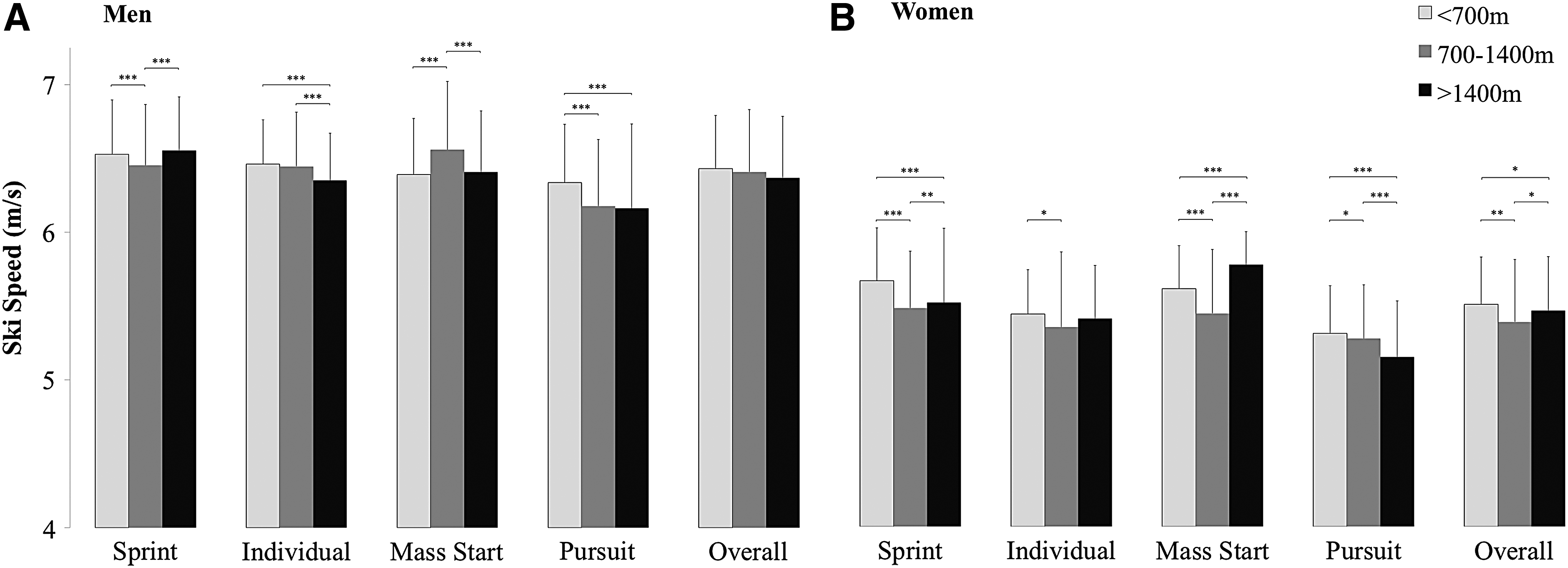
Skiing speed in elite men
Prone shooting performance
Both men and women's prone shooting performances (Fig. 2A, B) were significantly deteriorated by the altitude of the race. The average shooting performance was lower by 3.6% and 3.2% (p < 0.001) at <700 m and by 2.1% and 2.3% (p < 0.001) at 700–1400 m when compared with >1400 m, for men and women, respectively.

Prone shooting accuracy in elite men
Standing shooting performance
Shooting performances were always significantly lower (p < 0.001) for standing than for prone shooting.
Men's standing shooting performances (Fig. 3A) was lesser by 2.7% at <700 m than at >1400 m (p < 0.001) and by 1.6% at <700 m than at 700–1400 m (p < 0.001). Women's standing shooting average performances (Fig. 3B) was lower by 2.5% at <700 m and by 2.7% at 700–1400 m than at >1400 m (both p < 0.001).

Standing shooting accuracy in elite men
When pooling all shooting performances (i.e., for both sexes and both shooting positions), the performance was lower between <700 and >1400 m by an average of 3.0% (all p < 0.001). However, contradictory to our hypothesis, the altitude-induced alteration in standing shooting was not statistically different from prone shooting between the three altitudes. There was no difference in the altitude effect on prone versus standing shooting performance.
Discussion
The main purpose of the present study was to investigate the influence of altitude on elite biathlon performances. Our results show an inconsistent effect of altitude on skiing speed (Fig. 1A, B), including some unexpected results, such as improved performance at the highest altitude (e.g., sprint in men, mass start in women). Due to many confounding factors (snow and weather conditions, course profiles, tactical pacing particularly during mass start), these results appear controversial and trivial. However, the altitudes compared in the present study do not differ to a large extent, and therefore, the decrease in skiing speed due to the lower ambient oxygen pressure is minimal and likely washed out by these factors. In other words, the effect of altitude was not large enough to overcome the other confounding factors.
One believes that the shooting results are more robust due to the fact that the shooting conditions are more replicable (e.g., the shooting range specifications and configurations are similar everywhere and precisely detailed in the “IBU event and competition rules”) despite that wind is also an important factor. Overall, the shooting performance was lower (all p < 0.001) by at least 2.5% between <700 and >1400 m conditions.
Our data confirm that standing shooting performances were lower than prone shooting: for both men and women, the difference between the two shooting positions ranged between 5.3% and 6.5%, respectively. Overall, the present findings on prone and standing shooting performances show how, even at moderate levels, altitude negatively and significantly impacts elite level biathletes' performances. Considering that these changes decrease the average shooting performances by a minimum of 2.5% and that shooting accuracies are around 85%–90%, such changes could easily affect the final results and thus impact on individual biathletes' ranking positions.
To the best of our knowledge, the present study is the first one on the effect of altitude on biathlon performance. However, three previous studies have investigated shooting performance at altitude for military purposes and confirmed the detrimental influence of altitude on shooting performance. Compared with sea level, Tharion et al. (1992) reported reduced shooting performance at rest at 4300 m and Muza et al. (2000) found reduced shooting performance following a lift-carry task at 2743 m. Of higher interest for comparison with the conditions allowed in biathlon, Moore et al. (2014) measured shooting performance at rest and following a strenuous 1-minute run at sea level and at simulated altitudes of 1000, 2000, 3000, and 4000 m. Shooting performance was significantly reduced at 4000 m compared with all lower altitudes. Also, there was a strong trend for reduced performance at 3000 m compared with sea level and 1000 m. However, contradictory to our results, Moore et al. (2014) did not report any difference in shooting performance between sea level, 1000, and 2000 m despite differences in breathing frequency. Possible reasons for this discrepancy might include the performance level of the subjects (healthy men and women), the laboratory conditions (constant ambient temperature; NH provided by breathing through a facemask), and the exercise intensity (1 minute at 12 km/h) prior shooting.
However, contrarily to our hypothesis, prone and standing shootings were affected to the same extent by altitude, for both men and women. Altitude-induced higher HR (Mourot and Millet, 2019) and ventilation (Faiss et al., 2013) create increased movements of the abdomen and chest wall (Vickers and Williams, 2007), likely detrimental for both prone and standing shootings. The fact that post-exercise HR and VO2 kinetics are slower in hypoxia than in normoxia (Engelen et al., 1996) is also paramount in biathlon where athletes aim to induce a bradycardia with prolonged exhalation phases when arriving on the shooting range. Since being in altitude induces longer duration to return to resting values in HR and ventilation, one may speculate that athletes may shoot at higher HR or with a shorter exhalation pause. It was shown that breathing frequency was higher at 2000 m than at 1000 m during shooting in military personnel (Moore et al., 2014), but further investigation on these points (HR and duration of apnea when shooting) at different altitudes is required in biathlon. These mechanisms are likely more detrimental than the alteration in postural control in altitude that would influence only standing shooting. Finally, one cannot rule out that a lower temperature as generally noticed at the higher altitudes may per se cause poorer shooting (frozen fingers, ice on the riffle, etc.). It is a limitation that the ambient temperatures were not analyzed in the present study. Moreover, beyond all the environmental confounders (weather, wind, snow conditions, ambient temperature, profile of the races), one cannot rule out the influence of factors not assessed in the present study as the degree of individual acclimatization, the quality of the equipment (skis, waxing), or a possible influence of doping. Finally, one cannot rule out an influence of the decreased aerodynamic drag caused by the lower air density at the highest altitudes. However, this is likely noticeable only at the highest velocities during downhill and probably of lesser importance than the ski/waxing quality.
These results are those of the best biathletes in the world, whom, as most of their counterparts in endurance sports massively use altitude as an ergogenic method (Millet et al., 2017) and are therefore used to these environmental conditions. It is likely that altitude would have a higher influence in less expert biathletes.
Conclusion
Cutting seconds and improving by one shot the shooting performances could radically change individuals' biathlon ranking averages (Skattebo and Losnegard, 2018). The present study confirms the biathletes' and coaches' anecdotal observations that shooting is more difficult in altitude (as in Antholz/Anterselva). It is therefore crucial to prepare the biathletes by considering every detail, including altitude. Since it was beyond the scope of the present “brief report” to describe the training content of the elite biathletes, if they train at altitude and how often? Or their acclimatization strategy, the practical applications are limited. Since Antholz/Anterselva might be the site of the 2026 winter Olympic Games (to date, the final two host city candidates are Milano-Cortina d'Ampezzo and Stockholm-Are), the present results are of direct practical relevance. Yet, biathlon still remains one of the most variable and unpredictable Olympic sports.
Footnotes
Acknowledgment
The authors would like to thank P. Lemaire for his technical support in data extraction.
Author Disclosure Statement
No competing financial interests exist.