




Abstract
Bondi, Danilo, Vittore Verratti, Raffaella Nori, Laura Piccardi, Giulia Prete, Tiziana Pietrangelo, and Luca Tommasi. Spatial abilities at high altitude: Exploring the role of cultural strategies and hypoxia. High Alt Med Biol. 22: 157–165, 2021.
Background:
Over the past couple of decades, the number of people of different cultures traveling to places of high altitude (HA) increased. At HA, a decline in cognitive abilities has been described, including spatial skills. However, it is still unknown whether people accustomed to hypobaric hypoxia are less susceptible to cognitive decline.
Method:
We aimed to determine if three ethnic groups would show any difference in the performance of spatial abilities. Italian trekkers (46.20 ± 15.83 years), Nepalese porters (30.33 ± 8.55 years), and lowlander and highlander Sherpas (30.33 ± 8.55 and 37.00 ± 16.51 years) were tested with a building photograph recognition, a map orienting, and a mental rotation task during a Himalayan expedition. Accuracy and response times were collected at low altitude (LA) and HA.
Results:
Nepalese performed the worst (photograph task: p = 0.015, η2p = 0.36; map task: p = 0.016, η2p = 0.36), but the difference was mitigated after correcting for length of schooling. Participants took more time to respond at LA than in HA condition (photograph task: 24.0 ± 15.3 seconds vs. 12.7 ± 6.3 seconds, p = 0.008, η2p = 0.57; map task: 12.5 ± 1.8 seconds vs. 7.8 ± 0.6 seconds, p = 0.038, η2p = 0.40). In the map task, participants performed with greater accuracy at LA (5.1 ± 0.4 vs. 4.4 ± 0.4 number of correct responses, p = 0.006, η2p = 0.59).
Conclusions:
Altitude hypoxia elicited impairments in cognitive spatial tasks. This may be due to the inability to acquire new unfamiliar patterns, and to the difficulty in managing a high cognitive workload. The ethnic differences were ascribed to schooling, even we consider the different system of reference usually exploited in each culture (egocentric: dependent, or allocentric: independent from the personal viewpoint), and that Westerners are more likely to focus on specific details of the scene. Further studies should investigate the diverse strategies to complete spatial tasks.
Introduction
Environmental stressors shape human variations, occurring alongside genetic, functional/physiological, and cultural/behavioral patterns (Leonard, 2015). Among environmental stressors, exposure to high altitude (HA) has become popular in the last couple of decades. In fact, an increase in the number of holidays and people hiking and mountaineering has increased the number of people exposed to HA. Hypoxia affects oxidative metabolism, stimulating the process of oxygen transport and storage to ensure adequate tissue oxygenation (Di Giulio et al., 2006; Verratti et al., 2009). In addition to the physiological response to altitude exposure (Savourey et al., 1997; Leonard, 2015), psychological and behavioral changes have also been addressed (Bahrke and Shukitt-Hale, 1993; Karinen and Tuomisto, 2017).
A plethora of neurological and neuropsychological effects in response to hypobaric hypoxia have been reported (Wilson et al., 2009). Both neuropsychological changes and brain abnormalities are usually reversible and may occur, even in the absence of mountain sickness (Fan et al., 2016). Impairments in attentional performance (Limmer and Platen, 2018), working memory (Shukitt-Hale et al., 1994), and in executive functions, complex attention, and verbal skills (Griva et al., 2017) have been reported as altitude increases. The high heterogeneity in personal responses is not clearly related to sociodemographic characteristics (Griva et al., 2017).
One of the most represented cognitive topics is memory; whereas long-term memory seems to be preserved, the decline of short-term memory, the capacity to learn, and spatial memory occurs at HA (Wilson et al., 2009). Indeed, the high sensitivity of the hippocampus and the limbic system to hypoxia makes the dysfunction in learning and memory likely to occur in response to altitude (Virués-Ortega et al., 2004). It has been reported that the lowest altitude for causing short-term impairment may be 3500 m, with deficits occurring in those tasks requiring a high capacity of memory (Virués-Ortega et al., 2004).
Populations living at HAs have adaptive advantages in facing environmental hypobaric hypoxia. These observations have been studied in terms of secular trends in human body size and morphology (Katzmarzyk and Leonard, 1998), but there have been fewer studies in relation to cognitive functions. Yan et al. (2011a) reported an impairment in verbal working memory among prolonged HA residents compared with sea level residents, whereas no impairment was found in the same population of highlanders (Han ethnic group) in the accuracy of spatial working memory tasks (Yan et al., 2011b). Ray et al. (2019) argued that adaptations might be due to ethnogenetic variations. Claydon et al. (2008) found that ethnic differences influence cerebrovascular responses.
Prior training does not seem to prevent the cognitive dysfunction due to environmental hypobaric hypoxia (Li et al., 2012). However, it is still unknown whether people who are exposed to hypobaric hypoxia (e.g., altitude porters, people who are used to carrying loads during altitude expeditions) have a different susceptibility to cognitive decline in response to hypoxia, compared with people who are not accustomed to be frequently exposed.
Himalayan expeditioners are highly influenced by their cultural environment. Previous works from the last couple of decades have revealed several cross-cultural differences between the Eastern and Western individuals, one of the most prominent being the difference between collectivism and individualism. For instance, it has been shown that Asian cultures are more prone to think of each person as a member of a group (collectivism), whereas Western cultures are typically based on personal independence (individualism) (Markus and Kitayama, 1991). It has also been suggested that language and urbanization could affect cognitive skills, with a particular reference to spatial cognition (Gramann, 2013; Saulton et al., 2017). For example, spatial orientation in humans is based on two distinct systems of reference, namely egocentric and allocentric (Witkin et al., 1977; Boccia et al., 2017).
Specifically, people use egocentric coordinates when memorizing spatial locations, considering them in relation to their own position (egocentric system). In contrast, when people plan or study a path by observing it on a map or when they use cardinal points to spatial orientation, the space around them is organized regardless of their own position (allocentric system) (Burgess, 2006; Avraamides and Kelly, 2008; Nori et al., 2018). Given that prior evidence suggests that Western cultures are guided by individualism, we expect this to be reflected as a higher performance in spatial tasks requiring an egocentric encoding, compared with Eastern cultures, who may perform better in spatial tasks requiring an allocentric encoding. Given the widely reported effects of acculturation on cognitive test performances (Boone et al., 2007), we may expect that the educational stage will attenuate the ethnic differences.
Purpose of the present study
We conducted an outdoor field study, in an ecological setting, to evaluate the possible detrimental effect of HA on spatial abilities. We hypothesized that participants in the three ethnic groups would show different performances in spatial abilities, due to the fact that hypobaric hypoxia may alter cognitive functions and that ethnic groups may differ in terms of their response to acute or chronic environmental stressors.
Materials and Methods
Participants
A sample of 22 healthy participants took part in the study, from three different ethnic groups: Italians, Nepalese, and Sherpas. Demographical data (age, gender, years of schooling) were recorded. The Italian group was composed of five healthy Caucasian lowlanders (four males, five female; age: 46.20 ± 15.83 years; schooling: 18.20 ± 3.56 years). The Nepalese group was composed of six healthy porters who were lowland dwellers (all males; age: 30.33 ± 8.55 years; schooling: 5.86 ± 4.71 years). The third group was composed of 11 healthy male Sherpas, five living in HA (age: 37.00 ± 16.51 years, schooling: 6.40 ± 4.28 years) and six living in low altitude (LA; age: 30.50 ± 6.60 years, schooling: 12.00 ± 3.79 years) (Table 1).
Self-Reported Data of the Volunteers: Living Altitude, Testing Altitude, Gender (Female, Male), Age (Years), and Schooling (Years of Instructions)
F, female; Liv. Alt., living altitude; M, male; Test. alt., testing altitude.
Design of the study
The research project “Kanchenjunga Exploration & Physiology” was a subset of “Environmentally modulated metabolic adaptation to hypoxia in altitude natives and sea level dwellers: from integrative to molecular (proteomics, epigenetics, and ROS) level, approved by the Ethics Review Board of the Nepal Health Research Council (NHRC), ref. no. 458.” All the procedures were performed in accordance with the ethical standards of the 1964 Helsinki Declaration.
The expedition was conducted at LA (500–2000 m), moderate altitude (2000–3000 m), and HA (3000–5500 m) (Schommer and Bärtsch, 2011), with a traveling plan suited to promote acclimation and prevent altitude sickness. The expedition was therefore conducted making use of the environmental stressor of hypobaric hypoxia, known to represent the most unfavorable characteristic of HA, disrupting cognitive functions in humans (Muthuraju and Pati, 2014). The expedition involved two populations, Caucasian trekkers and Nepalese porters, respectively, defined in terms of nonaltitude workers and altitude workers.
Participants completed a combined circuit with a distance of 300 km in 19 days, over 16,000 m of difference in altitude, while walking on average 6 hours/day along a route with ascents and descents in the Himalayas, Nepal. Dietary plans were not previously defined. The expedition was continuously supervised by an expert doctor; none of the participants suffered from altitude sickness, nor any psychotropic drugs, but a very low consumption of alcoholic beverage (only Italians, on average 66 ml/day of beer, cider, and substitutes). Italians only took one altitude drug per day (acetazolamide, to prevent and reduce the symptoms of altitude sickness) on three consecutive days before the highest altitude. This behavior is common in altitude expeditions in which Western travelers and local porters are involved.
The current study represents a field study conducted in a harsh environment, with an ecological setting: investigators did not modify any contextual factors, leaving the groups to behave as they wanted during the expedition. Indeed, the key principles of the ecological approach are dynamic organism/environment relationship, affordances, developmental changes, sociocultural strategies, extraindividual behavioral structures, and variation (Heft, 2013).
The study protocol involved cognitive testing on Italian and Nepalese participants at LA and HA (the time points LA and HA2 shown in Fig. 1), namely Kathmandu (1450 m) and Lhonak (4780 m). The Sherpas were tested once where they used to live. Lowlander Sherpas were tested in Kathmandu, whereas highlander Sherpas were tested in Ghunsa (the time point HA1 shown in Fig. 1) at 3427 m. All of the groups performed photograph and map description tasks, whereas the three-dimensional (3D) rotation task was performed by the Italians only, due to the lack of assistance of an expert operator able to translate and supervise the execution.

Altimetric plan and measurement time of psychological tests of “Kanchenjunga Exploration & Physiology” project.
Materials and procedures
All of the tests were administered on a tablet computer (diagonal size 12.3 inches, ratio 3:2, 267 ppi) (Microsoft Surface Pro 6; Microsoft Corporation). One operator registered the answers, while another measured the time of completion with a stopwatch.
To measure spatial abilities, the participants were asked to submit the following tasks: photograph and map description, and 3D rotations. For the photograph task (Nori and Giusberti, 2003, 2006), participants had to select a target building (previously studied for 3 seconds) among four photographs of similar buildings (one target, three distractors; Fig. 2a). Seven trails were presented; task scores were marked from 0 to 7. Each correct answer was scored 1 point. To correctly solve the task, participants had to mentally represent perceptually salient patterns without referring to any kind of spatial information about them: they based their answers only on the visual components of visuospatial working memory.
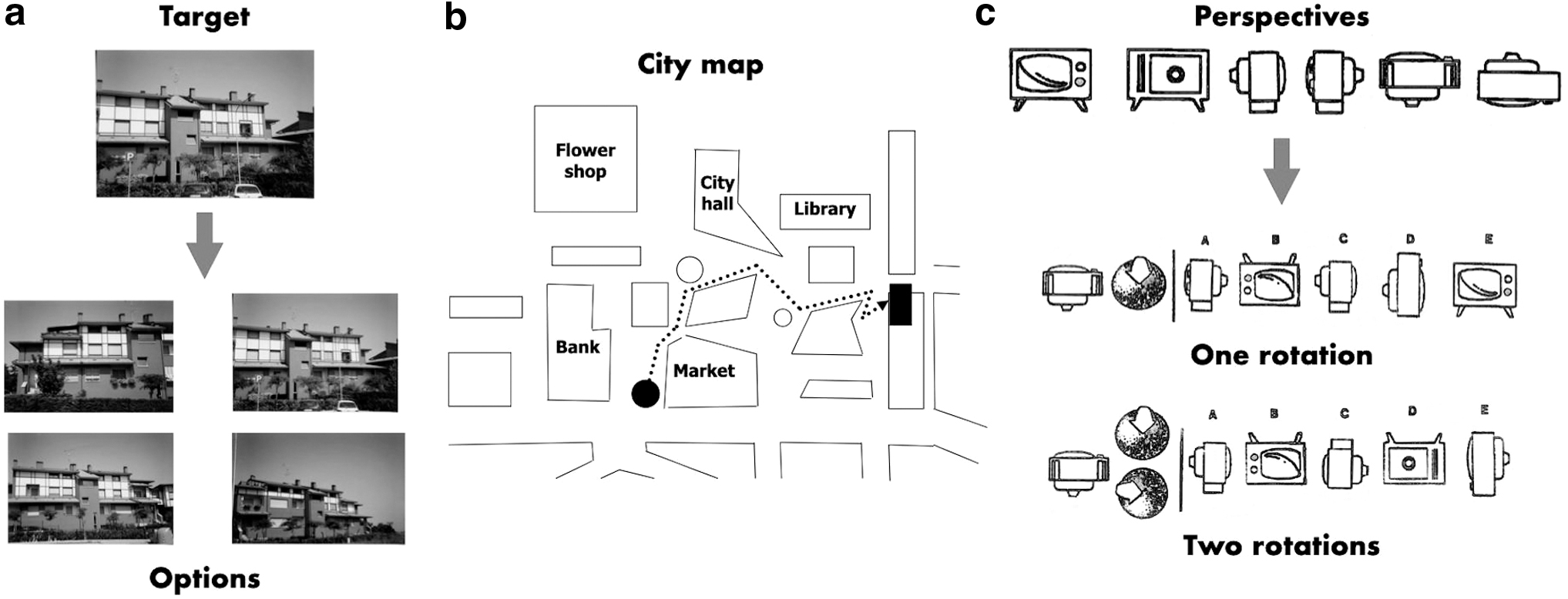
An example of the photograph task
In the map description task (Nori and Giusberti, 2006), participants were asked to describe a path depicted on the map. Starting from a black dot, they had to describe the route to reach the red dot, which represented the goal, by reporting the correct sequence of seven left-right turning points. Participants were not allowed to rotate the tablet computer on which the map was shown, to ensure that only left and right discrimination and sequential abilities were tested (Fig. 2b). Task scores were marked from 0 to 7. Each correct answer was scored one point. To solve this task, participants were required to assume an egocentric point of view and left-right discrimination skills: the spatial component of visuospatial working memory was involved in this task.
In the 3D rotation task (Nori and Giusberti, 2006), participants were given different perspectives of the same object on the screen, represented in different degrees of rotation on its vertical or horizontal plane. They were required to mentally rotate a target figure in the direction indicated by an arrow (e.g., 90° left, right, up, down), and then they were asked to choose the resulting perspective (after the rotation) among five alternatives (an example is shown in Fig. 2c). Seven items were presented, and task scores were marked from 0 to 7. Each correct answer was scored 1 point. To solve them correctly, participants relied exclusively on an abstract, mental representation of the object, characterized by a bird's eye viewpoint of an allocentric reference system: as before, the spatial component of visuospatial working memory was involved, but in its allocentric component.
The items of each task were presented randomly to the participants, who were tested individually (Fig. 3). Instructions were given in the native language of participants, both verbally and written on the computer. Each participant of the Italian and Nepalese group solved all tasks twice: the first one in LA condition and the second one in HA2 condition. For all the three tasks, both accuracy and response time (RT) were analyzed.

Ecological setting of cognitive tests (here the photograph task) at high altitude.
Analyses
Statistical analyses were carried out considering accuracy (ncr: number of correct responses) and RTs as the dependent variables. To calculate RTs of the map task, the experimenter started the stopwatch soon after presenting the spatial trial to the participant and stopped the stopwatch when the participant gave the answer. The analysis was conducted considering the total time participants used to respond to each spatial task.
Statistical analyses were performed using SPSS software (IBM SPSS Statistics 23). In particular, to investigate the possible difference among the three groups (Italian, Nepalese, and Sherpa), we first performed two one-way analysis of variance (ANOVA) on photograph task and on map description task, and then we ran two analysis of covariance, correcting for age or years of schooling. In addition, two repeated-measures ANOVAs were carried out on photograph task and map description task to compare the performance of Italian and Nepalese groups in LA and HA2 conditions, considering group as a between-subject factor and altitude as a within-subjects factor.
Finally, to compare the performance of lowlander and highlander Sherpas, we performed a series of ANOVA on the photograph and map description task, considering group (lowlanders, highlanders) and altitude as between factors. Partial eta squared (η2p) was computed as the effect size measure. Bonferroni post-hoc correction for multiple comparisons was used. The achieved statistical power (1 − β) was computed with the software G*Power Version 3.1.9.3 (Faul et al., 2007).
Results
There were differences in the years of schooling the different groups received. Italians ranged from 13 to 22 (median = 19), Sherpas from 0 to 16 (median = 10), and Nepalese from 0 to 12 (median = 7) years of schooling. Averaged results are shown in Table 2.
Averaged Results of Cognitive Tests
Both Italians and Nepalese usually live at LA.
Sherpas were tested at their living altitude.
3D, three-dimensional; HA, high altitude; LA, low altitude; MA, moderate altitude; N.A., not applicable; ncr, number of correct responses.
Ethnic groups
Considering the accuracy (expressed as ncr) in the photograph task, the main effect of group was significant (F2,19 = 5.24, p = 0.015, η2p = 0.36, 1 − β = 0.66). After correcting for age, the difference remained significant (p = 0.023, η2p = 0.34, 1 − β = 0.68), whereas after correcting for schooling, the effect was mitigated (p = 0.149, η2p = 0.19, 1 − β = 0.68). Post-hoc analysis showed that the Italian group performed better than the Nepalese group (accuracy, p = 0.017; 7.0 ± 0 vs. 4.7 ± 1.6 ncr), whereas the Sherpa group did not differ compared with the other groups (6.2 ± 1.3 ncr). For RTs (second), the main effect group was revealed (F2,19 = 5.35, p = 0.014, η2p = 0.36, 1 − β = 0.65). After correcting for age or schooling, the difference remained significant (p = 0.022, η2p = 0.35, 1 − β = 0.70, and p = 0.046, η2p = 0.29, 1 − β = 0.68, respectively). Post-hoc analysis showed that the Nepalese group was slower than the Sherpa group (RT, p = 0.016, 30.9 ± 4.2 and 14.5 ± 3.1 seconds, respectively).
Considering the map task, a main effect of group was significant for accuracy (F2,19 = 5.22, p = 0.016, η2p = 0.36, 1 − β = 0.67). As for photograph task accuracy, after correcting for age, the difference remained significant (p = 0.024, η2p = 0.34, 1 − β = 0.69), whereas after correcting for schooling the effect was mitigated (p = 0.406, η2p = 0.10, 1 − β = 0.72). Post-hoc analysis showed that the Italian group was more accurate than the Nepalese group (p = 0.016; Italian group 6.2 ± 1.3 ncr; Nepalese group 4.0 ± 1.1 ncr). For RTs, no significant difference was revealed, nor did any difference occur after correcting for age or schooling.
LA versus HA
When considering accuracy in the photograph task, the main effect of group was significant (F1,9 = 5.16, p = 0.049, η2p = 0.37, 1 − β = 0.72): the Italian group recognized more buildings (6.8 ± 0.6 ncr) than the Nepalese group (5.1 ± 0.5 ncr). As for RTs, a main effect, altitude, was revealed (F1,9 = 5.91, p = 0.008, η2p = 0.57, 1 − β = 1.00): in the LA condition, people took more time to respond (24.0 ± 15.3 seconds) than in HA condition (12.7 ± 6.3 seconds). No other significant difference was found.
As for accuracy in the map task, group was significant (F1,9 = 9.60, p = 0.013, η2p = 0.52, 1 − β = 0.67): the Italian group was more accurate (5.8 ± 0.5 ncr) than the Nepalese group (3.7 ± 0.5 ncr). A main effect of altitude was also revealed (F1,9 = 12.77, p = 0.006, η2p = 0.59, 1 − β = 1.00): in the LA condition, participants gave more correct answers (5.1 ± 0.4 ncr) than in HA condition (4.4 ± 0.4 ncr). No other difference was revealed. With regard to RTs, altitude was significant (F1,9 = 5.91, p = 0.038, η2p = 0.40, 1 − β = 0.83): in the LA condition participants took more time to respond (12.5 ± 1.8 seconds) than in HA condition (7.8 ± 0.6 seconds).
No significant difference was found when considering 3D rotation tasks, moving from 75% ± 25% to 87% ± 30% of ncr, and from 59 ± 23 to 55 ± 20 seconds (accuracy and RT, respectively; from LA to HA2). This test was performed by Italians only (two of them completed the task with 100% of accuracy both in LA and HA2, two improved, and one worsened from LA to HA2).
Living altitude
No significant difference was found when looking at accuracy and RT of the photograph task, nor concerning the map task. When comparing lowlander Sherpas and highlander Sherpas, a tendency to take less time to respond in the map task (F1,9 = 3.49, p = 0.095, η2p = 0.28, 1 − β = 0.59) was found; such tendency was mitigated after correcting for age (p = 0.139, η2p = 0.25, 1 − β = 0.62) and, at a higher extent, after correcting for schooling (p = 0.236, η2p = 0.17, 1 − β = 0.61).
Discussion
Hypobaric hypoxia is known to impair cognitive functions and the heterogeneous findings may be due to ethnicity, altitude, and duration of stay (Ray et al., 2019). The present study aimed to evaluate the spatial abilities of altitude travelers and workers and Himalayan people. We recruited volunteers in the framework of the “Kanchenjunga Exploration & Physiology” project, designing our study in an ecological setting.
Ethnicity and cultural differences
We found several differences among ethnic groups, where Westerners were found to perform with greater accuracy at visual short-term memory and egocentric spatial cognition tasks. Specifically, Italians performed the best and Nepalese the worst in both the photograph task and the map task. This is consistent with prior research that Westerners are more individualistic in culture, but it is worth highlighting that results were related to years of education as well. As expected, the more time spent at school, the higher the probability that they would perform better in the spatial tasks. Even though no group was familiar with these specific tasks, we argue that the habit to perform cognitive testing (e.g., at school) in the Italian sample may have affected the results of this ethnic group with respect to Nepalese and, to a lesser extent, to Sherpas (who had an intermediate level of schooling in the current study).
In addition, the Nepalese group took more time to respond in the photograph task, while Italians took more time in the map task. Again, the longer time to respond to a more complex task (involving left and right discrimination, and sequential abilities) may have been due to a greater concentration exerted by the group who was more used to performing cognitive testing. In summary, one of the reasons behind the ethnic difference we found could be ascribed to the difference in schooling. Below, we focus on other possible additional reasons.
Indeed, ethnic differences in visuospatial working memory could be ascribed to the possible difference in the ability to exploit specific subcomponents of working memory. Considering that the map task and 3D rotation task require an egocentric and an allocentric frame of reference, respectively, we would expect that these two subcomponents can be differently affected by both cultural habits and possibly altitude (hypoxia). The higher performance in accuracy of the Italian group in the map orientation task, compared with the other groups, could be explained by the attitude of different cultures to exploit some specific information in spatial tasks. For instance, it has been shown that Eastern people describe a scene by making more reference to the background and global information, whereas Western people focus more on specific objects presented in the environment (Masuda and Nisbett, 2001). These different patterns were also confirmed by eye-tracking studies (Chua et al., 2005).
We may argue that the higher performance of the Western participants tested in the present study, namely the Italian group, may be attributed to the previously shown trend of Western participants to focus on specific elements in the scenes. Considering this view, the egocentric frame of reference exploited by the Italian participants could have been the reason for their better performance in the map task, in which left-right rotations have to be encoded by referencing their own position in a particular moment, possibly together with the higher education level (Vasilyeva and Lourenco, 2012). As a matter of fact, Western participants are more prone to focus on a specific object in the scene (Masuda and Nisbett, 2001; Cramer et al., 2016) and this is the skill required to correctly solve a task in which differences are introduced among different (distractor) images.
Altitude matters
Another important result of the present study is that the time to respond decreased with altitude, independently by the ethnic groups. This effect may have been due to the familiarization with unusual tests. Alternatively, an attentional deficit may be evoked. Indeed, the impairment of attentional performance after hypobaric hypoxic exposure (Chua et al., 2005) may have triggered the capacity to focus on the test, increasing the superficiality while concluding the task. The familiarization may have produced a decreased time, which did not elicit a decreased accuracy in the short-term visual memory test (i.e., the photograph task), but in the more complex map description task. We found an impairment in the spatial abilities required by the map task.
It is worth noting that none of the participants suffered from altitude sickness symptoms, which means acclimation was successful in our study. As a result, we are extending the research topic of cognitive responses to hypobaric hypoxia with a new insight: the ecological environmental stressor of altitude hypoxia elicits a cognitive impairment in a task requiring an egocentric point of view, left-right discrimination skills, and spatial component of visuospatial working memory.
Our results were found to be similar to the results described by Crow and Kelman (1971), who reported that acute exposure to (simulated) 3656 m of altitude impaired the ability to acquire unfamiliar skills. In their study, hypoxia did not produce any marked effect on short-term memory, as in our study (Crow and Kelman, 1971). The absence of results in the simple visual memory test (herein the photograph task) agrees with the findings of short-term memory impairments at HA in those tasks requiring high capacity of memory (Virués-Ortega et al., 2004). In addition, it can be argued that a proper acclimation (as in the current study) to altitude preserves working memory abilities (Malle et al., 2016).
In contrast, the absence of results in the most complex task (herein the 3D rotation task) may be attributed to the contingent sample size; only five volunteers were tested in this task, two of whom had 100% accuracy both at LA and HA. However, Ma et al. (2016) reported mental rotation is affected by acute hypoxic exposure (simulated), with compensatory mechanisms that are effective when the cognitive workload is not excessive. Thus, further field studies with a larger sample size may unveil the adaptation of mental rotation tasks to altitude hypoxia exposure. In addition, it should be of interest to couple the degree of hypoxemia (Asmaro et al., 2013) and the impairments in selective cognitive functions.
Ethnicity and altitude
We did not find any ethnic difference in the cognitive adaptation to altitude hypoxia. Recently, Ray et al. investigated the ethnic difference in several cognitive functions during a 21-day-long HA sojourn (4111 m), comparing young lowlander Indian and Kyrgyz soldiers. They concluded that differences in the time course of cognitive (i.e., simple reaction time and spatial working memory) adaptations might have been due to ethnogenetic variations (Ray et al., 2019). Considering that they found a cognitive impairment in both ethnic groups, although speculative, we conclude that the difference in cognitive functions of spatial abilities during an altitude trek may emerge during the process of adaptation.
Beyond the middle-term exposure (19 days of altitude trek), we provided evidence about the long-life exposure of a typical Himalayan ethnic group, that is, Sherpa. The living altitude of the Sherpa ethnic group did not seem to affect accuracy and RTs significantly, but a trend was found for highlanders taking more time to respond in the map task. This tendency seems to agree with the findings of Yan et al. (2011b), who reported the native HA group to respond more slowly in spatial working memory tasks. We may argue that such difference may not be related exclusively to education. Indeed, those authors affirmed that despite the fact that long-life HA exposure impairs the brain visuospatial system, accuracy differences do not occur because of compensatory mechanisms, that is, switching the brain strategy to the utilization of attention resources.
Limitations
A noticeable limitation of the current study was the small sample size tested. The study design was also limited: not all of the three groups were tested at both LA and HA. In addition, the learning effect we suggested could have been specifically tested with an additional control group. However, finding a control group that could match age, schooling, and ethnic distribution would have been highly demanding. Another limit was the absence of baseline cognitive functions (e.g., fluid intelligence). The use of acetazolamide may have interfered with cognitive function, as reported (Wang et al., 2013). However, the logistic impairments that affected our design are common for a field study conducted in extreme environments. Thus, as it is typical in studies conducted in ecological situations, where controlling the variables is difficult and influenced by the environmental context, we are cautious about interpreting and inferring the results of the current research.
Implications and perspectives
During altitude expeditions, participants are exposed to environmental stressors, which can affect stress management. The fact that neither a cultural advantage (a higher level of schooling) nor an ecological hypoxic mitigation training (the job of altitude porters) protected against a cognitive impairment of some spatial abilities allows us to advocate for a major focus on spatial abilities in altitude expeditions, since they may be crucial when facing dangerous situations and with participants unaware of their impairments.
The map task we tested in the current study may be useful to detect altitude-related impairments, as we found left and right discrimination to be affected by altitude. In contrast, we do not suggest using the RT as a discriminative factor to identify the effect of altitude, unless the familiarization is accurately controlled.
Considering the massive presence of women in modern altitude traveling, gender differences may represent a topic worth investigating. In particular, when considering spatial abilities and spatial orientation tasks, which involve high visuospatial working memory load, gender differences are more likely to emerge (Coluccia and Louse, 2004). Similarly, previous experiences that promote the development of spatial skills as well as sociocultural factors should add a new level of understanding to this current work (Lawton, 2010). It could also be helpful to study people with subtle cognitive deficits and their predisposition to develop altitude sickness or make miscalculations.
It is worth noting that hypoxic neurodegeneration mimics the hallmarks of aging: lipofuscin deposition and mitochondrial degeneration inducing spatial memory impairments have been proposed as hallmarks of the acceleration of the biological aging of hippocampal neurons (Biswal et al., 2016). Similarly, the downregulation of brain-derived neurotrophic factor has been suggested as the cause of spatial memory impairment due to hypobaric hypoxia exposure (Kumar et al., 2018). Further research on human models is needed to identify the physiological pathways that regulate hypoxic neurodegeneration inducing spatial ability impairment.
An additional point to note about our ecological setting is that participants were involved in an altitude trek. Considering that cognitive functions, such as processing speed, working memory, and visuospatial attention, worsened after HA aerobic exercise (Walsh et al., 2020), a further focus on discriminating the effect of the physical exercise carried out at altitude on the subsequent cognitive impairments is worth investigating.
Conclusions
This research aimed to investigate the ethnic differences and the effect of altitude on spatial cognition into the framework of a Himalayan expedition. The ethnic differences we found in spatial abilities were mainly explained in terms of schooling. In addition, we argue that a higher level of accuracy showed by the Italian participants may be due to the Western egocentric frame of reference and to the habit of Western people to be more focused on specific details presented in the environment. We found an impairment of left and right discrimination and sequential abilities due to altitude, as revealed by the map task, independently by ethnic groups. We suggest this adaptation may be related to both a detrimental role of hypoxia in acquiring new unfamiliar patterns, and to altitude-related cognitive impairments of spatial skills requiring higher cognitive workload.
Considering the reduction of time to respond we found at HA, further studies should test if such adaptations are due to familiarization or attentional deficit. Further research is needed to define the course of adaptations with time and altitude and the differences due to cognitive workloads.
The environmental stressor of altitude hypoxia causes an impairment in spatial skills. Expeditions to very HAs should take this deficit into account, given the fundamental role of spatial abilities when dealing with the highest mountains. Attentional dysfunctions, as well as disorientation and short-term visual memory, may lead to the success or failure of an HA expedition. As a consequence, this may result in specific advice to manage or counteract detrimental alterations. In an evidence-based perspective, specific training methods aimed to enhance spatial skills may be developed to face harsh environments.
Footnotes
Authorship Confirmation Statement
Conceptualization, D.B., V.V., R.N., and L.P.; methodology, D.B., V.V., R.N., and L.P.; formal analysis, D.B., R.N., and L.P.; investigation: D.B.; resources, V.V., R.N., L.P., and T.P.; data curation, D.B. and V.V.; writing—original draft preparation, D.B. and G.P.; writing—review and editing, D.B., V.V., R.N., L.P., G.P., T.P., and L.T.; visualization, D.B., R.N., and L.P.; supervision, V.V.; project administration, V.V.; and funding acquisition, V.V. and L.T.
All authors have read, reviewed, and agreed to the published version of the article.
Acknowledgments
The authors thank Mission Nepal Holidays Pvt. Ltd (Kathmandu, Nepal) for logistical support, Ghunsa Hospital (Ghunsa, Nepal) for the assistance in logistics, and all the Italian trekkers, Nepalese porters, and Sherpas. They also thank Dr. Luca Iezzi who provided language and writing assistance.
Author Disclosure Statement
The authors declare no conflict of interest. The funders had no role in the design of the study; data collection, analyses, or interpretation of the data; writing of the article; or in the decision to publish the results.
Funding Information
Funded by the Department of Psychological, Health and Territorial Sciences, “G. d'Annunzio” University of Chieti-Pescara, Italy.