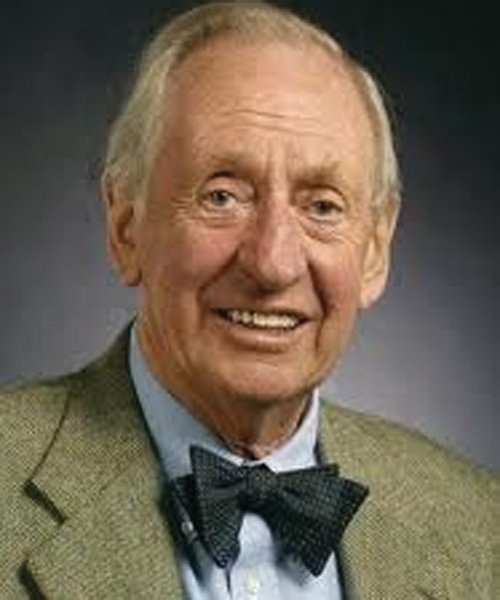
At the International Hypoxia Symposium, held from February 19 to 24, 2019, at Lake Louise, Canada, Peter Hackett, MD, of the Institute for Altitude Medicine interviewed John B. West, MD, PhD, DSc, FRCP, FRACP, Professor of Medicine and Physiology, the School of Medicine, University of California, San Diego. The video of the interview can be found here: https://youtu.be/0TlKPFlRV2s
Dr. Hackett: Peter Hackett here with John West at the International Hypoxia Symposium in Lake Louise, Canada. I am lucky to grab John for a few minutes for an interview. John, you have been coming to this meeting for quite a long time.
Dr. West: Forever, yeah.
Dr. Hackett: What do you recall about the first time you came to a hypoxia symposium?
Dr. West: I think it was at Banff Springs. And I do not know whether you know this, but the story was that originally it was at Banff Springs with Charlie Houston and so on, and then Hermann Rahn came along and drove up to Lake Louise and said, “This is it. You cannot get any better than this.”
And there was one, at least, at Jasper, I remember, which is pretty remote. And then, of course, here. I do not know how many I have been to, but many.
Dr. Hackett: I think you have been to most of them. In fact, we count on you to come here and inspire us. What has this meeting meant for you over the years? Why do you continue to come?
Dr. West: It is a wonderful way of meeting colleagues in high-altitude physiology, medicine. I mean, even on this occasion, which I am getting a little bit out of it now, but I met a guy today from Bayreuth in Germany. When I said I was there in 1953, he almost fell off his chair. It was true. I went to the opera in Bayreuth in 1953.
Anyway, it is just a unique [meeting]. There is no other meeting where you would get this concentration of people interested in high-altitude medicine and physiology. So, it is very special.
Dr. Hackett: And one of the unique aspects is the integration of the clinicians and the basic scientists.
Dr. West: Yes, absolutely.
Dr. Hackett: Can you give us some thoughts from your tremendous perspective as the dean of high-altitude physiology, really, and medicine, how the field has progressed over the last four decades that this meeting has been taking place?
Dr. West: Yes. Well, of course, the science has progressed enormously: subjects such as high-altitude pulmonary edema and high-altitude cerebral edema, or the session we had this morning, for example, was an example of cutting-edge stuff.
But also, the whole business of the physiological mechanism of hypoxia has changed. I mean, if somebody came along from when I first came to these meetings to the meetings [of today], they would not know what people were talking about. The whole molecular basis of it has, of course, changed tremendously, and I kind of opted out on that a bit. And it is still moving fast there, so it is very interesting and stimulating.
Dr. Hackett: Very stimulating. I have to ask you, one of the things you are best known for, of course, was the ’81 Everest expedition, and you presented the results here in ’83, I think it was.
Dr. West: Yes.
Dr. Hackett: That was an incredibly bold thing.
Dr. West: Yes. I mean, that was a fantastic thing.
Dr. Hackett: It could have been a disaster.
Dr. West: Absolutely. And, I mean, the fact that you are still here is remarkable. I hope all the audience knows that you were stuck upside down near the summit of Mount Everest, completely alone, with the evening coming on, and almost certain to die. And here you are, as sharp as ever, and that is very remarkable.
I should say a word or two about the way American Medical Research Expedition to Everest (AMREE) came about, because, of course, I was on the Silver Hut Expedition back in 1960, when most of the audience was probably still at school and whatever. And that was very remarkable, too, because before 1960, I had no particular interest in high altitude. I had been interested in the lung, and I had been working on that.
I was at Hammersmith Hospital in London and looking at the distribution of blood flow in the lung, and I happened to sit next to somebody at a meeting of the Physiological Society, and she said, “Did you know that Griff Pugh and Ed Hillary were arranging a physiological expedition to a high altitude?” And I said, “I did not know, but I will contact Griff.” That was a very exceptional opportunity.
And, we made a large number of measurements at 5800 m, 19,000 feet, and also made the first measurements, more or less, at extreme altitude on the Makalu Col at 7440 m, Mike Ward and myself.
So, I always used to say that I hold the world's highest measured maximum oxygen consumption, and there were only two of us at the time, and the other one had high-altitude pulmonary edema. As a matter of fact, I think he had high-altitude cerebral edema, as well.
Dr. Hackett: That was which person?
Dr. West: That was Mike Ward. So, we put together the bicycle, got it out on the Makalu Col, and made measurements there. So that was very special. But, of course, that started a tremendous interest in what happens at even higher altitudes, and that was the stimulus for AMREE.
Dr. Hackett: Did you think going to Everest was even more dangerous than Makalu?
Dr. West: Makalu was dangerous. Ed Hillary developed a stroke, and there was a big mess at the end. Fortunately, I was relatively fit, and we had some emergency oxygen, which I used to get up to the Col, and it was a disastrous situation, trying to get our group off the mountain alive.
And I must say, I did not know, but Pete Mulgrew was uncontrollable, and I gave him some morphine, which made him go to sleep. And we tied him up to a couple of backpacks and trundled him down. It was a perilous descent, though. It was remarkable that he survived. And of course, he developed very severe frostbite of both lower legs. I sometimes wonder whether all the morphine had something to do with it. Anyway, he survived, which is very remarkable. So, that was very dramatic.
I mean, on Everest, as you know, we were pretty lucky, particularly with you. And there was no serious problem, I think you could say, on Everest at all. I mean, we had no serious injury, and it was more luck than good management, I would say.
Dr. Hackett: It was very lucky.
Dr. West: Yes.
Dr. Hackett: Speaking of students, you have been quite an inspiration at this meeting for hundreds of students. Hypoxia [symposium] has put a big emphasis on having students attend. You have been a wonderful inspiration for those students. Have you also personally developed relationships here over the years that have contributed to advances in your career, ideals?
Dr. West: Yes. Oh, yes, very, very much so. I met some very interesting people at this meeting.
Dr. Hackett: What advice do you have for future hypoxia goers and organizers?
Dr. West: Well, I am often asked by young people, to suggest an area of interest, something like that. But I think it is really what you like. I mean, I became extremely interested in high altitude after the Silver Hut Expedition. It became an enormous interest.
And I would say the most important thing is to follow your interest, because you will work hard, and it is important to work with good people, if you can do that. But the most important thing is to follow your interests and work hard at it. And, the payoff is terrific. The satisfaction of seeing the science develop is very very satisfying.
Dr. Hackett: Well, you had the opportunity to go to Silver Hut. Many people here have the opportunity to hear from people like you and others, so hopefully that will help them decide what really interests them and give them some new opportunities.
Dr. West: Sure, yes.
Dr. Hackett: Thanks very much for your time. It is great to see you here after, what, 40 years now we have been doing this. It is fantastic.