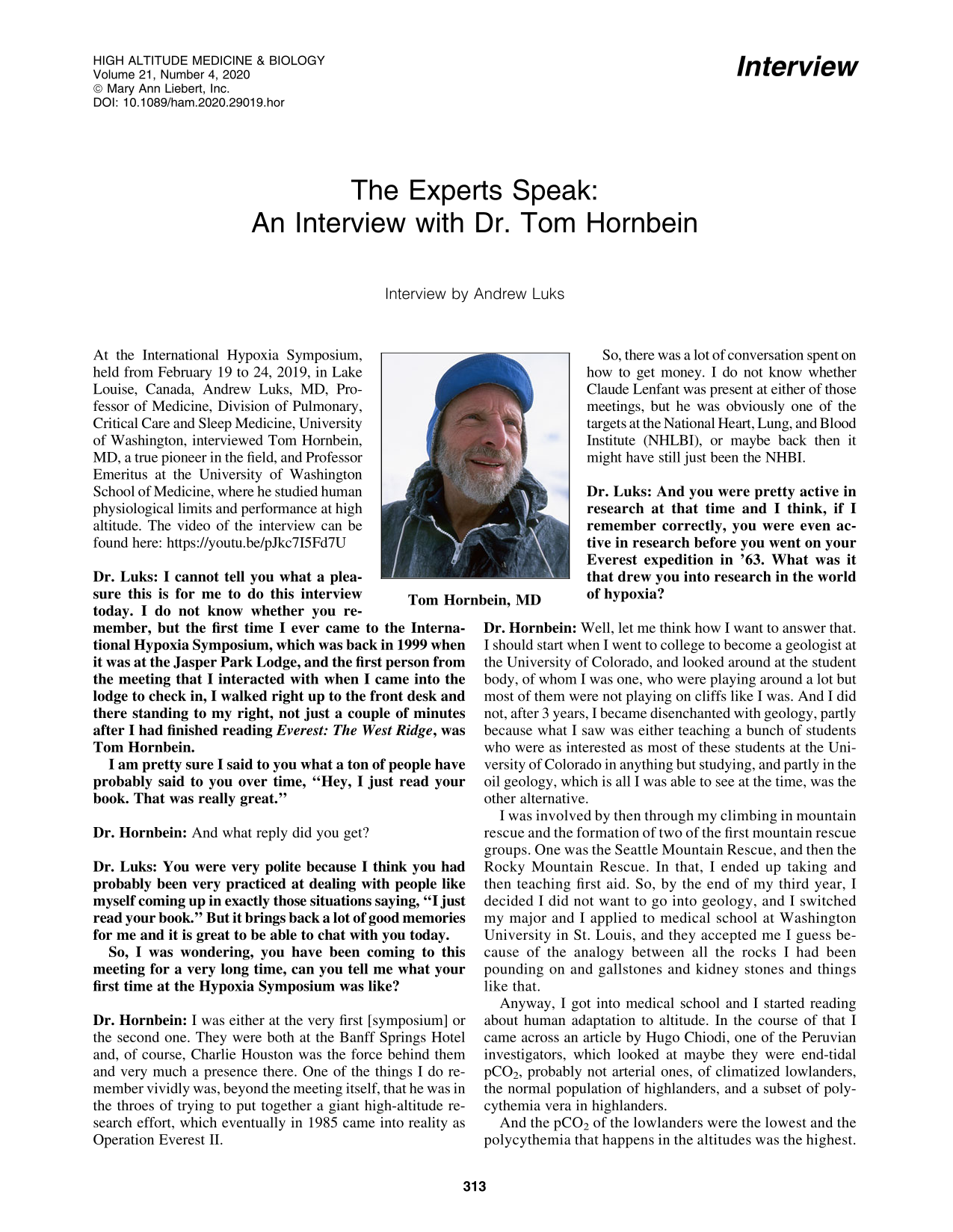
At the International Hypoxia Symposium, held from February 19 to 24, 2019, in Lake Louise, Canada, Andrew Luks, MD, Professor of Medicine, Division of Pulmonary, Critical Care and Sleep Medicine, University of Washington, interviewed Tom Hornbein, MD, a true pioneer in the field, and Professor Emeritus at the University of Washington School of Medicine, where he studied human physiological limits and performance at high altitude. The video of the interview can be found here: https://youtu.be/pJkc7I5Fd7U
Tom Hornbein, MD
Dr. Luks: I cannot tell you what a pleasure this is for me to do this interview today. I do not know whether you remember, but the first time I ever came to the International Hypoxia Symposium, which was back in 1999 when it was at the Jasper Park Lodge, and the first person from the meeting that I interacted with when I came into the lodge to check in, I walked right up to the front desk and there standing to my right, not just a couple of minutes after I had finished reading Everest: The West Ridge, was Tom Hornbein.
I am pretty sure I said to you what a ton of people have probably said to you over time, “Hey, I just read your book. That was really great.”
Dr. Hornbein: And what reply did you get?
Dr. Luks: You were very polite because I think you had probably been very practiced at dealing with people like myself coming up in exactly those situations saying, “I just read your book.” But it brings back a lot of good memories for me and it is great to be able to chat with you today.
So, I was wondering, you have been coming to this meeting for a very long time, can you tell me what your first time at the Hypoxia Symposium was like?
Dr. Hornbein: I was either at the very first [symposium] or the second one. They were both at the Banff Springs Hotel and, of course, Charlie Houston was the force behind them and very much a presence there. One of the things I do remember vividly was, beyond the meeting itself, that he was in the throes of trying to put together a giant high-altitude research effort, which eventually in 1985 came into reality as Operation Everest II.
So, there was a lot of conversation spent on how to get money. I do not know whether Claude Lenfant was present at either of those meetings, but he was obviously one of the targets at the National Heart, Lung, and Blood Institute (NHLBI), or maybe back then it might have still just been the NHBI.
Dr. Luks: And you were pretty active in research at that time and I think, if I remember correctly, you were even active in research before you went on your Everest expedition in ’63. What was it that drew you into research in the world of hypoxia?
Dr. Hornbein: Well, let me think how I want to answer that. I should start when I went to college to become a geologist at the University of Colorado, and looked around at the student body, of whom I was one, who were playing around a lot but most of them were not playing on cliffs like I was. And I did not, after 3 years, I became disenchanted with geology, partly because what I saw was either teaching a bunch of students who were as interested as most of these students at the University of Colorado in anything but studying, and partly in the oil geology, which is all I was able to see at the time, was the other alternative.
I was involved by then through my climbing in mountain rescue and the formation of two of the first mountain rescue groups. One was the Seattle Mountain Rescue, and then the Rocky Mountain Rescue. In that, I ended up taking and then teaching first aid. So, by the end of my third year, I decided I did not want to go into geology, and I switched my major and I applied to medical school at Washington University in St. Louis, and they accepted me I guess because of the analogy between all the rocks I had been pounding on and gallstones and kidney stones and things like that.
Anyway, I got into medical school and I started reading about human adaptation to altitude. In the course of that I came across an article by Hugo Chiodi, one of the Peruvian investigators, which looked at maybe they were end-tidal pCO2, probably not arterial ones, of climatized lowlanders, the normal population of highlanders, and a subset of polycythemia vera in highlanders.
And the pCO2 of the lowlanders were the lowest and the polycythemia that happens in the altitudes was the highest. So, I had this brilliant idea that I had learned by then about chemoreceptors in my professional year, which maybe there was some relationship between polycythemia and breathing.
In your senior year, you can get 6 months to do anything you want to, so I went to the laboratory of the guy who would become my mentor, a research guy, Albert Roos, with this idea of studying the effect of polycythemia on breathing.
And he took me in and we got connected with a professor, Bill Harrington, in hematology, and transfused me up with 5 units of blood to a hematocrit of ∼60 from 45, and I pedaled away on a stationary bicycle, breathing various oxygen mixtures, but air, oxygen, and a low oxygen mixture that was probably equivalent to 12,000 feet or so, and demonstrated that with deep breathing, as the hematocrit goes up, breathing goes down.
That article was accepted for publication by the Journal of Applied Physiology. Those statistics, there was only an N of 1. I smile thinking back to it. You could not even do that kind of study nowadays.
Dr. Luks: Brownie Schoene always referenced to how you were such an important mentor for him. If you were sitting today with, say there was an undergraduate or graduate students here at Hypoxia [Symposium] and you had the opportunity to talk to them, what type of advice would you impart to them about how to be successful in this field?
Dr. Hornbein: At a certain level, it is totally unprofound. It is: commit yourself, take risks, and have a ball. And make a difference. Making a difference, at least in my life, has been more in the impact I think I have had on other people's lives than my so-called great scientific contributions. So, to have the opportunity to influence people like Brownie and others in their futures unfolding, to do just what I did, only better, and then pass it along to the next generation, I guess that has been the thrill of the game. And you are included in that.
Dr. Luks: Thanks. I have definitely benefited from your advice over time as well.
Dr. Hornbein: Well, those years after Brownie left when we taught together, they were really special.
Dr. Luks: Yes, one of my fondest memories, that fellowship and coming up as a junior level person, was getting the opportunity to work together like that. So, if I remember correctly, the International Hypoxia Symposium has been going since 1979, and you have been at most of them, if not all of them over the years. When you look back at all that time that you spent here, what are some of your fondest memories?
Dr. Hornbein: Well, from my current perspective, which is very narrow, I guess the fondest memories are the people I have gotten to know and reconvene with, like all of you here now. And the reason I come now is not to update my brilliant science, because a good share of this I barely understand, but mainly to reconnect with people who are very precious in my life in one way or another from all over the world. It is not a bad place to be anyway. And it is also fun for me.
Dr. Luks: We all enjoy doing the same thing as well.
Dr. Hornbein: Well, that is one of the things you should take from your elders.
Dr. Luks: To continue the tradition?
Dr. Hornbein: Yes.
Dr. Luks: It is a deal. Tom, thanks very much for taking the time to chat with me and share your experiences and thoughts.
Dr. Hornbein: Thank you for giving me the privilege of doing that.