




Abstract
The cytochrome P450 epoxygenase, CYP2J2, converts arachidonic acid to four regioisomeric epoxyeicosatrienoic acids (EETs), which are highly abundant in the kidney and considered renoprotective. Accumulating evidence suggests that EETs are important in regulating renal and cardiovascular function. Further, EETs have been confirmed to exert diverse biological activities including potent vasodilation; fibrinolytic properties; and antiinflammatory, antiapoptotic, and mitogenic effects. In the current study, we investigated the effects of overexpression of CYP2J2 via recombinant adeno-associated virus (rAAV) in protection against renal damage in a rat 5/6 nephrectomy (5/6-Nx) model of chronic renal failure. The rAAV-CYP2J2 gene delivery in vivo increased EET generation; attenuated the rise in blood pressure; and reduced the levels of proteinuria, serum creatinine, and blood urea nitrogen. Morphological analysis indicated that rAAV-CYP2J2 gene delivery reduced 5/6 nephrectomy-induced glomerular sclerosis, tubular dilatation, luminal protein cast formation, and tubulointerstitial fibrosis. rAAV-CYP2J2 gene delivery also significantly lowered collagen I and IV deposition, as well as renal cell apoptosis detected by TUNEL staining, caspase-3 activity, and the loss of mitochondrial membrane potential (ΔΨm). Furthermore, rAAV-CYP2J2 gene delivery regulated the level of protein expression including transforming growth factor (TGF)-β1/SMADs; matrix metalloproteinases (MMPs); mitogen-activated protein kinases (MAPKs); and apoptosis-related proteins Bax, Bcl-2, and Bcl-xL. Together, these findings demonstrated that rAAV-CYP2J2 gene delivery can protect remnant kidney against renal injury in 5/6-Nx rats by inhibiting apoptosis and fibrosis via regulation of protein expression including TGF-β1/SMADs, MMPs, MAPKs, and apoptosis-related proteins.
Introduction
The increase in circulating EET levels by overexpression of cytochrome P450 (CYP) epoxygenase has been indicated to lower blood pressure and ameliorate renal damage in several different animal models including the spontaneously hypertensive rat (SHR) and in salt-sensitive hypertension (Lee et al., 2010; Xiao et al., 2010). The same phenomenon was observed in CYP2J2 and CYP2C8 transgenic mice (Lee et al., 2010). More recently, we showed that overexpression of CYP2J2 increased EET biosynthesis and significantly attenuated hypertension in SHRs (Xiao et al., 2010). All these evidences support the hypothesis that increasing EET levels would be beneficial against chronic renal failure.
Chronic renal failure (CRF) is the progressive loss of kidney function, which is the final stage of various renal diseases. 5/6 nephrectomy, or the remnant kidney model, is a classical approach to induce chronic renal failure by reducing nephron numbers (Tu et al., 2008). The reduction of renal mass is achieved by either infarction or surgical excision of both poles, with removal of the contralateral kidney. 5/6 nephrectomy promotes hypertension, renal dysfunction, and glomerular sclerosis, and therefore it has also been used as a model for renal fibrosis and glomerular sclerosis (Griffin et al., 1994).
Recombinant adeno-associated viral (rAAV) vector has several advantages, such as broad tissue tropism, long-term transgene expression, and relatively low toxicity; it therefore offers great potential for treating human chronic diseases (Nathwani et al., 2011; Silver et al., 2011). Gene therapy for renal disease has been a daunting task mainly because of the particular anatomical architecture of the kidney and the presence of compartments in which several different cell types display specialized functions (Benigni and Remuzzi, 2008). However, several studies have indicated that AAV is capable of transducing the kidney, although at lower efficiency than other organs toward which AAV has natural tropism such as liver and heart (Zincarelli et al., 2008).
In this study, we examined the beneficial effects of overexpression of CYP2J2 by AAV vector on chronic renal failure in the 5/6-nephrectomized rat model. Our data strongly suggested that overexpression of CYP2J2 had a significant renoprotective effect by suppression of fibrosis and apoptosis, and these effects were partly mediated by regulation of transforming growth factor (TGF)-β/SMAD/matrix metalloproteinase (MMP) and MAPK signal pathways.
Materials and Methods
Construction and preparation of recombinant adeno-associated virus
The recombinant adeno-associated viral (rAAV) vectors (type 2) carrying human CYP2J2 or the green fluorescent protein (GFP) were prepared by triple plasmid cotransfection in HEK293 cells as described previously (Zhao et al., 2003; Wang et al., 2004; Xiao et al., 2010). rAAV was aliquoted and stored at −80°C for vector delivery.
Animal treatment and gene delivery
All animal experimental protocols were carried out in strict accordance with standards stated in the NIH Guidelines for the Care and Use of Laboratory Animals and were approved by the Institutional Animal Research Committees of Tongji Medical College (Wuhan, China). All surgery was performed under sodium pentobarbital anesthesia, and all efforts were made to minimize suffering. Animals were subjected to a 1-week adaptation period before experimentation. Thirty-two male Wistar rats (2 months old) weighing 200–220 g were used for this study. Twenty-four rats underwent laparotomy and 5/6 nephrectomy, using methods described previously (Hinojosa-Laborde et al., 1992; Tu et al., 2008). All twenty-four 5/6-nephrectomized rats were randomly divided into 3 treatment groups 1 month after surgery: the saline control group, rAAV-GFP group, and rAAV-CYP2J2 group. One milliliter containing 1011 rAAV-GFP or rAAV-CYP2J2, or saline, was injected into each nephrectomized rat via the tail vein. The other eight rats underwent only sham operation as normal controls.
Blood pressure measurement and collection of serum and urine
Systolic blood pressure of the animals was measured weekly with a manometer–tachometer (rat tail NIBP system; ADI Instruments, Sydney, Australia), using the tail-cuff method as described previously (Zhao et al., 2003; Tu et al., 2008). Twenty-four-hour urine samples were collected from rats in metabolic cages with antioxidant triphenylphosphine and stored at −80°C until use, as described previously (Tu et al., 2008). The tail vein bleeding method was used for blood collection, and then serum was harvested for assays.
Evaluation of urine 14,15-dihydroxyeicosatrienoic acid by ELISA
An ELISA kit (R&D Systems, Minneapolis, MN) was used to determine concentrations of 14,15-dihydroxyeicosatrienoic acid (14,15-DHET) (stable 14,15-EET metabolite) in the urine of rats as described previously (Chen et al., 2009; Xiao et al., 2010) to assess in vivo EET production.
Renal function assays
The levels of proteinuria, serum creatinine, and blood urea nitrogen were measured in duplicate in the clinical laboratory at Tongji Hospital, using an Aeroset clinical chemistry system (Abbott Laboratories, Chicago, IL).
Morphological and histological analysis
Four-micrometer-thick sections of kidney were stained with hematoxylin and eosin (H&E) for morphological analysis and determination of the extent of renal injury. Sirius red and Masson's trichrome staining was done to determine collagen deposition and the extent of fibrosis. For Sirius red staining, 10 fields from each tissue section were photographed and analyzed with the HMIAS-2000 medicine chart analysis system (Champion Medical Imaging, Wuhan, China) (Tu et al., 2008). The severity of glomerular sclerosis was evaluated according to the mesangial injury scoring (MIS) system described previously (Raij et al., 1984; Tu et al., 2008). An immunohistochemistry assay for the expression of collagens I and IV in kidney section was performed with a VECTASTAIN universal elite ABC kit (Vector Laboratories, Burlingame, CA) as described previously (Milz et al., 1998). For each slide, 10 high-power field (HPF) images were captured. The results were counted in a double-blind fashion.
Apoptosis assays
Apoptotic cells in kidney were detected by terminal deoxynucleotidyltransferase dUTP nick end-labeling (TUNEL) assay on paraffin-embedded sections, using a commercially available kit for detecting end-labeled DNA (R&D Systems) as described previously (Yuan et al., 2007). TUNEL-positive renal cells were counted under a microscope under double-blinded conditions in 10 random HPFs from each of 5 sections. The ratio of TUNEL-positive renal cells to the total number of renal cells was then calculated.
Detection of caspase-3 activity
Caspase-3 activity was measured with a colorimetric assay kit according to the manufacturer's instructions (R&D Systems) as described previously (Kunduzova et al., 2003; Chen et al., 2009). Data are expressed as arbitrary units per milligram of protein.
Measurement of mitochondrial membrane potential
To assess changes in mitochondrial membrane potential (ΔΨm), the potentiometric, fluorescent dye 5,5′,6,6′-tetrachloro-1,1′,3,3′-tetraethylbenzimidazolyl-carbocyanine iodide (JC-1; Molecular Probes, Eugene, OR) was used as described previously (Satoh et al., 2003). Intact mitochondria from fresh kidney tissue were extracted with a commercial mitochondrial isolation kit for tissue (Pierce Biotechnology, Rockford, IL). The mitochondria were stained with a commercial JC-1 mitochondrial membrane potential assay kit (Cayman Chemical, Ann Arbor, MI) before flow cytometry.
Western blotting
Western blots for analysis of protein expression and phosphorylation were performed according to a method described previously (Zhao et al., 2003). The first antibodies we used in this study were as follows: antibodies against TGF-β1, α-smooth muscle actin (SMA), and β-actin (Sigma-Aldrich, St. Louis, MO); matrix metalloproteinase (MMP)-2 and MMP-9 (Cell Signaling Technology, Beverly, MA); and phosphorylated SMAD2 (p-SMAD2), SMAD2, and SMAD7, phosphorylated extracellular signal-regulated kinase (p-ERK1/2) and ERK1/2, phosphorylated p38 mapk (p-p38 mapk ) and p38 mapk , phosphorylated c-Jun N-terminal kinase (p-JNK1/2) and JNK1/2, E-cadherin, and collagen types I and IV (Santa Cruz Biotechnology, Santa Cruz, CA).
Statistical analysis
Data are expressed as means±SEM. Comparisons between two groups were carried out by Student t test whereas comparisons among three or more groups were performed by analysis of variance (ANOVA) followed by Bonferroni tests for post hoc analyses. p<0.05 was considered significantly different.
Results
rAAV-CYP2J2 gene delivery induces significant and prolonged increases in CYP2J2 protein expression and 14,15-EET level
Western blotting showed that rAAV-CYP2J2 treatment induced abundant CYP2J2 expression in kidney (Fig. 1A). Interestingly, the expression of soluble epoxide hydrolase (sEH) was not affected significantly by 5/6 nephrectomy (5/6-Nx) (Fig. 1B). rAAV-mediated CYP2J2 gene delivery slightly increased the expression of sEH, although the effects were not significantly different (Fig. 1B). Furthermore, we examined urinary 14,15-DHET levels in rats. The results showed that overexpression of CYP2J2 was associated with a significant increase in urinary 14,15-DHET level compared with levels in control rats (p<0.05; Fig. 1C). These results indicate that rAAV-CYP2J2 gene delivery in rats induced significant and prolonged increases in both CYP2J2 protein expression and the level of 14,15-DHET in vivo, but had no significant effects on the protein expression of sEH.
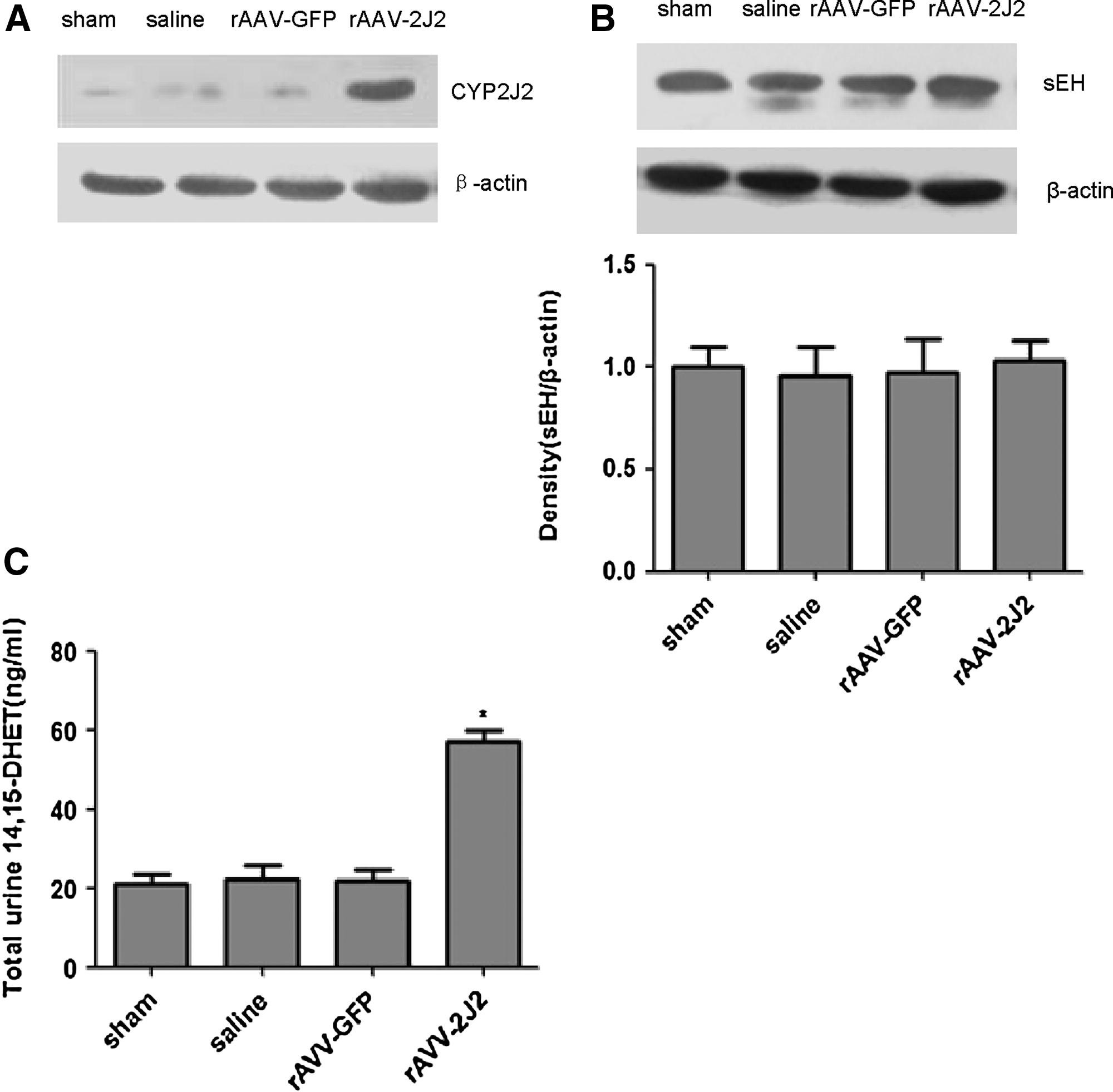
Expression of CYP2J2 and soluble epoxide hydrolase (sEH) in kidney and quantitative analysis of 14,15-dihydroxyeicosatrienoic acid (14,15-DHET) in urine.
Overexpression of CYP2J2 results in hypotensive effects and attenuates renal dysfunction
Systolic blood pressure (SBP) in 5/6-nephrectomized rats was significantly elevated compared with normal control rats 2 weeks after surgery (135±7 mmHg, n=8, vs. 97±6 mmHg, n=8; p<0.05) (Fig. 2A). rAAV-2J2 treatment reduced blood pressure by about 9 mmHg compared with preinjection levels 1 month after gene delivery and the hypotensive effect was maintained throughout the experiment period compared with both control groups, that is, the rAAV-GFP- and saline solution-treated animals (Fig. 2A). Three months after treatments, systolic blood pressure in rAAV-2J2-treated rats was about 12–19 mmHg less than in saline- or rAAV-GFP-treated rats (p<0.05). Compared with sham-operation control rats, 5/6 nephrectomy also led to a significant elevation in the levels of serum creatinine (Fig. 2B) and blood urea nitrogen (Fig. 2C). However, rAAV-2J2 gene delivery prevented any rise in these values. We also determined urinary protein excretion, and the results showed that rAAV-2J2 gene delivery notably attenuated the elevation of urinary protein (Fig. 2D). Combined, these results suggest that the overexpression of CYP2J2 exerts significant blood pressure–lowering effects and improvement of renal function.
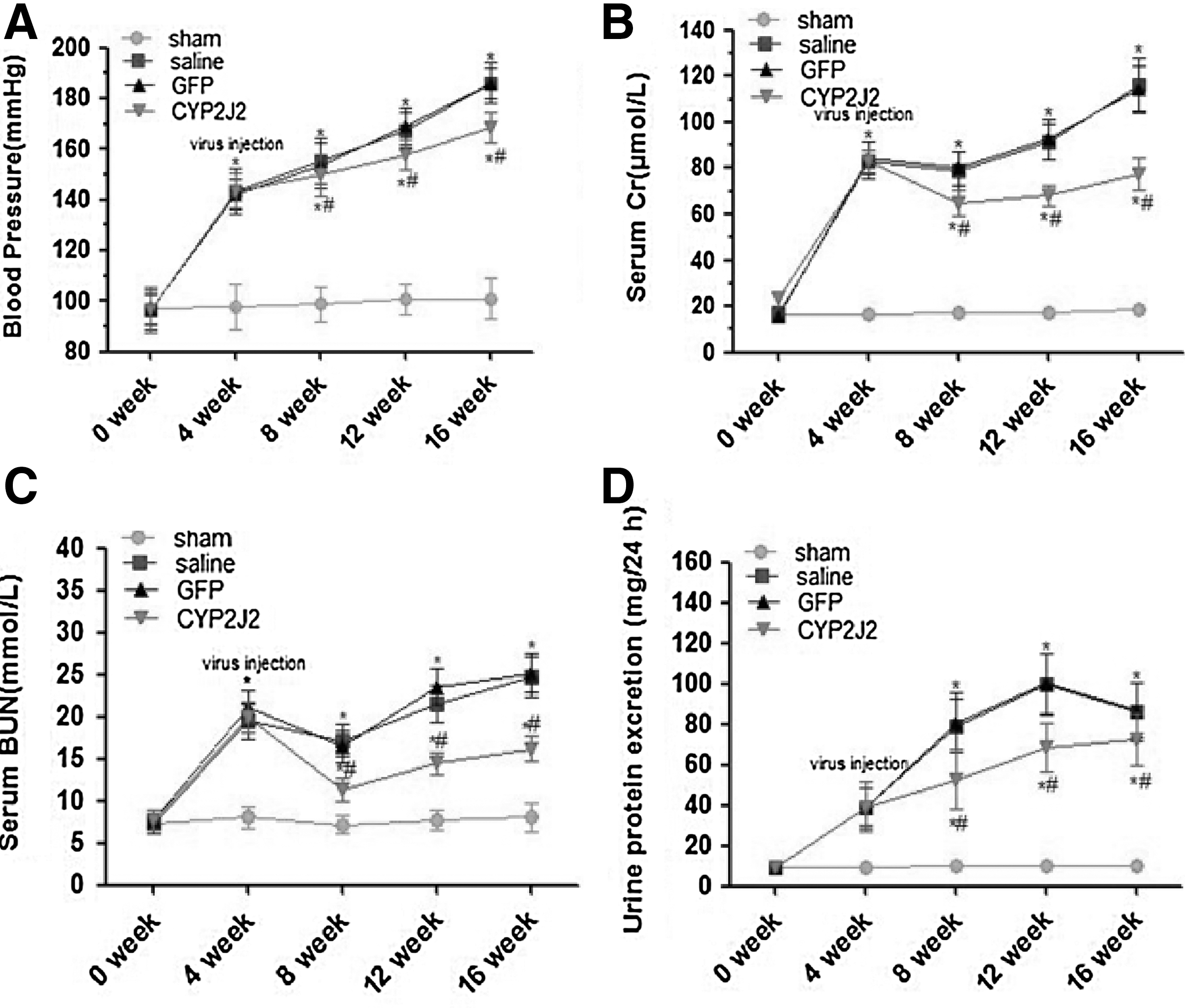
rAAV-CYP2J2 gene delivery lowers systolic blood pressure and improves renal function in 5/6-nephrectomized rats.
Effects of rAAV-2J2 treatment on kidney morphology in 5/6-nephrectomized rats
The effects of rAAV-2J2 delivery on renal injury were identified by staining with H&E, Masson's trichrome (MT), and Sirius red (Fig. 3A). H&E staining revealed severe glomerular injury characterized by glomerular sclerosis, glomerular compensatory hypertrophy, tubular dilation, luminal protein cast formation, mesangial expansion, loss of brush border, and increase in mesangial matrix accompanied by sclerotic changes in kidney sections in 5/6-nephrectomized rats. In contrast, rAAV-2J2 delivery significantly attenuated these pathological changes (Fig. 3A). Furthermore, Masson's trichrome staining of kidney sections showed significant tubulointerstitial injuries including collagen deposition and glomerular fibrosis in rats treated with saline and rAAV-GFP, whereas rAAV-2J2 treatment significantly alleviated the injuries including reducing extracellular matrix (ECM) accumulation (Fig. 3A). Sirius red staining also showed that rAAV-2J2 treatment reduced collagen deposition in kidneys (Fig. 3B). Moreover, rAAV-2J2 infusion induced a notable decrease in mesangial injury scoring (Fig. 3C) compared with 5/6-nephrectomized control rats. All these data suggest that rAAV-2J2 treatment significantly attenuates glomerular and tubulointerstitial injury induced by 5/6 nephrectomy. We also observed the morphology of liver and did not detect any change in liver cells by CYP2J2 overexpression (data not shown).

Histological assessment of rat kidney.
rAAV-2J2 delivery attenuates collagen deposition and expression induced by 5/6 nephrectomy
Immunohistochemical staining showed that rAAV-2J2 treatment for 3 months notably reduced collagen deposition induced by 5/6 nephrectomy in both glomeruli and the interstitium to a great degree (Fig. 4A), and also reduced the expression level of collagen types I and IV as detected by Western blot (Fig. 4B).
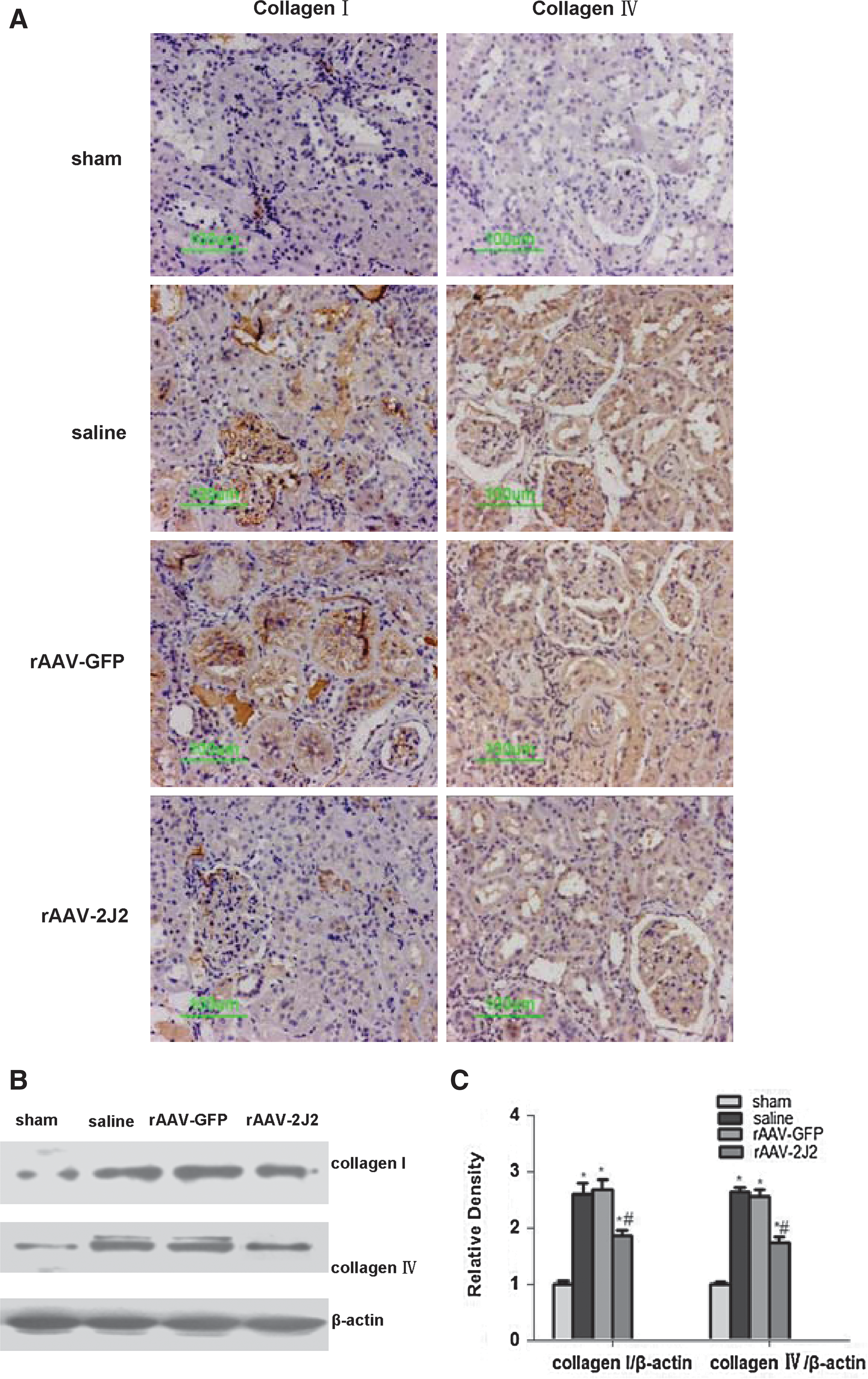
CYP2J2 gene delivery attenuated the expression of collagen types I and IV in kidney.
Effect of rAAV-2J2 delivery on the expression and phosphorylation of TGF-β/SMADs, MMPs, and MAPKs
Western blots showed that TGF-β1 expression and SMAD2 phosphorylation levels were significantly upregulated and SMAD7 expression was notably downregulated in 5/6-nephrectomized rats, but that rAAV-2J2 infusion significantly reversed these adverse effects (Fig. 5), suggesting that overexpression of CYP2J2 inhibited the desmoplastic effects of the TGF-β1/SMAD signaling pathway without affecting β-actin levels. SMAD4 expression was slightly increased by CYP2J2 treatment, although the change had no statistical significance.

5/6 nephrectomy and CYP2J2 overexpression alter renal transforming growth factor (TGF)-β/SMAD, matrix metalloproteinase (MMP)-2/MMP-9, and mitogen-activating protein kinase (MAPK) signaling pathways.
Further, we found that, as shown in Fig. 5B, overexpression of CYP2J2 notably reversed the reduction in expression of MMP-2 and MMP-9 induced by 5/6 nephrectomy.
The expression and activation of p38 mapk , JNK, and ERKs were investigated. Results showed that 5/6 nephrectomy significant increased p38 mapk and JNK phosphorylation (Fig. 5C) and slightly upregulated ERK phosphorylation, and that rAAV-2J2 gene delivery markedly reduced phosphorylation of p38 mapk and JNK and slightly upregulated the phosphorylation of ERK further. However, neither 5/6 nephrectomy nor rAAV-2J2 gene delivery had an effect on expression levels of p38 mapk , JNK, and ERK.
Tubular epithelial–mesenchymal transdifferentiation (TMET) was induced by TGF-β1 and played a crucial role in renal fibrosis. Representative Western blots showed that 5/6 nephrectomy significantly increased the expression of α-SMA and notably diminished the expression of E-cadherin (Fig. 5D). However, rAAV-2J2 gene delivery markedly attenuated the detrimental effects.
rAAV-2J2 gene delivery reduces renal cell apoptosis induced by 5/6 nephrectomy
TUNEL staining showed that 5/6 nephrectomy induced a marked increase in apoptotic cells in kidney, but that rAAV-2J2 treatment dramatically reduced apoptosis (Fig. 6). In addition, 5/6 nephrectomy notably increased caspase-3 activity in rats treated with saline or rAAV-GFP, but the increase was attenuated by rAAV-2J2 treatment and renal cell apoptosis induced by 5/6 nephrectomy correlated with increased renal caspase-3 activity (Fig. 6C).

rAAV-2J2 gene delivery reduces 5/6 nephrectomy-induced renal cell apoptosis.
It is well established that the reduction in mitochondrial membrane potential, ΔΨm, plays a key role in triggering apoptosis (Shi, 2001). In the current study, ΔΨm was detected by means of JC-1 and flow cytometry. The results are illustrated in Fig. 6D. Mitochondria displaying red fluorescence (upper left quadrant; Fig. 6D) indicate high ΔΨm; those displaying both red and green fluorescence (upper right quadrant; Fig. 6D) indicate low ΔΨm, and mitochondria displaying green fluorescence (lower right quadrant; Fig. 6D) indicate lower ΔΨm than that of mitochondria recorded in the upper right quadrant (Fig. 6D). Fluorescence-activated cell-sorting (FACS) analysis showed that high ΔΨm was maintained in mitochondria extracted from kidneys of sham-treated rats (76.5%) (Fig. 6D), but 5/6 nephrectomy notably decreased the ΔΨm in rats infused with saline (21.6%) or rAAV-GFP (25.4%). rAAV-2J2 gene delivery caused a significant increase in the percentage of mitochondria exhibiting a decreased red-to-green fluorescence ratio.
We further investigated the expression of apoptosis-related proteins by Western blotting and confirmed that 5/6 nephrectomy significantly increased the expression of Bax and downregulated the expression of Bcl-2 and Bcl-xL in rats treated with saline or rAAV-GFP. However, rAAV-2J2 infusion significantly reversed the changes induced by 5/6 nephrectomy.
Discussion
The current study confirms effective expression of the rAAV-mediated CYP2J2 gene in 5/6-nephrectomized rats and investigates the effects on blood pressure, renal function, and renal morphology. Our data demonstrate that a single intravenous injection of rAAV-CYP2J2 exerts prolonged renoprotective effects against renal injury and renal failure associated with 5/6 nephrectomy. rAAV-CYP2J2 gene delivery reduced blood pressure, improved renal function, and attenuated glomerular sclerosis and tubulointerstitial injury by inhibiting cellular apoptosis and fibrosis. The mechanisms may be associated with regulating the expression of important signal molecules, including TGF-β/SMADs/MMPs, MAPKs, and mitochondrial apoptosis pathway-related proteins Bax, Bcl-xL, and Bcl-2 and their activation. These combined data indicate that rAAV-mediated CYP2J2 gene therapy protects the kidney against development and progression of chronic renal failure in 5/6-nephrectomized rats.
Hypertension is one of the most important progression factors of chronic renal disease. The antihypertensive effect of EETs has been confirmed in numerous rat and mouse models, including spontaneously hypertensive rats, angiotensin II-induced hypertension, and deoxycorticosterone acetate (DOCA) and salt-induced and salt-sensitive hypertension (Imig, 2005; Jung et al., 2005; Loch et al., 2007; Lee et al., 2010). The antihypertensive effect of EETs was mediated by a decrease in vascular resistance and enhanced renal Na+ excretion (Imig, 2005; Imig et al., 2005). More recently, Lee and colleagues have confirmed that increased endothelial CYP epoxygenase expression attenuates afferent arteriolar constrictor reactivity and hypertension-induced increases in renal injury in CYP2J2 transgenic mice (Lee et al., 2010). Similarly, Xiao and colleagues (2010) also confirmed that overexpression of CYP2J2 notably exerted antihypertensive effects in SHRs. Consistent with the previous reports, data in the current study demonstrated that rAAV-CYP2J2 treatment resulted in prolonged elevation of renal CYP2J2 expression and significantly lowered blood pressure in 5/6-nephrectomized rats. In addition, it should be mentioned that inhibition of soluble epoxide hydrolase (sEH) to increase the level of EETs also has an antihypertensive effect, although the effects are model dependent (Fornage et al., 2002; Simpkins et al., 2009). The pathogenesis of hypertension in chronic renal failure is tremendously complex (Klahr and Morrissey, 2003), and the precise molecular mechanisms of EETs on blood pressure control and renal function require further investigation.
Previous studies have demonstrated that overexpression of CYP epoxygenase significantly increases cellular and circulating EET levels and attenuates renal injury in various models of hypertension (Lee et al., 2010). And the circulating levels of EETs are decreased in renovascular disease (Minuz et al., 2008). The integral role of renal CYP epoxygenase function in the regulation of renal sodium transport and blood pressure has been demonstrated in mice with targeted disruption of CYP2J5 and CYP4a10 (Nakagawa et al., 2006; Athirakul et al., 2008). All these reports suggest that increasing EET levels may have renal protective actions (Kaergel et al., 2002). However, the specific contribution of CYP epoxygenase to the renal function of 5/6-nephrectomized rats has remained unclear. In the current study, as expected, 5/6 nephrectomy promoted arterial hypertension, proteinuria, and impaired renal function, accompanied by severe renal fibrosis, as well as elevated apoptotic renal cells. rAAV-CYP2J2 gene delivery reversed these detrimental effects. rAAV-CYP2J2 gene delivery significantly reduces severe collagen deposition and cell apoptosis in renal cortical and medullary areas, and subsequently renal failure.
Tubulointerstitial fibrosis (TIF) is the ultimate common pathway to end-stage renal disease. In this complicated biological process, the signal pathway of TGF-β/SMADs has been considered a key mediator of the fibrotic process, and blockade of TGF-β and (or) SMAD2/SMAD3 by diverse strategies has provided strong experimental evidence of the therapeutic potential that may be achieved by targeting this pathway (Javelaud and Mauviel, 2004; Yan et al., 2009). Data from this study strongly indicate that TGF-β/SMAD signaling is a critical pathway leading to progressive tubulointerstitial fibrosis and rAAV-CYP2J2 gene delivery attenuated ECM deposition, confirmed by decreased accumulation of collagens I and IV detected by immunohistochemistry and Western blot. These beneficial effects were mediated, at least in part, by downregulation of TGF-β, dephosphorylation of SMAD2, and upregulation of SMAD7. On the other hand, MMPs play an important role in ECM degradation whenever tissue repair or remodeling occurs, especially during fibrosis (Liu, 2006). We have also acknowledged in the current study that rAAV-CYP2J2 gene delivery restored the expression of matrix metalloproteinases 2 (MMP-2) and MMP-9, which were downregulated by 5/6 nephrectomy. In addition, previous reports showed that upregulation of p38 mapk causes marked interstitial fibrosis with increased ECM abundance, which can be significantly attenuated by p38 mapk inhibition (Li et al., 2005). Similarly, remodeling of specific ECM components and upregulation of TGF-β has been demonstrated in a genetic model with sustained JNK activation (Petrich et al., 2004). We acknowledge here that rAAV-CYP2J2 gene delivery notably promoted the dephosphorylation of p38 mapk and JNK.
Cumulative evidence demonstrated that renal fibrosis in the remaining kidney of 5/6-nephrectomized animals was accompanied by increased renal cell apoptosis (Li et al., 2004). As expected, in the current study, the number of apoptotic cells in the remaining kidney significantly increased as detected by TUNEL staining. In addition, many kinds of cytokines can trigger apoptotic responses in the remnant kidney, leading to decreases in mitochondrial membrane potential (Satoh et al., 2003). In turn, disruption of the mitochondrion leads to activation of caspase-9 and caspase-3 (Cummings and Schnellmann, 2002). CYP epoxygenase-derived eicosanoids (EETs) have been reported to promote renal epithelial cell proliferation and angiogenesis via MAPK and PI3K/AKT signaling pathways (Chen et al., 1998, 2000) and via dephosphorylation of JNK1/2 (Kunduzova et al., 2002). In particular, 11,12- and 14,15-EETs have been characterized as powerful mitogens, and they are reported to induce mitogenesis of renal epithelial cells (Chen et al., 1998; Michaelis et al., 2003). Data from this study strongly indicate that rAAV-CYP2J2 gene delivery notably protected renal cells from apoptosis. These effects are associated with the maintenance of mitochondrial membrane potential as detected by JC-1 staining, restoration of the expression of Bcl-2 and Bcl-xL, downregulation of Bax, and the promotion of phosphorylation of ERK1/2 and dephosphorylation of JNK1/2.
Tubular epithelial–mesenchymal transdifferentiation (TMET) was induced by TGF-β1 and played a crucial role in renal fibrosis (Tu et al., 2008). E-cadherin is a characteristic marker of tubular epithelial cells, and loss of E-cadherin is an early and important step in TEMT. α-SMA is the characteristic marker of myofibroblasts and is not abundant in renal tubular epithelial cells. The appearance of α-SMA in tubular cells is also an early and important step in TEMT. We have observed that EETs notably inhibited TEMT in HK2 cells induced by TGF-β coincubation (our unpublished data). In the current study, we confirmed that 5/6 nephrectomy significantly reduced the expression of E-cadherin and elevated the expression of α-SMA in 5/6-nephrectomized rats receiving saline or rAAV-GFP. However, overexpression of CYP2J2 notably attenuated the detrimental effects induced by 5/6 nephrectomy.
In conclusion, we have demonstrated improved function of the remnant kidney in 5/6-nephrectomized rats by rAAV-CYP2J2 gene delivery via inhibition of renal fibrosis and renal cell apoptosis. rAAV-CYP2J2 gene delivery notably exerts an antihypertensive effect in 5/6-nephrectomized rats, and it may be mediated by a decrease in vascular resistance and enhancement of renal Na+ excretion. Simultaneously, rAAV-CYP2J2 gene delivery significantly alleviated renal fibrosis, promoted the dephosphorylation of p38 mapk and JNK1/2, inhibited the activation of TGF-β/SMAD signaling, and promoted the activation of MMPs (MMP-2 and MMP-9). rAAV-CYP2J2 treatment protected renal cells from apoptosis, maintained the mitochondrial membrane potential, promoted phosphorylation of ERK1/2, upregulated the expression of apoptosis-related proteins Bcl-2 and Bcl-xL, and downregulated the expression of Bax.
Footnotes
Acknowledgments
The authors thank Drs. Xiao Xiao and Chunping Qiao (Eshelman School of Pharmacy, University of North Carolina at Chapel Hill) for English editing and Jiaomei Shao for expert technical assistance. This work was supported by grants from the National Natural Science Foundation of China (nos. 30930039, 81170111, and 81070236) and the National Basic Research Program of China (973 Program) (no. 2007CB512004). The funders had no role in study design, data collection and analysis, the decision to publish, or preparation of the manuscript.
Author Contributions
Conceived and designed the experiments: G.Z., L.T., D.W.W., and P.H.W. Performed the experiments: G.Z., L.T., S.L.Y. Analyzed the data: X.G.L., C.C., X.X. Wrote the paper: G.Z., L.T.
Author Disclosure Statement
The authors have declared that no competing interests exist.