




Abstract

Introduction
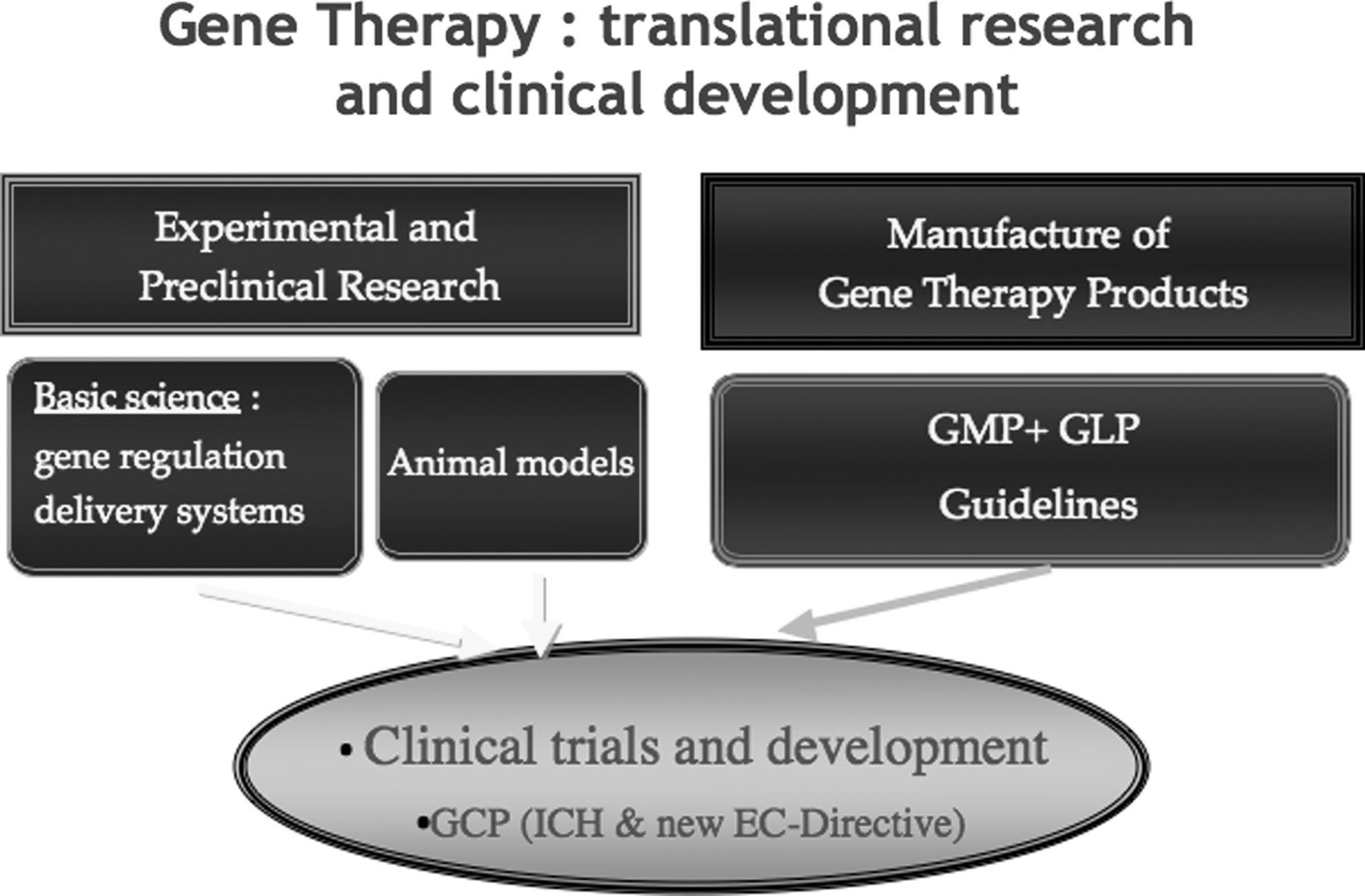
The development of clinical gene therapy is translational, which extends from basic science in gene technology, to experimental and preclinical research ending with product manufacture and clinical trials.
First International Workshop on Human Gene Transfer, Chateau de Montvillargenne, Chantilly, France
The first international symposium on gene therapy in Europe took place in April 1991, a year after Michael Blaese's team carried out the first gene therapy clinical trial in a monogenic disorder at the National Institutes of Health. This meeting, hosted by Michel Boiron and Odile Cohen-Haguenauer, was held at the Chateau de Montvillargenne and was attended by over 250 participants (Fig. 2). The meeting focused specifically on two areas in which gene transfer is particularly relevant to medicine, namely (i) the transfer of human genes to experimental animals with the aims of understanding the regulation of gene expression and creating models of human diseases, including those caused by homologous recombination, as pioneered and presented by Mario Capecchi; and (ii) the introduction of genes into human somatic cells with the ultimate aim of treating human diseases. Progress presented on this occasion was particularly gratifying. In a powerful experimental system, Claudio Bordignon (Milano) reported that genetically immunodeficient mice can be made immunocompetent by the infusion of genetically engineered lymphocytes from children with adenosine deaminase severe combined immune deficiency (SCID-ADA). At the clinical level, Michael Blaese gave a progress report on a clinical trial with children with SCID-ADA. At that time, lymphocytes transduced with an ADA-containing retroviral construct had already survived in blood circulation for up to several months and the ADA-enzyme level was significantly increased in peripheral blood white cells. It is not possible in a brief summary to do justice to those who contributed to this meeting with original results or with new ideas. The discussion was extremely stimulating, ranging as it did from the intricacies of technical details to philosophical and ethical issues (Cohen-Haguenauer et al., 1992). The symposium of Montvillargenne gave a wonderful overview of the current “state of the art” in gene transfer and an outline for future expansion (Cohen-Haguenauer and Boiron, 1991; Fig. 3). Bringing together molecular biologists, geneticists, and clinicians, the meeting made it especially clear that disciplinary labels do not matter, but a common purpose does.

The first international symposium on gene therapy in Europe, which gathered over 250 participants, took place in April 1991, at the Chateau de Montvillargenne, near Chantilly in a warm atmosphere, remote from downtown Paris. At night, a quartet played “Debussy's string quatuor”.

The Montvillargenne symposium gave a wonderful overview of the “state of the art” in gene transfer at that time, including the transfer of human genes to experimental animals with the aim to better understand regulation of gene expression and to create models of human diseases including via homologous recombination as pioneered and presented by Mario Capecchi; and a think tank on what to do next, with Lucio Luzzatto as a driving force. This first international workshop materialized into a book of proceedings published by INSERM in 1991.
It soon became evident that expertise and synergies across disciplines were needed in order to help solve crucial issues discussed during the symposium, ranging from gene regulation, safety, and type of gene delivery methods based on both virology and molecular modeling and chemistry, as well as routes and schedules of administration, which might be more effective in addressing which disease among a broad variety to treat. Since a multidisciplinary approach is needed to allow fruitful exchange between clinicians and researchers in basic science, the European Learned Society on human gene transfer and therapy was founded to meet this need, and it stands as the first such organization in the field worldwide.
First Learned Society on Human Gene Transfer and Therapy
The European Working Group on Human Gene Transfer and Therapy (EWGT), later to be called the European Society on Gene and Cell Therapy (ESGCT), was officially founded in January 1992, by Odile Cohen-Haguenauer with the initial support of the European Haematology Association established by Michel Boiron. Lucio Luzzatto's support and commitment were also critical. The society's main goal was to develop and coordinate clinical and scientific research in the area of gene transfer and gene therapy in Europe. The EWGT/ESGCT aimed at disseminating and coordinating information and the exchange of technology, material, and human expertise in the following ways: • The annual meeting of EWGT provided a forum for exchange of information and presentation of peer-reviewed data. • A scientific directory was established that described both the area of interest and the expertise of each member's team. • The EWGT also created a registry of clinical protocols of gene transfer and therapy, either in current application or planned for the future. • Twice a year, the EWGT scientific secretary released a newsletter to both foster interaction between members and circulate information from the board. Each issue included an update of the clinical protocols registry and a section dedicated to regulatory issues.
The first meeting was held on October 17, 1992, at the Chateau de Maffliers and included the founding members (Table 1). It was decided that the society would be run by a board consisting of individuals elected for a fixed term by the assembly of voting members. The officers of the board (i.e., president, vice president, secretary, and treasurer) were to be elected for fixed periods of time by the board members. The first elected board featured Claudio Bordignon as president, Erwin Wagner as vice president, and the following members: Olivier Danos, Jean-Michel Heard, Stephen Russell, Dinko Valerio, Thierry Velu as treasurer, and Odile Cohen-Haguenauer as scientific secretary based in Paris, France (Fig. 4). The society by-laws were registered in Belgium as a European nonprofit association. Any scientist or medical doctor working in the area of gene transfer and therapy was considered eligible for membership. Company personnel and researchers working outside Europe were welcome as associate members. By 1996, this unique group had achieved a federation of all major European teams working in the field and included over 550 members, including ones from Israel and 17 countries in Eastern Europe, North America, and Asia.
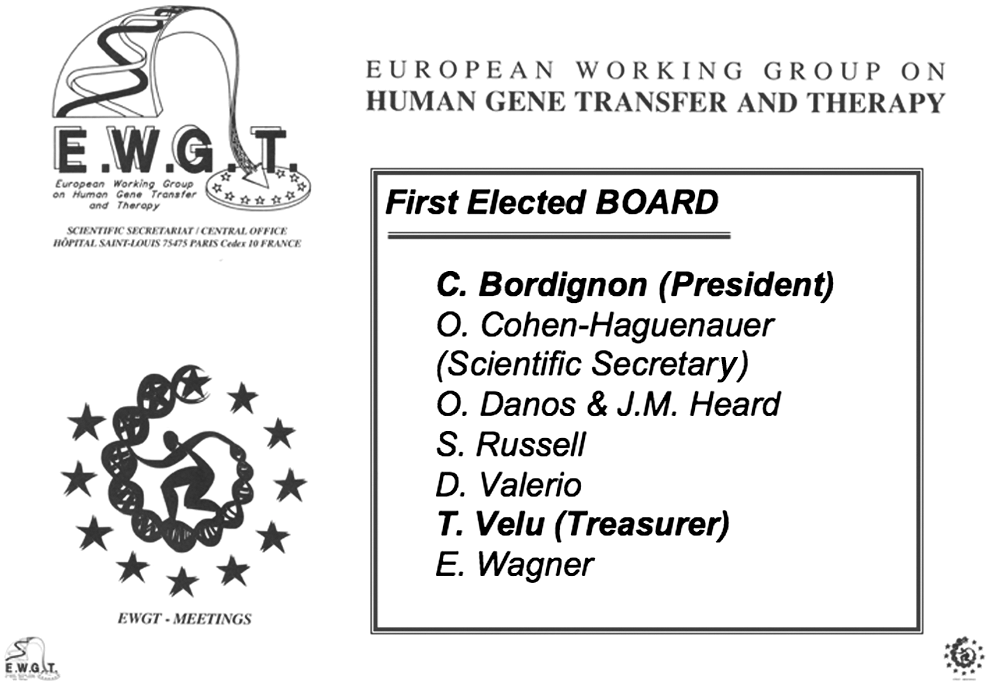
The European Working Group on Human Gene Transfer and Therapy (EWGT) later to be called the European Society for Gene and Cell Therapy (ESGCT), was officially founded in January 1992. The Society is run by a board consisting of individuals elected for a fixed term by the Assembly of voting members. The officers of the board i.e. president, vice president, secretary and treasurer are elected for fixed periods of time by the board members.
U.S. consultant.
A Unique Organization for Scientific Networking in Gene Therapy
A multidisciplinary membership has always been a priority for the EWGT because it is felt to encourage fruitful exchanges between scientists and clinicians. The coordination of information and exchanges of technology, materials, and human expertise (including medical knowledge of clinical conditions) has been streamlined by the scientific secretary/central office via a number of media (Table 2; Cohen-Haguenauer, 1996b).
The scientific directory
In order to maintain an interactive network for communication and collaboration, a directory of scientific forms completed by group leaders was distributed on floppy disks by the scientific secretariat to members at regular intervals following updates; in 1996, the directory held approximately 300 records. The directory included names, addresses, scientific profiles, and the research programs of each group (Table 3). Additional directories focused on specific applications: (1) gene therapy of cancer; (2) neuromuscular diseases; (3) metabolic and inherited diseases; (4) AIDS and infectious diseases; (5) cystic fibrosis; and (6) gene delivery systems/production scale-up as a topic common to all areas. These directories have greatly facilitated interaction between members and created opportunities to form consortia later to be funded by the European Community. The scientific directory was not further maintained past 1997.
ESGCT, European Society for Cell and Gene Therapy; EC, European Community; DG, Directorate General.
Registry of clinical protocols
Gene marking and gene therapy clinical trials were initiated in Europe in 1991, and for both genetic diseases (e.g., ADA-SCID) and cancer in 1992. In 1996, approximately 50 clinical trials were in progress or planned to begin (EWGT newsletter no. 6, May 1996). EWGT created a registry of clinical protocols throughout Europe. This listing was updated in each issue of the EWGT newsletter and reproduced in Human Gene Therapy up until 1997 along with protocols reviewed by the National Institutes of Health, Office of Biotechnology Activities-Recombinant DNA Advisory Committee.
The following items were recorded: disease of interest; gene of interest; cell target; vector; investigator; company; location (town); status (activated, closed, or planned); and number of patients involved.
Internal communication: quarterly newsletter
The EWGT scientific secretary released a quarterly newsletter by which EWGT members could interact and the board could spread information (Fig. 5). For instance, issue 2 included, with the special permission of the European Commission Directorate General III (EC-DGIII), the “Guidelines on Gene Therapy Products and Medicinal Products Derived from Biotechnology” released by the Committee for Proprietary Medicinal Products in December 1994. Issue 4 was dedicated to bioethics, with statements from the Group of Advisors on Ethical Implications of Biotechnology of the European Commission and the International Bioethics Committee (IBC) founded by United Nations Educational, Scientific, and Cultural Organization (UNESCO). The announcements section of the newsletter included information on meetings in the field of gene transfer and therapy, doctoral and postdoctoral positions, and so forth. Finally, each issue offered the opportunity to forward information provided by registered members of the society.

The EWGT/ESGCT aims at disseminating and coordinating information and exchange of technology, material and human expertise. With its inception up until 1997, the scientific secretary initiated: (i) a scientific directory—circulated on floppy disks—which included the details of both area of interest and expertise of each member's team; (ii) a registry of clinical protocols of gene transfer and therapy, either in current application of planned for the future; (iii) a newsletter released twice a year to foster interaction between members and circulate information. Each issue included an update of the clinical protocols registry and a section dedicated to regulatory issues. Cover pages from issues 5 and 6 are shown, as examples.
Research Funding
With the fourth framework program of the DGXII, somatic gene therapy was registered for the first time as a priority in both the Biomed 2 and Biotechnology programs. This represented a significant step forward because up until 1994 official recognition of this field by the European Parliament and the Commission of the European Union were strongly disputed. Both the acting president and scientific secretary of the society initiated action from 1992 onward to convince members of the European Parliament and decision-makers at EC DGXII-research that gene therapy was not meant to modify the inherited genetic make-up of human race but rather provide innovative options and hope for lethal diseases, many of which were orphan or rare disorders affecting infants and children. Support of the DGXII was expected to affect gene therapy research positively and foster new international collaborations (“European added value”), as later proved to be the case (Draghia-Akli, 2012).
Scientific Meetings and Training
EWGT yearly meeting
Since the first meeting in October 1992, EWGT has held an annual Congress in October or November of each year. The venue moves between different European countries so as to encourage recruitment of new members and to share the organizational workload between existing members. These meetings receive sustained support from the DGXII of the European Commission (Human Genome Area, FP4-Biomed 2 programme).
The first Congress open to public registration took place in Baveno-Stresa (November 1993; President Claudio Bordignon), following the first meeting of the founding members in 1992 at Maffliers. The aim was to define gene therapy research and to identify active groups in Europe. The second annual meeting (London, November 1994; President Stephen Russell) focused on gene transfer technology. Scientific abstracts were initially published in Gene Therapy. The third annual meeting took place in Barcelona (November 1995; President Fatima Bosch) and attracted over 500 scientists. The goal was to revisit major questions such as results of early clinical trials and how progress in cell biology and transplantation could provide support to improve gene therapy effort. The fourth annual meeting took place in Leiden (November 1996; President Dinko Valerio and Vice President Rob Hoeben). Topics covered included technological aspects of gene transfer and therapy along with safety, cell engineering, and ethical issues.
Since the inception of the European society's meetings, communication of recent data and the participation of young scientists have been encouraged. A significant amount of time is allocated to oral presentation of selected posters, and fellowships are available (candidates being selected by a panel of referees). Every year the “ESGCT European Award on Gene Therapy” is given to a young scientist who is believed to have significantly contributed to the field. This award was initially granted by Fondazione Malattie rare Mauro Baschierotto and was created with the help of the first president, Claudio Bordignon. Finally, simultaneous interactive workshops focus on specific diseases.
Training
Besides the requirement for technical resources, this rapidly evolving and complex field requires a high level of technological skills and education. Expertise in molecular biology has to combine with knowledge of disease pathophysiology, immunology, and toxicology. In addition, management of the biological risks mandate strict adherence to regulatory requirements. Efficient and widespread training has been organized by the EWGT as the society was initiated. A partnership was established with the European School of Haematology (led by Didi Jasmin and created by Michel Boiron) to deliver a series of three “Euroconferences.” This series of training meetings focused on European efforts to define the best vectors for somatic stem cells gene therapy. It received support from the DGXII of the European Commission (“training and mobility of researchers”) as Euroconferences in 1995. Such courses provided training for young scientists with fellowships made available, at a level otherwise only possible in the United States. The first conference took place in Palermo in April 1996. While scientific publications obviously contribute to higher education, the establishment of a strong network inside the scientific and medical community streamlines the spread of knowledge.
Regulation of Gene Therapy
Background
The initiation of clinical trials (most of them being pilot or phase I/II studies, initially and ever since) requires an appropriate rationale, including a satisfactory balance between the potential risks and benefits, and the use of clinical grade reagents. The manufacture of either “drug,” “device,” or “biological product” used for therapeutic purposes for human patients was and still is regulated by Good Manufacturing Practices and Good Laboratory Practices among other regulations and guidelines. Because good implementation of clinical trials requires the coordination of both medical knowledge pertaining to a particular disease and scientific knowledge of the technology and adherence to regulatory requirements, partnerships between academic centers and biotechnology companies play a critical role in promoting technological innovation and early clinical trials. Gene therapy for the rare inherited disorders led to the establishment of academic production centers in both the United States and in Europe. (Cohen-Haguenauer, 1996a).
European centralized regulation
In December 1994 the Committee for Proprietary Medicinal Products approved a final draft of the guidelines concerning “Gene Therapy Products: Quality Aspects in the Production of Vectors and Genetically Modified Somatic Cells” (DG III/3477/92; this text was reproduced in the February 1995 issue of the EWGT newsletter). These products would be subject to a centralized procedure for marketing authorization issued by the European Medicines Evaluation Agency (EMEA later to become European Medicines Agency [EMA] in 2011).
At the level of each member state
Information relevant to regulation of human gene transfer and therapy in each member state was collected and updated at regular intervals in the EWGT newsletter and eventually published (Cohen-Haguenauer, 1995; Cohen-Haguenauer et al., 2002).
Scientific advisory body
The EWGT and its board in particular are prepared to act as a scientific advisory body for the review of guidelines, scientific programs, clinical protocols, etc., and were asked to act in this capacity by the EC DGIII-Pharmacy and DGXII-research. In addition, the board circulated among the society members primary recommendations and safety considerations when considering clinical implementation of protocols (Cohen-Haguenauer, 1994; 1997).
Extended Audience
European platform of biotechnology companies
EWGT made a common statement together with Animal Cell Technology Industrial Platform (ACTIP), the organization representing European biotechnology companies in that field. This statement identified two areas of high priority: first, to encourage development of technologies through preferential partnership between companies and academic labs, according to common areas of interest; and second, to provide consistent advice and expertise to European authorities.
Although there were important examples of companies specializing in gene therapy, such as Transgene S.A. (Strasbourg France, founded in 1980), Therexsys Ltd. (Keele, U.K., 1992), and lntrogene B.V. (Risjswik, the Netherlands, 1993), the picture of industrial involvement in the field of gene therapy in Europe was characterized at that time by the involvement of big pharmaceutical companies such as Boehringer Ingelheim, Boehringer Mannheim, Glaxo, Rhône Poulenc-Rorer (with the creation of Gencell), and Novartis (Sandoz–Ciba Geigy merger). Unfortunately this situation was soon to vanish because of the technological complexity and the timelines necessary to achieve first clinical proofs of concept.
The implementation of clinical gene therapy protocols benefited from the direct involvement of several academic groups of excellence. The need for early and comprehensive analysis of the results of clinical protocols was anticipated, addressing in particular safety and efficacy issues that required both scientific and medical expertise and significant financial resources.
Interaction with bioethics committees
Sustained contacts (and representation in respective meetings) were established between the EWGT and both the Group of Advisors on Ethical Implications of Biotechnology of the European Commission and the IBC founded by UNESCO in which Odile Cohen-Haguenauer served as a permanent delegate representing the European Society. Both bodies shared the same President, Mrs. Noëlle Lenoir.
Interaction with charities and patient associations
Interactions with charities and patient associations mostly involved those serving patients with genetic disorders, e.g., Association Française contre les Myopathies (AFM acting as a major sponsor), Fondazione Malattie rare-Mauro Baschirotto, Italian Telethon, and lysosomal storage diseases or DMD associations.
Interaction with official representatives: European Commission
Interactions with official representatives took place with both DGIII (Directorate of Industry-Industrial Affairs III. Consumer Goods Industries-Pharmaceutical Products) and DGXII (Directorate of Science Research and Development-joint Research Centre-Life Sciences and Technologies both in Biomed 2-, Biotechnology- and Training and mobility of researchers programmes).
Inspiring the Birth of Gene Therapy Learned Societies Worldwide: Contribution to the Creation of the American Learned Society
As reported by George Stamatoyannopoulos (2010), the European Society had a hand in the creation of the American counterpart when he decided to launch the American Society for Cell and Gene Therapy (ASGCT) and initiated action towards this end in the spring of 1996. At that time, the ESGCT scientific secretariat had a circulation list of over 2000 international contacts worldwide. In order to help establish the ASGCT and to announce its creation, Odile Cohen-Haguenauer sent to George Stamatoyannopoulos as many labels as contacts listed in the ESGCT files. Attendance at the first ASGCT meeting held in Washington, DC, in June 1998 met expectations, and Jim Wilson was the first elected president of the ASGCT.
Evolution of the ESGCT
With the Barcelona meeting in November of 1995, a new logo was created for the ESGCT meetings, while the former was still in use as the symbol of the scientific secretariat/ central office (Fig. 4). After the initial growth phase of success—fast expansion over 5 years, intensive networking, and funding for the first time through the EC DG-research fourth framework programme (FP4)—transition times and political issues came into play with the renewal of the society president position. Together with the vote for a new, young, French president, shifting of the scientific secretariat out of France was eventually requested and implemented. When the new president took office, the scientific secretary and founder of the society immediately stepped down and use of the first logo was discontinued.
The society has also had to face difficult times when major adverse events occurred in clinical trials: first, in 1998 in the United States, with the tragic death of a young boy infused systemically with an adenovirus-derived vector; and, later in 2001 in France, when leukemia developed in an X-SCID infant as a direct consequence of the integration of the gammaretrovirus vector carrying the otherwise therapeutic gene into the host cell genome, which triggered enhancer-mediated genotoxicity and uncontrolled proliferation of gene-modified cells.
During this complicated period for the field, Bernd Gänsbacher took over as president in 1999 and remained extremely active in reshuffling and reshaping the society during five consecutive years up until 2004. Due to his efforts, the ESGCT started to recover and progressively improved both in membership and in the quality of the yearly meeting, which currently stands as an international reference.
At the same time and in parallel, it became obvious that ethical, legal, social, and regulatory issues (ELSA) had to be addressed; these had never been as salient components in the field of gene therapy. While the society was focusing on establishing its yearly meeting, it was not prepared to initiate major actions in ELSA. This is how Euregenethy 1 was born, as an FP4 EC-funded undertaking coordinated by Odile Cohen-Haguenauer. Euregenethy 2 followed as a thematic network under EC fifth framework program. Robust and sustained interaction with regulatory authorities, an active website, publications, and meetings gathering all stakeholders in the field led the thematic network to expand into funding collaborative research in a way that was meant to encourage synergies (Table 4). Indeed, the EC-FP6 NoE CliniGene was officially launched in 2006 as the European network for the advancement of clinical gene transfer and therapy. While CliniGene was running up until the end of 2011, partners involved in it experienced strong acceleration of progress in both basic and clinical research (Fig. 6). A state-of-the-art book has just been published by the NoE, which intends to share 6 years of intensive collaboration (

The EC-FP6 NoE CliniGene was officially launched in 2006 as the “European Network for the Advancement of Clinical Gene Transfer and Therapy“ funded by the EC-DG research (
EMA, European Medicines Agency; EMEA, European Medicines Evaluation Agency; CHMP, Committee for Proprietary Medicinal Products for Human Use.
In Conclusion
Whatever the interest raised by gene therapy and its innovative potential, the relevance of this approach constantly needs to be carefully considered in terms of feasibility, economical constraints, and ethical issues and against alternative treatments such as targeted drugs. Behind the disease and the possible therapy, there is first and foremost the patient. Patients are the most concerned with innovative therapies, which they might perceive as hope for a miracle. The community has a responsibility to move ahead and at the same time to convey to patients measured and conservative expectations. Multidisciplinary interaction only makes fruitful exchanges possible between investigators in basic science and clinicians in order to help overcome the many bottlenecks in play and draw a critical path between basic genetic discovery and clinical implementation. This was the basis for the creation of the ESGCT and later of CliniGene as its professional companion in the Ethical and Regulatory field and experimental arm, taking from Inder Verma's word of wisdom: “In science, we build up on what already exists, learning from others. Creativity comes from the ability to see the data, integrate them and extrapolate from them. You multiply by sharing: share your reagents, share your ideas openly and freely because science is a collaborative effort: no single person can do everything” (Vilcek Prize, 2008). It will soon be straightforward that a continuation of CliniGene actions will be necessary. The ESGCT is now well established (