




Abstract
Acute intermittent porphyria (AIP) results from haplo-insufficient activity of porphobilinogen deaminase (PBGD) and is characterized clinically by life-threatening, acute neurovisceral attacks. To date, liver transplantation is the only curative option for AIP. The aim of the present preclinical nonhuman primate study was to determine the safety and transduction efficacy of an adeno-associated viral vector encoding PBGD (recombinant AAV serotype 5–codon-optimized human porphobilinogen deaminase, rAAV5-cohPBGD) administered intravenously as part of a safety program to start a clinical study in patients with AIP. Macaques injected with either 1×10¹³ or 5×10¹³ vector genomes/kg of clinical-grade rAAV5-cohPBGD were monitored by standardized clinical parameters, and vector shedding was analyzed. Liver transduction efficacy, biodistribution, vector integration, and histopathology at day 30 postvector administration were determined. There was no evidence of acute toxicity, and no adverse effects were observed. The vector achieved efficient and homogenous hepatocellular transduction, reaching transgenic PBGD expression levels equivalent to 50% of the naturally expressed PBGD mRNA. No cellular immune response was detected against the human PBGD or AAV capsid proteins. Integration site analysis in transduced liver cells revealed an almost random integration pattern supporting the good safety profile of rAAV5-cohPBGD. Together, data obtained in nonhuman primates indicate that rAAV5-cohPBGD represents a safe therapy to correct the metabolic defect present in AIP patients.
Introduction
A
DNA transfer vectors derived from recombinant adeno-associated virus (rAAV) (a nonpathogenic Parvovirus) are now established as an efficient and versatile tool for gene therapy. AIP is an attractive candidate disease for gene therapy, since affected individuals are immunologically tolerant to the PBGD protein and the histology of the liver parenchyma is normal. This feature facilitates the access to hepatocytes of the 18–26 nm viral particles, which can easily cross the highly fenestrated hepatic endothelium. AAV2 is the best characterized prototypic recombinant vector and has been employed in over 40 clinical trials (Mingozzi and High, 2011a). However, humans are a natural host for AAV2 and primary infection often generates anti-AAV2 neutralizing antibodies, which are very prevalent in the general population (Boutin et al., 2010). AAV5, the most divergent of the AAV clades, is a more promising candidate for gene therapy applications, because of the very low prevalence of neutralizing antibodies against this serotype (Gao et al., 2004; Boutin et al., 2010; Sen et al., 2013).
The efficacy of AAV5 for liver-directed gene therapy has been demonstrated in large-animal models with preexisting immunity to AAV2 and AAV8 (Davidoff et al., 2005). Unlike other serotypes, recombinant AAV serotype 5 (rAAV5) transduces nearly exclusively the liver after intravenous injection to mice (Paneda et al., 2009). Transduction of hepatocytes with rAAV5 is dependent on the presence of the platelet-derived growth factor receptor and α2,3-N-linked sialic acid (Pilz et al., 2012). Intravenous administration of an AAV5 vector encoding a codon-optimized human PBGD cDNA provided sustained protection against induced attacks in a predictive model for AIP (Unzu et al., 2011). On the basis of this preclinical study, it can be assumed that porphyric attacks in patients can be prevented by increasing PBGD enzymatic activity in the liver (Unzu et al., 2011).
Recombinant AAV vector genomes persist predominantly as episomes, and compared with integrating retroviral and lentiviral vectors, recombinant AAV have not been determined to integrate into host chromatin with any significant frequency. Nevertheless, if integration takes place, preferred regions of integration have been identified. These are, for example, chromosomal breakage sites, DNA palindromic regions, active genes, GC-rich regions, and CpG islands (Nakai et al., 2003; McMahon et al., 2006; Li et al., 2011). However, more recent studies using linear amplification-mediated polymerase chain reaction (LAM-PCR) and pyrosequencing showed a close to random integration pattern within the nuclear genome (Nowrouzi et al., 2012; Kaeppel et al., 2013). Thus, additional integration site (IS) analyses in large animals are required to confirm the safety of the vector, regarding the potential risk of insertional mutagenesis.
Porphyric attacks are approximately five times more common in female than in male AIP patients (Deybach et al., 2006). To date, there is only very limited data regarding the transduction efficiency of AAV vectors in female nonhuman primates (NHPs) (Gao et al., 2006). Therefore, in the present study we analyzed the transduction efficiency of rAAV5 in both sexes of NHPs.
Our results indicate that intravenous administration of recombinant AAV serotype 5–codon-optimized human porphobilinogen deaminase (rAAV5-cohPBGD) was well tolerated and did not result in significant side effects. Moreover, vector integration frequency was low with a largely random profile. Importantly, dose-dependent and clinically relevant levels of PBGD transgene expression were detected. In conclusion, these data indicate that AAV5-based vectors are suitable tools for gene therapy of AIP.
Materials and Methods
Animals and experimental procedures
Young adult cynomologous monkeys (Macaca fascicularis; mean age 4 years) with body weights ranging from 2.5 to 4 kg were obtained from R.C. Hartelust (Tilburg, The Netherlands) (Supplementary Table S1; Supplementary Data are available online at
Clinical evaluation parameters included the following: viability/mortality, animal behavior (including an evaluation of general health), body weight, and food intake. With regard to the analytical parameters, the following were measured: serum biochemistry (by a biochemical autoanalyzer Boehringer Mannheim Hitachi 911); complete hematological/coagulation studies (by a Sysmex XT-1800i automatic hematograph and a coagulometer STAGO STart4); and urine analysis (by a Cobas u411 analyzer). Cardiac function was evaluated by electrocardiographic recordings obtained before administration and 15 days after treatment. Animal autopsy, performed 30 days after vector injection, completed the toxicology evaluation by means of organ weights, macroscopic evaluation, and anatomopathological characterization. The experimental design was approved by the Ethics Committee for Animal Testing of the University of Navarra and by the health department at the government of Navarra (ref: NA-UNAV-056-09).
Vector construction, cGMP-grade large-scale production, and purification
The therapeutic expression cassette of rAAV2 serotype 5 (rAAV2/5) contains the human cDNA of the housekeeping PBGD isoform under the control of the liver-specific EalbAAT promoter and the human PBGD polyadenylation sequence (bases 9,550–9,655: GenBank accession no. M95623). We developed a new sequence of the human cDNA sequence by (1) introducing a Kozak sequence to increase translational initiation, (2) increasing the GC content to prolong RNA half-life, and (3) changing rarely used codons with those that are used with high frequency in humans. That codon choice was related to the transfer RNA abundance in human cells to increase mammalian expression. Finally, two stop codons were added to ensure termination. Amino acid sequence of the human PBGD codon-optimized cDNA (cohPBGD) is identical to that obtained from the human housekeeping PBGD isoform (Unzu et al., 2011). rAAV2/5 vectors were generated in Sf9 insect cells30 by the Baculovirus Expression Vector System (Protein Sciences) in a wave bioreactor. Purification was performed by AVB Sepharose high-performance affinity medium (GE Healthcare). Eluate was diafiltrated with 5 eluate volumes of phosphate-buffered saline–5% sucrose.
rAAV titers, in terms of vg/ml, were determined by real-time quantitative PCR (qPCR) TaqMan (Applied Biosystems). Composition and purity of viral production was determined by sodium dodecyl sulfate–polyacrylamide gel electrophoresis. A single virus production of 240 ml was used for all the monkeys and the titer of the virus was 3.25×10¹² vg/ml.
Vector DNA and RNA quantification
Total DNA and RNA were extracted in duplicate by the QIAamp DNA and RNA mini kit from tissue samples and from the different body fluids. Total RNA was reverse transcribed to cDNA. Viral DNA and cDNA samples were quantified by means of qPCR (Unzu et al., 2011). The assay showed linearity, over a linear range of six logs (50 to 5×10⁷ genome copies per reaction). The lower limit of quantification was determined to be 50 vector genome copies per reaction. To determine the efficacy of the DNA extraction procedure and to detect the presence of potential PCR-inhibitory agents in the different samples, a parallel DNA viral extraction sample in duplicates was performed after the addition of 105 rAAV5-cohPBGD viral genomes. The assay was validated in accordance with the ICH harmonized tripartite guideline Validation of Analytical Procedures: Methodology.
PBGD activity measurement
PBGD activity was determined by measuring the conversion of porphobilinogen to uroporphyrin. Briefly, liver tissue was homogenized at 4°C in 4 vol. of KCl solution 1.15%. The homogenate was centrifuged at 12,000 rpm at 4°C for 20 min, and the clear supernatant was used for protein determination (Bradford using an albumin standard) and PBGD activity. The supernatant was incubated in the dark with porphobilinogen at a final concentration of 0.21 mM at 37°C for 60 min. The reaction was stopped with cold trichloroacetic acid 40%, and the uroporphyrinogen formed was oxidized to uroporphyrin after light exposure. Uroporphyrins were measured quantitatively in a Spectrofluorometer (LS20B; PerkinElmer) with an excitation peak at 405 nm and window emission peak values between 595 and 600 nm. PBGD activity was expressed in terms of pmol uroporphyrin/mg protein/hr by appropriate standards.
Analysis of humoral and T cell immune response in monkeys
The presence of neutralizing antibodies against AAV serotype 5 was determined as described (Paneda et al., 2011). To evaluate potential cellular immune responses directed against the vector capsid or the transgene after rAAV5-cohPBGD vector administration, peripheral blood lymphocytes were purified by centrifugation through ficoll-hypaque (GE Healthcare). Isolated lymphocytes (5×10⁵ cells/ml) were cultured in triplicate in medium alone, or in the presence of purified rAAV5 capsid proteins (10 μg/ml), or purified recombinant human PBGD protein (rhuPBGD) (10 μg/ml), or phorbal myristate acetate (PMA) 0.05 μg/ml+ionomycin 0.5 μg/ml (PI). After 48 hr, cells were harvested, RNA was extracted, and IFN-γ and β-actin expression was analyzed by reverse transcription followed by qPCR (RT-qPCR), using the primers described in (Paneda et al., 2011).
Vector integration analysis
To analyze the safety of rAAV5-cohPBGD in respect to vector integration, we included LAM-PCR as described previously to assess potential integrations events (Gabriel et al., 2009; Paruzynski et al., 2010; Abel et al., 2011; Kaeppel et al., 2013). Briefly, DNA was isolated from four liver sections per animal by the High Pure PCR Template Preparation Kit (Roche Diagnostics). About 500 ng of DNA was used for LAM-PCR, which starts with a linear amplification by primers binding outside of the inverted terminal repeats (Supplementary Table S2). This amplification step was followed by a double-stranded DNA synthesis and a restriction digest by the different endonucleases MseI and NlaIII (5-prime LAM-PCR), and MseI and Tsp509I (3-prime LAM-PCR), respectively. Afterward, a specific linker cassette was ligated, and two nested exponential PCRs by linker and vector-specific primers (Supplementary Table S2) were performed. Finally, the samples were prepared for next-generation pyrosequencing (GS FLX Titanium 454 pyrosequencing; Roche Diagnostics) by an additional exponential PCR by barcoded fusion primers as described previously (Gabriel et al., 2009; Paruzynski et al., 2010). Bioinformatical data mining was performed as described recently (Nowrouzi et al., 2012), allowing the analysis of different integration features, including integration profile, concatameric rearrangements, and occurrence of ITR breakpoints.
Statistical analysis
The data are presented as mean values±standard deviation, and all data were analyzed for significance by the Student's t-test (GraphPad Prism 5.0), where p<0.05 was considered significant. For the integration analysis, p-values were calculated by a binominal distribution, two-sided test (p<0.05).
Results
Vector administration and follow-up
Nine young adult cynomologous monkeys (mean age 4 years) were divided into three experimental groups (Supplementary Table S1): Group 1, the control group, consisted of 2 females (AZ126, AZ356) and 1 male (BD355), which received an intravenous infusion of 120 ml vehicle; Group 2, the low-dose group, consisted of 2 females (AX593, AZ265) and 1 male (BD359), which received an intravenous infusion of 1×10¹³ vg/kg rAAV5-cohPBGD; Group 3, the high-dose group included 2 females (AW734, AW073) and 1 male (BC012) given an intravenous infusion of 5×10¹³ vg/kg rAAV5-cohPBGD. The nine macaques were maintained for 30 days after infusion. No lethality occurred in any of the animals to which the vector was administered. No alterations in weight gain or food intake were observed in the treated animals compared with the control group (Supplementary Fig. S1A). Intermittent diarrhea was observed in the animals, but this was explained to pertain to the presence of intestinal parasites (detected in the histological study of intestinal samples; Data not shown). Clinical laboratory parameters, including hematological parameters, coagulation tests, urine analysis, renal and liver function tests, and complete blood count, remained normal at any time after injection. A transient elevation of aspartate aminotransferase (AST) and creatine phosphokinase (CPK) was observed at 8 and 48 hr after vehicle or vector injection, but alanine aminotransferase and gamma glutamyl transferase remained unaltered (Fig. 1). Levels of AST and CPK returned to basal levels after 72 hr.
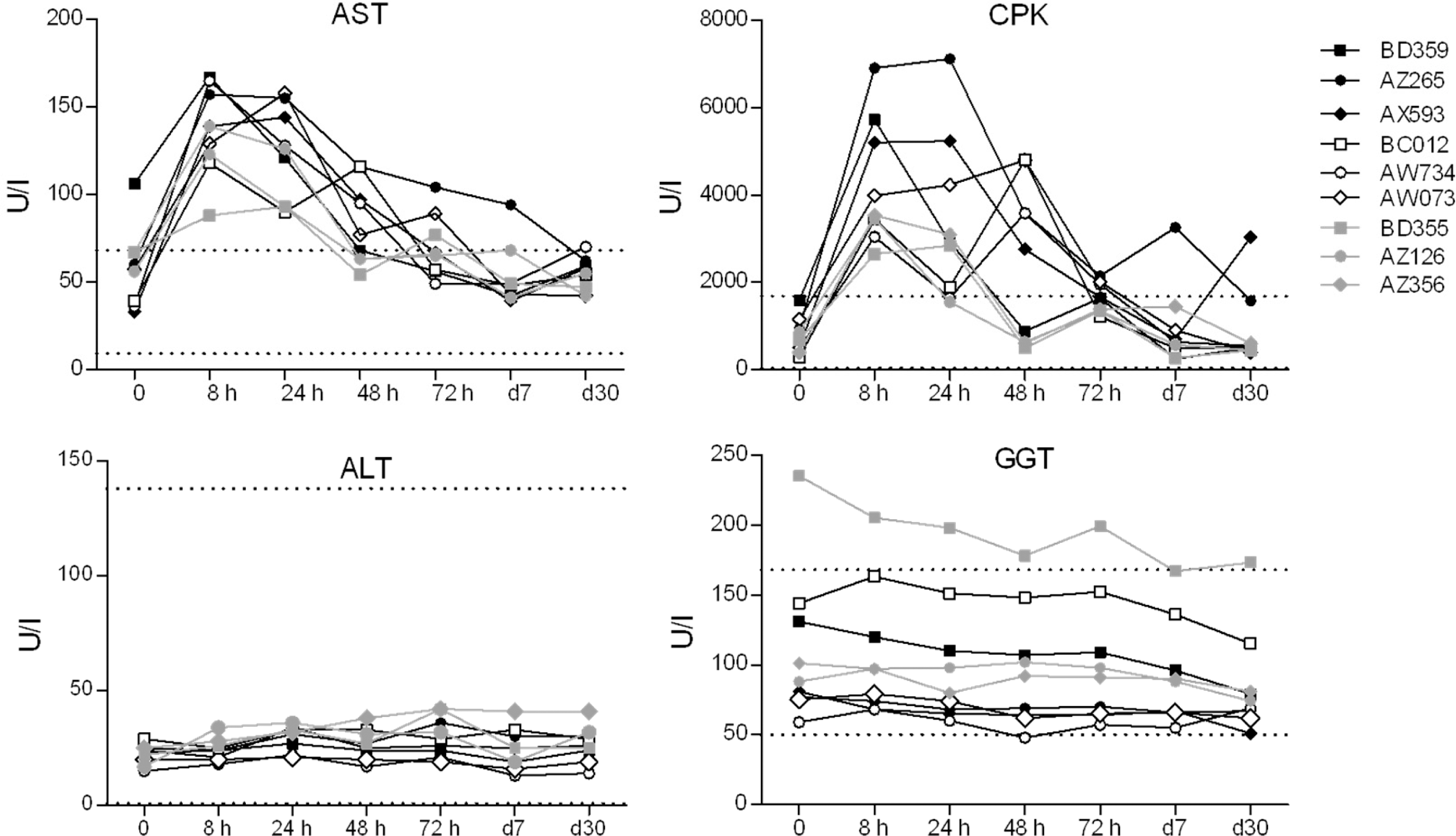
Serum biochemistry. Individual values of AST and CPK units/liter (U/l) at different time points after the administration of the vector or vehicle. 0 (before injection), 8, 24, 48, and 72 hr and 7 and 30 days after vector injection. The horizontal dashed lines represent the upper and lower normal values for the different parameters in Macaca fascicularis; the information was obtained from the Canadian Council on Animal Care and from California National Primate Research Center. ALT, alanine aminotransferase; AST, aspartate aminotransferase; CPK, creatine phosphokinase; GGT, gamma glutamyl transferase.
We did not observe any elevation of proinflammatory molecules such as the monocyte chemotactic protein-1 (MCP-1) or IL-6 shortly after rAAV5-cohPBGD injection (Supplementary Fig. S1B and C). Electrocardiography was performed at baseline and 15 days after vector administration, and no significant changes were observed (data not shown).
Viral shedding
Using real-time qPCR, we investigated the presence of the vector DNA in serum, urine, feces, nasal secretion, saliva, and semen at different time points after rAAV5-cohPBGD administration. We found maximum vector DNA concentrations 8 hr after vector injection, decreasing thereafter to fall below detectable levels at day 30 postinjection (Fig. 2A). Presence of vector DNA in serum was sustained in macaques that received the highest dose of rAAV5-cohPBGD. Vector DNA was transiently present at very low levels in saliva, urine, nasal secretion, and feces, but was undetectable in all animals by day 30 (Fig. 2B–E). Semen samples from male monkeys were obtained before and at different time points after vector injection. Vector DNA was detected only once, at day 8, in the macaque that received the high dose. A semen sample from the same animal at day 30 was negative (Fig. 2D).
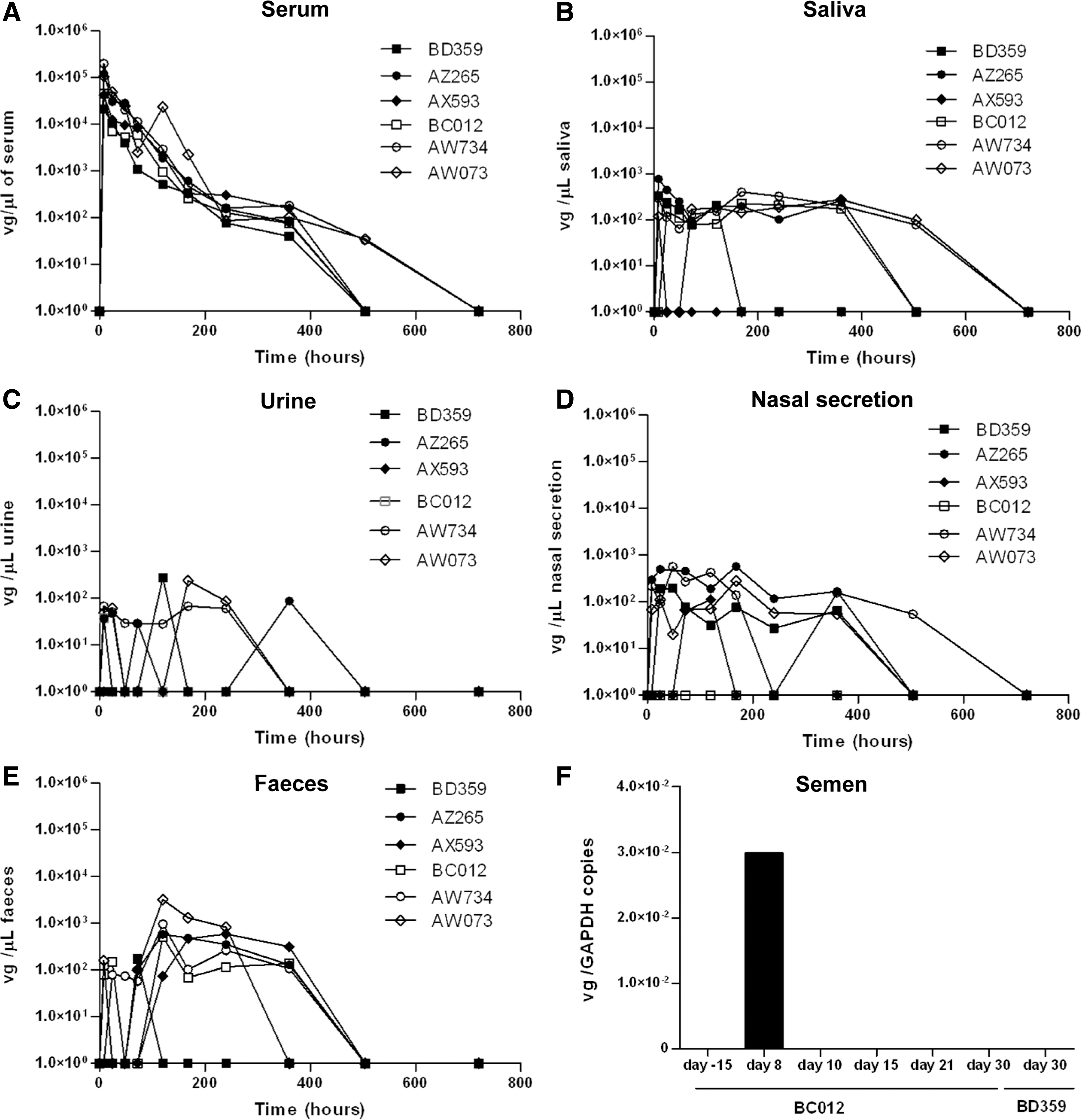
Analysis of vector DNA in body fluids. Shedding of vector DNA was analyzed by qPCR in several
rAAV5-cohPBGD liver transduction efficiency
Total DNA was purified from eight different regions of the liver at necropsy. Vector DNA was analyzed by qPCR. The endogenous gapdh gene served as the internal reference. As illustrated in Fig. 3A, vector DNA was homogenously distributed through the liver parenchyma. The amount of vector genomes in the liver was directly proportional to the dose administered. In the low-dose group, the vector genome/vg copy number per μg of DNA ranged from 5×10⁴ to 2×10⁵ vg/μg, while in the high-dose group, the copy number ranged from 1.5×10⁵ to 1×10⁶ vg/μg (Fig. 3A). To analyze vector expression levels, total RNA was extracted from eight different regions of the liver, and cohPBGD expression levels were determined by RT-qPCR. mRNA analysis showed that all the animals receiving rAAV5-cohPBGD expressed coPBGD mRNA at levels >10,000 copies/μg RNA (Fig. 3B). The transduction efficiency in male and females were comparable. Using RT-qPCR, we compared the levels of human PBGD mRNA expressed by the vector to the PBGD naturally expressed by the macaque hepatocytes. As shown in Fig. 3C, the levels of transgenic PBGD expression obtained after the injection of the low and high dose of virus is ∼10% and 50% of the naturally expressed PBGD, respectively. Next, we analyzed PBGD activity in liver biopsies taken before vector administration (Basal, B) and in the eight different regions of the liver taken at necropsy (30D). As shown in Fig. 3D, only in the group injected with the higher dose of virus a significant increase on PBGD activity was detected.

rAAV5-cohPBGD liver transduction.
rAAV5-cohPBGD biodistribution
We analyzed the biodistribution of vector DNA upon sacrifice 30 days after vector administration. A total of 33 tissue samples were studied to determine the presence of vector genome by qPCR. No signal was detected in any organ from animals infused with vehicle (data not shown). In monkeys treated with rAAV5-cohPBGD, the biodistribution pattern was independent of vector dose. The highest concentrations of vector DNA were detected in the liver, the spleen, and in the adrenal gland—average of 1×10⁵ vg/μg DNA in the low-dose cohort and 5×10⁵ vg/μg DNA in the high-dose group (Fig. 4A). Lower vector copy numbers were determined in lymph nodes, lung, heart, kidney ovaries, and uterus (∼1×10³ vg/μg of DNA) (Fig. 4A). We also determined transgene expression in different tissues by RT-qPCR. In addition to the liver, human PBGD expression was detected only in the adrenal glands, but at levels 10 times lower than in the liver (Fig. 4B). Interestingly, lower levels were found in male NHPs than in female NHPs.

Tissue distribution of vector DNA.
Analysis of the immune response
We analyzed the humoral and cellular immune response against the viral capsid proteins and against the rhuPBGD. Figure 5A shows that all the animals receiving rAAV5-cohPBGD developed high levels of anti-rAAV5 neutralizing antibodies that increased from day 15 to day 30. T cell immune response was measured by incubating peripheral blood leucocytes obtained 30 days after vector injection with AAV5 empty capsids or purified recombinant PBGD protein or medium as negative control or PMA and ionomycin as positive controls. As shown in Fig. 5B, IFN-γ was produced by monkey's peripheral blood leucocytes after PMA/ionomycin stimulation, but no response was detected upon capsid or rhuPBGD stimulation.
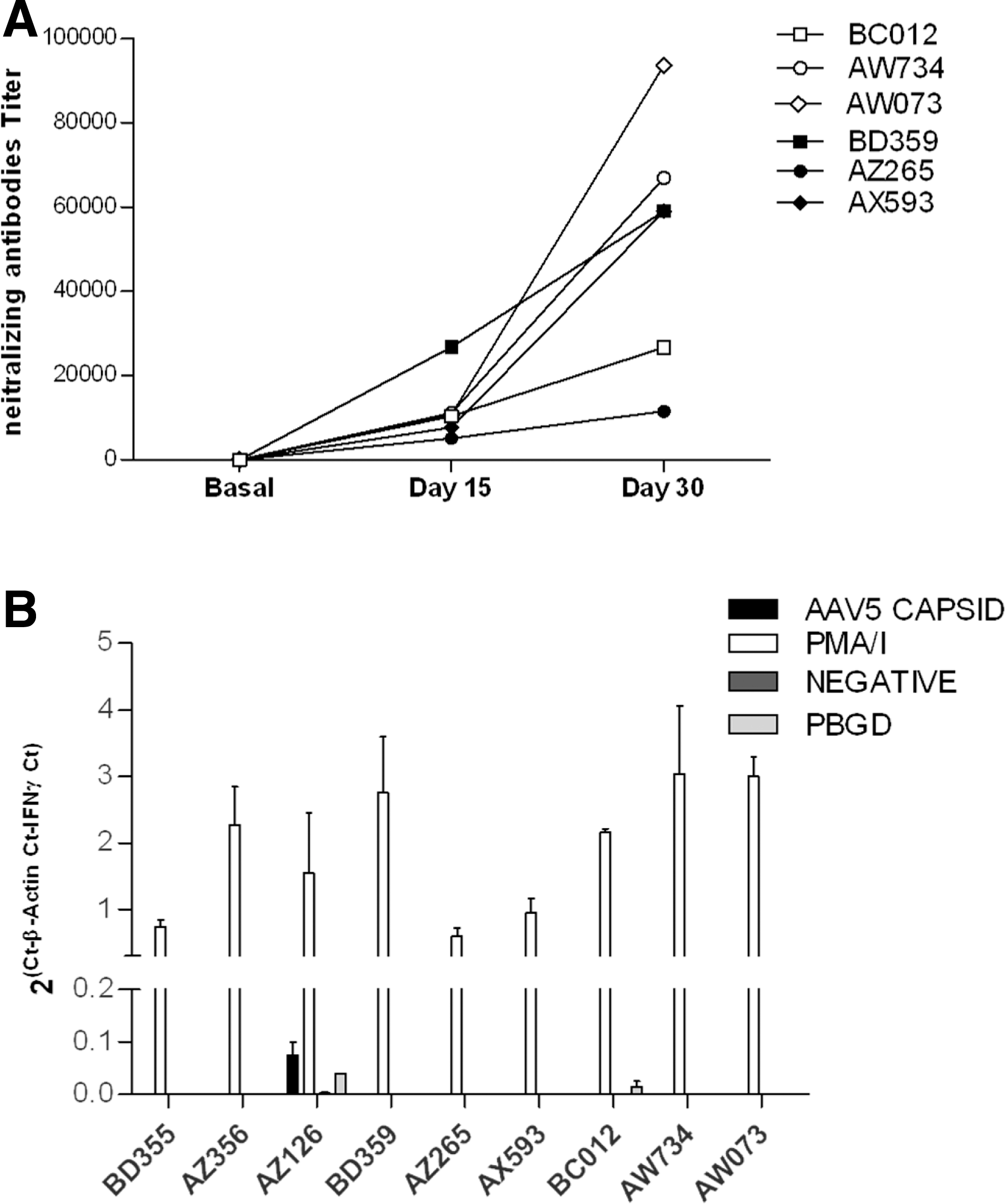
Immunological B and T cell responses against rAAV5-cohPBGD.
Analysis of integration patterns in host DNA
LAM-PCR coupled to next-generation pyrosequencing was used to identify rAAV5-cohPBGD flanking sequences in NHP liver 30 days after administration of 1×10¹³ or 5×10¹³ gc/kg. More than 100,000 rAAV-derived LAM-PCR amplicon sequences were characterized after 454 sequencing and revealed 752 unique ISs (583 exactly mappable and 169 multiple mappable ISs) (Table 1). Between 11 and 101 ISs were detected per sample, whereas on average more ISs were detected in the animals that received a higher amount of vector (39.9 vs. 25.8 IS) (Table 1).
On average, more integration sites were detected in the animals that received a higher amount of vector (36.9 vs. 25.8).
To determine the molecular fate of the vector sequence and investigate whether there were any integration hotspots in rAAV5-cohPBGD-injected NHP liver, we analyzed vector integration within either genes, areas that are part of CpG islands and also within DNA palindromic regions. The data were compared with a random data set of 10,000 AAV-IS. Of note, only 2.23% of all the exact mappable ISs were located in coding regions. Compared with the random data in which 1.75% of all ISs were located in genes, this value was not significantly different. In addition, no significant differences were detected for rAAV5-cohPBGD integration within CpG islands (0.17%) and the random data set (0.64%). To analyze the preferences of rAAV5-cohPBGD integration at DNA palindromic regions, the nucleotide pattern±15 bp around all ISs was characterized, separated for all forward (n=284) and all reverse (n=299) ISs. No nucleotide pattern was detected, indicating the absence of integration preferences at DNA palindromic regions. The occurrence of integration hotspots was further analyzed by the previously described definition of common IS (CIS) (Gabriel et al., 2009; Paruzynski et al., 2010; Abel et al., 2011). In total, only low-level clustering of 11 CISs of second order (two ISs within a window of 30 kb) were found. No preferred integrations in oncogenes or regulatory elements could be detected. In addition, the ratios between ISs and concatameric structures were estimated by comparing the retrieval frequency of ISs and vector–vector junctions (Fig. 6A). The minority of sequences (up to 0.99% after 3′LAM PCR) were assigned to concatameric rearrangements. Finally, the completeness of the ITR and the occurrence of preferentially ITR breakpoints was analyzed (Fig. 6B). Complete ITR sequencing was proven in 0.01% (5′ITR) and 0.08% (3′ITR) of all concatemeric ITR structures, respectively, whereas preferred breakpoints were detected in the C′-region of the ITR hairpin structure.
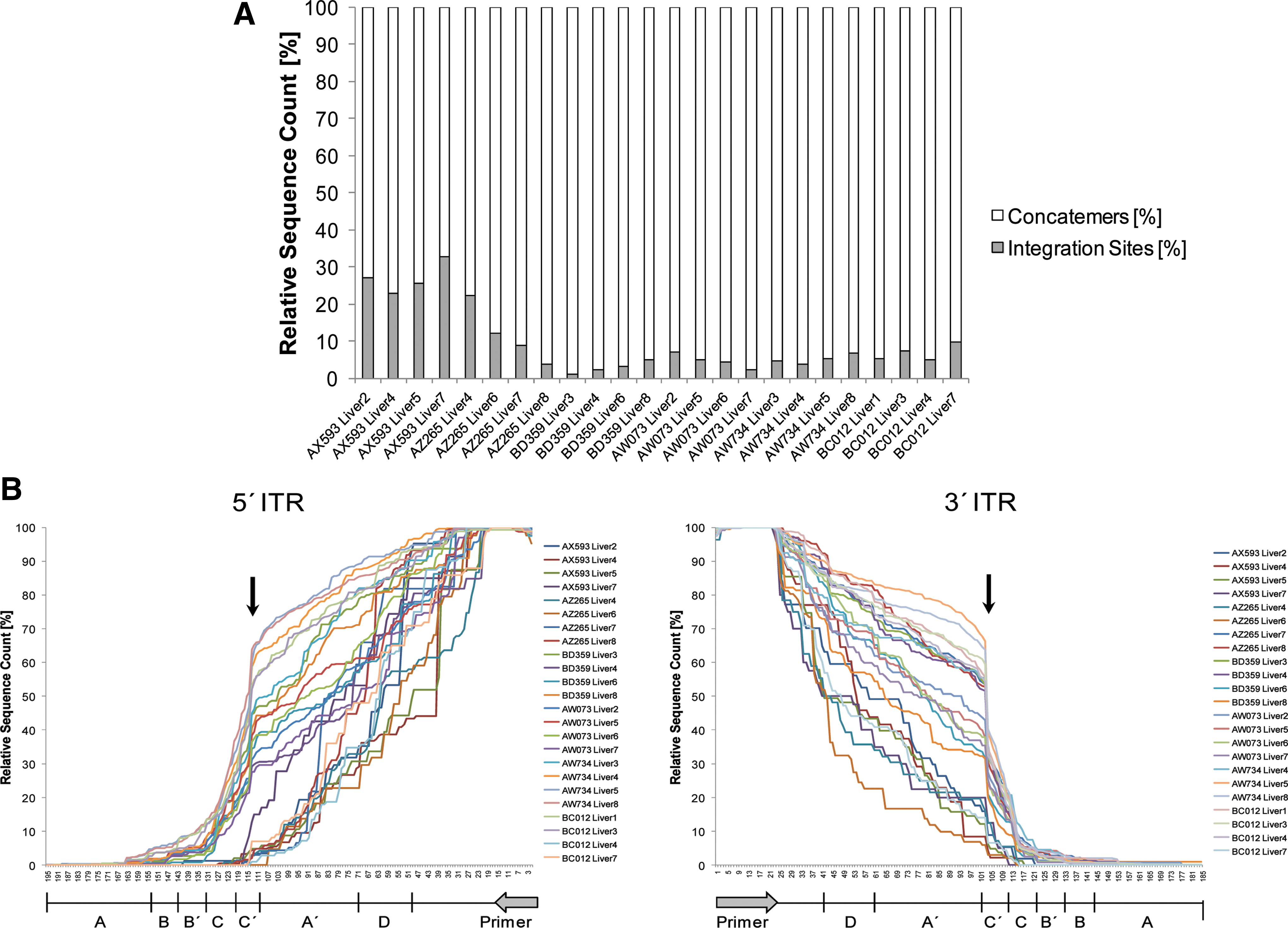
Analyses of AAV vector integration, concatemers, and ITR breakpoints.
Discussion
AIP is an autosomal dominant metabolic disease characterized by a deficiency of PBGD, the third enzyme of the heme-synthesis pathway. The only curative treatment at present is liver transplantation, which restores normal excretion of 5-aminolevulinic acid and porphobilinogen and prevents acute attacks (Soonawalla et al., 2004; Dowman et al., 2012). With AIP patients, however, liver transplant is associated with a high rate of hepatic artery thrombosis (Dowman et al., 2012). Furthermore, the effects of previous neuronal damage were not improved by transplantation. As an alternative to liver transplantation, gene therapy has the potential to be used in an earlier stage of disease progression before neurologic damage becomes irreversible. Thus, delivery of a copy of the PBGD gene to the liver that is then expressed as a functional enzyme is a promising therapeutic option for AIP (Johansson et al., 2004; Unzu et al., 2010, 2011; Yasuda et al., 2010).
Previous studies in a murine model of AIP demonstrated that systemic injection of rAAV5-cohPBGD vector led to efficient expression of PBGD protein within hepatocytes, which completely normalized the metabolic abnormalities associated with deficiency of this enzyme (Unzu et al., 2011). In the present study, we show that the intravenous infusion of a clinical-grade preparation of rAAV5-cohPBGD to macaques was particularly well tolerated, with no detectable side effects during and after the procedure. Only intermittent diarrhea was observed, independent of time or treatment group that is likely related to the presence of intestinal parasites. The transient elevation of AST and CPK levels observed after the injection of both rAAV5-cohPBGD and vehicle appears to be caused by muscle puncture when the therapy was administered. It has been previously reported that ketamine anesthesia, muscular trauma, or physical exercise increase CPK and AST activities in monkeys of both sexes (Kim et al., 2005).
Data on vector shedding are relevant with respect to a potential risk of exposure to the environment. Vector DNA was detected in the saliva, urine, nasal secretions, fecal specimens, and semen from macaques. However, the levels were very low and transient, consistent with data from previous studies (Nathwani et al., 2006, 2007; Favaro et al., 2009).
The quantification of the rAAV genomes in the liver depicts a homogenous distribution throughout the hepatic parenchyma and indicated that the transduction efficiency was dose dependent and sex independent. The majority of investigations analyzing the transduction efficiency of AAV vectors in NHPs have utilized males, whereas only very limited data exist for females. The performance of AAV vectors in NHP females is of particular relevance to this study, since AIP affects predominantly women (Deybach et al., 2006). Reported studies in mice describe important sex differences with respect AAV-mediated liver transduction (Paneda et al., 2009). However, our present data showed no differences in vector transduction efficiency with respect to sex within NHPs, illustrating how observations in mice are not always predictive to other species. In addition to the liver, vector DNA was detected in other organs, particularly the spleen, adrenal gland, lymph nodes, lung, and heart.
Consistent with the fact that cohPBGD was driven by a liver-specific promoter, high levels of cohPBGD mRNA were determined within hepatic tissue (compared with the much lower level within the adrenal gland). Furthermore, cohPBGD expression levels reached 50% of the naturally expressing PBGD protein in hepatocytes in the animals injected with the higher dose of the vector, which is equivalent to the expression levels of the protein in AIP patients (Deybach et al., 2006). Only in this group of animals we were able to detect a significant increase on PBGD activity 30 days after the injection of the therapeutic vector.
No cohPBGD message was detected within the spleen or lymph nodes, both of which are organs rich in antigen-presenting cells, important for the initiation of immune responses. This expression profile favors immune tolerance to the transgene, in line with previously reported results (Mingozzi et al., 2007).
In our study, the analysis of AAV vector integration into host DNA demonstrated that this occurs at a very low frequency. The analysis of vector DNA sequences revealed 752 unique ISs of which 309 ISs were obtained from the macaques injected with 1×10¹³ gc/kg and 443 ISs from the macaques injected with 5×10¹³ gc/kg. On average, more ISs were detected after injection of the high dose, indicating that the integration frequency of rAAV5-cohPBGD vector DNA is dose dependent. In contrast to other studies (Nakai et al., 2003; Li et al., 2011), rAAV5-cohPBGD revealed a largely random integration pattern in NHP hepatocytes after intravenous delivery. The absence of integration preferences and clustering was in line with a recent report where AAV was injected into NHP muscle (Kaeppel et al., 2013). Although the majority of sequences (93.98%) could be assigned to concatemeric structures, we cannot completely exclude the integration of concatemeric structures into the host genome.
Regarding antivector immune response, patients with hemophilia B treated with AAV2 or AAV8 vector encoding factor IX developed specific cellular immune responses against the viral capsid (Mingozzi and High, 2011b; Nathwani et al., 2011). In the case of patients receiving AAV2, the main cause for loss of FIX expression was attributed to the immune response (Mingozzi and High, 2011b). Patients treated with the AAV8 vector required prompt initiation of a short course of high-dose steroids. This treatment dampened the immune response, rescued FIX expression, and eventually led to long-term efficacy (Nathwani et al., 2011). In the present study, there were no T cell responses against AAV capsid proteins, nor against recombinant human PBGD protein. The absence of immunogenicity of the vector in the present study is not necessarily predictive of the immune response that may occur in humans, although represents a promising facet toward long-term expression within the human liver.
In summary, we demonstrated in NHPs that intravenous delivery of a clinically relevant dose of rAAV5-cohPBGD resulted in efficient liver transduction. Our results suggest that PBGD gene transfer offers a safe therapeutic approach to the management of human AIP. Indeed, eight patients with severe AIP are being sequentially enrolled in an open-label phase I trial aimed to determine the safety of the investigational gene therapy product for the treatment of AIP. The doses of recombinant therapeutic vector rAAV5-cohPBGD that have been selected based on the data presented in this study and proof-of-concept studies performed in mice (Unzu et al., 2011) are higher than the reported (and revised) highest dose of AAV2- and AAV8-LP1-hFIXco (2×10¹² vg/kg) administered to treat hemophilia B (Manno et al., 2006; Nathwani et al., 2011; Fagone et al., 2012). Importantly, no sign of toxicity or immune response has been detected in the patients treated so far, in agreement with the data reported in this study.
Footnotes
Acknowledgments
The authors thank Dr. Laura Guembe (Morphology and Imaging Unit, Centro de Investigación Médica Aplicada, Pamplona, Spain) for help in preparing and staining the tissue sections, and Alberto Espinal, Elena Ciordia, and Centro Deinvestigacion Farmacolócica Aplicada staff for animal care and vivarium management.
This work was supported by grants from the European Union VII Framework program [FP7-health: AIPGENE-2010-261506], Unión Temporal de Empresas (UTE) project, Centro de Investigación Médica Aplicada, Fundación Barrié de la Maza y Condesa de Fenosa, CIBERehd Instituto de Salud Carlos III, Ministerio Educación y Ciencia and Ministerio de Ciencia e Innovación [SAF2009-08524 and SAF2012-08524 to GGA], Fondo de Investigación Sanitaria [PS09/02639 to A.F.], and Fundación Mutua Madrileña.
Author Disclosure Statement
A.P., M.E.C., and M.M.M. are DIGNA Biotech employees. F.S. and H.P. are UniQure employees. E.L.F., C.K., C.U., A.G.G.R., D.D.A., S.G.B., C.O., R.F., A.S., I.N., A.B., J.J.G., C.V.K., J.P., M.S., A.F., and G.G.A. declare that they do not have anything to disclose regarding funding or conflict of interest with respect to this article.
References
Supplementary Material
Please find the following supplemental material available below.
For Open Access articles published under a Creative Commons License, all supplemental material carries the same license as the article it is associated with.
For non-Open Access articles published, all supplemental material carries a non-exclusive license, and permission requests for re-use of supplemental material or any part of supplemental material shall be sent directly to the copyright owner as specified in the copyright notice associated with the article.
