




Abstract

Introduction: Gene Transfer Comes of Age
I
In the Early Years: Learning to Embrace the Unexpected
I was raised in a family of engineers, and had always assumed that I too would one day have a career as an engineer. That all changed in 1971. I had just been accepted to attend Stanford University; however, at that time, the military draft was based on your birthdate, and my lottery number was low (50 out of 365), meaning that absent physical disqualification, I would be conscripted or “drafted” into military service. After considering the alternatives, an education at the Naval Academy in Annapolis seemed more desirable than the war in Vietnam. Luckily, the war had concluded by the time my collegiate studies were completed, and the Navy sent me to medical school in 1975. My first laboratory studies were in Roger D. Rossen's laboratory at Baylor College of Medicine, where I studied the immunology of rheumatoid factor, and later he arranged, along with James Woody, for me to spend a year of graduate studies in malaria immunopathology in the World Health Organization in Geneva (June et al., 1979a,b). By this time, I was “hooked” and had made the decision to become a physician scientist.
After completing residency, James Woody, a Navy Medical Officer and Head of the Navy's Experimental Transplant Unit organized my training in transplantation research, along with my colleague, Craig Thompson, at the Fred Hutchinson Research Center. There I became boarded in medical oncology and spent a year in the immunogenetics laboratory of John Hansen and Paul Martin. I learned more cellular immunology and, more importantly, John Hansen provided vision and Paul Martin taught me how to write an article. I became fascinated with T cell biology after witnessing the horrors of graft versus host disease: it was extraordinary how allogeneic T cells could destroy a patient (Thompson et al., 1984; June et al., 1985, 1986b), an unfortunately not uncommon event in the early days of bone marrow transplantation.
The Middle Years in Bethesda
At the completion of my postdoctoral studies in Seattle, I was assigned as a research medical officer to the Tissue Bank at the Naval Medical Research Institute in 1986. It was a wonderful opportunity, as I was given an independent laboratory with only 2 years of laboratory training. In 1994, I served as department head for the Immune Cell Biology Program (Fig. 1). While the Naval laboratory was small, it mattered little because the entire National Institutes of Health campus was literally just across the street. Funding was relatively easy to obtain and largely unrestricted so that long-term projects could be undertaken. I benefitted greatly from a long-term collaboration with Craig Thompson, whose laboratory was adjacent to mine at the Fred Hutchinson Cancer Research Center, and from colleagues at the National Cancer Institute.

Immune Cell Biology Program in 1993: Bruce Levine, top row, right; the author, Carl H. June, third row, left; other scientists were Kelvin Lee, Jeffrey N. Siegel, Ryo Abe, Thomas Davis, Steven Kessler, Peter Perrin, and David Harlan.
For the first decade of my career, the laboratory studies were grounded in basic sciences, where my laboratory was among the earliest to study the biochemistry of signal transduction in human T cells. These studies were initially based on the first single-cell assay to measure calcium flux, an assay that I developed with Peter Rabinovitch at the University of Washington (Rabinovitch et al., 1986; June and Rabinovitch, 1990). My initial studies were based on the clinical observation that cyclosporine was a wonderful noncytotoxic drug to block T cell activation in vitro, yet it was disappointing in the clinic (Storb et al., 1986). Paul Martin, John Hansen, and Shu Man Fu had just discovered the agonistic properties of a monoclonal antibody termed “clone 9.3.” The central hypothesis of my laboratory studies for the next 10 years was that signaling of T cells through the 9.3 receptor, later named CD28, explained costimulation and the cyclosporine conundrum (Martin et al., 1986; Ledbetter et al., 1987; June et al., 1989, 1990; Thompson et al., 1989).
Costimulation was the modern term for a concept originally introduced by Bretscher and Cohn that lymphocytes required two signals for full activation: the first signal was antigen specific and second signal delivered by cell–cell contact was antigen nonspecific (Bretscher and Cohn, 1970). While simplistic in retrospect, the strength of this hypothesis was that it was grounded in an important clinical observation. It soon became evident to me that many findings with transformed cell lines could not be repeated when primary cells were tested, because of differences in costimulation (June et al., 1986a) or contamination (Nelson-Rees et al., 1981). This had a profound influence over my career, with me always insisting in lab meetings that studies be done with primary cells, even though more difficult than the use of leukemic cell lines.
In retrospect, the best parts of these middle years were the early transition to independence and the stable laboratory funding, which were features of medical research in the 1980s. I am a firm believer that a combined degree is not necessary. Related to this, especially in the present era, is the conviction that many years of productive science are wasted by physician scientists who must serve long periods of time as indentured servants in the labs of senior faculty. In my experience, what is necessary is that any prospective student be exposed to laboratory and clinical medicine so that an informed decision can be made as to whether the primary focus is in the clinic or in the laboratory. I completed a chief residency and attended on the medical service for 1 month of every year until 1996, but the rest of the year was entirely devoted to projects in the laboratory. My own experience mirrors the theory espoused by Malcolm Gladwell that one needs an intensive 10,000 hr of training to enter a field (Gladwell, 2008). In those years, one could assimilate that body of knowledge in 2 years. I was fortunate to garner my 10,000 hr of training in medical oncology and in immunology while completing medical studies. Parenthetically, I was never permitted by the Navy to spend dedicated time for doctoral studies in immunology.
In contrast, the most unfortunate aspect of the years in Bethesda was that while I was trained as a specialist in leukemia, I was unable to conduct research in cancer with internal funds from the Department of Defense. Therefore, my interests in immunology were channeled into immunopathology, as the Navy could fund research in infectious diseases, and in my case, malaria and HIV/AIDS. This was a proverbial blessing in disguise, as I was forced to learn about virology, leading to the discovery of new viruses, human herpes virus 6 and 7 (Frenkel et al., 1990a,b), and to learn insights with HIV-1 that later aided in studies for cancer patients (Linette et al., 1988). The lesson from these experiences is that it is good to have laboratory experience in more than one field or, at the least, to have close collaborators from other fields, as illustrated by my later collaboration with Frederic Bushman at the University of Pennsylvania (Penn) (Levine et al., 2006; Wang et al., 2009).
The cross-cutting benefits to my laboratory having worked for a decade in infectious diseases before beginning cancer studies in earnest cannot be underestimated. A final benefit of my initial career in research within the military was that I was able to observe the large-scale vaccine efforts that the Army and Navy infrastructure had assembled, eventually leading to the first success ever with a therapeutic vaccine for HIV (Rerks-Ngarm et al., 2009). This experience proved essential for later studies at Penn, where my team became a virtual biotechnology company embedded in an academic institution: a process that was essential for the successful translation of gene transfer technology. Valued mentors in the Army and Navy vaccine efforts were Michael Strong, Robert Hartzman, Nelson Michael, Donald Burke, Edmund Tramont, and Stephen Hoffman.
Chimeric Antigen Receptors for HIV/AIDS
After establishing my laboratory in Bethesda, my first graduate student was Gerald Linette, a combined degree student who was interested in the immunobiology of HIV/AIDS. His initial project was to culture T cells from patients with HIV. My laboratory had been using CD28 agonistic stimulation to propagate T cells (June et al., 1987, 1989), and Gerry's first experiments were to extend this by growing T cells from patients with late-stage HIV infection. He found that the signals through latently infected cells were quite different from uninfected T cells (Linette et al., 1988).
In 1992, Bruce Levine began postdoctoral studies in my laboratory, and his project was to pick up Gerry's project by further studying the effects of HIV on T-cell signal transduction and to develop a T-cell culture system for HIV. His first goal was to produce viral stocks from the HIV/AIDS patients so that we could then later use the virus recovered from these patients as reagents. However, when he harvested the supernatants from the T cell cultures, he was unable to find any virus in the cultures. I was incredulous and actually became angry, as how could anyone fail to recover virus from patients with late-stage HIV/AIDS? Recall that this was long before potent antiretroviral therapy was available, and essentially all patients had high levels of viremia. So I went down to the lab and repeated Bruce's experiment—to my chagrin I also flopped by not recovering virus from the patient-derived T cell cultures. We later learned that this so-called CD28 antiviral effect was because of the downregulation of the CCR5, the HIV-1 coreceptor on CD4 cells (Riley et al., 1997). This happy accident eventually resulted in two more articles in Science (Levine et al., 1996; Carroll et al., 1997), and launched our initial studies toward adoptive transfer of T cells for patients with HIV/AIDS (June et al., 1993). The lessons learned from this experiment were that the most interesting results are those that are unexpected and to not resist changing the course of research as new opportunities arise.
To culture T cells from patients with HIV infection, Levine developed beads with immobilized antibodies to the T cell receptor and CD28 to develop a system that for the first time provided robust growth of T cells from patients with HIV or cancer, and it also was scale independent: he could culture T cells in volumes that varied by a million-fold from 96-well microplates to liter-sized culture flasks (Levine et al., 1998). Bruce used this new culture system to conduct fundamental studies on the growth potential of human T cells (Weng et al., 1995, 1996; Levine et al., 1997; Palmer et al., 1997; Liu et al., 1999). Levine developed a good manufacturing practice (GMP)-compliant cell culture system that enabled the first trials with the adoptive transfer of CD4 cells in patients with late-stage HIV/AIDS. We found that CD4 counts improved, as did immune function in the patients (Levine et al., 2002; Bernstein et al., 2004).
As a result of our initial success with adoptive T cell transfers in AIDS patients, Dale Ando and Kristen Hege at Cell Genesys contacted us with a proposition to collaborate with a chimeric antigen receptor (CAR) for HIV/AIDS patients. This was intriguing, as I'd never heard of the concept of CARs that had first been made independently in three laboratories in 1991 (Irving and Weiss, 1991; Letourneur and Klausner, 1991; Romeo and Seed, 1991). Bryan Irving and Arthur Weiss at the University of California had constructed CD8:zeta and CD4:zeta CARs to study signal transduction, and they realized that the CD4:zeta CAR might have a practical application to retarget T cells to HIV-infected T cells. Zelig Eshhar and colleagues later improved the utility of CARs by grafting antibody domains to the signaling domains, extending the library of targets for CAR T cells (Eshhar and others 1993). In 1997 we used Bruce Levine's cell culture system to conduct phase I trials with the CD3:zeta “first-generation” CAR for HIV (Mitsuyasu et al., 2000; Walker et al., 2000). Happily, the trials were successful in that they demonstrated safety and feasibility and improved immune function in the patients with HIV.
With Stephen Deeks and Cell Genesys, we conducted the first randomized phase 2 trial with gene-modified T cells in patients with HIV, and while this trial again demonstrated safety, there were only modest antiviral effects with CD4:zeta CAR T cells (Deeks et al., 2002). However, when we analyzed the cells from these patients a decade later, we were surprised to discover that the vast majority of patients had retained engraftment for a decade or more following infusion of these gene-modified CAR T cells. The CAR T cells were present at high frequencies with stable levels, and had a projected half-life that exceeded 17 years in these patients (Scholler et al., 2012).
In addition to our collaboration with Cell Genesys, we also established successful interactions with VIRxSYS, Sangamo, and Adaptimmune that enabled additional first-in-human trials with gene-modified T cells. With VIRxSYS, we conducted the first trial using lentiviral-engineered T cells testing the VRX496 antisense envelope construct, showing safety and some immunogenicity directed to VSV-G that was used to pseudotype the lentiviral vector (Levine et al., 2006). With Sangamo, we used zinc finger nucleases to disrupt CCR5, rendering the cells resistant to HIV infection in a mouse model (Perez et al., 2008) and later in a phase I trial in humans testing gene-edited T cells (Tebas et al., 2014). These collaborations were noted by Don Kohn to be a model for academic–biotechnology partnerships (Kohn, 2007), and ultimately led to the alliance between Penn and Novartis in 2012. In addition, these interactions were beneficial in that they fostered the development of productive interactions with the FDA in the area of gene-modified T cells. This proved beneficial, as one of our trials with Adaptimmune uncovered an off-target effect with T cells modified to express a T cell receptor for MAGE A3 that resulted in serious toxicity (Cameron et al., 2013; Linette et al., 2013).
CARs Move to Philadelphia
After retiring from the Navy in 1996, at the conclusion of my 12-year service obligation incurred from the training support that I had received in college and medical school, I considered several academic positions. However, I was extremely fortunate to be recruited to Penn by Jim Wilson and Craig Thompson. In Philadelphia, as opposed to other institutions such as free-standing cancer centers, I was able to continue research in immunotherapy for HIV, while beginning adoptive immunotherapy experiments in cancer patients. I was fortunate to recruit many of the members from the original immune reconstitution team in Bethesda to move to Penn (Fig. 2). Jim Riley, Bruce Levine, Katia Schlienger, and Richard Carroll were appointed as assistant professors in the research track at Penn. Bruce Levine, along with Julio Cotte, who also relocated to Philadelphia, established the first GMP-compliant cell-manufacturing facility at Penn. Jim Riley established a Human Immunology Core. Bruce and Jim have since become independent faculty and have risen to the rank of full professor, while Katia has had a successful career in the pharmaceutical industry. Unfortunately, Richard Carroll, who became my laboratory manager, died from pancreatic cancer in 2010 at the age 52.
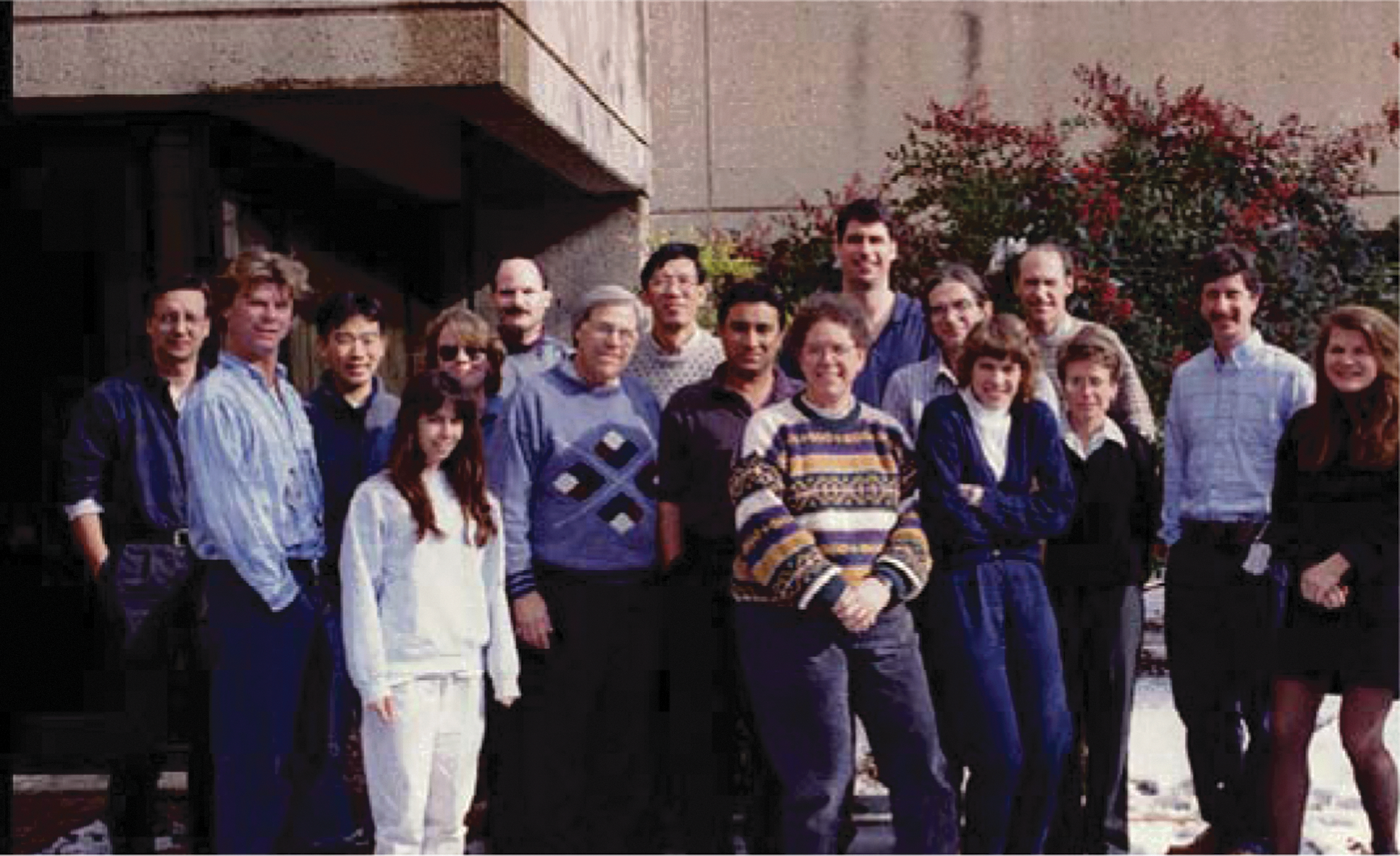
Immune Cell Biology Group in 1997. This was the team for HIV studies: Richard Carroll and Jim Riley to the author's right in the back row, and to the author's left, Bruce Levine and Katia Schlienger. Other scientists were Dan St. Louis, Owen Wieslow, Wendy Bernstein, and Sumesh Kaushal.
We first tested adoptively transferred T cells in cancer patients with chronic myelogenous leukemia, with Aaron Rapoport at the University of Maryland. We also evaluated this approach in patients with advanced lymphoma, in collaboration with David Liebowitz at the University of Chicago and with Gina Laport at Penn (Laport et al., 2003) using the same cell-manufacturing approach that Bruce had developed for HIV. The initial patients with treated chronic myelogenous leukemia were successful, in that their T cell counts increased; one patient of the four initially reported remains disease-free in a molecular remission now more than 15 years after infusion of her T cells (Rapoport et al., 2004).
At Penn the basic science part of my lab continued working on signal transduction. My first graduate student at Penn was Marcela Maus, who studied the role of artificial antigen presenting cells and the role of the 4-1BB costimulatory molecule in addition to CD28 (Maus et al., 2002, 2004). Marcela and, later, Megan Suhoski, a graduate student, found that 4-1BB promoted human CD8 cell growth and could augment CD8 T cell growth and function beyond that provided by the CD28 signal (Suhoski et al., 2007). Carmine Carpenito and Michael Milone were postdocs in the lab working on CARs based on our initial work with CD4:zeta cars for HIV. Their projects were to develop CARs for leukemia, and for this we selected CD19 as did others in the field (Roessig et al., 2002; Brentjens et al., 2003; Cooper et al., 2003), and for solid tumors we tested mesothelin as a target. Carpenito and Milone, along with Jim Riley, adapted the CD4:zeta CAR into a “second-generation” CAR. In the process, they changed from retroviral vector to a third-generation lentiviral vector developed by Dull and colleagues at Cell Genesys (Dull et al., 1998). They further demonstrated that EF-1alpha was a superior internal promoter for constitutive expression in human T cells, and chose 4-1BB as an improved costimulatory domain compared with CD28 (Carpenito et al., 2009; Milone et al., 2009).
Milone and Carpenito had the second-generation CD19:4-1BB:zeta CAR working in preclinical studies in 2004. David Porter, the principal investigator for our trials in leukemia, dubbed the CAR “CART19” for
Lessons: Follow Your Passions
Over the years we've had a number of lessons from our experiences in this journey to develop cell-based therapies for HIV and cancer. First, your best publications probably won't end up in top-tier journals. If they're too far ahead of their time, they won't be appreciated until later. In Bruce Levine's case, his observation of the self-renewing stem cell-like properties of T cells discovered in the 1990s (Levine et al., 1997) was not widely appreciated until recently (Gattinoni et al., 2011). Second, accidents can be good: embrace the unexpected results and follow up on these as they are often times more scientifically interesting than predictable responses from less imaginative experiments. Third, cross-cutting fields have low-hanging fruits. By working in HIV and cancer immunotherapy in parallel, we had many benefits, such as the first use of lentivirus in HIV that was then applied to engineered cancer T cells, leading to improved persistence and expression. Fourth, a nonstandard genealogy in training can be an advantage; my initial education in the Navy was far from the usual pathway to academia, yet provided me with certain advantages when I entered academia. It is notable that others trained in the Navy later found advantages in academia and biotechnology, such as Craig Thompson, Judah Folkman, and Craig Venter.
Footnotes
Acknowledgments
I would like to think my many colleagues and mentors for inspiration over the years: during training, Roger D. Rossen and Robert R. Rich at Baylor College of Medicine, Luc Perrin at the World Health Association, John Hansen and Paul Martin at the Fred Hutchinson Cancer Center, and Al Singer and Richard Hodes at the National Cancer Institute. At the Naval Medical Research Institute, many thanks to mentors Jim Woody, Kenneth Sell, Robert Hartzman, and D. Michael Strong and many academic colleagues, including Kelvin Lee, Thomas Davis, Steven Kessler, Ryo Abe, and David Harlan, and especially to the team that moved me to Penn, including Jim Riley, Richard Carroll, Katia Schlienger, and Bruce Levine. My long-term clinical colleagues have been invaluable in clinical translation, including Wendy Bernstein, Naomi Aronson, Pablo Tebas, David Porter, Stephen Schuster, and Stephan Grupp. At Penn I have had numerous interactions with colleagues in HIV who have helped provide insights into our cancer therapies, including Frederic Bushman, Robert Doms, and James Hoxie. I am indebted to Anne Chew, Gabriela Plesa, Dana Hammill, Jennifer Leight, and others in the Translational Research Program at Penn and to Jim Wilson and Bill Kelley, who are true pioneers in the science and the field of gene transfer and who provided the infrastructure that has allowed my group to be successful. Finally, I thank my wife, Lisa, and our five children for their support.
This work is dedicated to the memory of Cynthia June, Chris Broeren, and Richard Carroll, who had untimely deaths from cancer.
Author Disclosure Statement
C.H.J. is an advisor to Novartis, Celldex Therapeutics, Globimmune, and Immune Design. In addition, he is an inventor on patents licensed to Novartis and receives grant support from Novartis.