




Abstract
Rare diseases are major challenges in healthcare and medical research and are the basis of national development strategies in many countries. However, inadequate definition of rare diseases and lags in orphan drug development in China hinder rare disease research. In response, the first National Rare Diseases Registry System of China (NRDRS) was established, and various cohort studies have been launched since 2016. More than 20 top academic institutions in China are currently participating in this joint effort to carry out nationwide registration of rare diseases. The primary objectives are to establish standardization for the registration platform, build biobanks of genomic data, and create partnerships for data sharing and research collaboration. Innovative informatics technologies have been implemented to develop the NRDRS, including employment of ontological and knowledge bases to render standardization and support standard of care. Development of informatics analysis tools will facilitate accurate and more efficient diagnoses for rare diseases. Long-term research collaboration is encouraged to create additional national rare disease networks for research translation and to benefit patients with rare diseases. The NRDRS of China and related cohort studies are anticipated to enlighten rare disease research significantly in China.
Introduction
R
Advancements in genomic testing have helped to shed light on diagnosis and management of rare diseases. As the majority of rare diseases are genetic in origin, 8 molecular genetic diagnostic techniques can play a critical role in this area. In addition to traditional genetic testing methods, high-throughput next-generation sequencing technology is being widely adopted and functions as a major tool in rare disease diagnosis and research. 9 Transcriptomics and metabolomics data may be applied to address the diagnostic demands that are unmet by traditional enzymatic detection techniques. 10,11 State-of-the-art informatics tools allow efficient interpretation and annotation of omics data and provide a comprehensive understanding of rare conditions. 12 The surge in development of these new technologies has already benefited many patients by enhancing diagnoses and treatment, and they show great promise in future clinical settings.
Call for Action in Rare Diseases Research and Management
Inadequate definition of rare diseases and insufficient support for policy making
The definition of rare diseases remains controversial in China and has resulted in numerous problems with policy making, healthcare systems, and legislation. Most definitions of rare diseases are based on their prevalence in the general population. In past decades, the most widely accepted definition has been the EU's, which suggests rare diseases have an incidence of <5/10,000 people. 1 At a seminar conducted by the Genetics Society of the Chinese Medical Association in 2010, experts mainly in the field of medical genetics proposed that any diseases with a prevalence of <1/500,000 in the overall population or 1/10,000 among newborns should be considered a rare disease. 13 However, the proposed definition has received inadequate external support and has not been adopted widely by all stakeholders in rare diseases, leaving the definition of rare diseases in China a controversial issue. In 2015, Cui et al. suggested defining rare diseases based on the return on investment in new orphan drugs. According to this bottom-up strategy, a prevalence of 2–4/10,000 individuals was proposed as a reference threshold to define rare diseases compared to levels in the United States and EU when the national population was taken into consideration. 14 China is still on its way to reaching a consensus definition of rare diseases. Due to the lack of definition and epidemiological data of rare diseases, it is difficult to accelerate policy-making processes related to them. Accurate scientific perspective evaluations of rare diseases in China are granted to provide reference for relevant government policies.
Lags in development of best-practice guidelines and orphan drugs
Developing novel therapeutics is always a risky and difficult endeavor, and drug development for rare diseases is further marked by unique challenges related to limited premarket testing. 15 The majority of innovative drugs developed by China's domestic pharmaceutical companies focus on common diseases, 14 and imported drugs are largely unaffordable by patients with rare diseases in China. 7 Nevertheless, the orphan drug market is of great value; lower development costs, faster Food and Drug Administration approval times, and lower failure rates attract numerous funds to orphan drug development. 16 It is estimated that by 2020, global sales of orphan drugs will reach U.S.$178 billion and contribute to 20% of prescription drug sales. 17 Successful orphan drug development requires better diagnostic methods, deeper understanding of pathologic mechanisms, and smarter drug development strategies. Orphan drug research and development is becoming a focus of attention in China's biomedical industry. Once united, a well-defined patient population, clearly clarified genetic etiology, and dedicated advocacy foundation can catalyze drug discovery, turning the challengeable features of rare diseases into research advantages. The concentration of rare disease patients in China enables follow-up medical research and clinical trials so as to promote development of its biomedical industry. On the other hand, the lack of relevant laws and recognized best-practice guidelines make rare disease diagnosis and treatment unformulated. The National Commission of Health and Family Planning in China reported on 202 clinical pathways for diseases under 23 disciplines in 2017. Of them, few best-practice guidelines have been designed for rare diseases. More attention to rare disease research and attempts to define clinical pathways and best practices are required to guarantee patients with rare diseases a better quality of life.
Domestic and overseas attention to rare diseases
Recently, many countries have been taking action to bolster research on rare diseases by including them as part of national development policies. 18 The EU began Horizon 2020, in which rare diseases are listed as a central research field. 19 Establishment of the International Rare Disease Research Consortium in 2011 largely facilitated global collaboration in rare disease research. 20 While attempts to build global registries and linked rare biorepository databases continue, various registry systems all over the world, such as the Banque Nationale de Données Maladies Rares project in France and the Swabia registry located in Germany, have been founded. 21 –25 Information centers, such as the Genetic and Rare Diseases Information Center program funded by the National Center for Advancing Translational Sciences and National Institutes of Health, aim to provide the public with access to current, reliable, and understandable information about rare and/or genetic diseases. 26
Compared to the advancements in rare disease research in developed countries, China has progressed rather slowly, and academic attention has not focused on rare diseases until recent years. Though the abundance of patients provides a solid scientific foundation for rare disease research in China, their sporadic distribution makes it difficult to transform the patient resource to the research advantage. The first official rare disease preventative and therapeutic association was built in Shandong Province in 2010. Since then, local rare disease research centers have been established in Shanghai, Beijing, and Guangzhou, and a pilot rare disease registry study was launched in Shandong in 2013. In 2016, the Shanghai Municipal Commission of Health and Family Planning released the first official list of rare diseases. However, insufficient collaboration and communication between organizations hinder the construction of a national rare disease research network. To facilitate rare disease research and utilize the dispersed patient resource, the first nationwide patient registry system for rare diseases, the National Rare Diseases Registry System of China (NRDRS), was established in China in 2016.
Challenges to overcome in rare disease research in China
While China has an obvious abundance of rare disease cases within its large population, this fact has not yet been leveraged effectively in scientific research. Although ongoing rare disease research programs are frequently initiated in multicenter joint actions, inefficiency and insufficiency in data sharing remains a bottleneck of rare disease research in China. Without well-established standardization of disease registries or well-organized research consortiums, it is very difficult for many single institutions to gather adequate phenotype and genotype data to conduct convincing research.
Variation in medical competency among hospitals produces heterogeneity in practice patterns, leading to delayed, inconsistent, or erroneous diagnoses. This problem is especially prominent in China, considering the imbalance in regional distribution of social and medical resources. Moreover, the lack of patient privacy standards has stirred up controversies on the ethics of rare disease studies. Many institutions and laboratories maintain their biobanks, along with accurate patient identification information, raising concerns about protection of patient privacy. Researchers participating in the study of rare diseases are expected to make improvements in data management with more stringent security requirements, such as de-identification of unique individual characteristics. 27
Steps to Launching a National Rare Disease Registry System
As the first nationwide rare disease registration platform in China, the key missions of this project are to establish a large-scale Internet-based registry platform and a biobank, release standardized operating procedures for rare disease registries, and build data sharing procedures for seamless collaboration among multiple centers. The general study plan is shown in Fig. 1.
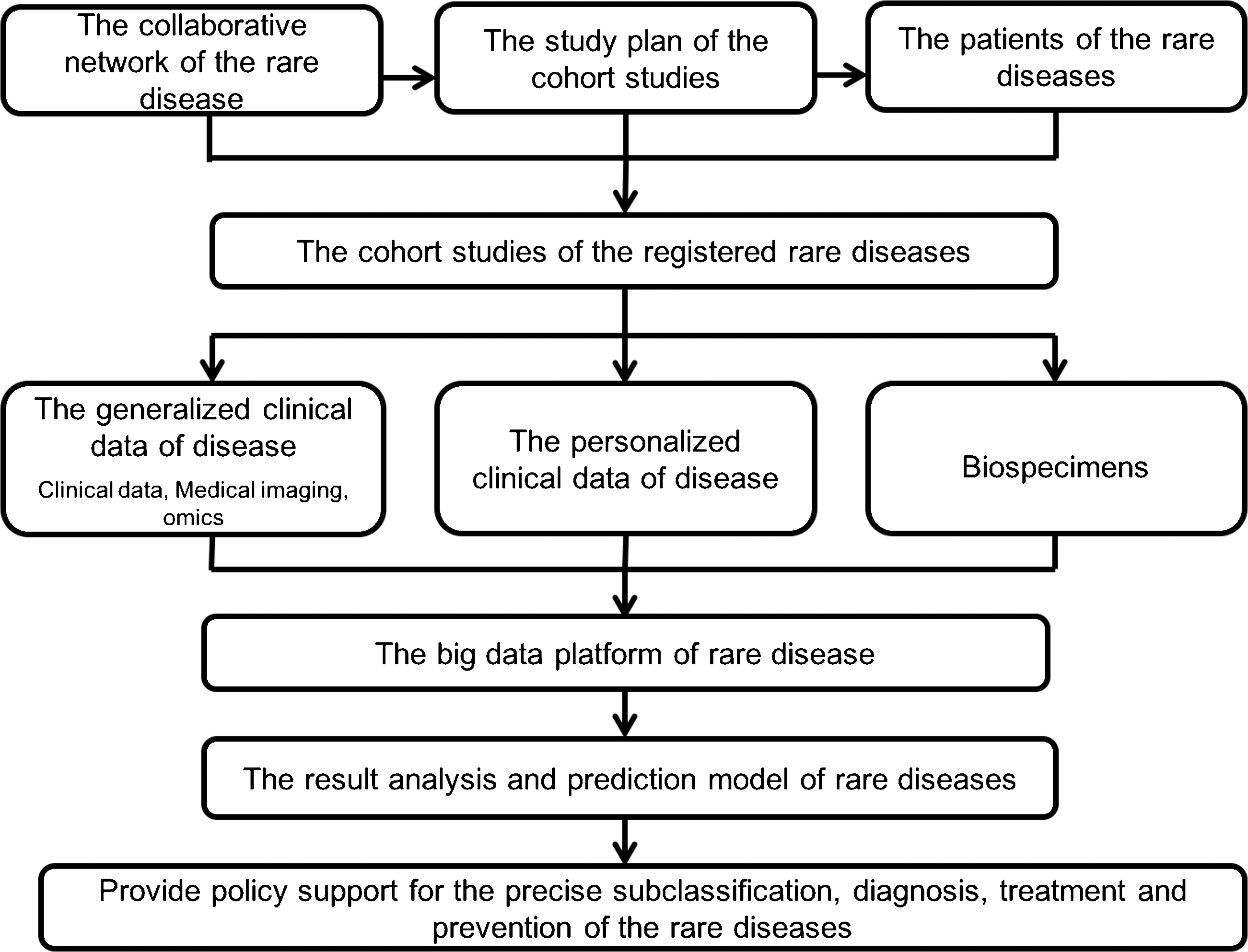
The general study plan of the cohort studies of the registered rare diseases. A total of 20 top academic institutions with expertise in rare diseases research set forth to establish the nationwide collaborative network, to make study plan of the cohort studies, and to initiate the registration for patients with rare diseases. Clinical data including imaging, omics, disease-specific data items, and biospecimen data are integrated to form the Big Data platform of rare diseases, allowing data analysis and development of prediction models for rare diseases. It is anticipated that the cohort studies will support policy making for the precise subclassification, diagnosis, treatment, and prevention of rare diseases.
Standardizing a nationwide rare disease registration platform
The NRDRS plans to establish standardizations for rare disease registries, including case registration, cohort identification, and follow-ups, in order to conduct nationwide registry studies of rare diseases. Both general and specified standards are to be established in this project. General technical standards, which apply to common features identified in different diseases, fall into three categories: clinical, multimodal imaging, and multi-omics data. Detailed coverage of the general standards for each category is shown in Table 1. As the first step to launching a large-scale rare diseases registry system, specifications in data collection for each entity included in this project will be set up to gather relevant information in an interoperable and reproductive way that facilitates data sharing and analysis.
Detailed coverage of categories in the general technical standard
Establishing biobanks to collect genomic data
One of the primary goals of rare disease research is to find a cure or effective treatment strategy for the disorder in question, but rare diseases offer a deep glimpse into the roles of genes and proteins in human disease pathogenesis in general. The NRDRS plans to build and maintain biobanks for specific rare diseases to assist biomedical research. The biobank here refers to a comprehensive database that contains both biological samples and related information. The core tasks include the following: (1) development, validation, and revision of unified standards for collecting and processing biological samples of multiple rare diseases; (2) establishment of a database network of rare biological sample libraries in order to develop a comprehensive biobank system where the core libraries serve as principle components with which satellite libraries can integrate, allowing system-wide data retrieval from any satellite database; and (3) smooth data retrieval from various systems, including the registration platform, biobank management systems, hospital information systems, and electronic medical record management systems.
Validating the standardization by conducting multicenter retrospective cohort studies
Biomedical research facilitates precise diagnoses and early intervention, which promotes a longer life-span and better quality of life for patients. The shared rare diseases information platform of the NRDRS is expected to accelerate integration of clinical diagnosis and treatment information with the data and sample library of clinical cohort studies in order to identify an accurate approach to the diagnosis and treatment of rare diseases. Indeed, the study of a disease largely simplifies its diagnosis and makes early intervention possible, especially for rare diseases with common clinical manifestations.
The NRDRS plans to conduct cohort studies of 50,000 cases of at least 59 types of rare diseases. The list consists of cardiovascular, pulmonary, urinary, endocrinologic, metabolic, hematologic, neurologic, musculoskeletal, and dermatological diseases. For patients suspected of having one of the above-mentioned diseases, their clinical records and biological samples would also be integrated into the NRDRS database after obtaining informed consent. Detailed genomic analyses would be performed to identify disease-related genes, which provide data for the construction of a digital clinical phenotype and genotype evaluation model.
A total of 20 top academic medical institutions in China are participating in this project and have been contributing continuously to this large-scale multicenter retrospective cohort. The cohort studies will provide insight into epidemiologic, pathologic, diagnostic, and therapeutic aspects of specific rare diseases. On the other hand, technical standards and specifications of previously established data collection and biobanks will be validated through these cohort studies to support further registration studies on rare diseases.
Exploring data sharing and research collaboration mechanisms between institutions
In order to conduct the above-mentioned, large-scale, multicenter cohort studies successfully, the NRDRS aims to establish a national rare disease collaboration network with wide coverage. Collaboration networks will be integrated by registering the participating institutions on a registration platform via the Internet, while permission to participate will be granted following a standardized qualification process. Their support makes foundation of the multicenter clinical and biological sample databases for rare diseases possible.
A multi-level sharing mechanism for the national rare disease registration system is needed to coordinate different types of targeted users, as well as shared contents and assumption of obligation. Authorized users would include natural persons, medical staff involved in the healthcare of rare diseases, rare disease registry study researchers, managers of registration databases, and administrative officers within the health sector. Principles, methods, contents, as well as the rights and obligations of authorized users need to be explored and determined.
Strategies to Promote Rare Disease Research in China
Implementing ontology to render standardization and cross-referencing
The infrastructure of a common information platform requires a series of standards regarding data transmission, terminology, ontology, and research norms. 28 Medical ontology systems, which stipulate semantic standards, provide basic support for the standardization and integration of Big Data in healthcare. However, the existing medical ontology system in China is insufficient to satisfy the descriptive demand in clinical settings. Although a number of medical semantic standards have been widely recognized in international communities, such as the Systematized Nomenclature of Medicine-Clinical Terms, 29 Unified Medical Language System, 30 and Human Phenotype Ontology, 31 directly implementing English ontology systems in China is expected to meet with considerable resistance. The NRDRS is collaborating with partners and engaging in the construction, maintenance, operation, and dissemination of medical ontologies in the Chinese language. A major first step that was taken in 2017 was the integration of Chinese Human Phenotype Ontology into the NRDRS. 32 Next steps include the development of a well-known disease ontology for rare diseases, the Orphanet Rare Diseases Ontology, in the Chinese language and its integration with the NRDRS and promotion in the rare diseases community in China.
Employing existing knowledge bases to support standard of care
While defective integration of available information may lead to diagnostic errors, data integrated from existing knowledge bases can update the general information on rare diseases, support standard of care, and enhance further scientific research. Well-developed health information tools, such as clinical decision support systems, simplify the search process for practical rare disease information for clinicians.
33
Orphanet (
Developing powerful informatics analysis tools to facilitate accurate and efficient diagnoses of rare diseases
Rare disease research depends not only on traditional medical information, but also heavily on omics data, including genomics, transcriptomics, and metabolomics, all of which continuously generate excessive amounts of data. It has been reported that certain rare disease data have grown to the petabyte scale, which challenges real-time performance, extensibility, and scalability of data management systems. 35 The analysis and annotation of the enormous amounts of data require several informatics tasks. These include adaption of the granularity of disease classifications to reflect rapidly evolving understanding of the molecular basis of disease, visualization of complex genetic information, and evidence generation through integrative analysis of novel, high-throughput molecular assays with clinical and population data. 36 With the development of new analytical techniques, it is anticipated that in the near future, identification of personal variants and their relation to a given disease, together with laboratory and clinical findings, will be used to build more accurate personalized predictive models that assess susceptibility or predict outcomes of specific treatments. 37 Powerful informatics tools for omics data collection, storage, annotation, and interpretation lay solid foundation for rare disease research and facilitate accurate and efficient diagnosis of rare diseases.
Establishing long-term research collaborations to form a rare disease research network in China
Joint efforts are particularly essential for rare disease research due to its sparsity. Dozens of working groups, multicenter projects, national or international networks and consortiums have been set up worldwide as a call for action. Currently, there is a growing trend toward regular academic communication, increased data sharing, and close research collaboration in the field of rare diseases in China. During its first year, the NRDRS of China built connections among 20 top academic institutions nationwide to promote data sharing. Meanwhile, the NRDRS is now taking action to build strong partnerships with international organizations. Working together with Orphanet, Orphanet China will be launched to manage China's national information on rare diseases to create rare diseases nomenclature and ontology in Chinese, contribute to existing knowledge bases, and participate in international research consortiums in the future. In September 2017, the 12th annual International Conference on Rare Diseases and Orphan Drugs was held in China by the Chinese Organization for Rare Disorders, Rare Diseases International, and Peking Union Medical College Hospital, drawing global attention to China's rare disease research and bringing opportunities to form international research networks. For rare diseases, small-scale collaborations could have a substantial impact by preventing unnecessary duplication of registration, thereby speeding development of research. Global research collaborations will boost promotion of rare disease knowledge bases and development of rare disease research in China.
Translating rare disease research into new diagnostics and treatments
Translational medicine is regarded as a two-way street: bench to bedside and bedside to bench. In other words, testing novel therapeutic strategies in humans is complemented by feedback on the understanding of how humans react to the treatment. 38 As for rare diseases, advances in genetic analyses and knowledge of disease mechanisms have allowed scientific understanding to mature. However, translational capability fails to keep pace with basic science, significantly limiting the capacity to transform research into clinical practice. In order to address the absence of preclinical and clinical data required for regulatory review purposes, varied translational research efforts have been initiated by research institutes and centers of the National Institutes of Health. 39 A combination of translational scientific approaches will be required, including improved diagnostic and patient selection methods, innovative clinical trial designs, and novel techniques for describing, monitoring, and interpreting disease outcomes in enriched populations. 15 Since the first Symposium on Translational Medicine was held in China in 2007, this topic has garnered more attention in China. Now, five translational medical centers are under construction. In particular, the center located within Peking Union Medical College Hospital undertook the responsibility of rare disease research, accelerating the transformation of academic achievement into direct benefits for patients with rare diseases.
Building Rare Disease Clinics and prenatal molecular diagnosis centers
A long diagnostic delay has been identified as a characteristic problem for rare disease patients worldwide. 40 –42 While epidemiological studies concerning the general impediments to rare disease diagnoses in China are absent, long diagnostic delays in individual rare diseases have also been reported. 43,44 Several medical centers in China have already established Rare Disease Clinics to facilitate such diagnoses. One of the leading NRDRS participants, Peking Union Medical College Hospital, which is already recognized for treatment of complicated and undiagnosed diseases in China, is actively preparing to become a permanent Rare Disease Clinic.
A prenatal molecular diagnosis center that aims to provide genetic counselling with international standards is also in the NRDRS's plan. For rare pediatric diseases with established diagnostic methods, expansion of cases and mutation spectra would further the knowledge of disease phenotypes and natural courses, thereby improving prenatal diagnoses. Based on existing experience, the NRDRS aims to explore new molecular diagnostic methods for rare pediatric diseases with known pathogenic gene variants and develop a new diagnostic panel of next-generation sequencing technologies.
Conclusion
As a national strategy for enhancing the development of medical science and population health in China, the NRDRS and its cohort studies will strive to improve both clinical care and scientific research. Their studies will contribute to the existing knowledge base of rare diseases in China and will systemically support healthcare planning, policy making, and health technology assessment. This platform is open to domestic and international collaboration and will provide support for communication between experts, organization of patient recruitment, data integration and analysis, and patient advocacy for rare diseases worldwide. When integrated with precision medicine, establishment of the NRDRS and its related cohort studies will improve patient care, enhance medical science, further innovate diagnostics and therapeutics, support policy-making processes, and, most importantly, benefit patients with rare diseases.
Footnotes
Acknowledgment
The manuscript was funded by the National Key Research and Development Program of China (2016YFC0901500).
Author Disclosure
The authors have no conflicts of interest to disclose.