




Abstract
The CRISPR/Cas system could provide an efficient and reliable means of editing the human genome and has the potential to revolutionize modern medicine; however, rapid developments are raising complex ethical issues. There has been significant scientific debate regarding the acceptability of some applications of CRISPR/Cas, with leaders in the field highlighting the need for the lay public's views to shape expert discussion. As such, we sought to determine the factors that influence public opinion on gene editing. We created a 17-item online survey translated into 11 languages and advertised worldwide. Topic modeling was used to analyze textual responses to determine what factors influenced respondents' opinions toward human somatic or embryonic gene editing, and how this varied among respondents with differing attitudes and demographic backgrounds. A total of 3,988 free-text responses were analyzed. Respondents had a mean age of 32 (range, 11–90) years, and 37% were female. The most prevalent topics cited were Future Generations, Research, Human Editing, Children, and Health. Respondents who disagreed with gene editing for health-related purposes were more likely to cite the topic Better Understanding than those who agreed to both somatic and embryonic gene editing. Respondents from Western backgrounds more frequently discussed Future Generations, compared with participants from Eastern countries. Religious respondents did not cite the topic Religious Beliefs more frequently than did nonreligious respondents, whereas Christian respondents were more likely to cite the topic Future Generations. Our results suggest that public resistance to human somatic or embryonic gene editing does not stem from an inherent mistrust of genome modification, but rather a desire for greater understanding. Furthermore, we demonstrate that factors influencing public opinion vary greatly amongst demographic groups. It is crucial that the determinants of public attitudes toward CRISPR/Cas be well understood so that the technology does not suffer the negative public sentiment seen with previous genetic biotechnologies.
Introduction
T
Given the paucity of research exploring public attitudes toward CRISPR/Cas technology, we conducted an online survey of 12,562 participants from 185 countries exploring public attitudes toward human gene editing. 9 This work highlighted firm support for gene editing for health-related purposes in somatic and embryonic cells, with decreased support for its use for eugenic manipulation. Critically, as part of this survey, respondents were asked to share the reasons for their opinions and what factors influenced this. Using this textual data, we aimed to determine what factors influence respondents attitudes toward human gene editing.
Methods
Questionnaire development and administration
To gauge public opinion, we developed a 17-item online questionnaire (Supplementary Table S1; supplementary data are available online at
The questionnaire was refined by thinking-aloud cognitive phase testing—a tool by which people are asked to take the questionnaire and then interviewed to check their understanding of each question and to ensure that multiple participants interpret the questions in the same way. 10 This testing was undertaken in 10 English-speaking people. Changes were made iteratively to two of the application questions and the explanatory paragraph, with no changes deemed necessary to the final open-ended question. The final English questionnaire was then translated into Arabic, Chinese, French, German, Hindi, Japanese, Portuguese, Russian, Spanish, and Turkish. To ensure consistency across the questionnaires, a separate translator then back-translated each language with changes made as appropriate. The questionnaires were then formatted and placed onto an online platform and completed by a third translator before dissemination.
The questionnaire was launched online in June 2015. At this time, we began advertising on social media through Facebook, Twitter, and Google. A separate questionnaire was formatted for WeChat, which is one of the commonly used social media applications in China, to enable dissemination in China, where Twitter, Facebook, and Google promotions are restricted.
Data preparation and text cleaning
Survey responses were collated before being translated back into English. Data preparation and analyses were performed in the R statistical environment (version 3.1.2) and Python (version 3.4.3). All data and scripts are available at
We used descriptive statistics to summarize demographic features of respondents. Given the likelihood of spurious responses, participants with extremes in reported age, below 10 and above 90 years, were dropped (n = 141). For dependent variables, we collapsed the Likert scale to a three-point scale (disagree, neutral, agree) initially merging the “Neutral” and “I Don't Know” response categories. For each participant in the survey, when possible, we retrieved geolocation data. IP addresses were queried using a function in R to return location data (country, region/state, longitude and latitude, etc.) from
To allow meaningful textual analysis on the free-text responses, the responses were initially cleaned before processing. As the free-text data was UTF-8 encoded and entered in multiple languages, we translated the non-English responses into English with the use of Google Translate.
11,12
After translation, we removed “Internet Slang,” such as “lol” (laugh out loud) and “idk” (I don't know), and substituted in their full equivalent. We also performed automated spelling correction on the now translated and slang-free text. The spelling correction algorithm (
Data analyses
Topic modeling is a soft clustering method based on the identification of latent topics (in the form of multinomial distributions over words) based on document-level co-occurrence. Of the 12,562 survey respondents, 3,935 provided a textual response to the final open-ended question; these were used as the basis for topic modeling, taking a single response as a “document.” Topic modeling was performed using the Mallet 13 implementation of latent Dirichlet allocation, with models trained for a user-defined number of topics T = (15, 20, 25, 30, 40, 50). Optimization was performed using an average normalized pointwise mutual information objective function 14 and yielded 25 as the optimal assignment of T. The resultant 25 topics were further pruned to 16 by applying two criteria: (1) topics that were allocated to small numbers of documents were removed (based on a topic prior <0.1); and (2) topics with low model precision were removed, based on the automatic injection and subsequent detection of intruder words, as described by Lau and colleagues. 14 The final list of 16 topics and their constituent words are provided in Table 1. We then determined the topic proportions for different partitions of the data, based on demographic variables and yes–no responses to particular questions. The statistical significance for differences in topic proportions over particular subpopulations (of x individuals) was determined by generating a null distribution (no enrichment) of composition scores for 1,000,000 subpopulations of x individuals sampled with replacement from the full set of respondents. A nonparametric p value was calculated from this distribution, using an empirical cumulative distribution function approximation with a default pseudocount of 1. 15
List of topics derived from the topic model and their constituent words
Results
After curation of nonsensical answers, a total of 3,935 free-text responses were analyzed from 185 countries. The mean age of these respondents was 32 (11–90) years, and 1,464 (37.2%) were female. A total of 1,794 (45.6%) reported a religious affiliation, 921 (23.4%) had worked in health care, and 1,790 (45.5%) had received a tertiary education. Only 476 (12.1%) had not heard of gene editing before the survey, whereas 1,291 (32.8%) had significant prior knowledge. The breakdown of responses to each question relating to the application of somatic or embryonic gene editing is provided in Fig. 1.
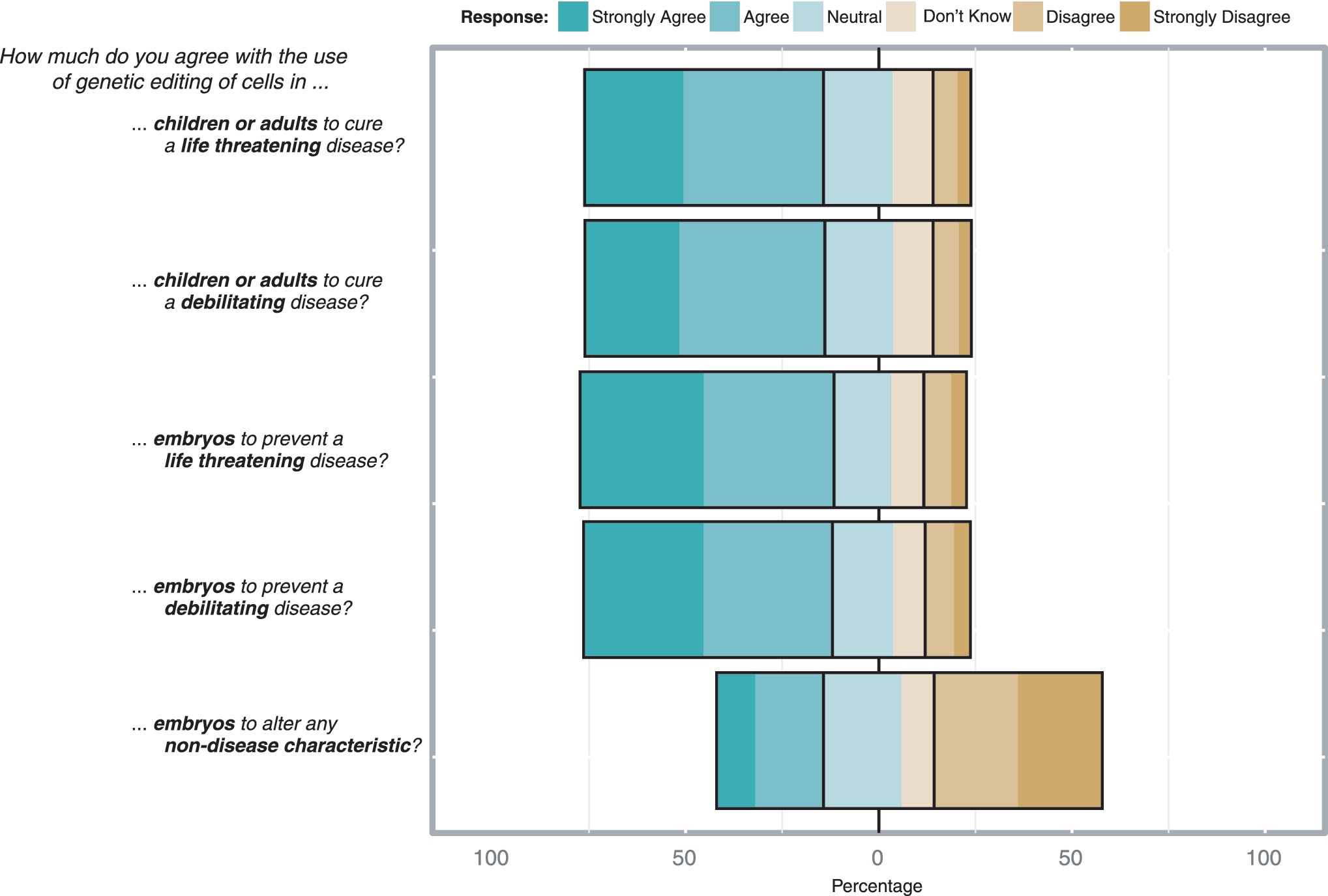
Proportion of responses to questions relating to the application of human gene editing. Questions are displayed in the order presented to participants as outlined in Supplementary Table S1, and responses were divided across a five-point Likert scale. “Strongly Agree” and “Agree” as well as “Strongly Disagree” and “Disagree” were collapsed for analysis. “Neutral” and “I Don't Know” responses have been merged. Color images available online at
The most prevalent topics found on text analysis included Future Generations, Research, Human Editing, Children, and Health (Fig. 2 and Table 1). Respondents who were against gene editing for health-related purposes in somatic cells, showed a higher use of the words associated with Better Understanding than people who agreed to gene editing for this purpose (p < 0.001). By comparison, participants who disagreed with gene editing for health-related purposes did not refer to topics such as Religious Beliefs and Natural Selection more frequently. For questions related to embryonic gene editing, Better Understanding was again overrepresented (p < 0.001), rather than topics like Future Generations or Children. In contrast, for genetic editing of non-health-related traits, respondents who agreed were less likely to discuss Future Generations and more likely to cite the topic Children in their responses compared with those who disagreed (p < 0.001).
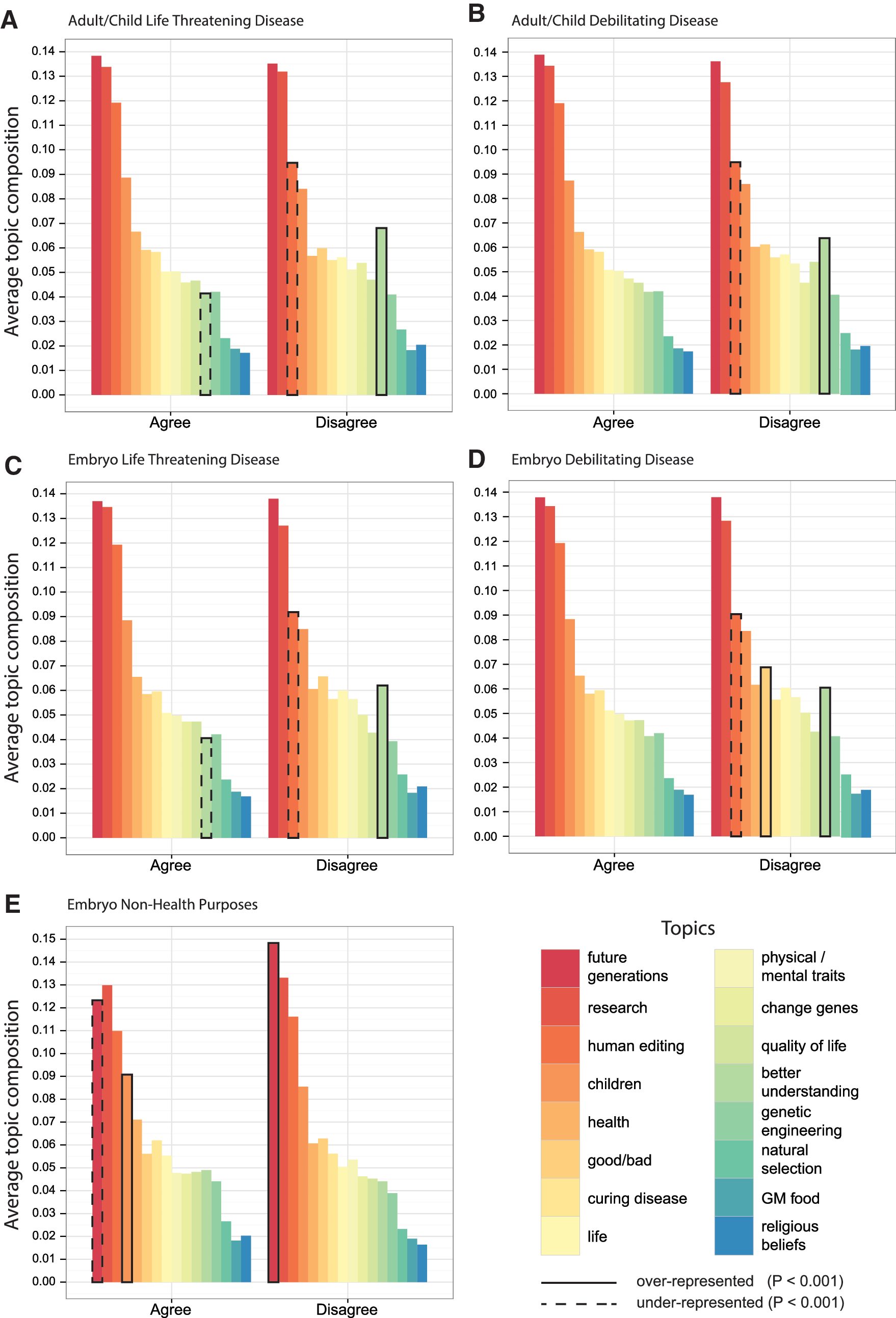
Breakdown of topic models for the free-text responses. People were asked to outline the reasons for their opinions on applications of gene editing. Each topic comprises a list of co-occurring words as defined in Table 1, and topic composition is compared between respondents who agreed with each question and those who disagreed. Use of gene editing
Respondents from different demographic backgrounds were more likely to discuss certain topics in their responses. People from Western countries, such as the United Kingdom and Australia, more frequently discussed Future Generations, whereas this was less frequently cited amongst respondents from Eastern countries such as Japan and China (p < 0.001; Supplementary Fig. S1). French respondents most commonly discussed the topic Children and were less likely to comment on Future Generations (p < 0.001). Chinese respondents more frequently discussed the topic Better Understanding (Supplementary Fig. S1) and respondents from both China and Japan were less likely to raise the topic Future Generations (p < 0.001) compared with those from other countries. Respondents from the United Kingdom and South Africa were less likely to discuss the topics Research and Children. These changes in topic prevalence between countries were reflected in analysis by self-reported ethnicity. Respondents who identified as European Caucasians were more likely to discuss Future Generations, whereas respondents who identified as North and South East Asian were less likely to discuss this topic (p < 0.001). Conversely, Research was underrepresented amongst European Caucasians and overrepresented amongst South East Asian respondents (p < 0.001).
Christian respondents were more likely to discuss Future Generations whereas respondents of the Islamic faith were more likely to discuss Research (p < 0.001; Supplementary Fig. S2). Respondents with no self-reported religious affiliation were less likely to discuss the topic Research (p < 0.001). The topic Religious Beliefs was equally mentioned amongst religious and nonreligious respondents. Participants who had substantial prior knowledge of gene editing were less likely to discuss Future Generations in their responses and more likely to discuss the topic of Children (p < 0.001; Supplementary Fig. S3). Gender and economic background had no significant impact on the determinants of respondents opinions toward gene editing.
Discussion
Our previously published findings indicate that whereas there is firm agreement with the use of human gene editing for health-related purposes, at approximately 60%, this support is far from universal. 9 Importantly, topic modeling highlights the overrepresentation of the topic Better Understanding amongst respondents who disagreed with health-related applications, suggesting that propensity to disagree may arise from a desire for better understanding of the technological features and potential risks, rather than a resistance to the concept of gene modification in itself. Although there is little empirical evidence supporting the deficit-model approach to public engagement, 16 the experimental nature, imminent clinical translation, and complex ethical issues associated with genome modifications may mean that public education is of great significance in this area. Leading researchers have raised the need for early and thorough public engagement, 6,17 and our findings further emphasize the importance of this.
Despite strong opposition from the scientific community toward embryonic gene editing, 4,6,17,18 our findings demonstrate similar levels of agreement for both embryonic and somatic cell editing amongst our respondents. 9 Interestingly, for respondents with contrasting opinions regarding embryonic gene editing for health-related purposes, the topics of Future Generations and Children were mentioned with similar frequency. However, participants who disagreed with embryonic editing for non-health-related purposes were more likely to discuss Future Generations. Respondents who agreed with embryonic gene editing for non-health-related purposes were more likely to discuss Children, and less likely to cite Future Generations, perhaps indicating that these participants are considering only the immediate benefits to individual families and children, rather than the potentially negative impact that widespread human enhancement could have on future humanity. In support of this, a study by Hendriks and colleagues found that the immediate benefits to individuals and their children's quality of life was the number one reason respondents were in favor of genome modification, whereas those opposed were concerned about the negative long-term consequences for society as a whole. 19
Religious affiliation was associated with an increased resistance toward all applications of gene editing, particularly amongst Christian respondents. 9 This is consistent with previous research highlighting markedly lower support for genome editing amongst religious individuals. 20 Interestingly, these respondents were no more likely to discuss the topic of Religious Beliefs in their free-text responses compared with nonreligious respondents (Supplementary Fig. S2). Instead, Muslim respondents were more likely to discuss the topic Research, whereas Christians more frequently discussed Future Generations. This perhaps indicates that the resistance Christian respondents have shown toward all applications of gene editing is not a product of the concept of genome modification contradicting Christian doctrine, but instead a result of values arising from living in a Christian environment, which culturally places special emphasis on embryos and other body parts. 21 More focused research will be required to gain deeper understanding of the beliefs and other influencing factors behind this.
Text analysis found the topic Research overrepresented in respondents who reported that they were of Asian ethnicity, and the topic Better Understanding overrepresented amongst respondents from China. In contrast, respondents from Australia and the United Kingdom were more likely to discuss Future Generations. This may indicate a difference in priorities across countries when assessing the acceptability of new biotechnologies. It appears that the opinions of respondents from Western countries are shaped by the impact of embryonic gene editing on future generations, whereas in general, Eastern respondents were more greatly influenced by the progress of research and ensuring technical proficiency.
Topic modeling provides a valuable means of interpreting high-volume textual data to derive associations and meaning. Of course, the demographic classifications we have used represent highly heterogeneous groups, with a variety of motivations and influencing factors that cannot be captured with one open-ended question. As such, our results represent general trends across broad demographics, and further in-depth investigation, with focus groups and in-depth interviews, will be required to better understand the attitudes of each demographic group. Furthermore, despite the large-scale collection enabled by online surveys, this collection method also has obvious limitations and recruitment biases, such as a lack of exposure to people not on social media, 22 and in our study, a gender bias favoring male respondents.
Conclusion
With the rapid progress of CRISPR/Cas technology, clinical translation appears imminent. As such, it is imperative that the scientific community endeavor to understand public attitudes toward genome engineering to avoid research being impeded by ethical controversy. Importantly, our findings show that respondents who disagreed with health-related somatic or embryonic gene editing did so because of a desire for greater understanding, rather than a personal sensitivity toward the technological features. Furthermore, we found that the factors influencing opinions varied considerably across different regions and cultural backgrounds. These global trends highlight the need for further in-depth analysis of specific socioeconomic groups. Understanding the influencing factors on public opinion toward gene editing is vital in guiding political policy and planning effective public education. Further research in this area will ensure that CRISPR/Cas does not incur the same varied sentiments suffered by other genetic biotechnologies.
Footnotes
Acknowledgments
The authors are grateful for the assistance of Eve Boccara, Teresa Carvalho, Qin Chen, Nora Yahia Hakami, Sandy Hung, Qicheng Jiang, Tejal Kulkani, Seema Mandhare, Megan Munsie, Isabel Sanchez, Erdal Tan, Nitin Verma, Anu Verma, and Seyhan Yazar. This work was supported by Australian National Health and Medical Research Council Fellowships (P.G.S., A.W.H.), Australian Research Council Future Fellowships (T.B., A.P.), the BrightFocus Foundation, Retina Australia, the Ophthalmic Research Institute of Australia, and Operational Infrastructure Support from the government of Victoria, Australia.
Author Contributions
Conceptualization: T.McC., E.F., G.R., C.MacG., and A.W.H.; methodology: T.McC., L.F., L.S., H.H.L., and A.W.H.; software: G.E.C.G., D.M.B., and T.B.; formal analysis: P.G.S., D.M.B., T.B., and A.W.H.; resources: C.C., H.H.L., and A.P.; writing (original draft): T.McC. and D.M.B.; writing (review and editing): L.F., E.F., G.R., C.MacG., L.S., C.C., H.H.L., T.B., A.P., and A.W.H.; visualization: D.M.B. and T.B.; supervision: A.P. and A.W.H.; funding acquisition: C.C., A.P., T.B., and A.W.H.
Author Disclosure
None of the authors have any conflicts of interest related to this work.
References
Supplementary Material
Please find the following supplemental material available below.
For Open Access articles published under a Creative Commons License, all supplemental material carries the same license as the article it is associated with.
For non-Open Access articles published, all supplemental material carries a non-exclusive license, and permission requests for re-use of supplemental material or any part of supplemental material shall be sent directly to the copyright owner as specified in the copyright notice associated with the article.
