




Abstract
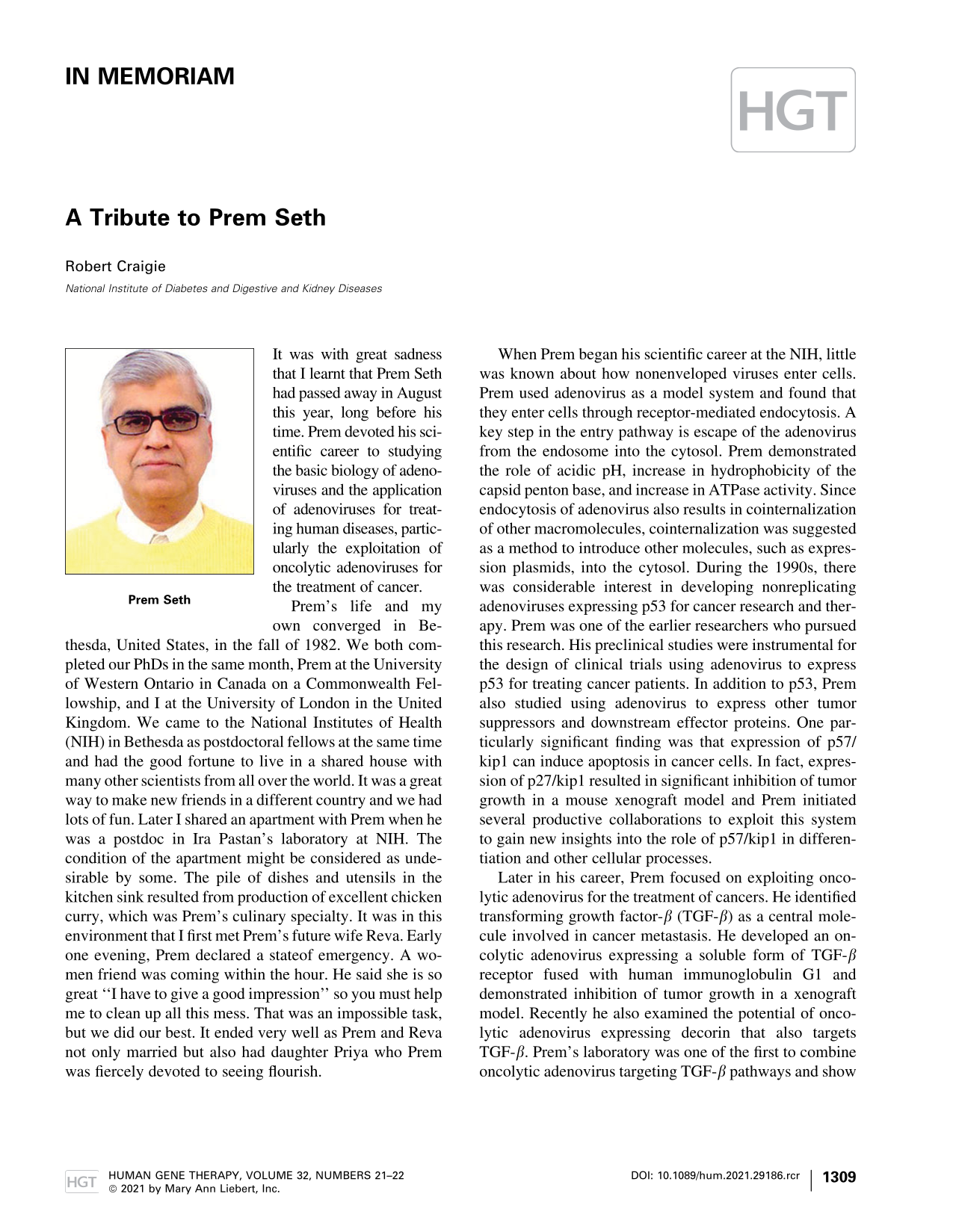

It was with great sadness that I learnt that Prem Seth had passed away in August this year, long before his time. Prem devoted his scientific career to studying the basic biology of adenoviruses and the application of adenoviruses for treating human diseases, particularly the exploitation of oncolytic adenoviruses for the treatment of cancer.
Prem's life and my own converged in Bethesda, United States, in the fall of 1982. We both completed our PhDs in the same month, Prem at the University of Western Ontario in Canada on a Commonwealth Fellowship, and I at the University of London in the United Kingdom. We came to the National Institutes of Health (NIH) in Bethesda as postdoctoral fellows at the same time and had the good fortune to live in a shared house with many other scientists from all over the world. It was a great way to make new friends in a different country and we had lots of fun. Later I shared an apartment with Prem when he was a postdoc in Ira Pastan's laboratory at NIH. The condition of the apartment might be considered as undesirable by some. The pile of dishes and utensils in the kitchen sink resulted from production of excellent chicken curry, which was Prem's culinary specialty. It was in this environment that I first met Prem's future wife Reva. Early one evening, Prem declared a stateof emergency. A women friend was coming within the hour. He said she is so great “I have to give a good impression” so you must help me to clean up all this mess. That was an impossible task, but we did our best. It ended very well as Prem and Reva not only married but also had daughter Priya who Prem was fiercely devoted to seeing flourish.
When Prem began his scientific career at the NIH, little was known about how nonenveloped viruses enter cells. Prem used adenovirus as a model system and found that they enter cells through receptor-mediated endocytosis. A key step in the entry pathway is escape of the adenovirus from the endosome into the cytosol. Prem demonstrated the role of acidic pH, increase in hydrophobicity of the capsid penton base, and increase in ATPase activity. Since endocytosis of adenovirus also results in cointernalization of other macromolecules, cointernalization was suggested as a method to introduce other molecules, such as expression plasmids, into the cytosol. During the 1990s, there was considerable interest in developing nonreplicating adenoviruses expressing p53 for cancer research and therapy. Prem was one of the earlier researchers who pursued this research. His preclinical studies were instrumental for the design of clinical trials using adenovirus to express p53 for treating cancer patients. In addition to p53, Prem also studied using adenovirus to express other tumor suppressors and downstream effector proteins. One particularly significant finding was that expression of p57/kip1 can induce apoptosis in cancer cells. In fact, expression of p27/kip1 resulted in significant inhibition of tumor growth in a mouse xenograft model and Prem initiated several productive collaborations to exploit this system to gain new insights into the role of p57/kip1 in differentiation and other cellular processes.
Later in his career, Prem focused on exploiting oncolytic adenovirus for the treatment of cancers. He identified transforming growth factor-β (TGF-β) as a central molecule involved in cancer metastasis. He developed an oncolytic adenovirus expressing a soluble form of TGF-β receptor fused with human immunoglobulin G1 and demonstrated inhibition of tumor growth in a xenograft model. Recently he also examined the potential of oncolytic adenovirus expressing decorin that also targets TGF-β. Prem's laboratory was one of the first to combine oncolytic adenovirus targeting TGF-β pathways and show that oncolytic adenovirus can be effective in both immune-deficient and immune-competent mouse models. More recently, he has developed improved safe oncolytic adenovirus that can be administered systemically and evade the pre-existing adenovirus and have enhanced tumor uptake, but with liver detargeting. Preliminary studies showed that these viral vectors produce tumor-directed immune activation and inhibit tumor growth and spontaneous metastasis. Prem was recently awarded an NIH grant to develop these approaches for cancer treatment.
His scientific accomplishments have been recognized by many of his peers, although Prem was foremost a great mentor, having trained numerous scientists who have gone on to establish successful programs in academia and industry. Prem will be remembered as a brilliant and creative scientist, an inspirational mentor, and a cherished friend.
Prem is survived by his wife Reva, daughter Priya, their dog Channel, who all miss him very much as do his relatives, friends, and colleagues. He has contributed much to our lives, and he lives on in our hearts. The future of humanity is in the passing on of knowledge and culture to solve the problems of our future. Prem achieved more than his fair share in this common endeavor.
Robert Craigie, PhD
Principal Investigator
NIDDK