




Abstract
Purpose:
The wound healing process involves a complex series of biological events. Skin grafts have several uses as a reconstructive method. There are several dressings for the skin graft donor site, but the optimum dressing agents that provide all the requirements at the same time are unclear. This prospective, randomized, placebo-controlled clinical trial aimed to evaluate the therapeutic effect of Zataria multiflora cream in the wound healing process of partial-thickness skin graft donor sites and compared it with a placebo.
Materials and Methods:
This clinical trial study was performed on patients who underwent split-thickness skin grafts. Enrolled patients applied Z. multiflora cream and placebo controlled (petrolatum ointment) twice a day, from the day of intervention at the skin graft donor sites in two parts, separately. On 7, 14, 21, and 28 days after surgery, the wound healing process was evaluated, photographed, and scored according to the Bates-Jensen assessment tool. Evidence of infection was evaluated. The main agent and placebo were compared during the wound healing process.
Results:
Decreases in wound surface area and total score were significantly greater in the Z. multiflora group (p < 0.05). The wounds of 30% of patients in the second week and 90% of patients in the third week were completely epithelialized in the Z. multiflora group. These values were 3.3% and 36.7% for the control group, respectively, and so, the healing rate was ∼9-fold in the second week and 2.45-fold in the third week in the Z. multiflora group compared with the control group (p < 0.05).
Conclusion:
Wound healing and reepithelialization accelerated significantly in the first, second, third, and fourth week after intervention in the Z. multiflora treatment group, due to modulating the inflammatory phase and improving the proliferative phase.
Clinical Trial Registration Number:
IRCT20210624051695N1.
Introduction
The wound healing process involves a complex series of biological events that restore skin barrier function, prevent dehydration, and reduce the risk of infection. Delay in wound healing leads to chronic inflammation and increased scarring. 1 Skin grafting as a reconstructive procedure is a beneficial technique in cases such as scar repairing, burn wound healing, and other wounds. After harvesting a split-thickness skin graft, a new wound is formed at the donor site that needs to be properly managed and treated. The donor site is a suitable wound for evaluating the effect of topical agents on wound healing, and due to the similarity of the structure of the split-thickness skin graft donor-site wound to superficial partial-thickness (second-degree) burns, 2,3 the results of the effectiveness of drugs can be used in burns and other wound healing. Donor-site management is an important issue.
Many patients feel more discomfort at the donor site than at the recipient site. 4 There are several dressings with topical agents for the skin graft donor site, 5 but the optimum dressing agents that provide all the requirements at the same time (such as prevention of infection, rapid wound healing, and pain reduction) are unclear. 1 Petrolatum gauzes are often used as standard or traditional dressings due to their moisture properties. 2 In a study by Voineskos et al., the results showed that the evidence supporting moist wound dressings is weak and further trials and studies were needed to determine the optimal dressing for skin graft donor sites. 4
Some definite disadvantages of petrolatum ointment (Vaseline®) have been reported in previous studies, such as maceration of the wound surface during warm weather, due to the water seal properties of the petrolatum ointment. The dressing becomes contaminated with the patient's sweat and exudate accumulation, making it a suitable anaerobic medium for bacterial growth, and when an infection is developed, it can rapidly spread to the entire wound surface. Vaseline has no antibacterial activity. 2
Although in the era of modern medicine, the use of the plant has declined, wound healing development is taking place, and due to antibiotic resistance, scientists have revised the traditional ideal dressings, including herbal topical agents. The use of herbal medications in wound healing is a good idea for future studies. 6,7
The wound healing process significantly depends on the degree of inflammation and infection. 8,9 Previous studies have shown that herbal drugs with antioxidant and anti-inflammatory properties shorten the wound healing process. 10 Alkanna tinctoria, Aloe vera, and Salvia officinalis accelerated wound healing. 11 –13
Zataria multiflora (Lamiaceae family) is a historical plant that grows in Iran, Afghanistan, and Pakistan, and is also known as thyme. 14,15
The main active ingredients of Z. multiflora are p-cymene, ɣ-terpinene, carvacrol, and thymol, which lead to antioxidant, anti-inflammatory, antibacterial, and antifungal properties and accelerate wound healing. 16 –19 Thymol derivatives show strong wound healing along with anti-inflammatory and antimicrobial properties. 20 Although the wound-healing effect of Z. multiflora was identified in an animal study, 21 there are no similar studies on the effect of this plant on human wound healing.
The purpose of this study was to evaluate the healing effectiveness of Z. multiflora dressing for split-thickness skin graft donor-site coverage compared with placebo-controlled dressing (petrolatum ointment) at the donor site after harvesting the skin graft.
Materials and Methods
Patients and study protocol
A prospective, randomized (1:1), blinded, placebo-controlled clinical trial was conducted between September 2020 and September 2021 at Vali-Asr and Razi Hospitals, tertiary university hospitals in Tehran (see Supplementary CONSORT checklist). Permission to perform the study was granted by the Ethics Committee at Tehran University of Medical Sciences (
All the patients undergoing split-thickness skin graft harvest for the treatment of burn wounds, trauma, scars, or tumors were included in the study. Exclusion criteria were a history of hypersensitivity reaction to the Z. multiflora derivatives, immunodeficiency state, pregnancy, age older than 60, those suffering from diseases that could interfere with wound healing, such as diabetes, renal or liver failure, malignancy, hypoalbuminemia (serum albumin <4 g/dL), malnourishment, and patients who do not want to participate in the study. Written informed consent was obtained from all patients. The sample size was calculated based on alpha (significance level set at 0.05), study power (1 − beta error probability) of 80%, and effect size of 0.5.
All of the enrolled patients were administered general anesthesia, and the donor site was prepared with 10% povidone iodine solution. All skin grafts were harvested from the anterolateral thigh region (from two adjacent areas at a distance of about 1 cm) in thickness of 0.4 mm with an electric Dermatome (Humeca, USA). Z. multiflora cream (group A) was applied randomly on one of the two skin graft donor sites and a placebo topical agent was used on the other site (petrolatum ointment, group B). The randomization sequence was generated by a statistician based on simple randomization through random allocation software and maintained by an administrator who had no other involvement in the trial.
Allocation concealment regarding groups A and B was implemented according to sequentially numbered and sealed envelopes. In the operating room, the donor-site wounds were dressed randomly with Z. multiflora cream on one site and placebo on the other site by one of the main researchers based on the randomization sequence, then bandaged with a single layer of petrolatum gauze in the control group, and Z. multiflora-impregnated gauze in the Z. multiflora group along with several dry sterile gauzes. On the first postoperative day, the top dressing layers were removed in both groups, but left the first petrolatum- and Z. multiflora-impregnated gauze layer in place to prevent damage to the wounds, and Z. multiflora and placebo creams were applied twice daily at the respective site. The Z. multiflora cream and placebo ointment were identical in appearance, weight, texture, and color. They were only recognizable by a code (A or B).
The researchers and the patients were blinded to the content of the ointment throughout the study and during the statistical analysis. All the dressings were peeling off spontaneously during the first week. This treatment was performed for 1 month.
Bates-Jensen wound assessment tool
Donor-site reepithelization and the percentage of healing were evaluated postoperatively with the Bates-Jensen wound assessment tool (BWAT), as well as signs of infection on days 7, 14, 21, and 28. Another physician, who was blinded to the treatments, visually and photographically assessed all patients.
BWAT is a standard assessment tool that includes 13 items that assess wound size, depth, edges, undermining, necrotic tissue type and amount, exudate type and amount, skin color surrounding the wound, peripheral tissue edema and induration, granulation, and epithelialization tissue. Each item gets points and the total score was calculated by adding together the 13-item scores. A lower total score indicates more wound healing. 22
Statistical analysis
The SPSS® version 26 (IBM North America, New York, NY, USA) was used to analyze the data. The descriptive statistics were employed to report the mean, standard deviation, frequency, and percent for the participants' characteristics. The Shapiro–Wilk test was performed to evaluate normality. The authors used a sample T-test to analyze the quantitative variables between the two groups, and chi-square and Fisher's exact test for the qualitative variables. The significance level was set at 0.05.
Results
Demographic results
Thirty-eight patients were enrolled in this study (see Supplementary Sample size). Eight patients did not come for follow-up and were excluded from the study (Fig. 1). Among the included patients (30 patients in each group), 80% were male and 20% were female. The mean age was 50.33 years; the youngest patient was 10 years old and the oldest participant in the study was 59 years old. There was no significant relationship between demographic data and wound healing rate (p > 0.05) (Table 1). Ten patients underwent skin grafts for the treatment of basal cell carcinoma, 10 patients due to squamous cell carcinoma, 6 participants due to burning, and other patients due to other causes such as hidradenitis, diabetic foot ulcer, and dermatofibroma. There was no significant difference between these diseases and the rate of wound healing in the two groups (p > 0.05).
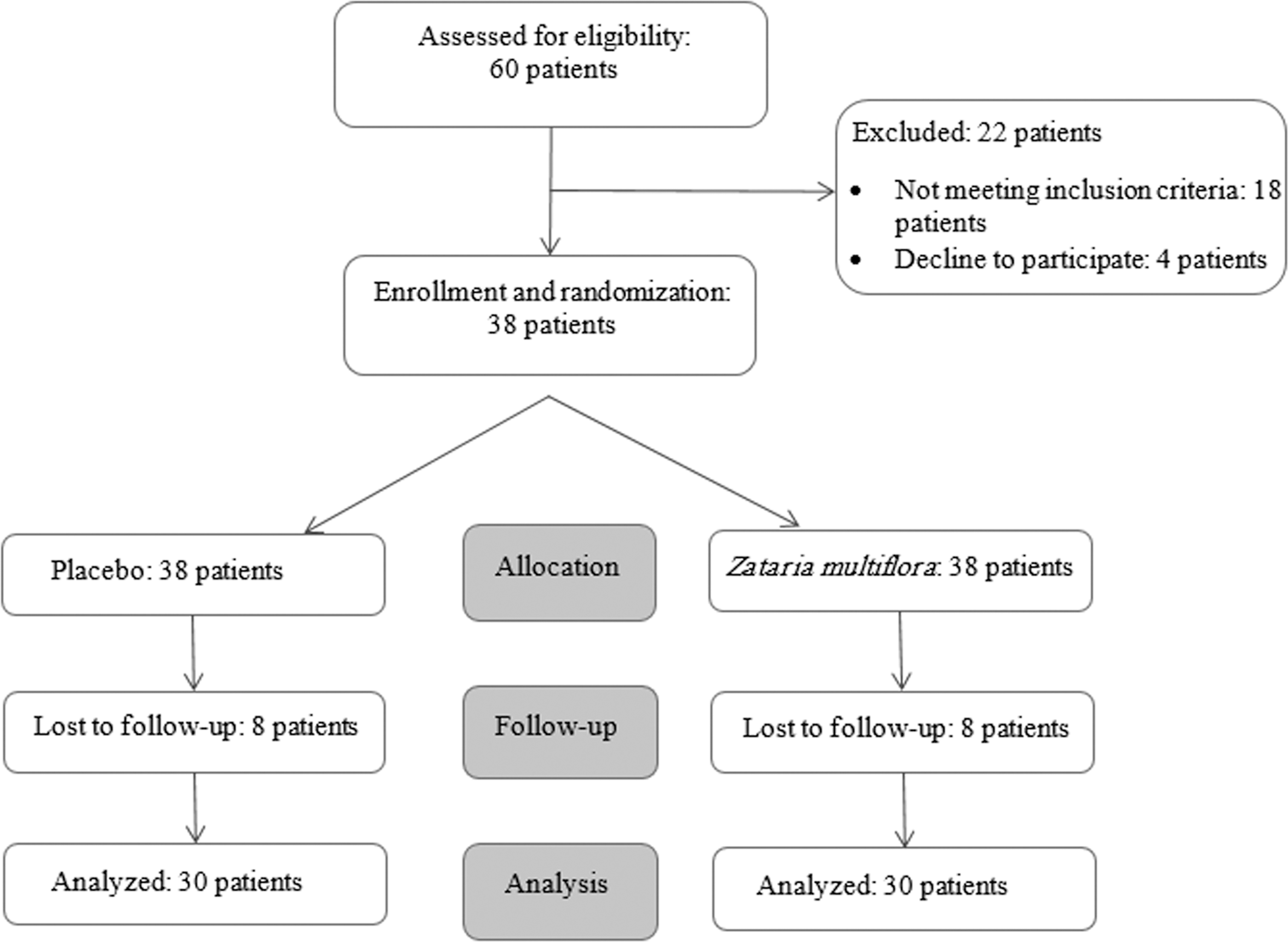
Consort flowchart of the study.
Demographic Results
The treatments (Zataria multiflora cream and placebo) were performed on two sites of patients. All demographic parameters were the same for both treatments.
SD, standard deviation.
BWAT results
There was no significant difference in wound total scores and wound size of both groups at baseline (p > 0.05). The total score was significantly different between the Z. multiflora group in comparison with the control group in the first, second, third, and fourth week after the intervention (p < 0.05). The decrease in total scores was significantly higher in the Z. multiflora group compared with the control group on days 7, 14, 21, and 28 after the dressing was applied (p < 0.05) (Fig. 2).

The linear graphs of average wound total scores (according to the Bates-Jensen criteria) demonstrate the change of total scores at the first, second, third, and fourth week after the graft harvesting in each group of Zataria multiflora cream and placebo.
The wound size was significantly reduced in the Z. multiflora group compared with the control group after the first, second, third, and fourth week after the operation. The average surface areas were 58.53 ± 36.75, 11.27 ± 16.62, 3.7 ± 16.5, and 0.33 ± 1.82 cm2 in the Z. multiflora group, whereas these values were 80.4 ± 22.47, 39 ± 28.31, 15.4 ± 22.6, and 4.8 ± 11.67 cm2 in the control group at days 7, 14, 21, and 28, respectively (p < 0.05).
No adverse effects such as erythema and pruritus were seen in either group treated with Z. multiflora and placebo creams. In the second week, scant bloody exudate was seen in two patients in the Z. multiflora group and five patients in the control group and it was resolved in the following weeks. There were no significant differences in exudate type and amount between the two groups (p > 0.05).
Wound reepithelialization occurred faster in the treatment group with Z. multiflora than in the control group (Table 2 and Fig. 3). In this study, the wounds of 90% of patients in the Z. multiflora group were completely healed by the third week and 96.7% of patients by the fourth week. While in the control group, 73.3% of patients' wounds completely healed by the fourth week. At the end of the fourth week, the wounds of eight patients in the control group did not heal completely, but there was one patient in the Z. multiflora group who did not heal completely.

Wound healing and reepithelialization in the control group (number 1, left side of each picture) versus Zataria multiflora treatment group (number 2, right side of each picture) in baseline
Percentage of Patient Wound Reepithelialization in the First, Second, Third, and Fourth Week After the Graft Harvesting in Each Group of Zataria multiflora Cream and Placebo
Discussion
In this clinical study, the authors compared the effect of Z. multiflora with petrolatum ointment on skin graft donor-site wounds in patients. Dressing the wound in the control group with Vaseline ointment is the standard treatment and conventional dressing, 2 and wound management in the two groups (whether the dressing is open or closed) is similar and only the topical agent is different. This study showed that Z. multiflora cream exhibited significantly wound healing effects on donor sites compared with the control group. To the best of knowledge, this study is the first clinical study to evaluate the healing effect of the Z. multiflora topical cream on human nonmucosal wound healing.
Previous studies have shown the anti-inflammatory and healing effects of Z. multiflora on animal wounds such as rats or rabbits and oral mucositis in patients who underwent radiation therapy due to head and neck malignancy. 21,23,24 In an in vitro study, the healing properties of thyme oil by HaCat keratinocytes showed that thyme oil 25 and 50 μg/mL significantly stimulated the migration of HaCat cells, and so, it could lead to wound closure and faster wound healing. 25
Under optimal conditions, the skin graft donor site will heal within 7–21 days, depending on the patient's age, size, and depth of the graft. 2 The healing process occurs in three stages: inflammation, proliferation, and maturation. 21 These results showed that twice-daily application of Z. multiflora cream containing thymol, according to the Bates-Jensen assessment criteria, had a significant effect on the wound healing rate and reepithelialization occurred faster in the group treated with Z. multiflora cream versus the control group. The proportion of patients in the Z. multiflora group achieving complete wound healing on the first, second, third, and fourth week was 0%, 30%, 90%, and 96.7%, respectively, significantly higher than in the control group: 0%, 3.3%, 36.7%, and 73.3%, respectively.
An animal study showed that the use of zein/thyme essential oil dressing had a greater effect on the healing process than the use of zein oil alone and the control group. The wound did not heal completely in the control group without dressing after 11 days. In the group that used electrospun zein oil membrane, the healing rate was higher, although after 11 days the wound was still not completely healed; when the electrospun zein/thyme essential oil mesh, which has antibacterial properties, was applied, the wound healing process was significantly accelerated and, after 11 days, the wound healed almost completely. 21
The results of this study showed that the use of Z. multiflora leads to complete wound healing ∼9 times faster than the control group in the second week (9 patients [30%] in the Z. multiflora group vs. 1 patient [3.3%] in the control group). This rate of wound healing is significantly higher than the control group compared with other similar studies.
Reducing scarring is one of the major cosmetic concerns in the field of plastic and reconstructive surgery. Superficial partial-thickness burn wounds heal in 7–14 days, leaving only a slight discoloration of the skin and textural differences without significant scarring after healing. 3 Therefore, partial-thickness wounds such as split-thickness skin graft donor sites do not leave a significant scar if they heal within 14 days after graft harvesting.
In a study, the wound healing effect of Moroccan thyme honey in combination with each of the oils of Thymus vulgaris, Origanum vulgare, Rosmarinus officinalis was compared with each other and with the control group on thermal and chemical burn wounds of rabbits. Similar to these results, the best treatment result was related to the combined group of thyme honey and thyme oil, which led to complete wound healing in 14 days and had the shortest wound healing time compared with other groups. Since inflammation causes many issues, such as infection, impaired collagen synthesis, and wound dehiscence, in that study, thymol was considered an effective factor in wound healing due to its anti-inflammatory properties. 24
In the previous clinical study, Aloe vera cream accelerated the wound healing process compared with dry gauze dressing; this may have been due to the moisture effect of Aloe vera dressing, but in this study, it appears as though the pharmacologic properties of thymol were responsible for the observed beneficial effects on wound healing. 26 The anti-inflammatory properties of thymol accelerate wound healing. Riella et al. study results show that thymol significantly reduces edema and inflammation and reduces the influx of leukocytes into the wound area. Thymol-impregnated dressings significantly reduced wound size on days 7 and 14 compared with the control group, as well as improved granulation tissue, collagenization density, and arrangement. 20
In the study by Farahpour et al. on infected Pseudomonas aeruginosa wounds, the topical administration of Z. multiflora essential oil led to increased insulin like growth factor 1, vascular endothelial growth factor, and fibroblast growth factor 2 gene expression, and so, the wound healing process accelerated and the proliferative phase improved by increasing fibroblasts, increasing the transport of glucose, stimulating cell migration, and inducing angiogenesis. 19
The wound healing effect of Z. multiflora plus honey was evaluated on full-thickness wounds in rats. The use of a topical agent twice a day had similar results to this study, which was a split-thickness wound. 27
This study results also suggest that thymol-based wound healing drugs such as Z. multiflora topical cream, which modulates the inflammatory phase and improves the proliferative phase of wound healing, may be more effective than standard wound dressings for managing skin graft donor sites, and due to its antimicrobial properties, it may reduce the risk of infection and accelerate wound healing. 19,28,29
Conclusion
Decreases in wound surface area and total score were significantly greater in the Z. multiflora group. The wounds of 30% of patients in the second week and 90% of patients in the third week were completely epithelialized in the Z. multiflora group. These values were 3.3% and 36.7% for the control group, respectively, and so, the healing rate was ∼9-fold in the second week and 2.45-fold in the third week in the Z. multiflora group compared wiht the control group. Therefore, the study results suggest that wound dressings with Z. multiflora cream can facilitate wound healing.
Limitations
In this study, the authors just evaluated Z. multiflora cream on split-thickness graft donor sites and they did not check for other wound types such as burn and full-thickness ulcers. In the future, further studies are recommended to evaluate the healing process of all kinds of wounds. Poor cooperation of patients for the follow-up treatment process and scar evaluation due to the COVID 19 pandemic. Further studies in the future after pandemic control and studies with more patients and a longer follow-up are recommended. Most existing studies have investigated the healing of infected wounds and the antimicrobial effect of Z. multiflora. Future studies are suggested for the clinical evaluation of the noninfectious wound healing process in humans.
Footnotes
Authors' Contributions
I (G.K.) am a professor of plastic and reconstructive surgery at Imam Khomeini Hospital Complex, Tehran University of Medical Sciences, Iran. My student M.M.N. conducted this study as his thesis in the last year of plastic surgery residency under my direct supervision. I and other authors (M.M.N., G.K., S.J.H., J.R., and A.Y.) confirm that this research is from the academic center in Tehran/Iran that is primarily involved in education and research. M.M.N. and G.K. were involved in conceptualization. All authors were involved with conducting a research and investigation process and contributed to the content, drafting, and editing of the article. All authors reviewed and approved the final article.
Availability of Data and Materials
The data sets used and/or analyzed during the current study are available from the corresponding author on reasonable request.
Author Disclosure Statement
No competing financial interests exist.
Funding Information
No funding was received for this article.
Supplementary Material
CONSORT checklist
Sample size
References
Supplementary Material
Please find the following supplemental material available below.
For Open Access articles published under a Creative Commons License, all supplemental material carries the same license as the article it is associated with.
For non-Open Access articles published, all supplemental material carries a non-exclusive license, and permission requests for re-use of supplemental material or any part of supplemental material shall be sent directly to the copyright owner as specified in the copyright notice associated with the article.
