




Abstract

The Society for Integrative Oncology (SIO) (https://integrativeonc.org/) was founded in 2003 as a not-for-profit, international, multidisciplinary professional organization, intended to bring together integrative oncology practitioners and researchers across multiple disciplines. The mission of SIO is to advance evidence-based, comprehensive, integrative healthcare to improve the lives of people affected by cancer.
SIO has led the definition of the field of Integrative Oncology, with the current definition stating: “Integrative oncology is a patient-centered, evidence-informed field of cancer care that utilizes mind and body practices, natural products, and/or lifestyle modifications from different traditions alongside conventional cancer treatments. Integrative oncology aims to optimize health, quality of life, and clinical outcomes across the cancer care continuum and to empower people to prevent cancer and become active participants before, during, and beyond cancer treatment.” 1 While these approaches sometimes may not be considered part of standard Western oncology practice, integrative oncology can guide patients, families, and health care providers through the complex process of implementing these potential treatment options.
History of Evidence-Based Clinical Practice Guidelines
Over the years, SIO has developed multiple evidence-based clinical practice guidelines, seeing their potential value in guiding treatment choices for people with cancer, their health care team and supporters, as well as promoting the uptake of integrative oncology evidence into clinical practice. These guidelines serve as best practices for incorporating integrative therapies into conventional oncology clinical practice. In 2007, SIO published guidelines on the use of “Complementary Therapies and Integrative Oncology in Lung Cancer.” 2 These were updated in 2013. 3 In 2009, SIO published “Evidence-Based Clinical Practice Guidelines for Integrative Oncology: Complementary Therapies and Botanicals.” 4 This article focused on the use of integrative therapies in the supportive care of cancer patients. In 2014, “Clinical Practice Guidelines on the Use of Integrative Therapies as Supportive Care in Patients Treated for Breast Cancer” was published in short form, 5 updated and expanded upon in 2017, 6 and endorsed by American Society of Clinical Oncology (ASCO) in 2018. 7 This endorsement was significant because ASCO is the largest and most influential professional organization for oncologists and other oncology health care professionals worldwide, with over 50,000 members, setting the standard for research evidence and conventional cancer treatment recommendations. Having ASCO formally recognize and endorse SIO guidelines for integrative therapies in their flagship journal, Journal of Clinical Oncology, was an important step toward increasing broad awareness of the multitudinous evidence supporting integrative therapies, and for more mainstream and widespread acceptance of these modalities.
SIO has since received funding from the Samueli Foundation for clinical practice guideline development and entered into formal collaboration with ASCO on three evidence-based integrative oncology guidelines for adults, focusing on cancer-related pain management, 8 care of anxiety and depression symptoms experienced by those with cancer, 9 and symptoms of fatigue, 10 all of which were published in the Journal of Clinical Oncology. Below, we summarize each of these guidelines’ recommendations in more detail.
Pain Guideline
The aim of the guideline was to provide evidence-based recommendations to practicing health care providers on integrative approaches to managing various types of pain in people with cancer. SIO and ASCO convened an interdisciplinary expert panel of oncology specialists (i.e., integrative, medical, radiation, surgical, palliative), social sciences, mind–body medicine, nursing, and patient advocacy representatives, guided by an experienced ASCO guideline development methodologist. The literature search included systematic reviews, meta-analyses, and randomized controlled trials (RCTs) published from 1990 through 2021. Outcomes of interest included pain intensity, symptom relief, and adverse events. Expert panel members used this evidence and informal consensus to develop evidence-based guideline recommendations.
The literature search identified 227 relevant RCTs. Recommendations included that among adult patients, acupuncture should be recommended for aromatase inhibitor–related joint pain. Acupuncture or reflexology or acupressure may be recommended for general cancer pain or musculoskeletal pain. Hypnosis may be recommended to patients who experience procedural pain. Massage may be recommended to patients experiencing pain during palliative or hospice care. These recommendations are based on an intermediate level of evidence, benefit outweighing risk, and with moderate strength of recommendation. The specific wording and strength of each recommendation is provided in the guideline summary table (Fig. 1). Acupuncture interventions received the strongest recommendations, and in these studies, acupuncture was typically delivered over the course of 8–12 sessions of 30–45 min each, using specific acupoints in the body related to pain control, including the ears. Manual or electroacupuncture may be used.

Pain recommendations summary table.
The quality of evidence for other mind–body interventions or natural products for pain was either low or inconclusive, and there was insufficient or inconclusive evidence to make recommendations for pediatric patients.
Partnering with ASCO has also meant that the guideline has been supported by many professionally designed dissemination tools, including a visual abstract, treatment algorithms, summary table, pocket guides, PowerPoint slide show, a podcast, as well as patient-facing materials that are posted on cancer.net. A summary Q&A article was also published simultaneously in the companion JCO Oncology Practice. 11 These can all be freely accessed here: https://society.asco.org/practice-patients/guidelines/patient-and-survivor-care#/182035.
Finally, SIO independently designed high-quality interactive continuing education modules on each of the recommendations, which summarize each recommendation and related treatment modality with a description of the therapy, discussion of mechanisms of action, evidence summary, and safety and practical tips for access. These are freely available on the SIO website here: https://integrativeonc.org/training-modules/.
Anxiety and Depression Guideline
This guideline was intended to provide evidence-based recommendations to health care providers on integrative approaches to managing anxiety and depression symptoms in adults with cancer, both during and after conventional cancer treatment. As with the pain guideline, SIO and ASCO convened an interdisciplinary expert panel to review the literature, which included systematic reviews, meta-analyses, and RCTs published from 1990 through 2023. Outcomes of interest included anxiety or depression symptoms as measured by validated psychometric and patient-related outcomes tools. Expert panel members used this evidence within the Guidelines into Decision Support methodology to develop evidence-based guideline recommendations.
The literature search identified 110 relevant studies (30 systematic reviews and 80 individual RCTs), which included a total of over 400 individual RCTs, to inform the evidence base for this guideline. Recommendations were made for mindfulness-based interventions (MBIs), yoga, relaxation, music therapy, reflexology, and aromatherapy (using inhalation) for treating symptoms of anxiety during active treatment, and MBIs, yoga, acupuncture, t’ai chi and/or qigong, and reflexology for treating anxiety symptoms after cancer treatment. For depressive symptoms, MBIs, yoga, music therapy, relaxation, and reflexology were recommended during treatment, and MBIs, yoga, and t’ai chi and/or qigong were recommended post-treatment. The quality of the evidence and strength of the recommendations are represented in the accompanying treatment algorithms (Figs. 2 and 3), showing that the highest quality and strength is for the MBIs, followed by yoga interventions.
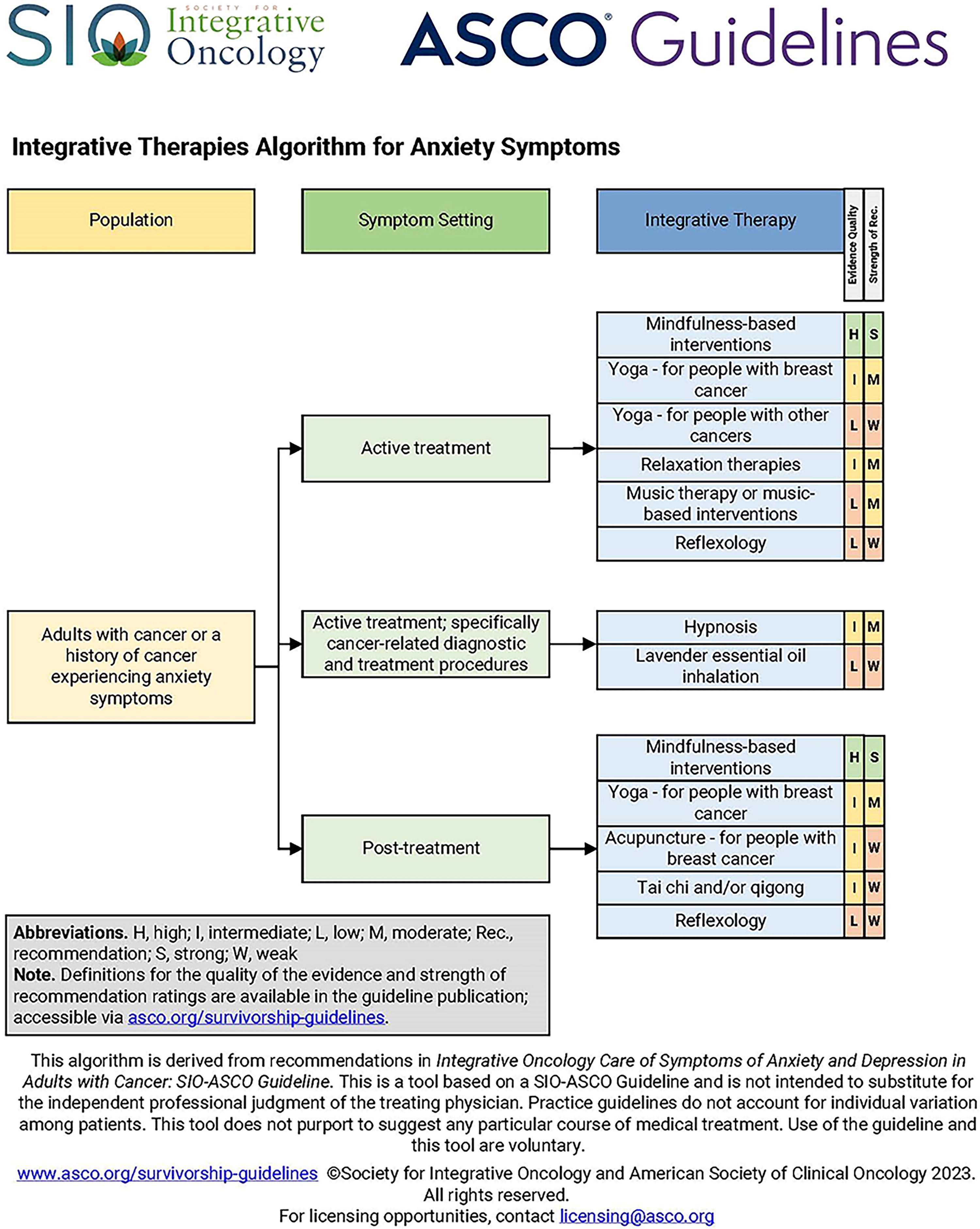
Anxiety treatment algorithm.
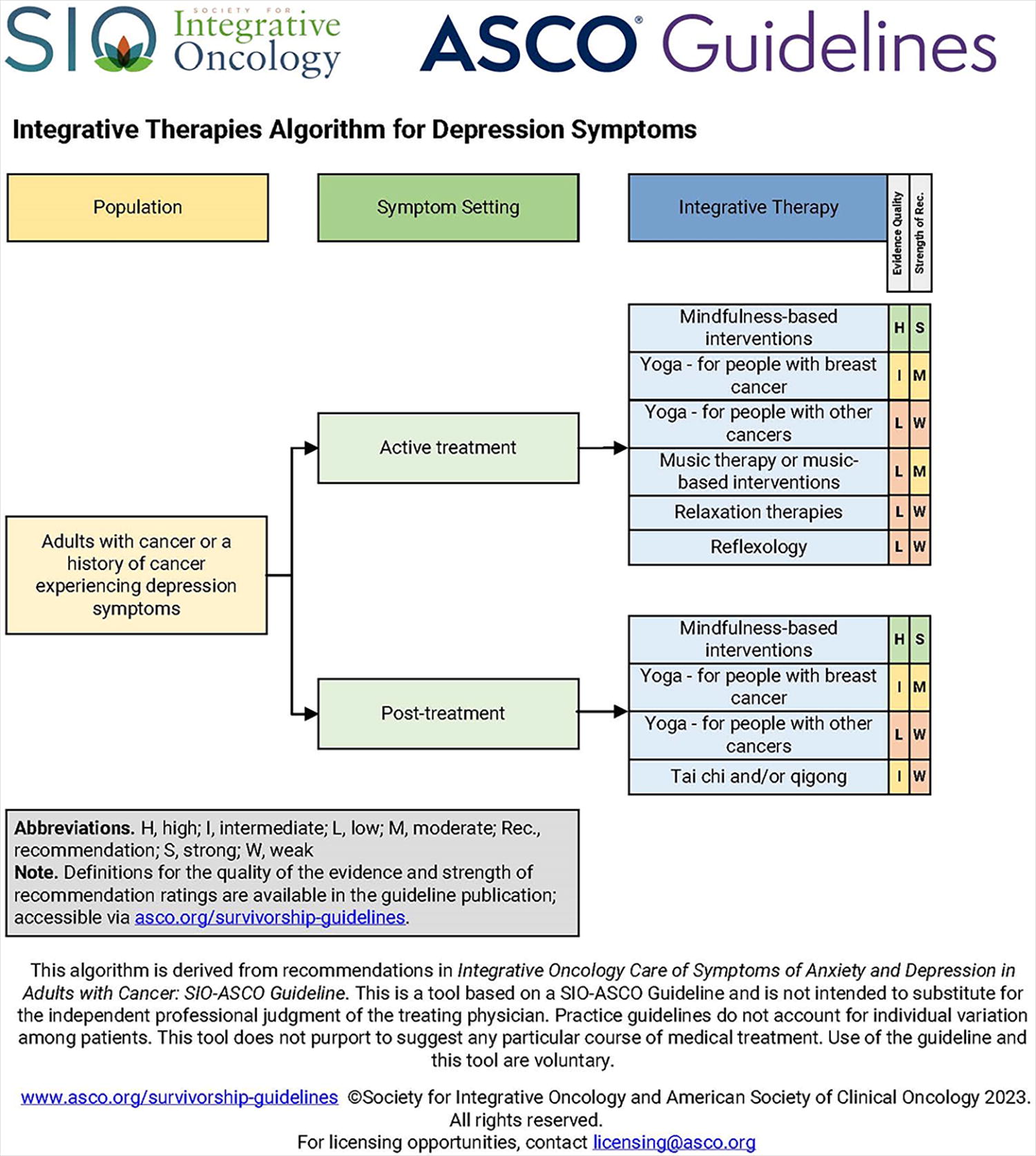
Depression treatment algorithm.
MBIs are typically group-based multiweek, in-person programs based on the Mindfulness-Based Stress Reduction program of Jon Kabat-Zinn. 12 Participants are trained in mindfulness through daily mindfulness meditation practice, discussion of topics such as stress and the stress response, coping, attitudes of acceptance, nonjudgment and compassion, and gentle mindful movement through Hatha yoga practices. Yoga interventions usually include 6–12 weeks of once or twice per week gentle restorative or therapeutic Hatha yoga practices, usually delivered in group-based programs. These therapies have been studied in women with breast cancer more than other cancer types.
Other therapies that are of interest to people with cancer were listed in the guideline as “inconclusive” due to lack of a sufficient evidence base, though for each of these, there was some research reviewed. These include nutritional interventions, light therapy, psilocybin-assisted supervised therapy, massage, dance/movement therapy, laughter therapy, healing touch, acupressure, biofeedback, autogenic training, energy healing, melatonin, or other natural products and supplements.
Supplemental material for the anxiety and depression guideline including a slide set, pocket guide, visual abstract, treatment algorithms, summary table, and patient-facing materials as well as the summary Q&A article 13 can be found here: https://society.asco.org/practice-patients/guidelines/patient-and-survivor-care#/189460.
Fatigue Guideline
The ASCO-SIO fatigue management guideline was recently published in May 2024. 10 As with the other guidelines, a multidisciplinary panel of experts was convened to review the evidence. Guideline development involved a systematic literature review of RCTs published up to 2023 (largely between 2013 and 2023) and included 113 trials. Both conventional and integrative therapy recommendations were included in the guideline. See Figure 4 for the visual abstract. Of the integrative therapies, mindfulness-based programs and t’ai chi or qigong were recommended to reduce the severity of fatigue during cancer treatment with the highest level of evidence. American ginseng may also be recommended in adults undergoing cancer treatment. For survivors after completion of treatment, recommendations were strong for exercise and mindfulness-based programs both in person and web-based/online, conditional for yoga, and acupressure.
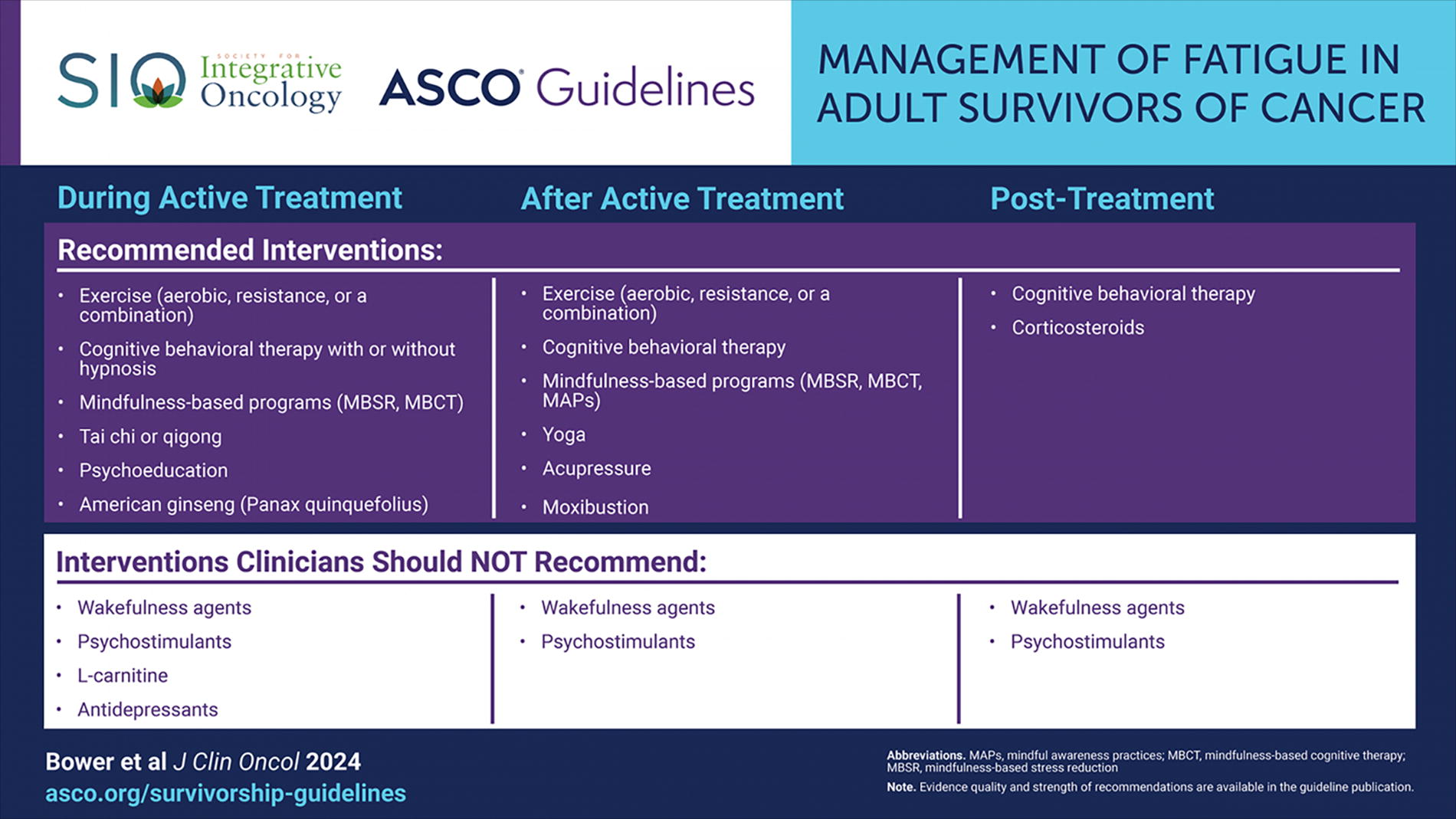
Fatigue visual abstract.
There were also suggestions to avoid recommending
Across all three guidelines, systematic limitations of the evidence base have been identified, including assessment of risk of bias, nonstandardization of therapies, lack of diversity in study samples in terms of types of cancer, stages and demographics, and lack of active control conditions.
Summary
As with most guidelines, the SIO and ASCO joint guidelines are living documents intended to be updated with newer research of relevant therapies and clinical outcomes data, and to be applicable for generalized cancer practice across disciplines. The field of integrative oncology continues to evolve, and it is expected that larger trials with diverse populations will allow sharper definitions of relative benefit and harms associated with a growing array of structured integrative oncological practices. Future directions should include increasing access to integrative services and addressing the variety of barriers that exist, including available services, cost, and lack of insurance coverage. Additionally, greater diversity among clinical trial participants is needed to ensure results are widely applicable. At the current time, small sample sizes, homogeneity of populations, and diversity in clinical practice of integrative modalities are key features that may limit the scope of recommendations. As the field of integrative oncology expands, these limitations are expected to change over time, and the dissemination of the evidence and the appropriate application of guidelines in integrative oncology are expected to be incorporated into general cancer care.