




Abstract
Isoprinosine is a synthetic purine derivative with immunomodulatory and antiviral properties, which result from an apparent in vivo enhancement of host immune responses. To evaluate the serum levels of certain cytokines during and after isoprinosine treatment, we assigned 10 healthy volunteers to receive isoprinosine 1 g, 3 times daily, 5 consecutive days weekly. Both treatment and follow-up phase last 3 weeks. Interferon-γ (IFN-γ), interleukin-2 (IL-2), IL-10, and tumor necrosis factor-α (TNF-α) were measured in serum using commercial ELISA kits at baseline, 7th, 10th, 14th, 21st, 28th, 35th, and 42nd day. We observed an increase in serum levels of all measured cytokines at 7th to 10th day. The levels of IL-2 had another raise at 42nd day after drop to initial values (P < 0.05; P < 0.001, respectively). Those of IL-10 held up enhanced from 7th to 28th day of measurement (P < 0.01). There was a nearly flat line of values of TNF-α after initial slight increase at 10th day. We found a moderate negative correlation between IFN-γ and IL-2, IL-10, and TNF-α (Spearman’s r: −0.63, −0.62, −0.63; P < 0.05, respectively). We have demonstrated the immunomodulating properties of isoprinosine in healthy adults. It suggests resumption of the research with up-to-date methods to elucidate the mechanisms of action of inosine pranobex and maybe the other inosine compounds in different clinical settings.
Introduction
I
Cytokines regulate the intensity and duration of immune response. The levels of specific cytokines reveal its state at that given time. Secretion of type-1 and type-2 cytokines promotes development of subsets of memory T-helper-1 (Th1) and T-helper-2 (Th2) cells, respectively (O’Garra 1998). There are many aspects to immune dysfunction and possibilities of assays depending on research question. We studied the influence of isoprinosine in vivo in healthy volunteers (probands). To establish an effect and main alterations in result of immunomodulating activity of the compound, we determined the Th1/Th2 cytokine profile in serum from healthy subjects during and after isoprinosine intake (for didactic reasons, we note the intake as “treatment” nevertheless we studied healthy individuals).
Materials and Methods
Subjects
Ten participants were recruited from the employee population of the hospital. All participants were at least 18 years old, in relatively good health, and did not take any medication known to impact the outcome parameters of the study. Potential enrollees were excluded for history of chronic viral infections, diabetes, renal impairment, HIV, pregnancy, or any immunomodulating treatment in the last 6 months. Female participants also were required to use effective contraception during the study. Participants also were instructed not to change their routine diet, exercise, or lifestyle while in the study. The project was approved by local committee, and all participants signed an approved informed consent document.
Each participant was assigned to receive isoprinosine (Newport Pharmaceuticals Ltd., tabl. 500 mg) 1 g 3 times daily for 5 consecutive days weekly. Treatment period lasts 3 weeks. The follow-up period was 3 weeks after the discontinuation of the drug.
Laboratory investigation and immunoassays
All blood samples were drawn at 08:00 to 09:00
The concentrations of cytokines in plasma and culture supernatants were measured using commercially available enzyme-linked immunosorbent assays (ELISA) (Human Quantikine HS, RD Systems, USA; Human TNF-α: ELISA eBioscience; IL-2: ELISA eBioscience; IFN-γ: ELISA eBioscience), according to the manufacturer’s instructions. The absorbance (OD450) was measured in a microtiter plate reader. Cytokine concentration (ng/mL) was calculated after extrapolation from standard curves. The detection limit of the assays was as follows: IL-10, LD 2.0 pg/mL; TNF-α, LD 4 pg/mL; IL-2, LD 4 pg/mL, and IFN-γ, LD 25 pg/mL.
Statistical analyses
Nonparametric Mann–Whitney U-test and paired t-tests were used to assess differences at each baseline and follow-up interval. The relationship between IFN-γ, IL-2, IL-10, and TNF-α was determined by Spearman’s correlation. In all cases, α = 0.05 was used to determine statistical significance.
Results
We included 10 healthy subjects, 6 men and 4 women, mean aged 41.0 ±8.08) years. We measured serum cytokine levels during and after ISO treatment using ELISA commercial kits. Isoprinosine was generally well tolerated. Subjects did not mention any side effects. No clinical or laboratory abnormalities were noted and nobody discontinued treatment due to adverse effects.
Level of IFN-γ increased at 7th day of treatment and reached peculiar pick at 10th day in almost all participants, although not achieving significance (P = 0.1). Serum levels of IFN-γ in the remaining samples and during follow-up retained at almost equal values (Fig. 1A and 1B).

(
Similarly, serum levels of IL-2 at 10th day of treatment increased as compared to baseline (P < 0.05). Then the levels dropped to the initial values. At 35th day, serum IL-2 raised again (P < 0.01) and achieved its maximum level at the end of the follow-up period (P < 0.001), graphically shown in Figure 2.
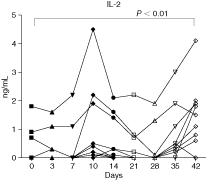
Interleukin-2 (IL-2) serum levels during and after isoprinosine (ISO) treatment. The t-test for paired differences showed significance at 10th (t = 2.38, P < 0.05), 35th (t = 4.14, P < 0.01), and 42nd day (t = 9.08, P < 0.001) vs. baseline. Paired t-test also showed significance between levels at 21st vs. 42nd day (t = 5.49, P < 0.001).
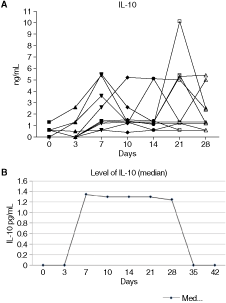
We observed most remarkable changes in the serum levels of IL-10. There was a rapid increase as early as at 7th day (0.310 ± 0.142 vs. 2.340 ± 0.593, P < 0.01). Then the levels slightly decreased and we measured maximal values for IL-10 at 28th day. Paired t-test showed increase at 7th day (t = 3.4, P < 0.01), which retained significant at 10th, 14th, 21st, and 28th day (t = 3.03; 2.89; 3.04; and 3.57, respectively, P < 0.025) (Fig. 3A and 3B).
(
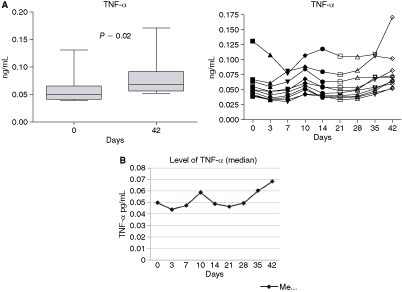
Changes in the serum levels of TNF-α did not take the same pattern as other measured cytokines. Although there was a slight increase at 10th day, we revealed a nearly flat line of values during the treatment and follow-up phase. At 42th day, we detected almost 75% raise (0.058 ± 0.009 vs. 0.079 ± 0.010, P < 0.02) (Fig. 4).
(
When scattered all measured pairs, we found a moderate negative correlation between IFN-γ and IL-2, IL-10, and TNF-α (Spearman’s r: −0.63, −0.62, −0.63; P < 0.05, respectively).
Discussion
Isoprinosine is a synthetic drug, consists of inosine and p-acetamidobenzoate salt of N,N-dimethylamino-2-propanol (Campoli-Richards and others 1986). It is an immunomodulating agent, which has been reported to potentiate of both T-lymphocyte and phagocytic cell function (Wybran and others 1978; Wybran and others 1982). It induces the appearance of phenotypic markers of differentiation on immature precursor T cells, augments helper or suppressor T-cell functions, and increases the production of TNFβ (Morin and Ballet 1982). Most interventional studies have aimed primarily the viral illnesses and restoration of immune function in cancer patients. Many surveys focused on possible mechanism for ISO-caused immune modulation in 1980s and in early 1990s, which are far behind current knowledge and methods. More, there is a lack of studies in healthy humans to reveal the possible effects of ISO on cytokine secretion.
We report data for kinetics of various cytokines response during and after ISO treatment in healthy adults. It is believed that ISO is Th2–Th1 shifter as it appears to raise IL-2 and IFN-γ and lower IL-10 (Milano and others 1991; Hadden 1994). It is found that ISO augments IL-2 production from mononuclear cells in AIDS patients in vitro. Enhancement of IL-2 production was also demonstrated when a normal control mononuclear cells were treated with ISO (Tsang and others 1985). Most of data concern in vitro studies and measures cells production (Hersey and others 1984; Barasoain and others 1986; Tsang and others 1986; Wiranowska-Stewart and Hadden 1986). Some studies, however, did not support such hypothesis revealing lack of any effect of ISO on IL-2 or TNF-α production in vivo (Pedersen and others 1990). Our data clearly indicate the raise of IFN-γ, IL-2, and TNF-α during and after the treatment. Also, we observed corresponding kinetics of cytokine response. There was a rapid increase at 7th to 10th day and another peak after discontinuation of the drug. Thus we support data for benefit of not-continuous ISO treatment, suggesting that some stimulus occurred after drug discontinuation. Kumar et al. reported similar enhancement of IL-1a and IL-10 in ISO-treated chronic fatigue syndrome patients after discontinuation of the drug (Kumar and others 2000).
IL-10 is an anti-inflammatory cytokine, produced mainly by monocytes and to a lesser extent by lymphocytes. It has pleiotropic effects in immunoregulation and inflammation and down-regulates the expression of Th1 cytokines, MHC class II antigens, and co-stimulatory molecules on macrophages (Moore and others 2001). In our series, we observed quick raise of IL-10 during the treatment phase and another augmentation at the end of follow-up.
Because of important fluctuations in the inflammatory cytokines, these results go further. First, a previous report showed increase in NK and T cells activity after the cessation of Isoprinosine (Hersey and Edwards 1984). Second, they suggest that the decline of cytokine secretion might not be flat, but there are variable fluctuations through increased capacity of affected cells to secrete cytokines in case of minimal or physiological stimuli. We are lacking enough studies for time-course interleukins secretion in healthy adults, but some fluctuations are reported in stable disease (Bogaty and others 2005). At last, TNF-α was paradoxically increased after some immunomodulating therapy and is still not appropriately explained (Iyer and others 2007). The cytokine profile of apparently health individuals might be more dynamic than generally assumed, even if not caused by isoprinosine treatment. The determinants of these fluctuations of an individual’s inflammatory profile in the clinically quiescent state are unknown.
The treated population consists of healthy subjects in absence of a major antigen-driven process or other immune-mediated condition. By this reason, we cannot conclude for the type of response in accordance of TH1/Th2 paradigm. It was believed that isoprinosine functioned as an immunopotentiator augmenting the antigenic signal (Fischbach and Talal 1985). Our results support the nonspecific modulation of immune responses as all treated subjects were in good clinical state.
We could then speculate that ISO leads to nonspecific stimulation of early or nondifferentiated cells, which can produce different cytokines (NK-, T-, B cells) (Schroder and others 2004). The enhanced IL-10 production may perhaps be a strike back to the ISO-caused proinflammatory cytokine production in order to maintain the relative homeostasis.
Endogenous purines and other inosine compounds have been shown to exert immunomodulatory effects in a variety of disease models (Poluektova and others 1995; Mabley and others 2008). Inosine has proved to be a powerful immunomodulatory agent both in vitro (Hasko and others 2000; Marton and others 2001) and in vivo (Garcia Soriano and others 2001; Liaudet and others 2002; Mabley and others 2003; Szabó and others 2006). Inosine treatment reduces the production of inflammatory cytokines by murine and human macrophages stimulated by lipopolysaccharide (Hasko and others 2000; Garcia Soriano and others 2001). Inosine also reduces production of proinflammatory cytokines and chemokines (Mabley and others 2003). It is difficult to pinpoint the mode of action of inosine but is believed to be post-transcriptional (Hasko and others 2000). It is expected to increase the window of therapeutic opportunity, as it may remain effective even in a post-treatment paradigm.
The likely mechanism of ISO-mediated immune modulation should be further investigated in vitro in the light of different clinical settings. Our work holds promise for an important aspect of clinical immunopharmacology. We have demonstrated the immunomodulating properties of isoprinosine in healthy adults. It suggests resumption of the research with up-to-date methods to elucidate the mechanisms of action of inosine pranobex and maybe the other inosine compounds.