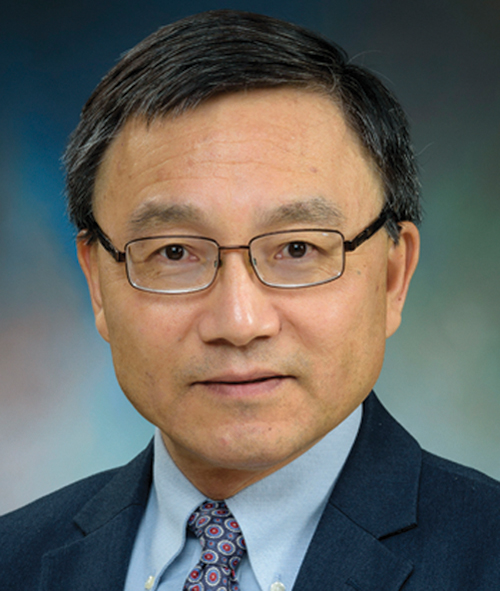
This month we continue with our Experts Speak series to feature JICR interviews with three prominent scientists in the field of interferon and cytokine research: Pei-Yong Shi, PhD, Adolfo Garcia-Sastre, PhD, and Michael Diamond, MD, PhD. All three are currently working at the forefront of SARS-CoV-2/COVID-19 research, and have made important contributions to understanding virus-host interactions that regulate RNA virus infection and immunity.
Michael Gale, Jr., PhD
Editor–in-Chief
A few weeks ago, Srilatha Raghuram, the journals publishing manager of Journal of Interferon and Cytokine Research at Mary Ann Liebert, sat down with Pei-Yong Shi, virologist at the University of Texas Medical Branch, Galveston in the first interview series called “Experts Speak” to talk about their involvement in SARS-CoV-2 research.
Pei-Yong Shi: Thanks for the opportunity to arrange this to talk about our work.
Journal of Interferon and Cytokine Research: My pleasure. So, let us start off by just a brief introduction.
Pei-Yong Shi: I am Pie-Yong Shi, professor at the department of biochemistry and molecular biology at The University of Texas Medical Branch at Galveston. I am a virologist and translational scientist.
JICR: So, your main focus is virology or viral immunology. Do you work with the coronaviruses? Do you work on flaviviruses?
Pei-Yong Shi: I would not claim myself an immunologist, but work on immunology when projects need.
My expertise is on the virus side and work on flaviviruses, such as West Nile, dengue, and Zika viruses. The reason we got on to SARS-CoV-2 is because as a virologist I feel obligated in response to the COVID-19 pandemic. We should do something. That is why we started to work on the SARS-CoV-2 since the beginning of last year.
JICR: So can you elaborate your work on coronaviruses? What kind of experiments you are actually doing now?
Pei-Yong Shi: My career is unique in a way that I have extensive experiences in 3 branches of biomedical research. I have 8 years with the public health laboratory, specifically with New York State Health Department.
So, I am very sensitized to new disease outbreaks, particularly infectious diseases. That is the first. The second is, I have 10 years' experience in pharmaceutical companies. I used to work on hepatitis C, HIV, and antiviral drugs for Bristol–Myers Squib. I also have 7 years' experience with Novartis to lead their global tropical disease and drug discovery. So, I am very much into translational research. The other third of my career is like all academic professors doing basic research in university. I joined UTMB 5.5 years ago. Before that, I was the executive director for Novartis leading their global tropical disease drug discovery.
JICR: The study that you are conducting now, the SARS-CoV-2 study, so what is the aim of your study?
Pei-Yong Shi: We strategized to enter the response to SARS-CoV-2 as a virologist. We felt building a reverse genetic system for this new virus will be very impactful. That is our entry point. We developed the first reverse genetic system published in the peer-review journal and, then using that, we have started to study multiple aspects of this virus. For example, in terms of research, we have been studying new variants since the pandemic. The virus continues to evolve because initially the virus has to adapt to the new host of humans. So, there were initial mutations in the early days, for example, the spike gene D614G mutation, which appeared 2 months after the viruses have hopped onto human host.
The spike D614G was the first prevalent mutation since the pandemic of this virus. We showed that this mutation conferred replication advantage of this virus. Once the virus has this mutation, it replicates better in the upper respiratory airway of infected animals as well as in human primary airway culture. Later on, other groups directly demonstrate that this spike D614G mutation can improve the transmission efficiency of the virus in hamsters and ferrets. Currently, we are studying the U.K. B.1.1.7 variant, which is dominant right now in the United States, ∼65% to 70% prevalence in circulation.
We were interested in the mutations in that variant. Based on the clinical results, this variant has gained transmission efficiency. We have identified spike mutation N501Y that is critical for the improved transmission of the B.1.1.7 variant. The N501Y mutation converged independently in variants from different geographic locations. Mechanistically, this mutation significantly increases the spike protein binding to the host receptor.
Pei-Yong Shi: This is just the one type of the work we do using the reverse genetic system to look at the biological consequences of these newly identified variants. The second category of the work we have been doing is to enable vaccine development. Using the reverse genetic system, we engineered a reporter gene such as a fluorescent gene or luciferase into SARS-CoV-2. We use those reporter viruses to rapidly test the antiviral activities of either drugs or antibodies. Early in the pandemic, plasma from infected individuals, who had high neutralizing antibody titers, was used for COVID-19 therapy. So, it was important to have an assay that can rapidly identify these plasmas. Later on, it becomes more important for vaccine development. All vaccines require to measure their neutralization antibody levels, which is one of the major protective parameters against COVID-19.
Pei-Yong Shi: So, for vaccine development, it is essential to measure the neutralizing antibody response after vaccination in preclinical animal models and clinics in humans. Using this rapid high-throughput assay, we supported the neutralizing test for Pfizer's vaccine. We are very happy to be part of the team with Pfizer and contributed to the first approval of the COVID-19 vaccine with 95% efficacy. In addition, using the luciferase reporter SARS-CoV-2, we also collaborated with Gilead to test the clinically approved antiviral drugs for potential COVID-19 treatment, including remdesivir.
Although the reporter viruses are very useful for supporting vaccine and the antiviral discovery, the limitation is that SARS-CoV-2 is a biosafety level-3 (BSL-3) agent. So, you need BSL-3 containment to perform the experiments. That limits many laboratories, including pharmaceutical companies. For example, it is challenging to screen millions of compounds in BSL-3. So, we have been trying to unleash that limitation. Toward that goal, we recently reported a trans complementation system. In that system, we deleted 2 genes from the viral genome, and then we made a stable cell line that expresses those 2 missing genes. When we transfect the RNA with the 2 deleted genes into those cells, the system produces virus particles. Those particles look like authentic viruses that can infect normal cells. Since normal cells do not express the 2 missing genes, the infection will be single round. Therefore, the new system can potentially be performed at BSL-2. So, we think our trans complementation system may be a game change for many laboratories, allowing them to do viral infection at BSL-2. We are in the final stage to get it approved for BSL-2 use.
JICR: I think that is actually extremely interesting, everything that you have said so far, because there are so many aspects to your studies. My next question is, Have you looked at interferon therapy for SAR-CoV-2 as one of the options? What roles do these type I and type II interferon play with COVID-19 outcomes and is interferon therapy for SARS-CoV-2 a viable option to mitigate the disease?
Pei-Yong Shi: We have done some studies on this topic. We cloned almost every individual gene from the SARS-CoV-2. We looked at 2 aspects of individual viral genes. First, do any of these genes block the interferon production? Second, do any of those genes block interferon signaling? This unbiased approach has allowed us to identify genes that can interfere with interferon production and signaling. Afterward, we looked at which steps during the interferon production and signaling the identified viral proteins intersect the interferon pathways.
For the identified genes from SARS-CoV-2, we also examined whether the equivalent genes from different coronaviruses, such as the MERS-CoV and the SARS-CoV, behave differently in antagonizing interferon response. Such information may shed light on the immune defense and disease development for different coronaviruses.
Along the same line, for SARS-CoV-2 variants, it would be interesting to investigate the effect of mutations in these identified viral proteins on innate immune response. We have been studying variant of concern or variant of interest since the second half of last year. We have analyzed the U.K., Brazil, South Africa, California, New York, and…
JICR: India, Right?
Pei-Yong Shi: Right, now is India. We systematically looked at their impact on vaccine's neutralization activity. Specifically, we swapped the spike gene from each variant into the original Washington index isolate USA-WA1-2020, creating a panel of viruses bearing distinct variant spikes. Through collaboration with Pfizer, we tested a panel of vaccinated human sera against the viruses for their neutralization levels. In this way, we can address the question of how the mutations in the variant spikes affect neutralization activity. My team, together with Pfizer and BioNTech, has published several studies on this topic. We found B.1.351 variant, initially identified in South Africa, had the most decrease in neutralization activity.
JICR: What about the mutations outside the spike protein?
Pei-Yong Shi: It will be interesting to look at the genes outside the spike, particularly those we have previously identified to modulate interferon response. We are currently investigating how those nonspike mutations may contribute to the innate immune response.
JICR: That leads to the next question. So, what kind of public health outcomes do you hope to get out of this more antivirals? Vaccines?
Pei-Yong Shi: I think both vaccine and antivirals are important.
JICR: And more understanding?
Pei-Yong Shi: Yes. Vaccine has already shown its power to control the transmission. Antiviral will compliment vaccine in helping those who have not been vaccinated, those who are not qualified for vaccination, or do not respond well to vaccination. For those individuals, therapeutics will be important to safeguard their health. Globally, we need to vaccinate as many people as quick as possible. This will minimize the emergence of new variants. Vaccination should be the central strategy to control the current pandemic. But depending on the circumstances, public health measurement is equally important before you can implement mass vaccination in certain regions.
JICR: So any other conclusions or anything else you want to say before we sign off on this topic?
Pei-Yong Shi: Through the COVID-19 pandemic, we have again witnessed that science plays a major role in finding solutions to overcome diseases. The reason we are able to rapidly develop the vaccines is because the accumulation of knowledge about this group of viruses, such as SARS-CoV, MERS-CoV, and the other coronaviruses.
It clearly demonstrates the power of science. We must continue investing in science and public health. In addition, public policy is also extremely important to guide the nation through such pandemics. Again, with the approved safe effective vaccines available, we should get as many people vaccinated as soon as possible. We should continue engaging the public to overcome vaccine hesitancy.
JICR: Yes. It is interesting you say that because I was talking to one of those high-risk people trying to convince her to get the vaccine because she had comorbidities such as diabetes.
Pei-Yong Shi: Well, thank you for doing that. It is a social responsibility that, as scientists, we should not only do science, but also communicate science to the general public. This could help remove the vaccine hesitancy and other public health issues.
Finally, thank you so much for the discussion today.
JICR: Thank you so much for taking the time to talk to me.