




Abstract
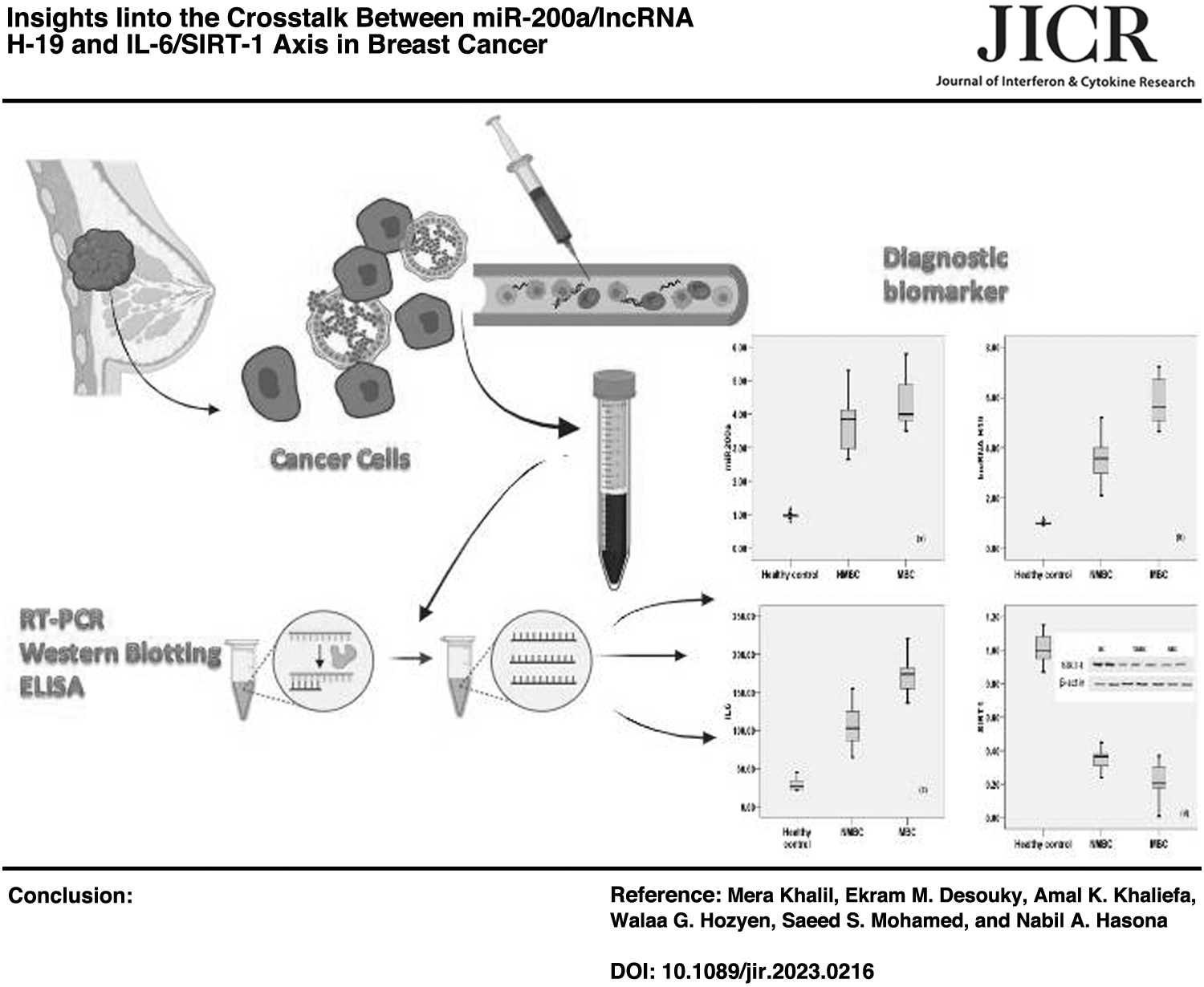
Breast cancer (BC) is a highly prevalent malignancy that poses a significant threat to women's well-being. Novel biomarker identification helps to improve clinical outcomes and provide tailored treatments. Our research aims to explore the diagnostic potential of miR-200a/lncRNA H-19 and interleukin-6 (IL-6)/SIRT-1 axis crosstalk and evaluate the impact of metastasis on gene expression, which provides valuable insights into the diagnosis and treatment of BC. In this case–control study, we collected blood samples from 54 nonmetastatic breast cancer (NMBC) patients, 46 metastatic breast cancer (MBC) patients, and 50 healthy individuals. We used real time-polymerase chain reaction to measure the expression levels of lncRNA H-19 and miR-200a, whereas enzyme linked immunosorbent assay was used to determine the IL-6 levels. In addition, we evaluated SIRT-1 expression level using a Western blot assay. The levels of lncRNA H-19, miR-200a, and IL-6 were higher in BC patients, whereas SIRT-1 levels were lower. Patients with MBC had higher levels of lncRNA H-19, miR-200a, and IL-6 than those with NMBC. In addition, the expression of lncRNA H-19 and miR-200a showed a negative correlation with SIRT-1 expression, whereas the levels of lncRNA H-19 and miR-200a showed a positive correlation with IL-6 expression level. The diagnostic potential of lncRNA H-19 and miR-200a in BC is undeniable. Moreover, the robust association of IL-6/SIRT-1 with lncRNA H-19/miR-200a expression presents a promising opportunity for clinical outcomes and tailored treatments.
Introduction
Global cancer data show that breast cancer (BC) has surpassed lung cancer as the most prevalent cancer diagnosed in women worldwide (Bashar and Begam, 2022). BC is a serious threat to the health and well-being of women. Unfortunately, it is still the most common cause of cancer-related deaths among females (Francies et al., 2020; Wilkinson and Gathani, 2022). The increasing prevalence of BC poses a significant risk to women's health (Wang and Wu, 2023).
Therefore, it is vital to improve the understanding of new prognostic markers and therapeutic targets and implement effective treatment modalities to enhance the quality of life for individuals diagnosed with BC. Egypt has the second highest absolute burden of BC, with a mortality-to-incidence ratio accounting for 40% (Sung et al., 2021).
Scientific research on the human genome has indicated that only 2% of human genes are responsible for protein synthesis, whereas the remaining 98% are noncoding. These noncoding RNAs (ncRNAs) can be divided into various categories based on their length, such as long noncoding RNA (lncRNA) and micro RNA (miRNA). They have diverse and significant biological functions (Negeem et al., 2023; Zhang et al., 2019). lncRNAs, which are >200 bp in length, participate in various pathophysiological processes such as cellular proliferation, differentiation, angiogenesis, metastasis, and drug resistance during cancer development (Jin et al., 2020; Zhang et al., 2019).
H19 (lncRNA H19) is a lncRNA located on 11p15.5, expressed from the maternal allele as an oncofetal imprinted gene (Lu et al., 2014). It is highly expressed during embryonic development and normally downregulated after birth (Liao et al., 2023). Its abnormal expression is linked to various diseases especially cancers (Khalil et al., 2023a; Khalil et al., 2023b). The biological effects and molecular mechanisms of lncH19 in BC are not yet well understood.
miRNAs are small RNAs that regulate gene expression by targeting messenger RNA (mRNA) to block or destroy translation (Hasona et al., 2023). There are 5 members of the miR-200 family, distributed over 2 clusters. Here are miR-200b, miR-200a, and miR-429 in the first cluster, found on chromosome 1. miR-200c and miR-141 are in the second cluster, situated on chromosome 12 (Diaz-Riascos et al., 2019).
There have been inconsistent reports on the expression of miR-200 family members in different types of cancer. Some studies have found that miR-200 is downregulated in lung, colon, or BC (Ye et al., 2014), whereas others have reported its overexpression in various disorders such as colorectal cancer (CRC), ulcerative colitis, and Crohn's disease (Khalil et al., 2023a; Khalil et al., 2023b). Enforced expression of miR-200 promotes metastatic spread in BC models (Sánchez-Cid et al., 2017).
Early detection of BC allows the commencement of early treatment, so that advanced stages are averted and the incidence of complications could be decreased, especially the serious ones such as distant metastasis that could decrease the mortality and improve the survival of patients and the quality of life for them (Abdel-Samed et al., 2022).
A more favorable prognosis for BC is linked to early detection, which highlights the importance of timely screening methods. This study aimed to get better insights into the complex crosstalk between miR-200a/lncRNA H-19 and interleukin-6 (IL-6)/SIRT-1 axis and assess the impact of metastasis on the gene expression among all the study groups.
Materials and Methods
This case–control study included 100 adult female Egyptian patients with BC who were recruited from the Oncology Department, Faculty of Medicine, Beni-Suef University. All participants in the study provided their written informed consent, followed the ethical principles of the Declaration of Helsinki, and the agreement of the Research and Ethics Committee (FMBSUREC/03102023). The study participants were categorized based on their medical histories and clinical examinations. The enrolled individuals' diagnoses were verified using mammography.
Consequently, they were categorized into 3 main groups. Group I comprises the control group that was recruited during the routine checkup (50 age-matched healthy females with no history of BC, fibroadenoma, or palpable breast lumps in the family and no hypertension or diabetes mellitus. Group II included 54 patients with nonmetastatic breast cancer (NMBC). Group III included 46 patients with metastatic breast cancer (MBC). The clinical information was obtained from the reports of the patients including age, family history, and the state of menstrual cycles. None of the patients had had radiation, chemotherapy, or any form of antihormonal medication before taking part in the study.
Peripheral blood samples (5 mL) were drawn from each subject and into 2 plain tubes. Then, 2.5 mL was transferred to a plain tube, permitted to clot for 15 min, and the separated serum was used for laboratory measurements. Serum was stored at −80°C for further RNA extraction and SIRT-1, lncRNA H-19, and miR-200a assay. The other 2.5 mL of whole blood was mixed with ethylenediaminetetraacetic acid for further biochemical investigation.
IL-6 assay
Using an ELISA kit (Cat#SEA079Hu) and the manufacturer's instructions, serum IL-6 was identified.
Serum lncRNA H-19 and miR-200a assay
A miRNeasy extraction kit was used to extract the RNA from a total sample volume of 100 μL serum (Qiagen, Valencia, CA, USA). Before reverse transcription of the RNA into complementary DNA (cDNA) using the DNase Max Kit, the sample was treated with DNase to eliminate any sources of DNA after extraction. Using the assay primers listed below, the cDNA was amplified using SYBR Green. The gene bank accession numbers for miRNA200-a, lncRNA H-19, and U6 are NR_029834.1, NR_002196.3, and NM_001357943.2, respectively. The differential expression was assessed by the 2−ΔΔCt method (Livak and Schmittgen, 2001).
SIRT-1 expression assay
A Bradford assay was performed to determine protein concentration. Nitrocellulose membranes were coated with 20 μg of proteins that had been electrophoresed on sodium dodecyl sulphate-polyacrylamide gel electrophoresis gels. The membranes were blocked and incubated overnight with SIRT-1 primary antibodies (cat. no. sc-74465) at 4°C. The membranes were incubated with secondary antibodies, developed with an enhanced chemiluminescence kit provided by SANTA CRUZ BIOTECHNOLOGY, INC., and the bands were quantified utilizing ImageJ.
Statistical analysis
The results are presented as means ± standard error means after analysis with SPSS 22 (SPSS, Inc., Chicago, IL, USA). The Tukey multiple range test was employed for post hoc multiple comparisons in paired comparisons. The correlation between the variables was evaluated using the Pearson correlation coefficient. Utilizing receiver operating characteristic (ROC) curves, the diagnostic efficacy of miR-200a and lncRNA H-19 was evaluated.
Results
Table 1 presents clinical and histological information of all study participants, aged 40–60 years. No age-related changes were observed between healthy controls and BC patients (P > 0.05). As given in Table 1, 74.07% of the NMBC participants had a tumor size of <5 cm, and 87.04% of the patients displayed negative estrogen receptor (ER)/progesterone receptor (PR) status. Whereas 80.43% of the MBC participants had a tumor size of <5 cm, and 82.61% of the patients displayed negative ER/PR status.
Baseline Characteristics of the Nonmetastatic and Metastatic Breast Cancer Patients and the Healthy Control
DM, diabetes mellitus; ER, estrogen receptor; MBC, metastatic breast cancer; NMBC, nonmetastatic breast cancer; PR, progesterone receptor; SD, standard deviation.
Table 2 gives lncRNA H-19 and miR-200a relative gene expression and IL-6 expression levels in healthy control and BC groups (NMBC and MBC). Our study reported that BC patients have significantly higher levels of lncRNA H-19 and miR-200a gene expression than the healthy control group (P < 0.05), as illustrated in Figure 1a, b.
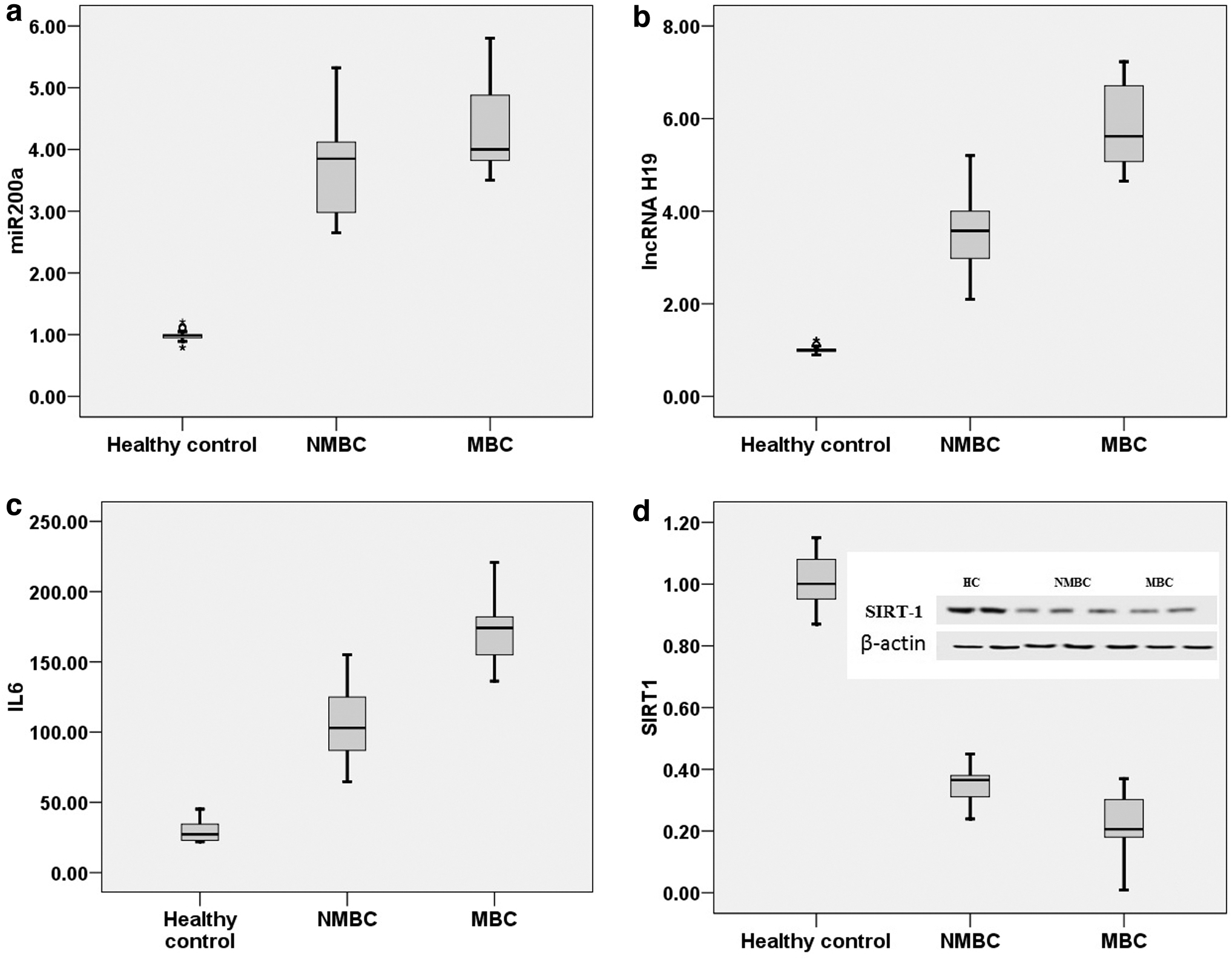
Expression Levels of lncRNA H-19 and miR-200a, Among Healthy, Nonmetastatic Breast Cancer, and Metastatic Breast Cancer Study Participants
Data are expressed as mean ± standard error mean. According to the Tukey multiple range test, the different letters indicate statistical significance different means.
IL-6, interleukin-6; lncRNA H-19, long noncoding RNA H-19; miR-200a, microRNA-200a.
In contrast, levels of SIRT-1 gene expression were found to be significantly lower in BC patients than in the control group (P < 0.05), as illustrated in Figure 1d. Regarding IL-6 expression levels, all participants with BC had significantly higher rates than healthy individuals (P < 0.05). IL-6 levels were higher in patients with MBC than in nonmetastatic patients (P < 0.05), as shown in Table 2 and Figure 1c.
The correlation of lncRNA H-19 and miR-200a is significantly positive (r = 0.78, P < 0.05), whereas miR-200a negatively correlates with SIRT-1. Table 3 gives a substantial inverse relationship (r = −0.74, P < 0.05) between SIRT-1 and miR-200a. In addition, lncRNA H-19 and IL-6 exhibited a strong positive connection (r = 0.88, P < 0.05). Furthermore, the table indicates that miR-200a had a positive correlation with IL-6 (r = 0.78).
The Correlation Between lncRNA H-19, microRNA-200a (miR-200a), Interleukin-6, and SIRT-1 Among Study Participants
Significant linear correlation at P < 0.05 (2 tailed).
According to ROC analysis, serum lncRNAH-19 is effective in distinguishing individuals with BC from all study participants. The best cutoff value for this discrimination was found to be 4.615 (area under the ROC curve [AUC] = 0.975; 95% confidence interval = 0.9511–0.998; P < 0.001) with a sensitivity and specificity of 100%, as shown in Fig. 2a. Moreover, ROC analysis revealed that serum miR-200a discriminated participants with MBC from all study participants with the best cutoff value of 3.44 (AUC = 0.848, P < 0.001), the sensitivity of 100%, and specificity of 72.12% (Fig. 2b).
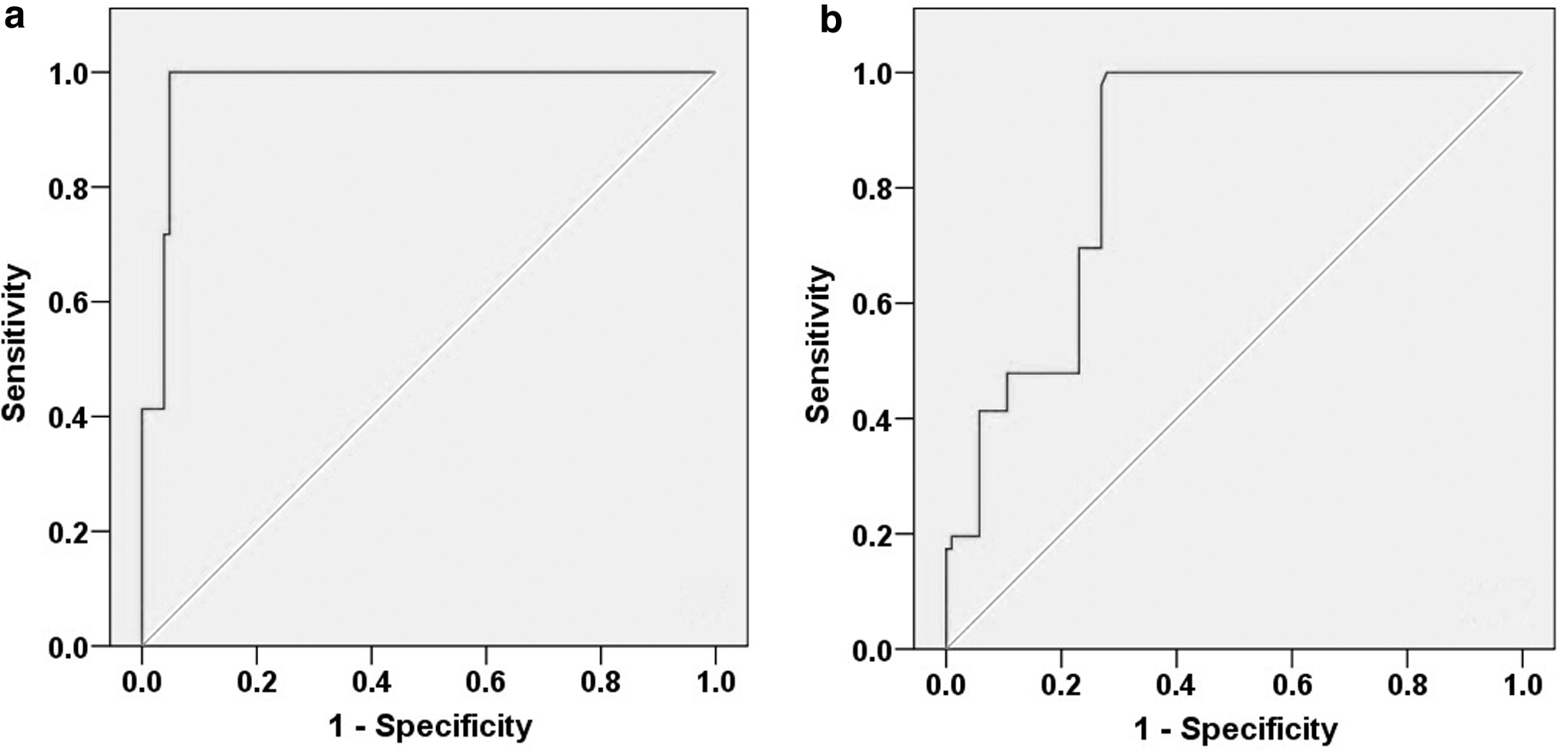
ROC curves for lncRNAH-19 and miR-200a in
In addition, serum lncRNA H-19 was able to differentiate between participants with MBC and those without with a sensitivity of 100% and specificity of 90.74%, and the best cutoff value of 4.615 (AUC = 0.951, P < 0.001) (Fig. 3a). Serum miR-200a discriminated MBC from NMBC participants with the best cutoff value of 3.43 (AUC = 0.708, P < 0.001), sensitivity of 100%, and specificity of 46.30% (Fig. 3b).
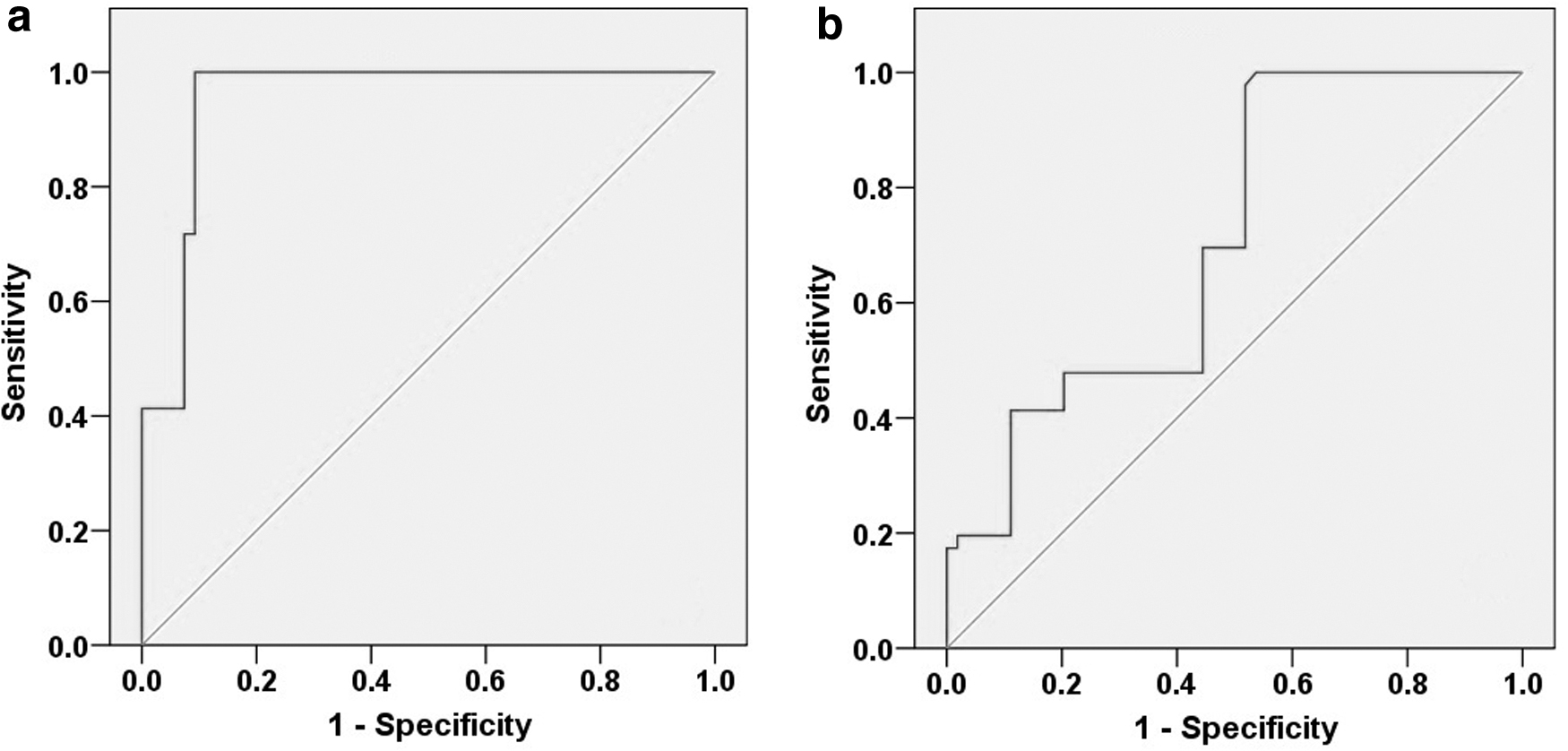
ROC curves for lncRNAH-19 and miR-200a in
Discussion
BC is a global health concern, with an increasing prevalence and substantial impact on individuals and health care systems (Khaliefa et al., 2023). The study examines the clinical and demographic characteristics associated with both metastatic and nonmetastatic forms of BC. Tumor size, ER/PR status, family history, and diabetic and hypertension history are valuable demographics for patients and healthy controls.
It is an indisputable fact that inflammation plays a pivotal role in the development and advancement of cancer. This fact highlights the need to prioritize anti-inflammatory measures to reduce the risk of cancer and improve treatment outcomes (Ayeldeen et al., 2023). Different types of normal cells, immune cells that penetrate tumors, and tumor cells release IL-6. Therefore, it was previously believed that the development of local tumors was responsible for higher levels of systemic IL-6. This study discovered that IL-6 levels were related to lymph node metastases because they were higher in the MBC group than in the NMBC group.
This study observed that serum levels of IL-6, which drives inflammation, were elevated in women with BC relative to control subjects. By controlling inflammation, we can enhance the management of BC, making it more effective and efficient. Esquivel-Velázquez et al. (2015) earlier reported that overproduction of proinflammatory cytokines in BC patients correlated with poor prognosis.
ncRNA transcripts are novel research hotspots correlated with carcinogenesis and metastasis in various human cancers. Their availability in circulation makes them a tempting target for early tumor detection (Abdel Hameed et al., 2022; Khalil et al., 2023b). In particular, ncRNAs play a dynamic function in the development and progression of cancer (Ayeldeen et al., 2023; Khaliefa et al., 2023; Yan and Bu, 2021). lncRNA H-19 is one of these lncRNAs involved in multiple disorders such as CRC, ulcerative colitis, Crohn's disease, and cervical cancer (Triantaphyllopoulos, 2023).
H19 overexpression is linked to BC incidence and progression. However, H19's expression and mechanistic involvement in BC remain unclear. LncRNA H-19 expression was found to be elevated in BC patients compared with controls and in BC cells according to prior research that reported a crucial role of H-19 for the BC prognosis (Kashyap et al., 2023; Wang et al., 2020). In this study, our findings reveal a significant correlation between an elevated level of H19 and the metastasis of BC.
Furthermore, it was previously reported that H19 exhibited a role in CRC metastasis by enhancing the Ras-Mitogen-activated protein kinase signaling pathway (Yang et al., 2021; Yang et al., 2018). Previous reports noticed the oncogenic role of lncRNA and miRNAs and its correlation with ER, PR, and lymph node metastasis in BC patients that could serve as a predictive factor for BC (Kalinina et al., 2021; Yang et al., 2021).
The epithelial–mesenchymal transition and metastasis in BC are significantly regulated by miR-200a, which binds with the 3′ untranslated region (3′ UTR) of the mRNA of the target gene DCAMKL-1 (Klicka et al., 2022). In our study, we aimed to investigate the potential of miR-200a as a biomarker for BC. Our findings suggest that miR-200a expression levels are significantly different between BC patients and healthy individuals, and increase significantly with the progression of BC, including metastasis.
The results of our study align with Sánchez-Cid et al. (2017), who demonstrated that patients with ductal BC had significantly higher expression levels of the miR-200 family, from tumors to distant metastases that related to the growth and metastatic properties of breast luminal progenitor cells. During MBC therapy, Fischer et al. (2022) reported that the circulating miR-200s have significant prognostic value as biomarkers. The data indicate that BC metastasis is linked to high levels of miR-200a. Furthermore, Madhavan et al. (2016) showed that increased plasma levels of miR-200a, miR-200b, and miR-200c predict the onset of BC metastasis with a remarkable accuracy of 2 years before diagnosis.
To confirm the upregulation of miR-200a in BC participants, we assessed the expression level of SIRT1 as miR-200a target gene. Various studies have shown the direct influence of miR-200a on SIRT1 expression (Eades et al., 2011; Fu et al., 2018). Previous studies elaborated on the possible regulatory role of ncRNA on SIRT1 through interactive sites (Shoorei et al., 2023). In this study, SIRT1 serum protein levels are significantly lower in BC patients than in the control group.
In addition, SIRT1 expression among BC patients dramatically dropped as metastases increased. Furthermore, there is evidence of a potential protective impact of SIRT1 as there is a strong negative correlation found between SIRT1 and miR-200a as well as a substantial negative association with IL-6 and lncRNA H-19. Our study aligns with Eades et al. (2011), who reported that miR-200a interacts directly with the 3′ UTR of the SIRT1 gene and significantly impacts SIRT1 expression. Hence, discovering a potential correlation between miRNA and SIRT1 is crucial, given the current use of miRNAs in clinical trials as drugs.
By comparing sensitivity versus specificity over a range of values, ROC curves identify the ideal cutoff value for a diagnostic biomarker. High sensitivity rules out, and high specificity rules in (Parikh et al., 2008). Using the ROC curve, we find that serum lncRNA H-19 expression could be used as diagnostic markers for BC from all study participants at 100% sensitivity and 100% sensitivity, respectively. Serum miR-200a accurately differentiates MBC participants with 100% sensitivity and 72.12% specificity. Furthermore, lncRNAH-19 is a potential biomarker for screening and diagnosing BC, according to ROC analysis results.
Although the study has drawn certain conclusions, it should be noted that it has limitations. First, the study was limited by a relatively small population of enrolled patients and controls, which requires a larger sample size to confirm our findings. In addition, further investigations are needed to determine the precise molecular mechanisms through which lncRNA H-19 and miR-200a contribute to the pathophysiology of BC.
In conclusion, our study provides evidence for the association of IL-6/SIRT-1 with lncRNA H-19/miR-200a expression that may help to identify a promising opportunity for clinical outcomes and provide insights for advancing treatment approaches.
Footnotes
Authors' Contributions
N.A.H. and W.G.H. conceived and designed the research study. M.K. and E.M.D. contributed reagents/materials/analysis tools. A.K.K., S.S.M., and N.A.H. analyzed the data. N.A.H. and S.S.M. wrote the article. Finally, all authors reviewed the article.
Ethics Approval
This study was conducted in compliance with the Declaration of Helsinki, and the ethics committee at Faculty of Medicine, Beni-Suef University, provided its approval (FMBSUREC/03102023).
Informed Consent
Written informed consent was obtained from all subjects before the study.
Author Disclosure Statement
The authors declare that they have no competing interests.
Funding Information
The authors declare that no funding for the research was received.