




Abstract
Cytokines are known to be a group of growing small proteins that are majorly responsible for the transmission of signals and communication between hematopoietic cells, the cells of the human immune system, and other types of cells. Cytokines play a dominant role in different types of disorders and in perpetuating the inflammation-related disorders. The production of cytokines is a natural process inside the body of a human being against any foreign invasion or due to some pathogenic state to maintain the homeostasis. Cytokines respond in two ways; in some cases, the production and development of cytokines as a therapeutic discovery or intervention will enhance the treatment process and support the reaction given by the body against any pathogenic activity, and in some cases, overproduction of these cytokines responds in the opposite way and behaves as antagonists toward a typical therapeutic drug and its treatment. Overall, 41 articles were reviewed, and it was found that cytokines have proved to be a therapeutic approach among various diseases and can be utilized as a good candidate or a better choice for cancer therapeutics in future development.

Introduction
Cytokines as therapeutics are one such prominent aspect for the management of diseases through natural processes. The major reason behind this is that cytokines act as the natural mediators of the immune system response and offer a range of conventional therapeutics. The therapeutic side or dimension of cytokines was discovered decades ago, and the various attempts to utilize recombinant cytokines as conventional medications have been in a tough spot over the years (Dinarello, 2007). The use of cytokines is becoming more feasible as per the current research on number of cloning done. The cytokine therapy has been proven to be remarkable therapeutic approach for the medication of patients suffering from advanced malignancies (Zhang et al., 2020). The prime target of such kinds of therapies is that they manipulate the immune system response for the development and generation of appropriate cells, that is, the immune effector cells, which will further eradicate the tumor, especially the solid tumors (Krueger, n.d). The past few decades witnessed rigorous research and analyzing the results in the field of the role of cytokines as effective therapeutics. Cytokines are generally referred to as the “language of the intercellular interaction” because they send the required signals as well as commands to various cells to carry out certain functions (Zhang and An, 2007). As per the information published by the World Health Organization, the cytokines are now considered the diagnostical markers and the most feasible targets for taking therapeutic measures (Tayal and Kalra, 2008). Also, the administration and delivery of a diverse range of cytokines as prominent therapeutics has been proven to have the potential to treat cancers and other kinds of infectious diseases and noninfectious diseases (Miller et al., 2009; Donnelly et al., 2009). The production house of cytokines is the helper T cells (Th cells) (Alberts et al., 2002). Th cells can be further divided into different subsets based on the cytokines they produce and the specific functions they perform. The two main subsets of Th cells are Th1 and Th2 cells. Th1 cells are involved in cellular immunity and play a crucial role in defending against intracellular pathogens, such as viruses and certain bacteria (Zhu and Zhu, 2020). They produce cytokines such as interferon-gamma (IFN-gamma), tumor necrosis factor-alpha (TNF-α), and interleukin-2 (IL-2), which stimulate the activation of cytotoxic T cells and macrophages. Th2 cells, on the contrary, are associated with humoral immunity and are primarily involved in defending against extracellular pathogens, such as parasites and allergens. They produce cytokines, such as IL-4, IL-5, and IL-13, which promote the activation of B cells and the production of antibodies (Luo et al., 2022). In addition to Th1 and Th2 cells, there are other subsets of Th cells that have been identified, such as Th17 cells and regulatory T cells, each with their own unique cytokine profiles and functions (Arun et al., 2011). Th cells are activated when they encounter antigens presented by antigen-presenting cells, such as dendritic cells. Upon activation, Th cells undergo proliferation and differentiate into specific subsets based on the cytokine milieu present in their microenvironment (Kumar et al., 2019).
Cytokines are one such component that serves multiple functions inside the body; the functions involve mediating the immunity, regulating the immunity, inflammation, and hematopoiesis, but as per the undergoing research, a significant number of cytokines are indulged in immune cell differentiation and proliferation. For example, there are various pro-inflammatory cytokines such as IL-1 and TNF-α both cytokines contribute toward the pathogenesis of various autoimmune diseases that include inflammatory bowel-related disease (IBD) and rheumatoid arthritis (RA), respectively (Kawai and Akira, 2006; Tayal and Kalra, 2008). Cytokines also play a vital role in inhibiting the development of different cancers by affecting the pathways that promote tumorigenesis and tumor metastasis (Han et al., 2020).
The current review includes the evidence from the previous studies that concerns the discovery and development of new diagnostic as well as prognostic markers for the purpose of target treatment and also with developing methods that can be effective while administering the cytokines in combination with different other treatments to get maximum effectiveness and to minimize its toxicities (Zhang and An, 2007).
Cytokines
Cytokines, basically the molecules that belong to a large family, are further classified in various ways. The reason behind a wide range of classifications is the absence of any definite form of classification. They exist in three different forms, which are glycoproteins, peptides, and proteins (Morán et al., 2013). The release of pro-inflammatory cytokines triggers the activation of immune cells and the subsequent production and release of additional cytokines (Schaper and Rose-John, 2015). In the past, the term “cytokine storm” was used to describe the sudden release of cytokines that intensify the inflammatory process (Kany et al., 2019). However, recent research reveals that a balanced release of both pro- and anti-inflammatory cytokines is essential in any immune response. Cytokines themselves have a diverse nomenclature, being referred to as interleukins, chemokines, or growth factors, among other names. They are organized into superfamilies based on similar structures rather than shared genes. In addition, it is worth noting that different cell populations have the capability to produce the same cytokine (Cicchese et al., 2018). Pro-inflammatory cytokines, such as IL-1, TNF-α, and IL-6, act as crucial mediators in initiating the immune response and promoting inflammation during chronic wound healing. These cytokines play a vital role in recruiting and activating immune cells, which help clear pathogens and damaged tissue. However, when pro-inflammatory cytokines are excessively released or the inflammatory response is prolonged, it can lead to chronic inflammation, hindering the healing process (Zhang and An, 2007). In contrast, recent studies have highlighted the significance of anti-inflammatory cytokines, including IL-4, IL-10, and TGF-β, in regulating the immune response and promoting tissue repair (Sanjabi et al., 2009). These cytokines aid in resolving inflammation, modulating immune cell function, and stimulating the formation of new blood vessels and extracellular matrix components necessary for tissue regeneration. Maintaining a delicate balance between pro-inflammatory and anti-inflammatory cytokines is crucial for optimal wound healing (Nirenjen et al., 2023). Imbalances in this equilibrium, such as an overwhelming pro-inflammatory response or inadequate anti-inflammatory signaling, can result in impaired healing, the persistence of chronic wounds, and the development of fibrosis (Nirenjen et al., 2023). The very common examples of cytokines are interferons and interleukins, which are mainly accountable for the regulation of the immune system and for responding to infection or inflammation inside the human body (Feldmann, 2008). Cytokines have a large number of distribution sources that lie near the cells which possess a nucleus and are capable of the production of IL-1 or IL-2, IL-6, and TNF-α, such kinds of cells are endothelial cells, resident macrophages, and some other epithelial cells (Kuzmich et al., 2017). TNF-α category of cytokines plays an important role in inflammatory conditions by giving appropriate signals. IL1 prevents the collagen-induced RA inside the human body. IL6 is a type of cytokine that helps in signal transduction. IL4 is a type of pleiotropic cytokine (Wojdasiewicz et al., 2014). The major producers of these cytokines are the Th2 cells as well as the mast cells. IL-10 has the ability to inhibit the production process and the initiation process of the T cells, macrophages, and also of monocytes (Iyer and Cheng, 2012). Along with this, IL-10 also regulates the growth of the B cells along with Th cells. IL-2 type of cytokines influences the activity and potential of cells, specifically natural killer cells. Another category or class of cytokines is Granulocyte-macrophage colony-stimulating factor (GM-CSF), which shows and exhibits pleiotropic effects (Kuzmich et al., 2017).
Cytokines as Therapeutic Targets for Diseases
The cytokines were introduced in the 1970s, since then scientists have been trying to come up with an innovative discovery with the assistance of cytokines molecules and changing the conventional or traditional methods for treating various diseases (Gupta et al., 2019). By this time, plethora of cytokines were studied using various molecular tools, for example, antibodies and cDNA probes, which have been developed to identify the pure recombinant proteins developed by researchers by unambiguous studies. The very first molecular approach led to the cloning of the first ever cytokine molecule which is IFNs, specifically IFN-beta, by the scientist Tada Taniguchi (Taniguchi, 2009). Cytokines being the low-MV type protein mediators of a short-range lie among the two neighboring cells. In earlier times, they were also referred to as the growth factors, interleukins, TNFs, and interferons, as they are involved in a huge range of biological processes for various purposes such as cell migration, proliferation, cell fibrosis, cell repair, cell inflammation, and angiogenesis (Chen et al., 2018). The associated receptors of cytokine molecules provide the essential signals for these kinds of biological processes. Furthermore, this mechanism initiating from a cytokine molecule to a definite signaling pathway leads to the cure of various diseases (Schaper and Rose-John, 2015). Cytokines are associated with various diseases as therapeutic agents under the following.
Cytokines for various immune disorders and inflammatory disorders
Cytokines play crucial roles in various immune and inflammatory disorders. An extensive body of research has shed light on the intricate mechanisms and significance of cytokines in different diseases, providing valuable insights into potential therapeutic interventions (Al-Qahtani et al., 2024). Impacting disease pathogenesis and offering potential targets for therapeutic intervention. Understanding the specific cytokines involved in different diseases allows for the development of targeted therapies that can modulate immune responses and reduce inflammation (Donnelly et al., 2009). IBD encompasses conditions like Crohn’s disease and ulcerative colitis. Studies have demonstrated elevated levels of pro-inflammatory cytokines, such as TNF-α and IL-6, in patients with IBD (Sanchez-Muñoz et al., 2008). These cytokines contribute to the chronic inflammation observed in the gastrointestinal tract of affected individuals. Targeting TNF-α with biological therapies, such as anti-TNF antibodies, has proven to be highly effective in reducing inflammation and managing IBD symptoms (Gareb et al., 2020). Asthma is characterized by airway inflammation and hyperresponsiveness. Pro-inflammatory cytokines, including IL-4, IL-5, and IL-13, play critical roles in promoting the inflammatory response and the recruitment of immune cells in the airways (Pelaia et al., 2022). These cytokines contribute to the production of IgE antibodies, mucus hypersecretion, and smooth muscle contraction, leading to airway narrowing. On the contrary, anti-inflammatory cytokines like IL-10 help regulate the immune response and reduce inflammation in the airways. Understanding the balance between pro-inflammatory and anti-inflammatory cytokines is crucial for developing targeted therapies to control asthma symptoms effectively (Habib et al., 2022). Psoriasis, a chronic inflammatory skin disorder, has also been extensively studied in the context of cytokines. Elevated levels of pro-inflammatory cytokines, including TNF-α, IL-17, and IL-23, have been observed in psoriatic lesions (Campanati et al., 2021). These cytokines contribute to the abnormal proliferation of keratinocytes, the activation of immune cells, and the recruitment of inflammatory cells to the skin. Targeting these cytokines, particularly TNF-α and IL-17, has proven to be highly successful in managing psoriasis and improving patients’ quality of life (Zhou et al., 2022). Autoimmune diseases, characterized by an immune response against self-components, also involve dysregulation of cytokines. In systemic lupus erythematosus, a complex autoimmune disease, pro-inflammatory cytokines such as TNF-α and IL-6 contribute to the systemic inflammation and tissue damage observed in affected individuals (Pan et al., 2020). These cytokines promote the production of autoantibodies and the activation of immune cells, leading to the deposition of immune complexes and organ damage. Similarly, in multiple sclerosis, pro-inflammatory cytokines such as IL-17 and IFN-γ are implicated in the immune-mediated destruction of myelin, the protective covering of nerve fibers (Rafael-Vidal et al., 2020). Therapies targeting these cytokines have shown promise in managing these autoimmune diseases. The dysregulation of cytokines in various immune and inflammatory disorders highlights the importance of understanding their roles and interactions (Gieseck et al., 2017). Researchers aim to develop targeted therapeutic strategies to modulate cytokine responses and restore immune homeostasis. This includes the development of biological therapies that specifically target key cytokines or their receptors to reduce inflammation and manage disease symptoms effectively. The success of anti-TNF therapies in diseases such as IBD and RA has paved the way for the exploration of other cytokine-targeted therapies in different conditions (Strzelec et al., 2023).
RA is a very common autoimmune and inflammatory disease that results in attaching the healthy cells of the immune system of a healthy human body (Feldmann and Maini, 2008). The prevalence of this disease is near about 1 percent in the industrial world. An effort has been taken to understand the cytokine expression in this particular disease, and it shows positive results in curing the diseased tissues of the human body. The breakthrough in this particular area was the stepping stone and first ever successful anti-cytokine therapy, which is administered in the form of TNF-α blockade (Kany et al., 2019). With the discovery of this therapy, a strong conclusion was reached, which states that blocking a particular cytokine can help to prevent the destruction of further joints and also prevent the spreading of the disease (Chen et al., 2018).
TNF-α was first discovered in the 1970s as a pro-inflammatory cytokine involved in immune responses and inflammation. However, it wasn’t until the late 1980s that the therapeutic potential of TNF-α became evident. Studies showed elevated levels of TNF-α in chronic inflammatory diseases such as RA, indicating its role in disease pathogenesis. This discovery sparked interest in developing therapies that specifically target TNF-α to alleviate inflammation and improve patient outcomes (Jang et al., 2021). The development of TNF-α inhibitors, also known as anti-TNF therapies, revolutionized the treatment landscape for chronic inflammatory conditions. The first breakthrough came with the approval of infliximab (Remicade) in 1998 for the treatment of moderate to severe RA. Infliximab is a monoclonal antibody designed to bind and neutralize TNF-α, effectively dampening the inflammatory response (Evangelatos et al., 2022). Since then, several other TNF-α inhibitors have been developed, including adalimumab (Humira), etanercept (Enbrel), golimumab (Simponi), and certolizumab pegol (Cimzia). These biological therapies have shown remarkable efficacy in various chronic inflammatory diseases, including RA, psoriasis, psoriatic arthritis, ankylosing spondylitis, and inflammatory bowel disease (Li et al., 2023). By the time along with this analysis, the researchers also deduce that the TNF-α molecule has the potential to cure various other kinds of chronic diseases (Parameswaran and Patial, 2010). Various clinical trials showed a great response of TNF-α in treating severe RA. There are two majorly important cytokines that are used in treating RA in human species, and they are TNF-α and IL-1 (Feldmann and Maini, 2008). The complete mechanism associated with this is explained in the diagram (ie, Fig. 1) given below. Regulating these cytokines during the treatment of RA is one of the most crucial steps. The very first clinical trials showed a remarkable efficacy of cytokines in the treatment but on the contrary, further studies and research work also revealed and deduced that the blockade of these kinds of different cytokines could not be able to control wholly the spread of arthritis in human body or in the patients (Lubberts and Van den Berg, 2013).
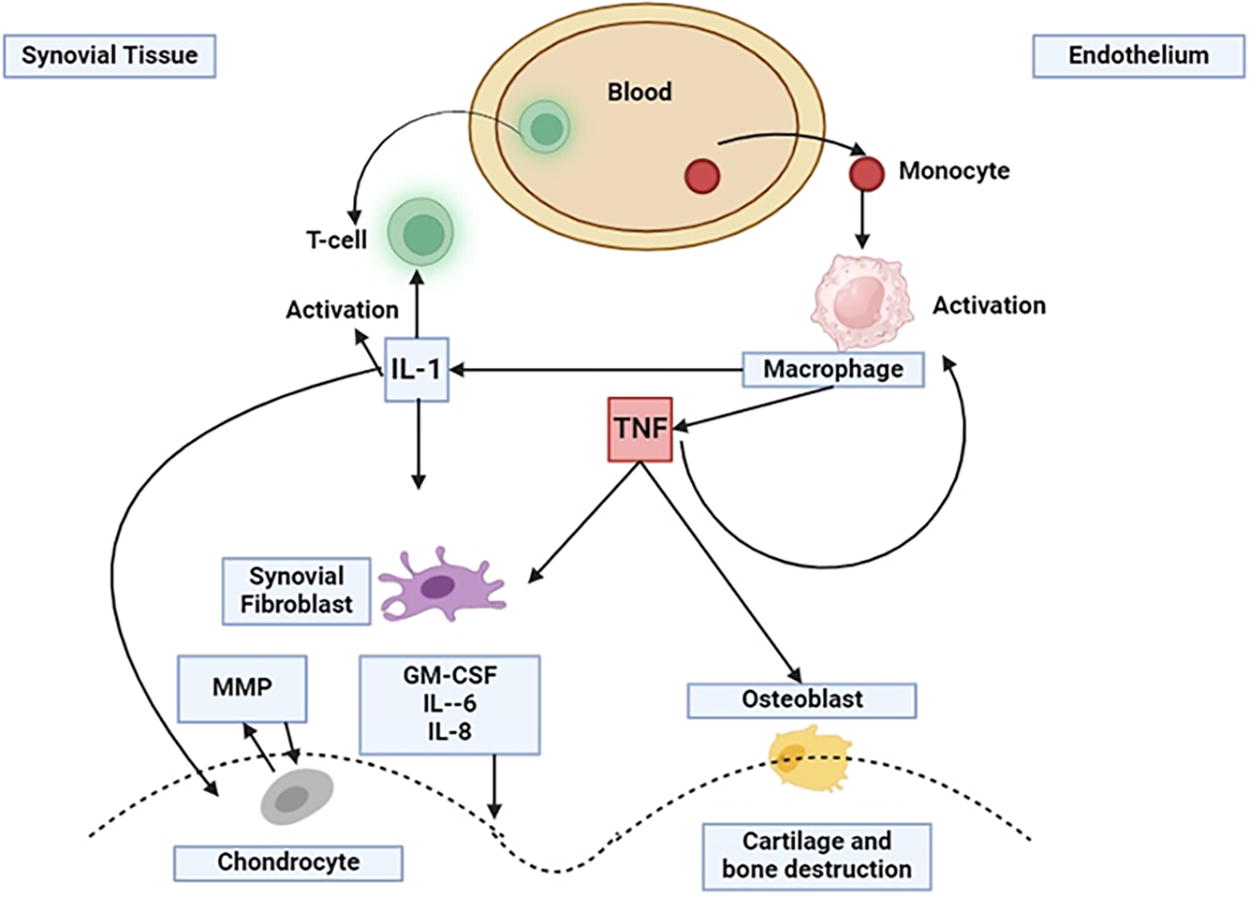
TNF mode of action in RA: Schematic representation of the mode of action of the TNF in RA. An initial inflammatory response is triggered in the synovial membrane, attracting autoreactive lymphocytes and macrophages to the inflamed tissue. Cytokines, primarily IL-1 and TNF, are produced and stimulate various cells including monocytes, macrophages, endothelial cells, and fibroblasts. These cells, in turn, produce additional cytokines such as IL-6, IL-8, MCP1, and GM-CSF. Ultimately, this leads to the production of matrix metalloproteinases, which are responsible for tissue destruction, as well as the activation of bone-destroying osteoclasts, resulting in joint damage. The complex interplay of these factors contributes to the pathogenesis of rheumatoid arthritis. Adapted from Pope (2002). IL-1, interleukin-1; RA, rheumatoid arthritis; TNF, tumor necrosis factor.
The dysregulation of cytokines in various immune and inflammatory disorders highlights the importance of understanding their roles and interactions. Researchers aim to develop targeted therapeutic strategies to modulate cytokine responses and restore immune homeostasis. This includes the development of biological therapies that specifically target key cytokines or their receptors to reduce inflammation and manage disease symptoms effectively. The success of anti-TNF therapies in diseases like IBD and RA has paved the way for the exploration of other cytokine-targeted therapies in different conditions (Guo and Lv Lu, 2023).
Cytokines for Carcinoma
The key scientists who brought cytokines into the treatment of cancer were Kendall Smith and James Griffin, these two people explore the chronological role of the cytokines as well as the cytokines receptors (Feldmann, 2008). After undergoing a lot of research analysis, the signaling pathway and route of the cytokines come into existence for the treatment purpose of different kinds of cancers. The work that was successfully done on tyrosine kinases for the identification of a specific type of family, that is, the JAK family and further IFN signaling which leads to the establishment of another family the STAT family which is accountable for the transcription factors, these breakthroughs revealed the major significance of the cytokine signaling (Conlon et al., 2019). With the insight into the normal pathways that are involved in cell growth makes it easier to understand the abnormalities underlying leukemia. A remarkable success and achievement in the research field related to cancer has been an unraveling of the special family called HER family and the associated or involved signaling pathways that they generate to yield the therapeutics for different kinds of major cancers such as breast cancer and colon cancer. The latest therapeutic techniques target the EGFR also called HER1 and another one is the HER2 for treating cancer (Conlon et al., 2019). Some of the observations that came out or revealed during the process of research were the cancer cells that were resistant to the cytotoxic effects of a particular cytokine TNF-α could be administered by the specific ligands for the associated target EGFR by overexpressing the HER2 and also oncogenes (WANG and LIN, 2008). This information further depicted that the antagonizing properties of HER2 could act as therapeutic and can be initiated the search for further monoclonal antibodies specific to the antagonistic HER2. This culminated in the development of a drug called Trastuzumab also known as or referred to as Herceptin (Nahta et al., 2004). This is a drug that is now extensively used in the treatment of the aggressive stages of a very common type of cancer, that is, breast cancer. The following diagram (Fig. 2) showcases the mechanism involved in treating carcinoma (Zettlitz, 2010).

Cytokines in cancer treatment: IL-2 receptor is recognized by three different types of receptor complexes, which are low-affinity receptor, medium-affinity receptor, and high-affinity receptor. These are expressed on natural killer (NK) and T lymphocytes. The nonsignaling of low-affinity receptor consists of only IL-2R alpha chain. The medium-affinity receptor is a combination of the IL-2R beta chain and the common gamma chain. Lastly, the high-affinity IL-2 receptor consists of the IL-2R alpha, the IL-2R beta chain, and the common gamma chain. Ligand which binds to the medium-affinity and high-affinity receptors leads to the phosphorylation of Janus kinase-1 and JAK3 which subsequently leads to the phosphorylation of STAT3 and STAT5, and results in transcriptional changes (Berraondo et al., 2018).
TLR4 signaling pathways accountable for early cytokines response as therapeutics in sepsis
Sepsis is one of the most life-threatening diseases whose full treatment is still not available. It is an acute condition of inflammatory disease caused by any species of bacteria. These bacteria invade our immune system and further hinder the normal functioning of the vital organs present inside the human body (Jarczak et al., 2021). Toll-like receptors also known or referred to as TLRs are a type of transmembrane proteins of the type 1 category. They act as the panel that is conserved for the PRR, that is, pattern-recognition receptors. TLRs are activated by the activity of pathogen-associated molecular patterns as a whole lead to the initiation of an innate type of immune response that is required to fight against the foreign invasion inside the body (Lambrecht et al., 2019). In the family of TLRs specifically, the TLR4 is responsible for the activation of an innate type of immune response. TLR4-4 plays a very significant role in initiating the immune system response against any disease inside the human body. The activation of such kind of responses inside the human body is due to the invasion of any bacterial endotoxin which leads to moderate to acute inflammatory disorders. The special feature of these pathways is that they target the pathologies (Lambrecht et al., 2019). TLR4 is recognized by a specific bacterium, that is, the gram-negative bacteria because it contains the lipopolysaccharide which is the main component of the structure or composition of gram-negative bacteria as it is present in its cell wall. Unlike the other TLRs the TLR-4 has a unique molecular structure or component more specifically which is composed of leucine-rich repeats, this is part of an extracellular component of this receptor and connected or associated to the intracellular component by the TIR domain. Now, this as a whole is accountable for the transduction of signal or transmission for the activation of cytokine response (Cannon, 2000). As shown in Figure 3, the phenomena of signal transmission start with a molecular recognition of the lipopolysaccharide present inside the bacterial cell wall by the TLR4 receptor which further leads to the dimerization of the receptor on the surface of the cell membrane (Kuzmich et al., 2017). After this, the cascade of interaction between proteins starts leading to the development or production of cytokines as well as interferons (called pro-inflammatory molecules). Now this at the end leads to the production of inflammatory and immune responses. The important feature of TLR4 is that it does not attach with the lipopolysaccharide (LPS) directly, it requires an adaptor protein called MD-2 called lymphocyte antigen-96 which then directly binds with the LPS which is a part of the bacterial cell wall to form a special complex (Lambrecht et al., 2019). The final step in this mechanism is that this complex attaches with the TLR4 noncovalently to activate the heterodimer which finally generates intracellular signal.
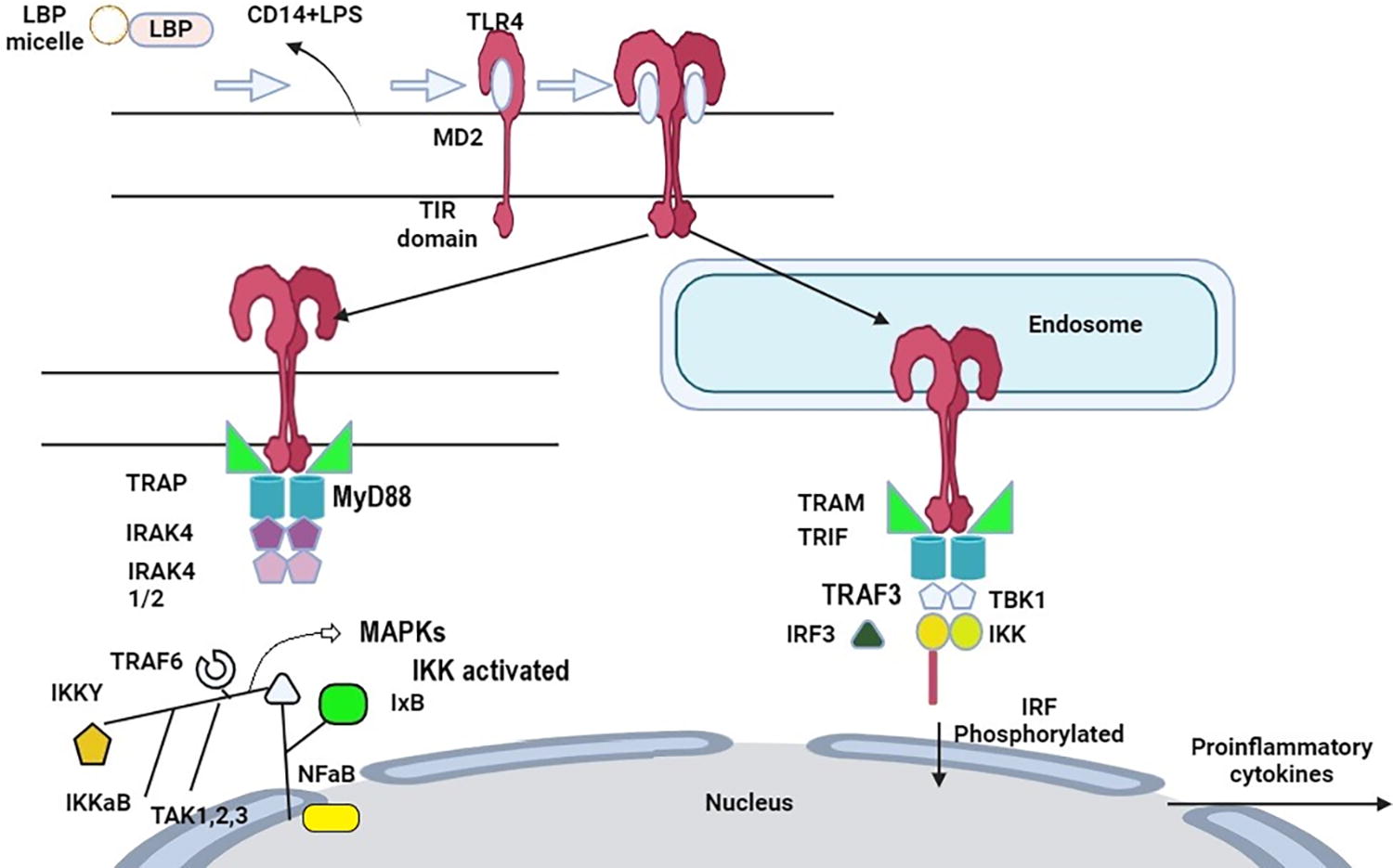
Toll-like receptor 4 (TLR4) signaling pathway. The intracellular part shows myeloid differentiation primary response gene and also the TIR-group containing adaptor, which further induces interferon-beta branches and the other part is extracellular part which is mediated by a protein named lipopolysaccharide (LPS) binding protein and the cluster of CD14 (Kuzmich et al., 2017). The signaling pathway of LPS and TLR4 involves both extracellular and intracellular components. In the extracellular part, LPS-binding protein (LBP), cluster of differentiation 14 (CD14), and MD-2 are involved. In the intracellular part, the pathway branches into two components: myeloid differentiation primary response gene (MyD88) and TIR-domain-containing adapter-inducing interferon-β (TRIF).
Cytokines for COVID-19
Cytokines play a significant role in the after-effects of COVID-19. There are a lot of problems that come along and are associated with the infection. One such disease is pneumonia. Pneumonia is one of the most usual after effects after recovering from this deadly disease. The patients who are suffering from pneumonia after the COVID-19 infection exhibit some differentiable features such as systemic hyperinflammation which occurs due to a disorder called macrophage activation syndrome (MAS) (McGonagle et al., 2020). There is another name for this syndrome as well and, that is, cytokine storm. Sometimes it is also known as secondary hemophagocytic lymphocytosis (sHLH). The cytokine storm which is induced here is different from the sHLH which is caused or originated by the immunodeficiency states. Generally, the problem of MAS arises in those people who have a background or history of adult respiratory distress syndrome (ARDS). This is primarily linked with the elevation in IL-6 as well as IL-1 (McGonagle et al., 2020). The infection of MAS comes with a number of complexities. The treatment of the patients suffering from this infection with cytokine therapy has proven very essential. Everybody around the globe is witnessing the acute conditions that are created by this deadly virus and also people are aware of the inaccurate information about the origin of this disease as well as no proper treatment available to date. It is quite evident the people around them are being cured or treated with the help of vaccines, some effective antiviral therapies, or by nonexisting herd immunity, or anti-cytokine therapy which includes anti-IL6 and IL1 antagonism (McGonagle et al., 2020) (PC, 2003). These specific therapies are used to mitigate against the additional disease, that is, hyperinflammation which results in ARDs. To deal with the problems like MAS or ARDS, IL6 plays a very significant role. Some studies show that during the infection by the SARS-CoV virus, the attacking area for this virus is the lungs, which will be preceded by or followed by ARDS 40 (Ni et al., 2020). So, as per the studies during the course of infection, the level of IL6 increases so the open reading frame of the virus and the N proteins acts as the antagonists to this pathway of interferon which leads to the regulation of the IFN-beta synthesis and it’s signaling. Both the cytokines, that is, IFN-beta and IFN-gamma inhibit or lower the replication of SARS-CoV (Rokni et al., 2020).
Discussion
Cytokines perform multiple functions, which in the future will be highly beneficial for carrying forward further research by scientists in the field of therapeutics. Cytokines show great response in therapeutics in cancer and inflammation-related disorders. Few of the cytokines are presently in clinical use, for example, EPO is a type of cytokine that is used for the treatment of disease like anemia, another example is TNF-α which is an antagonist, they are very useful in the treatment of disorders like autoreactive inflammatory diseases such as RA and Crohn’s disease (JU, 1994). One of the best examples in this category is inflammasomes, which actually are a group of multimolecular and intercellular complexes that surround the innate type of immune proteins. The major role of these inflammasomes is to direct the activation of a specific capsule-1which further leads to the secretion of the active form of cytokine, that is, IL-1 beta and the other one is IL-18 (Lopez-Castejon and Brough, 2011). So, this is how inflammasomes play a crucial role in the treatment of periodontal disease which is caused by the infection and inflammation inside the gums (Yilmaz and Lee, 2015). There is a plethora of other possible applications of cytokines. There are some specific types of characteristics which is showcased or portrayed by the cytokines such as pleiotropic spectra and their associated actions. The signaling pathways associated with the cytokines have been proven very effective in treating several acute conditions caused by various diseases but sometimes it may lead to some side effects also (Vilcek and Feldmann, 2004). This is the reason that encourages scientists as well as researchers across the world to develop target treatments with cytokines to minimize or cut down the side effects and to streamline the effect of treatment leading to speedy recovery (Vilcek and Feldmann, 2004). The example includes the use of tumor-specific antibodies fusion protein during the process of cancer therapy. In fact, nowadays cytokines can also be used in the treatment of depression which can be proven a remarkable landmark for future perspectives. However, the definite pathways associated with treatment of the depression in humans which is becoming a leading health problem is under the initial process of research but the utility of some of the pro-inflammatory cytokines, that is, IL-1 beta, IL-6, and also the TNF-α can be the prominent reason in analyzing the responsive and nonresponsiveness of the depression treatment. Another best way to avoid the pleiotropic side effects is using and developing ex-vivo strategies that involve cultivation, differentiation, expansion, etc., moreover, some kind of the protocols associated with somatic gene therapy are good indicators of cytokines applications. The results of these efforts can only predict whether it is feasible to replace the unspecific and broad-spectrum drugs which include steroidal and nonsteroidal inflammatory drugs, that is, NSAID with cytokines treatment or as therapeutics (Mire-Sluis, 1999).
Conclusion
Cytokines are known to be a group of growing small proteins that are majorly responsible for the transmission of signals and communication between hematopoietic cells, the cells of the human immune system, and other types of cells. There are two major cytokines used in treating RA in human species, and they are TNF-α and IL-1. In cancer therapy also, cytokines have shown their potential role through signaling pathways that lead to the suppression of carcinoma. From the literature, cytokines were also found to be associated with the recognition of pathogen patterns through TLRs, that is, TLR-4, and also concerns with pneumonia diseases such as coronavirus infection. This can be observed from the above literature that cytokines can be utilized as a diagnostic approach for various diseases as a future treatment modality.
Footnotes
Authors’ Contributions
Y.S. contributed to the conceptualization, methodology, investigation, and data curation of the study. K.B. contributed to the conceptualization, supervision, and project administration, and provided critical feedback. All authors have read and approved the final version of the article.
Author Disclosure Statement
There is no conflict among the authors.
Funding Information
No funding was received for this article.