




Abstract
Interferon-gamma (IFN-γ) is an important cytokine associated with antitumor immunity and has been implicated in the pathogenesis and progression of lung cancer. Nevertheless, no bibliometric analyses have been published in this field to date, and thus we aim to address this gap in knowledge. A search of the Web of Science (WOS) for literature related to the treatment of lung cancer with IFN-γ was conducted from 2002 to 2024. The extracted information from the included articles was subjected to visual analysis, and network diagrams were generated using software such as CiteSpace and VOSviewer. In total, 589 articles related to the treatment of lung cancer with IFN-γ were included in WOS between 2002 and 2024. The number of articles and citation frequency generally showed an increasing trend year by year. The United States and the University of California are the countries and institutions with the largest number of articles. The researcher who made the largest contribution to this field was Xin Cai from China (6). The Journal for ImmunoTherapy of Cancer published the largest number of relevant papers in the field (16 papers, IF = 12.469). The research hotspots in the field of immune escape in recent years have been IFN-γ, mechanism, immune checkpoints, and microtumor inhibitors. The field of IFN-γ treatment of lung cancer is evolving at a rapid pace. The current research focus within this field is on elucidating the mechanism of IFN-γ treatment of lung cancer, investigating the role of immune checkpoint inhibitors, and examining the tumor microenvironment and other pertinent topics.
Introduction
Lung cancer is a malignant tumor that develops from the bronchial mucosa or glands of the lungs. According to the International Cancer Center, in 2020, lung cancer had an incidence of 11.4% and a mortality rate of 18.0% worldwide, making it one of the leading causes of cancer death. In 2020, the incidence rate of lung cancer in China was 17.9%, with a mortality rate of 23.8%. Interferon-gamma (IFN-γ) is a crucial cytokine with antitumor immunity properties. It is linked to the development and advancement of lung cancer. As the sole member of the type II interferon family, IFN-γ is produced by activated T lymphocytes, natural killer cells (NK cells), and other cells (Jorgovanovic et al., 2020). Macrophages and other helper cells, such as dendritic cells, have been observed to promote the production of IFN-γ by resting T cells. Additionally, they have the capacity to produce a substantial amount of IFN-γ themselves (Murata et al., 2002). Furthermore, interleukin-12 (IL-12) (Galdiero, Marone, and Mantovani, 2018), interleukin-15 (IL-15), and interleukin-18 (IL-18), in addition to pathogen-associated molecular patterns, have been demonstrated to stimulate the secretion of IFN-γ (Castro et al., 2018; Gocher, Workman, and Vignali, 2022; Zaidi, 2019). In addition to activating cellular immunity and enhancing antitumor immune responses, active IFN-γ signaling has been demonstrated to trigger apoptosis and cell cycle arrest in human cancer cells. Furthermore, there is a long history of clinical trials in which IFN-γ has been employed as a direct anticancer agent in cancer therapy (Zheng et al., 2022). However, the available evidence indicates that IFN-γ exerts both antitumor and protumorigenic effects at different stages of the immunoediting process (Ivashkiv, 2018). Furthermore, there is considerable heterogeneity in the manner in which tumors are treated by IFN-γ (Zaidi and Merlino, 2011). Additionally, levels of IFN-γ in the tumor microenvironment (TME) tend to increase in conjunction with T-cell infiltration during chemoradiation (Medler et al., 2018).
Bibliometrics, as a mature publication information analysis method, has been widely used in different research fields (Chen et al., 2023a; Chen et al., 2023b; Huang et al., 2023; Zhang et al., 2023), especially the identification of bibliometric-related parameters, such as core scholars/institutions/countries and their cooperative relationships, keyword co-occurrence, and emergent analysis, which can greatly reveal the current status, hotspots, and research trends over time in specific research fields (van Eck and Waltman, 2010). Therefore, in this study, the related literatures of IFN-γ in the treatment of lung cancer included in the Web of Science (WOS) core collection database were used as the research object, and VOSviewer and CiteSpace were used for bibliometric analysis. The research hotspots and frontiers in the related research fields were analyzed and tracked to provide some reference for the study of IFN-γ in the treatment of lung cancer.
Materials and Methods
Data source
Under the premise of ensuring no data update, the search of WOS database was completed within one day from January 1, 2002 to October 1, 2024, and the search included the title of the article, keywords, abstracts, authors, institutions, and references and was stored in plain text format. Following are retrieval formulas:
1: Lung cancer* (Topic) OR lung tumor* (Topic) OR lung neoplasor* (Topic) OR lung onco* (Topic) OR lung carcinoma* (Topic) and Article OR Review (Document Type) and Oncology (Web of Science Categories) and English (Language)
2: Interferon-gamma (Topic) OR Interferon-gamma (Topic) OR INF-gamma (Topic) OR INF-gamma (Topic) and Article OR Review (Document Type) and Oncology (Web of Science Categories) and English (Language)
3#: 1# AND 2#
Inclusion criteria
Relevant literatures related to the study of IFN-γ in the treatment of lung cancer, such as mechanism study and clinical application related to IFN-γ.
Exclusion criteria
Repeated literatures; literatures not officially published or retracted; literatures with title, abstract, and content unrelated to IFN-γ in the treatment of lung cancer; conference papers, achievements, newspapers, and literatures with incomplete author information.
Data analysis
Microsoft Excel 2019 was used to sort the exported information, and CiteSpace 6.3.1 and VOSviewer 1.6.18 was used to complete the visual analysis of the author, institution, country, keywords, and citation information of the exported literature. The parameters in CiteSpace are set as follows: the time segment is from January 2002 to October 2024, the time slice is 1 year; the threshold is 10%, the node type is institution, author, country, keyword, etc., and the trimming method is slice time trimming and combined network trimming. The commonly used indicators in CiteSpace include author analysis, cocitation analysis, and co-occurrence analysis. The author analysis is to understand the interaction between scholars in a research field; co-citation analysis is a scientific mapping technology, which is mainly used to reveal the knowledge structure of a research field, such as potential themes; co-occurrence analysis reveals the co-occurrence relationship implied by the information content association and feature items by quantifying the co-occurrence information in each information carrier. In cluster analysis, modularity Q value is used to evaluate the cluster influence of the network. Q value >0.3 means that the cluster structure is significant. The higher the value, the better the clustering performance of the network. Profile value S is used to quantify the network homogeneity. S >0.5 indicates that the clustering is reasonable. VOSviewer has powerful theme clustering function, its nodes can represent countries, institutions, keywords, etc., the larger nodes indicate the higher frequency of occurrence; the connection between nodes represents the Co-occurrence frequency, and the line thickness of the connection represents the closeness between nodes; the color represents the clustering, and the nodes with the same color belong to the same cluster.
Data cleaning
To avoid affecting the analysis results due to the quality problems of the data itself and ensure the effectiveness of visual analysis, we clean the obtained data is a very critical step. Data cleaning is to convert data from different sources into a unified format, remove error records, and repeated records, supplement missed records, so as to improve the quality of data. In this study, 589 articles were obtained from the WOS (core collection) database in the early stage, repeated records were removed with the help of CiteSpace software, keywords were combined synonymously, and the same institution with different names was combined. Use VOSviewer to merge countries, such as Northern Ireland, England, Scotland, and Wales United into the United Kingdom.
Results
Trends of publication outputs
In total, 589 articles related to IFN-γ treatment for lung cancer was collected in this study. According to the citation analysis report, the total citation frequency of 589 articles was 30,843 times, the citation frequency of all articles was 52.37, and the H index was 79. According to the statistics of annual document volume and cited frequency (Fig. 1A), it was found that the annual document volume and cited frequency of studies related to IFN-γ in the treatment of lung cancer was generally on the rise, and the number of articles published in 2021 reached the highest number in the history of 48, and the citation frequency in 2022 reached the highest number in history of 2886. Excel (2019) software was used to analyze the trends in this field from 2002 to 2024 (Fig. 1B), and regression analysis was performed with year as the independent variable (x) and cumulative annual document volume as the dependent variable (y), which showed R 2 = 0.9233, indicating that the model had a good fit, equation y = 27.28e0.1443 x .
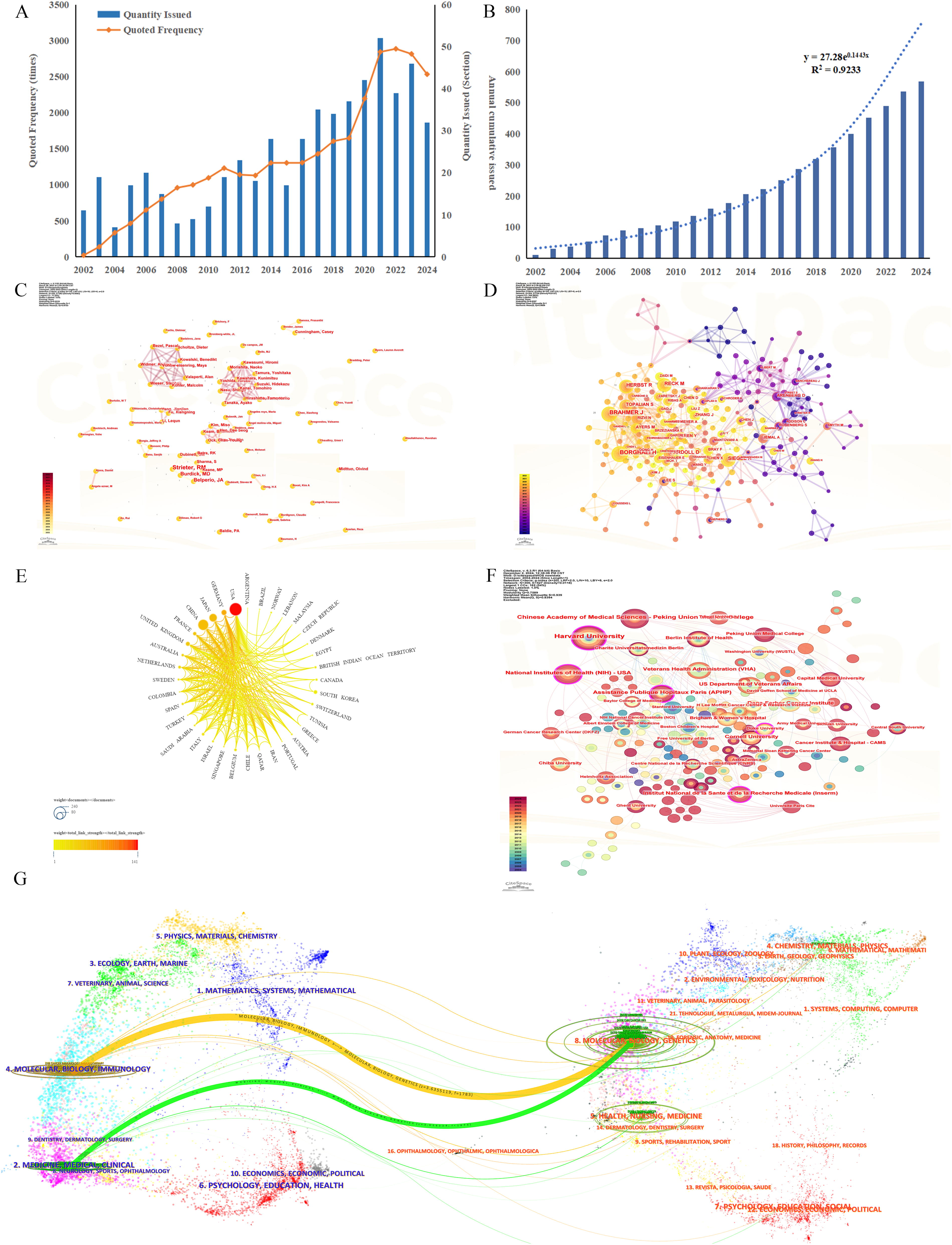
Analysis of the Publications, Authors, Countries, and Institutions on INF-γ Therapy for Lung Cancer from 2022 to 2024.
Bibliometric analysis of authors and coauthors
Co-occurrence analysis and relationship mapping were performed for authors (Fig. 1C) and cited authors (Fig. 1D) of the literature related to IFN-γ in the treatment of lung cancer, in which nodes represent the information of authors or cited authors, and connections represent their collaborative relationships. The Q value is 0.9519 in the co-occurrence map of the author and 0.9397 in the co-occurrence map of the cited author, and the S value of both is 1, indicating that the cluster effect and network homogeneity are reliable, including 252 nodes and 253 lines in the co-operation map of the author, 303 nodes and 724 lines in the co-operation map of the cited author. According to the number of documents issued, the authors were ranked, Cai Xin, who had the first number of documents issued, and Fu Xiangjing, who had the second number of documents issued, belonged to Huazhong University of Science and Technology, and the third was Vonow-eisenring, Maya, who had the Department of Immunology at the University of Zurich, with 6, 4, and 4 documents issued, respectively; among the cited authors, BORGHAEI H (Fox Chase Cancer Center, USA), TOPALIAN SL (Johns Hopkins University, USA), and HERBST RS (Yale University, USA) ranked in the top three, with 29, 27, and 24 cited frequencies, respectively.
Bibliometric analysis of countries and institutions
Visual analysis of the countries revealed that a total of 51 countries had published relevant publications in the field of IFN-γ treatment of lung cancer research, of which, 3 countries have published more than 50 articles, 16 countries have published between 10 and 50 articles, and the remaining countries have published less than 10 articles, indicating that the countries in this field were not evenly distributed and the top effects were very significant, and most papers were concentrated in a few countries. According to the number of documents issued, Scimago Graphica Setup was used to draw a visual map of international cooperation (Fig. 1E), showing that the top three countries was the United States (227 documents issued, H-index 40), China (147 documents issued, H-index 16), and Japan (94 documents issued, H-index 15); the countries with the first frequency of citation were the United States (46.78 times), followed by France (42.09 times), and Australia (36.08 times); and the top three countries with intermediary centrality were the United States (0.64), Germany (0.21), and Australia (0.20).
Analysis of the institutions revealed a total of 286 institutions contributing to the field of IFN-γ in the treatment of lung cancer (Fig. 1F), setting the minimum number of articles to 3 and mapping the institutional network by VOSviewer, and 34 institutions were found to play an active role in this field of research. According to the number of documents issued, the top five institutions were Harvard University, Veterans Health Administration, US Department of Veterans Affairs, Chinese Academy of Medical Sciences-Peking Union Medical College, and Assistance Publique Hopitaux Paris.
Bibliometric analysis of the higher-impact journals
Analysis of the journals revealed that a total of 88 journals had published relevant literature in the field of IFN-γ in the treatment of lung cancer, ranking according to the number of documents issued, and the top 10 journal publishers were 6 in the United States, 1 in the United Kingdom, 1 in Switzerland, 1 in the Netherlands, and 1 in Japan, and the top three were JOURNAL FOR IMMUNOTHERAPY OF CANCER (IF = 12.469), CANCER IMMUNOL IMMUN (IF = 6.630), INTERNATIONAL JOURNAL OF CANCER (IF = 7.316), and the highest impact factor (IF) in the top 15 journals was JOURNAL OF ONCOLOGY, IF = 50.717. CiteSpace software was used to draw a biplot superposition between citation and cited journals (Fig. 1G), and it can be seen from the figure that there are two citation paths, namely Molecular, Biology and Immunology—Molecular, Biology, Genetics (z = 3.6355119, f = 3566); Medicine, Medica, Clinical—Health, Nursing, Medicine (z = 2.026229, f = 2146). In the figure, the left side is the citation figure, the right side is the cited journals figure, the ellipse represents the number of publications corresponding to a journal, the ellipse length represents the number of authors, and the width represents the number of publications. In this figure, the citations were mainly concentrated in two fields, namely Molecular, Biology and Immunology and Medicine, Medical, Clinical. The citations mainly focused on the fields of Health, Nursing, Medicine and Molecular, Biology, and Genetics.
Analysis of cocited reference
Of the 589 articles included in this study, ranking according to citation (Table 1), 6 were published in N Engl J Med, 1 was published in SCIENCE, 1 was published in NAT REV CANCER, and 1 was published in J CLIN INVEST, all of which are leading journals in the field of medicine and biology. Among them, the most frequently cited article was Nivolumab versus Docetaxel in Advanced Nonsquamous Non-Small-Cell Lung Cancer published by H. Borghaei et al in N Engl J Med in 2015; the second most frequently cited article was Pembrolizumab versus Chemotherapy for PD-L1-Positive Non-Small-Cell Lung Cancer published by Reck M et al N Engl J Med; Third ranked is Mutational landscape determines sensitivity to PD-1 blockade in non-small cell lung cancer published in SCIENCE by Rizvi NA et al. CiteSpace Co-citation analysis (Fig. 2A) showed that the Q value was 0.7997 and the S value was 0.9233, which showed strong cluster effect and network homogeneity. We obtained seven clusters, including #0 Immune Checkpoint Inhibitors, #2 PD-1, #3 Tumro Micrornment, etc. The Figure 2B shows the top 16 references with the highest burst intensity. VOSviewer analysis found that 9,607 references were cited in 589 articles, each cluster represented a research field, and The upper left cluster mainly focuses on the clinical response and sensitivity of IFN-γ to immune checkpoint inhibitors; the lower left cluster mainly focuses on the clinical research of programmed cell death protein 1 (PD-1)/programmed cell death protein 1 ligand (PD-L1) inhibitors on lung cancer; the upper right clustering mainly focuses on the mechanism research of IFN-γ in the treatment of lung cancer; the lower right cluster mainly focuses on the safety, clinical activity, pharmacodynamics and immunological correlation of immune checkpoint inhibitors on lung cancer (Fig. 2C).
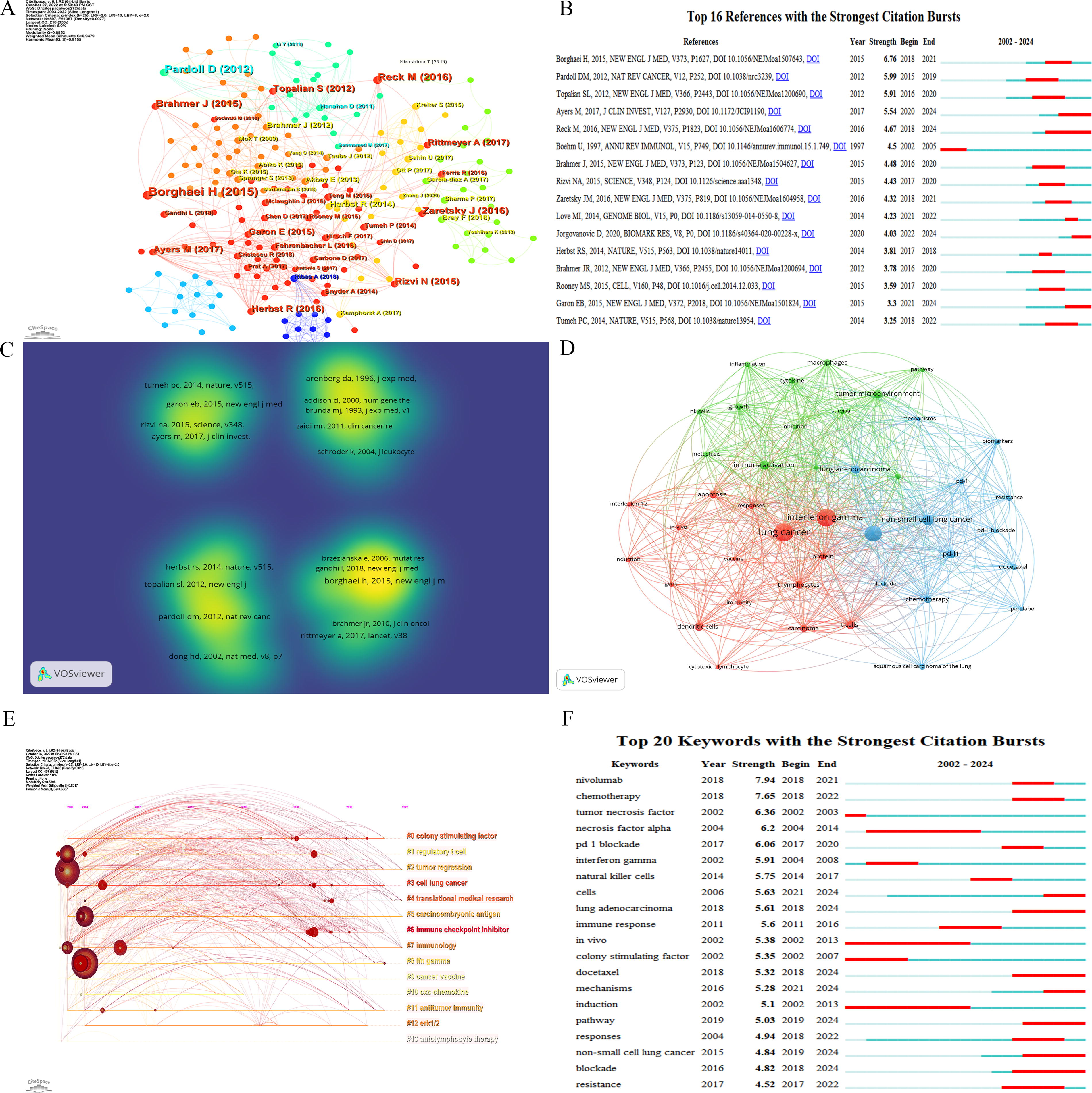
References and Keyword Analysis of INF-γ Therapy for Lung Cancer in 2022–2024.
List of References for INF-γ in Treatment of Lung Cancer
Analysis of keywords
The keyword frequency analysis elucidates the research pattern of IFN-γ in the field of lung cancer. VOSviewer statistics and cluster analysis (Fig. 2D) were performed, ranked according to frequency, and the keywords with more than 50 frequencies were Lung Cancer (lung cancer, 112 times), Interferon Gamma (IFN-γ, 111 times), and Immune Checkpoint Inhibitors (immune checkpoint inhibitors, 91 times). The same colored nodes in the figure indicate that the topics of these publications are similar, and each cluster representing a research area, the red cluster research content mainly focuses on the mechanism of IFN-γ in the treatment of lung cancer; the green cluster research content mainly focuses on the changes in the TME; and the blue cluster mainly shows the use of ICI. CiteSpace is used to merge the synonyms of keywords, co-occurrence, clustering, emergent analysis and draw keyword clustering timeline map (Fig. 2E). The co-occurrence knowledge map contains 460 nodes and 1,644 lines. The keywords emerging from the keyword clustering timeline map can represent the hotspots and foci of research, as well as future trends, of which the latest emerging keywords about IFN-γ in the treatment of lung cancer are Interferon Gamma (IFN-γ), Nivolumab (nivolumab), Mechanism (mechanism), and Checkpoint Immune Inhibitor, all of which are the hotspots of current research. In general, In general, keyword bursts indicate that research hotspots have evolved over time, and Figure 2F shows the top 20 keywords with the highest burst intensity. Among them, the red line represents the time period of mutation, “strength” is the emergent intensity, and keywords with high emergent intensity and close emergent year indicate the research frontier. Between 2002 and 2022, the keyword with the longest emergent cycle was Dendritic Cells, the keywords with the longest emergent period was Interferon Gamma (strength = 7.66).
Discussion
General information
The quantity of documents issued and its changing trend are important indicators to measure the current situation of a certain research field, and the frequency of citation is the most representative scientific measurement indicator used for evaluation by citation analysis, which is usually regarded as an important sign of academic influence or research quality. The results of this study showed that the trend of IFN-γ in the treatment of lung cancer can be divided into two stages. In the first stage (2002–2012), the number of documents issued fluctuated greatly, but the frequency of citation increased, indicating that everyone is in the initial stage of research on this field; in the second stage (2015–2022), the growth trend was obvious, and the number of documents issued in 2019–2021 showed an explosive increase, indicating that this field is receiving more and more attention, and the influence is further increased. Although the number of documents issued in 2022 has decreased, the frequency of citations is still on the rise, which indicates that IFN-γ treatment of lung cancer is still a research hotspot.
The central position of the national cooperation network is the United States and China, and the connection between the United States and other countries is close, indicating that the United States and other countries have a close relationship with cooperation, of which the intensity of cooperation with China is the highest. The number of documents issued, total cited frequency, intermediary centrality and H index in the United States are in the first place, indicating that the United States has more research in this field, and academic influence and research quality are in the forefront. The number of documents issued and the total frequency of citations in China are in the second place, but the frequency of citations in all articles is only 25.78 times, which may be because the research content is mostly biased toward clinical studies.
Through the ranking of the number of documents issued by institutions, it is found that the United States accounts for a relatively high proportion, indicating that the United States contributes greatly to the research in this field, and the intermediary centrality of these institutions is greater than 0.05, indicating that they have played a positive role in promoting the cooperative development of IFN-γ in the treatment of lung cancer. The research on this field in China is mainly based on Tianjin Medical University, Huazhong University of Science and Technology, and Sichuan University. Through the analysis of the published journals, it is helpful to understand the representative journals in this research field. The journal distribution showed that the top journals in this field were mainly distributed in the fields of clinical research and cancer research. Journal for Immunotherapy of Cancer was the journal with the highest number of articles in the top ten journals, and there was a small gap in the number of articles in the remaining journals. Through journal biplot superposition, it is found that this field mainly focuses on molecular mechanism research and clinical research.
Cocited analysis
Co-citation refers to that two literatures coappear in the reference catalogue of the third citation literature, and the knowledge structure of a certain research field, such as potential topics, can be revealed by mining the cocitation relationship of a literature spatial data collection. In this study, the co-cited analysis results showed that the related research contents of IFN-γ in the treatment of lung cancer mainly involved four research fields, and the red cluster mainly focused on the mechanism study of IFN-γ in the treatment of lung cancer, such as enhancing tumor immunogenicity, inhibiting angiogenesis, and regulating TME; the green cluster mainly focused on the mechanism study of PD-1/PD-L1 inhibitors on lung cancer, mainly clinical studies; the blue cluster mainly focused on its safety, pharmacodynamics, and immunological correlation in the treatment of lung cancer through the randomized controlled trials of immune checkpoint inhibitors and existing anticancer drugs; the yellow cluster mainly focused on the clinical response and sensitivity study of IFN-γ in predicting immune checkpoint inhibitors.
Research hotspot analysis
Keyword is the condensation and induction of literature content, keyword cluster analysis can reflect the hot spot of the related fields of literature research, emergent analysis can make a reasonable prediction of the frontiers of this research field. In this study, combined with keyword time line graph and emergent analysis, it can be seen that the mechanism of IFN-γ in the treatment of lung cancer, immune checkpoint inhibitors and TME has been the research hotspots.
Mechanistic studies
IFN-γ regulates immune responses and tumorigenesis primarily through the Janus kinase (JAK)/signal transducers and activators of transcription (STAT) signaling pathway (Gocher et al., 2022). In addition, IFN-γ also activates phosphatidylinositol-3-kinase (PI3K)/protein kinase B (AKT), mitogen-activated protein kinase (MAPK), and nuclear factor kappa-B (NF-κB) signaling pathways to regulate gene transcription and promote mRNA translation (Joshi et al., 2010; Kroczynska et al., 2016; Lin, Jamison, and Lin, 2012; Yao et al., 2021). Fang C et al first showed that IFN-γ can cause endoplasmic reticulum (ER) stress and unfolded protein response (UPR) in lung adenocarcinoma cells by activating JAK1/2-STAT and AKT-mTOR signaling (Chang et al., 2018).
Recent studies have confirmed that IFN-γ has a pro-tumor effect, especially in promoting cancer metastasis. IFN-γ can cause tumor immunosuppression by promoting the expression of PD-L1, major histocompatibility complexes (MHC) class I molecules, human leukocyte antigen G (HLA-G) on the surface of tumor cells, and the production of myeloid-derived suppressor cells (MDSC) (Minn and Wherry, 2016; Qu et al., 2022; Rozman and Svajger, 2018). Low-dose IFN-γ enhances stepness and metastasis of non-small cell lung cancer (NSCLC) through the intercellular adhesion molecule-1 (ICAM1) -PI3K-Ak (Song et al., 2019) t axis. IFN-γ can also promote tumorigenesis by increasing the expression of indoleamine 2,3-dioxygenase 1 (IDO1) and cytotoxic T-lymphocyte-associated protein 4 (CTLA4) (Ivashkiv, 2018; Mo et al., 2018).
Tumor microenvironment
IFN-γ play a central role in anti-tumor immunity, not only in the formation of long-lasting immune responses by adjuvant drugs or antibody combinations in the TME but also in regulating innate and adaptive immunity in the TME and allowing it to produce continuous antitumor immune responses (Lo Presti, Dieli, and Meraviglia, 2014). IFN-γ enhances cancer-specific immunity against DC cells, NK cells, and T cells and induces antiproliferative, antiangiogenic, and proapoptotic effects on cancer cells (Teranishi et al., 2020). Therefore, promoting the accumulation of anti-tumor cytokines and regulating the reduction of T lymphocytes is beneficial to reduce the immunosuppression of tumor cells (Raphael et al., 2015), enhance antigen recognition of tumor cells, and thus enhance antitumor effects (Aldinucci, Borghese, and Casagrande, 2019). IFN-γ can also alter angiogenesis and angiostatic chemokines by modulating tumor-derived neovascularization (Chemokines, CXC) expression balance (Addison et al., 2000), which in turn inhibits the growth and metastasis of NSCLC (Strieter et al., 2004). IFN-γ has an inhibitory effect on proangiogenic production by A549 cells Chemokine receptor 2 (CXCR2) can also inhibit NSCLC tumor growth by inhibiting tumor angiogenesis. Interleukin-10 (IL-10) (Boost et al., 2008), as an immunosuppressive factor, not only inhibits the apoptosis of tumor cells but also inhibits the effect of IFN-γ (Wu et al., 2019).
Immune checkpoint inhibitors
Immunotherapy has emerged as an efficient and novel treatment modality and is widely used in cancer therapy (Steven, Fisher, and Robinson, 2016). Immune checkpoint inhibitors, such as pembrolizumab, nivolumab, and atezolizumab, are now widely used in the treatment of various cancers such as melanoma, NSCLC, and pancreatic cancer (Banerjee et al., 2018; Crino et al., 2019; Levra et al., 2020; Long et al., 2017). The core function of immunotherapy relies on sufficient antitumor cells in tumor tissue, while destruction of immune cells in tumor tissue will lead to failure of (Bottcher and Sousa, 2018). Therefore, improving and enhancing immune cells in tumor tissue, especially CD8 + T lymphocytes, is critical to the success of cancer immunotherapy (Farhood, Najafi, and Mortezaee, 2019).
Early resistance to pembrolizumab in NSCLC patients is associated with downregulation of the IFN-γ signaling pathway, secondary late resistance, and hypermutation of the phosphatase and tensin homolog (PTEN), MHC, and β2 microglobulin (B2M) genes (Talb et al., 2022). Patients with squamous cell NSCLC treated with nivolumab had significantly better overall survival, response rate, and progression-free survival than docetaxel, with objective response rate more than twice that of docetaxel (Brahmer et al., 2015). However, a prospective cohort study found that ICI-treated lung cancer patients predisposed to reactivation of tuberculosis (Fujita et al., 2022), possibly because PD-1 inhibitors disrupted the balance of immune tolerance maintained by the interaction between PD-1 and PD-L1 (Boussiotis, 2016), which is important for maintaining immune homeostasis and preventing excessive immune responses with latent tuberculosis infected patients (Elkington and Friedland, 2015). Histone deacetylase (HDAC) inhibitors are partially mediated by increasing the expression of molecules involved in tumor immunogenicity and altering key immune cell populations (Zheng et al., 2016), of which HDAC6 and HDAC9 are involved in forkhead box protein 3 (FOXP3)-mediated transcriptional repression (Beier et al., 2012), class II HDAC inhibitors enhance the number and function of regulatory T cells and induce myeloid cells to differentiate from myeloid precursors into myeloid-derived suppressor cells (MDSCs) (Akimova et al., 2010), and class I/IV HDAC inhibitors reduce key immunosuppressive cell populations, i.e., enhancing tumor responsiveness to checkpoint inhibition (Briere et al., 2018). Epidermal growth factor receptor (EGFR) blockade can induce non-immune and immune escape mechanisms, and EGFR inhibitors can enhance the expression of MHC-I, which may be related to the decrease of MHC-I heavy chain and B2M at the mRNA level and the transcription of IFN-γ pathway components (Garrido et al., 2014). Mitogen-activated protein kinase kinase (MEK) inhibition enhances IFN-γ-stimulated activation of JAK-STAT signaling and has a particularly pronounced effect on MHC I and MHC II induction, whereas IFN-γ signaling in NSCLC cell lines is positively inhibited by HDAC-dependent epigenetic modifications and MEK/extracellular signal-regulated kinase (ERK) signaling (Neuwelt et al., 2020).
In summary, IFN-γ has a significant guiding effect against tumor clearance or inhibition both in the immune system and in the TME, especially under the regulation of the immune system, and its combination with drugs, antibodies, etc., brings new ways of thinking to the treatment of tumors. In lung cancer therapy, IFN-γ achieves antilung cancer effects mainly through signaling pathways such as JAK/STAT, PI3K/AKT, and PD-1/PD-L1. In this study, bibliometrics were used to comprehensively analyze the current development status and future development direction of IFN-γ in the field of lung cancer, which is helpful for researchers to have a deep and comprehensive understanding of this field, so as to provide theoretical support and reference for researchers to carry out subsequent in-depth study.
Footnotes
Authors’ Contributions
Z.L.: Conceptualization, Writing—original draft, Writing—review & editing. J.W.: Conceptualization, Writing—original draft.
Data Availability Statement
Original contributions are included in the article. Further inquiries may be directed to the authors.
Publisher’s Note
All claims expressed in this article are solely those of the authors and do not necessarily represent those of their affiliated organizations, or those of the publisher, the editors, and the reviewers. Any product that may be evaluated in this article, or claim that may be made by its manufacturer, is not guaranteed or endorsed by the publisher.
Author Disclosure Statement
The authors declare that the research was conducted in the absence of any commercial or financial relationships that could be construed as a potential conflict of interest.
Funding Information
The authors declare financial support was received for the research, authorship, and/or publication of this article. This research was supported by This work was supported by National Natural Science Foundation of China (NSFC) (Grant no. 82160900).