




Abstract
Abstract
Purpose:
To verify the safety and efficacy of botulinum toxin type A (BoNT/A) to promote protective ptosis in dogs.
Methods:
In this prospective interventional study, a total of 10 dogs underwent transcutaneous anterior chemodenervation of levator palpebral superioris with 15 U of BoNT/A. The systemic changes, ocular mobility, visual function, intraocular pressure (IOP), tear production, and the onset, degree, and duration of ptosis were evaluated on a daily basis during the first 7 days and on days 14, 21, and 28 after application.
Results:
The onset of the clinical effect was observed between 2 and 3 days after application of the toxin; the time taken for maximum ptosis to develop varied from 4 to 7 days (mean 5 days) and the average duration of the toxin effect was 21 days. The mean percentage reduction in palpebral fissure height was 42.859% (SD±35.714%–59.821%). There was not a statistically significant difference in IOP before and after the BoNT/A application (P=0.974), or lacrimal production evaluation (P=0.276). There was no change in ocular mobility and no other adverse effect was observed in association with the administration of the study drug.
Conclusion:
The application of BoNT/A into the levator palpebral superioris muscle in dogs was effective and safe to promote protective ptosis with a temporary covering of the cornea.
Introduction
The therapeutic use of BoNT/A in ophthalmology is mainly for the treatment of essential blepharospasm, strabismus correction, chronic dry eye syndrome, congenital nystagmus, facial paralysis, lacrimal hypersecretion syndromes, eyelid retraction, entropion, and for the production of protective ptosis.1,2,9 In this last case, BoNT/A when applied into the levator palpebral superioris muscle promotes ptosis with a temporary covering of the cornea, thus producing the same protective effect of some routine surgical procedures such as tarsorrhaphy.10–14
The only published study describing the use of BoNT/A in veterinary ophthalmology refers to a case in which the toxin was successfully used during 3 years for the treatment of a possible essential blepharospasm in a dog. 15
Therefore, the objective of this work was to verify the ability of BoNT/A to promote protective ptosis in dogs. Qualitative and quantitative evaluations of ptosis were obtained after applying the drug into the levator palpebral superioris muscle through the eyelid. Clinical parameters that were analyzed included the drug's initial action, level, and time of ptosis. Toxin influences on both intraocular pressure (IOP) and tear production, and occurrence of side effects were also evaluated.
Methods
This prospective interventional study was approved by the Ethics Research Committee from the Biology Institute at University of Campinas. The experiments were performed at the Veterinary College Hospital in Itajubá (FEPI) according to the Association for Research in Vision and Ophthalmology's statement for the use of animals in ophthalmic and vision research. The study involved 10 dogs, 5 males and 5 females, which met the eligibility criteria below.
Inclusion criteria were predefined as follows: Adult dogs, aged from 4 to 8 years, weighing between 8 and 25 kg, males and/or females, without clinical or ophthalmic disease. The exclusion criteria were as follows: pregnant females, dogs with a history of anaphylactic reactions, current bleeding disorders, systemic and/or ocular diseases, such as entropion or ectropion of the upper eyelid, the presence of infection or inflammation at the proposed injection site, and scarring in the region of the levator palpebral superioris muscle. Animals that were receiving any medication such as aminoglycosides, calcium channel blocking drugs, anticholinergic muscle relaxants, or were having a known hypersensitivity to any ingredient in the formulation were also excluded. It was decided to terminate the study if any serious adverse reactions occurred that could compromise the visual function permanently and/or endanger the animal's life.
A comprehensive physical and ophthalmologic evaluation and photographic documentation was performed before and after the implementation of BoNT/A. All examinations and data acquisition were executed by the same researcher. The ocular parameters evaluated included the degree of upper eyelid ptosis, the amount of tear production (Schirmer tear test Schering Plough Animal Health, Union, NJ), the mean of 3 readings of IOP (Tonopen Vet, Reicher, Inc., Depew, NY), and ocular mobility evaluation. Visual function, systemic changes, and photographic documentation of all the animals were carefully evaluated on a daily basis during the first 7 days and on days 14, 21, and 28 after BoNT/A application.
The lyophilized BoNT/A Prosigne® (Lanzhou Institute of Biological products, Lanzhou-Gansu, China, Lot 20100902), in a 100 U vial, maintained at a refrigeration temperature between 2 and 8 degrees, had been diluted prior to use with 2 mL of sterile 0.9% saline solution according to the manufacturer's recommendations to obtain a 5-unit concentration in a volume of 0.1 mL.
The dogs received, after disinfecting the site of application with iodine solution, a dose of 15 UI diluted in a total volume of 0.3 mL, which was applied in the region of the levator palpebral superioris muscle through the external face of the left upper eyelid. The application was made with a 1 mL sterile syringe with a 27 G needle, placed near the anterior orbital roof slightly behind the superior orbital rim in the mid-pupillary plane (Fig. 1). No anesthetic was required, and the animals were not subjected to any restriction of movement after application.
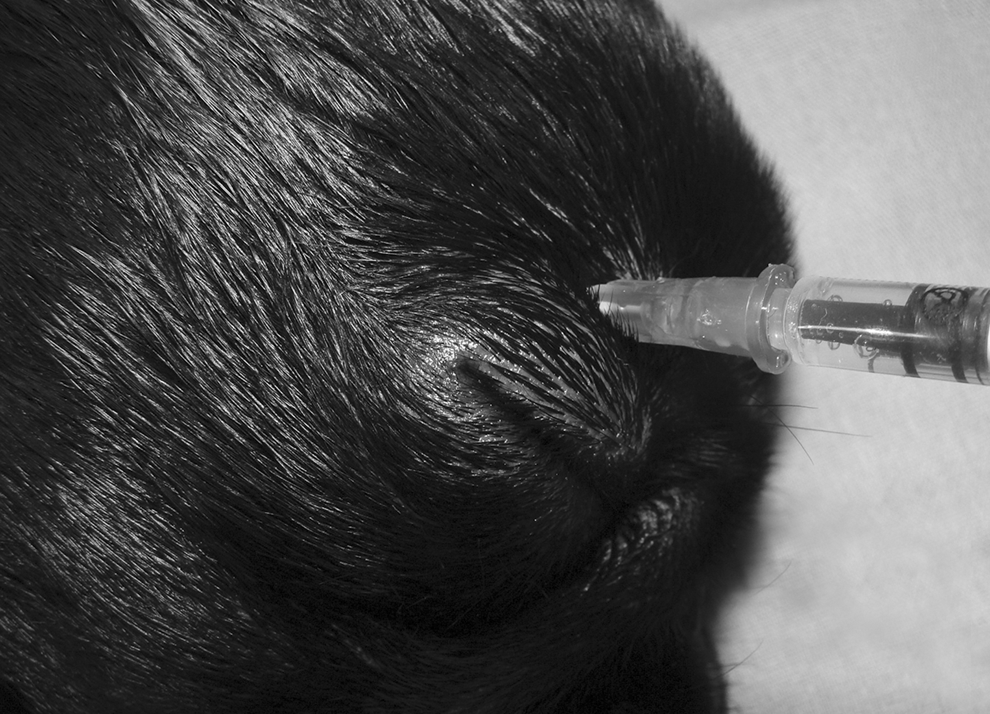
An example of botulinum toxin type A injection point.
Palpebral fissure length (AB) (Fig. 2) was defined as the measure of the horizontal distance between the medial and temporal canthus, the measure of the eyelid opening (CD) (Fig. 2) was considered as a major distance between the upper and lower lid edge in the central region as if a line was drawn perpendicular to the 2 farthest edges from the center of the upper and lower eyelids.

Palpebral fissure length (AB distance) and measure of the eyelid opening (CD distance).
The photographic documentation of all the animals was performed by digital photos that were taken in macro function with the Sony H50 camera at a distance of ∼5 cm from the eye of each animal (Fig. 3). The photographs were processed through the public domain NIH program 1.55 (written by Wayne Rasband at the U.S. National Institutes of Health and available on the Internet by anonymous ftp from zippy.nimh.nih.gov). After contrast enhancement, points were placed along the upper and lower eyelid contours, delineating the palpebral fissure area and setting the eyelid margin distances (AB and CD measures). Qualitative evaluation was also performed and ptosis was considered satisfactory when corneal coverage was equal to or greater than 50%, incomplete when a recovery between 25% and 49% was observed, and unsatisfactory when less than 25% of the corneal surface was covered. The researcher was masked for the sequence of the photographs during the palpebral measures.

Photograph documentation showing the evolution of ptosis degree of dog 4 at days 1, 3, 7, and 28, respectively.
To evaluate the feasibility of BoNT/A to induce temporary ptosis for corneal protection, the variables followed in this study were the onset and duration of clinical effect of BoNT/A, time for development of maximum ptosis, the mean percentage reduction in palpebral fissure height, lacrimal production, and IOP variations. The statistical analysis was performed by the Holm–Sidak method using the software sigma plot and all P values less than 0.05 were considered significant.
Results
The average weight of the animals used in our study was 14 kilograms (range 8.7 to 25 kilos). A total of 10 eyes underwent transcutaneous anterior chemodenervation of levator palpebral superioris muscle with a 15 U dose of BoNT/A injection in the left eyelid. The onset of clinical effects was observed between 2 and 3 days after application of the toxin. The time taken for maximum ptosis to develop varied from 4 to 7 days (mean 5 days). The average duration of BoNT/A effect was 21 days. The mean percentage reduction in palpebral fissure height was 42.859% (SD±35.714%–59.821%) (Table 1). The palpebral fissure height had gradually returned from the seventh day and in 3 dogs it was stabilized at pretreatment level on the 28th day. On the last day of follow-up, 7 animals still had some degree of ptosis, although these dogs had less than 20% of eye coverage (Fig. 4). In one animal the onset of effects was observed after the fourth day, with maximum coverage of 27.78% on the day 6 and return to the initial size on day 15. In our qualitative analysis, more than 50% reduction in palpebral fissure height (suitable ptosis) was observed in 4 out of 10 eyes and reduction with a cornea recovery between 25% and 49% (incomplete ptosis) was observed in 6 of the 10 dogs.

Development and recovery of the ptosis degree caused by the botulinum toxin application in levator palpebral superioris muscle in 10 dogs, which are represented by the squares.
In bold, a higher eyelid fissure reducing percentage.
M, male; F, female.
There was no significant difference in IOP before and after the BoNT/A application (P=0.974); the same was noted in the lacrimal production evaluation (P=0.276, Kruskal–Wallis One-Way Analysis of Variance on Ranks). There was no change in ocular motility and no other adverse event was observed in association with the administration of the study drug.
Discussion
Temporary protection of the cornea may be necessary following clinical keratopathy treatment including corneal ulceration or exposure, epithelial debridement, grid keratotomy, and after superficial keratectomy. The tarsorrhaphy and third eyelid flap are the techniques of surgical covering routinely used in veterinary medicine to achieve this protective function.16–18 These procedures frequently lead to pain and discomfort, however, they increase the healing rate and prevent the worsening of the corneal condition.11,13,16,19 The mechanism of action of protective ptosis is still unclear. In addition to irritation reduction caused by the decrease in eyelid movement on the cornea and less evaporation of the lacrimal film, there is an hypothesis that tear lysozymes, cytokines, and growth factors released by the vessels of the tarsal conjunctiva that are close to injury may act favorably on the repair process.11,13
This study is based on several reports that have been published demonstrating the feasibility of the use of botulinum toxin into the levator palpebrae superioris muscle for the production of protective ptosis in humans.10–14 Based on these favorable results, we believe that dogs can also benefit from the advantage of this application in relation to surgical procedures. The reasons are that the technique neither requires general anesthesia and surgical skills for its execution, nor produces inflammation of the eyelids and discomfort, daily care is not required, and principally it allows the application of topical drugs and the evaluation of corneal healing progression.10–14
There has been a suggestion to administer BoNT/A into the levator palpebral superioris muscle by the transconjunctival route, although for this study we chose to rely on Naik and colleagues 2008 methodology, and perform a transpalpebral injection with anterior placement of the toxin using a half-inch needle. This study has shown that this form of application allows a higher initial dose thereby avoiding repeated injections, and it maintains a longer duration of induced ptosis that may also potentially reduce the chances of complications such as ocular perforation and superior rectus underaction. 10
Prosigne is a lyophilized BoNT/A form produced from the purified crude toxin of the culture Clostridium botulinum strain Hall and 1 mouse unit (U) is equivalent to the amount of toxin found to kill 50% (LD50) of a mice group when injected intraperitoneally. This toxin was approved in 1996 for commercial use in China and was approved for therapeutic use in Brazil in 2003 (MS No. 1.0298.0317). Studies have shown that Prosigne® (Lanzhou Institute of Biological Products) and Botox® (Allergan, Inc., Irvine, CA) have 1:1 dose equivalence and have equal clinical effect, efficacy, tolerability, and safety.20,21
The dose determined for this study was not the same Dysport® (Ipsen Slough, UK/Galderma, Paris, France) dose of 33.3 U per point of application used in the treatment of blepharospasm in one dog 15 or 24 U that has also been used to induce protective ptosis in humans 22 because there is no bioequivalence between Dysport® (Ipsen Slough, UK/Galderma, Paris, France) and Prosigne® (Lanzhou Institute of Biological Products). Reports state that a simple dose-conversion factor is not applicable because units of different serotype A toxins are not interchangeable.23,24
Considering the local action of BoNT/A, which fundamentally consists of a selective inhibition of evoked acetylcholine release at the skeletal neuromuscular junction that result in a focal flaccid paralysis1,2,25 and anatomical muscular similarity between species, a 15 U dose was chosen for this study, the same maximum BOTOX® (Allergan, Inc.) dose used by Naik et al., 10 due to the dose equivalence between BOTOX® (Allergan, Inc.) and Prosigne® (Lanzhou Institute of Biological Products) 20 and it being within the studied species safe dose (L50). 26
In humans, after applying to the specific muscle, botulinum toxin starts its activity between 1 and 3 days, however, it is not uncommon that its effect begins up to 1–2 weeks after application. Its total effect occurs between 2–4 weeks, and the flaccid paralysis caused, which is dose dependent, can have variable durations lasting 4–8 weeks on average and gradually disappearing.1–4 Although we have seen a similar onset of action, the degree, time of total effect, and duration of ptosis was lower in dogs than that observed with the same dose and technique of application in humans. The hypothesis that dogs have a high natural resistance to the toxin has to be investigated to provide a safe and efficient protocol for the use of BoNT/A for therapeutic purposes in this species.
The difference in response between animals is probably due to some variation of the injection site. The dogs that showed the least degree of ptosis probably did not received the drug directly into the muscle, since it is known that an increased paralytic effect is obtained when the application is performed directly into the motor endplate.25,26 Further studies with an electromyography guided application are suggested. The dose and dilution are factors that also exert influence in response to the toxin, since they are directly related to the degree and duration of paralysis. 27 Some authors have described the repeated application to achieve a greater and longer lasting coating cornea,11–13 which is also necessary to be evaluated in future studies in dogs with the objective of obtaining a greater degree of coverage and a more prolonged effect.
Transient diplopia and superior rectus underaction are described as major side effects in humans submitted to this treatment, which occurs by toxin diffusion for the extraocular muscles.10,28 The diplopia cannot be evaluated in dogs and hypofunction was not observed in the studied animals. Another side effect reported was a case of acute glaucoma after application of BoNT/A for blepharospasm treatment in a patient predisposed to glaucoma; the IOP increase in this patient was due to mydriasis caused by the diffusion of the toxin. 29 Similarly, the diffusion of the toxin could also influence the tear production and for this reason BoNT/A is also used in the treatment of crocodile tears to decrease lacrimal production. 30 Studies demonstrated BoNT/A action on glandular activity, reducing salivary 31 and nasal secretion in dogs. 32 During this study no significant difference in IOP and tear production was observed, as were any other side effects that could contraindicate its use.
The form of computerized image analysis used in this study was an accessible, noninvasive, and precise procedure and could be used as a valuable clinical or research tool due to its simple and objective measurements.33,34
Application of BoNT/A for the production of ptosis in dogs was effective, safe, well tolerated, and easy to perform. Care after the application was not required and restrictions on movement were not performed because activity is important to contribute to an effective temporary ptosis. 13 We suggest further studies with different doses and forms of applications to obtain a higher degree of coverage, and clinical studies to assess whether this coverage brings real benefits to the healing of injuries.
Conclusion
Based on our findings, the application of BoNT/A into the levator palpebral superioris muscle in dogs was effective and safe to promote protective ptosis with a temporary covering of the cornea.
Footnotes
Acknowledgments
The authors thank Prof. Fernando Antônio Bretas Viana for the technical assistance and professional revision and the relevant facilities at the Faculdade de Medicina Veterinária de Itajubá (FEPI) to carry out this study.
Author Disclosure Statement
This research was supported by the resources of the Masters scholarships from CAPES. No competing financial interests exist.