




Abstract

After 7 years at JOPT's helm, Dr. Craig Crosson has decided to step down as Editor-in-Chief, recently taking on 2 prestigious administrative positions. Craig is now Senior Associate Dean of Research at the Medical University of South Carolina and Executive Secretary for the Association for Research in Vision and Ophthalmology. As editor for JOPT, Craig successfully guided the journal through a transitional period; seeing the journal take on a uniform article format (modernized size and layout), and bringing the journal into the electronic age with electronic submissions and electronic management of review flow in collaboration with our publisher. Under his stewardship, he saw both the number of submissions doubling (from 127 submissions in 2007 to 265 last year) and the impact factor increasing by ∼60% (see Fig. 1). At JOPT, we are all indebted to Craig for his tireless work over the past 7 years, and wish him the very best with his new responsibilities.
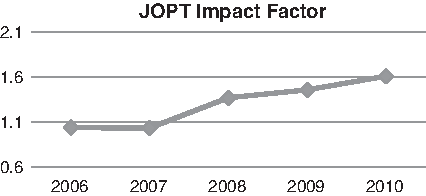
As the new editor, I plan to build on Craig's success and maintain the journal's current trajectory. My goals are (i) to increase JOPT's impact factor by at least one point over the next 5 years, bringing JOPT in line with the other 2 top-tier ophthalmology journals, Experimental Eye Research and Investigative Ophthalmology & Visual Science, and (ii) to firmly establish JOPT as the premier journal for the publication of original and review articles from international investigators in ocular pharmacology and toxicology. To accomplish this goal, my plan is to recruit innovative experts providing timely review articles, offer updates from investigational new drugs for ophthalmic applications in clinical trials, and rigorous, fair, and prompt reviews of original articles and case reports.
To meet the growing volume of submissions at JOPT, I have expanded our editorial board of experts to 30 members, including 4 associate editors, each managing an important focus area for the journal. Hence, Mike Niesman will help manage retinal pharmacology, Carol Toris will assist with the oversight of pharmacology of aqueous humor hydrodynamics and blood flow, Uday Kompella will support the direction of drug delivery and gene therapy, and Mike Stern will help supervise ocular immunology, inflammation, and infection. This expanded knowledge base will help me make better informed editorial decisions when reviewing the diverse spectrum of articles related to ocular pharmacology that are currently submitted to JOPT.
Advancements in ocular pharmacology are proceeding at a rapid rate. Particularly impressive are the development and use of novel therapeutics and delivery methods for the treatment of dry eye, ocular hypertension, wet age-related macular degeneration (AMD), and ocular infections. Another active area in ocular pharmacology is novel drug delivery technologies, including sustained release applications to subvert multiple interventions, oscillations in drug concentrations, and/or patient compliance issues. Moreover, advancements in the therapeutic management of surgical outcomes continue at a steady pace. On the horizon are novel therapeutic strategies, including cell-based therapies for “back of the eye” applications for the 2 major causes of adult vision loss, dry AMD, and glaucoma, affecting tens of millions of people worldwide. Even more exciting is the development of individually directed therapeutics using genetic targeting and progress in our understanding of the genetic basis for the differential responses of patients to ocular drugs. Taken together, this is an exciting time for ocular pharmacology, needing a premier journal to disseminate these important achievements. Given the focus of the journal and the quality of the editorial board, JOPT is uniquely positioned to communicate these findings.
We welcome your comments and your article submissions, and look forward to your active participation in the journal.