




Abstract
Purpose:
Technological development drives the optimization of therapeutics in ophthalmology, but quantifiable and systematic review of such innovation is lacking. To fill this gap, we characterize trends in ophthalmology-related patents in the United States from 2005 to 2020.
Methods:
Publicly available patent data from the US Patent and Trademark Office was analyzed with the R programming language. Ophthalmology-related patents were identified with a keyword search of their titles and claims text. Temporal trends were assessed with the Mann–Kendall trend test (α = 0.05, two-sided).
Results:
Of 4.5 million collected patents, some 21,000 (0.5%) were ophthalmology related. The number of annually granted ophthalmology patents increased over time (Mann–Kendall test: z = 4.91; P < 0.001), from 619 patents released in 2005 to 2,019 patents in 2020. Patent counts also increased over time for all ophthalmic subspecialties except oculoplastics, with steepest rises in retina (z = 4.91; P < 0.001) and cornea (z = 4.64; P < 0.001). The most cited patents were in biocompatible intraocular implants and implantable controlled-release drug delivery systems, which underscores particular advancement in therapeutic efficacy and safety in devices used in the treatment and management of common yet debilitating eye conditions.
Conclusion:
This exploratory analysis reveals hotspots for ophthalmology-related innovation in the United States that may predict current and future growth trends in device development and pharmacologic advancement in ophthalmology, paving the way for more diverse and effective treatment options for preserving vision.
Introduction
Innovations in ophthalmic care have transformed lives by reducing the burden of visual impairment and blindness and advancing the overall standard of ophthalmic care. For example, artificial intelligence (AI) has been at the forefront of innovation in ophthalmology and optometry, enabling automated screening and diagnosis of conditions such as diabetic retinopathy, age-related macular degeneration, glaucoma, and retinopathy of prematurity via analysis of complex ocular images.1–5 Smartphone-based imaging has been a promising innovation for screening in resource-limited settings, and together with machine learning and tele-ophthalmology, can render powerful reductions in disparities related to health care accessibility and resource allocation in the field of pediatric retinal care.1,6 Advances in therapeutic measures have also improved patient outcomes. The advent of advanced intraocular lenses and implantable sustained-release drug delivery systems has revolutionized cataract surgery and the management of chronic progressive pathologies like posterior uveitis and diabetic retinopathy.7–9
Furthermore, current clinical trials in gene therapies for inherited retinal dystrophies and primary open-angle glaucoma could lead to greatly enhanced therapeutic options in the near future. 10 Innovation has also made precision medicine more feasible across ophthalmology—for instance, recent novel drug delivery systems in glaucoma care that allow clinicians to tailor treatments to an individual patient's needs and coexisting ocular conditions point toward a nascent trend of precision medicine in ophthalmology. 11
These advances highlight the importance of continued exploration of trends in ophthalmic innovation to identify current gaps in knowledge and predict future directions. An essential component of the innovative process is patents and other forms of intellectual property, which play essential roles in encouraging innovation in medicine. The process of developing a new medical device, surgical protocol, or medication is long, costly, and risky, and patents enforce temporary monopolies to reward developers' research and development efforts. Without patents, innovative firms would be less likely to make the costly and risky investments needed to introduce new technologies and pharmaceuticals to market. 12 In the United States, patents are granted through the US Patent and Trademark Office (USPTO), which evaluates inventions on criteria such as novelty, nonobviousness, and enablement. 13
The number of medical patent applications filed and granted has risen dramatically, with 11,365 medical technology patents granted to US inventors in 2018 compared with 5,818 patents in 2000, not including crosstalk with patents classified under other technological areas.12,14 Given this growth in innovation, this study aims to uncover the trends in innovation pertaining to the field of ophthalmology in the United States by identifying and analyzing patent data related to eye care.
Methods
According to the guidelines of the Institutional Review Board (IRB) of University Hospitals Cleveland Medical Center, this study is exempt from approval.
Software packages in the Python programming language were used to download bulk patent data from the USPTO.15–17 Keywords related to ophthalmology (Supplementary Data) were generated and text search was used as the inclusion criterion to identify ophthalmology-related patents. The data search did not include optometry patents. Software packages in the R programming language were used for statistical analysis of the acquired data and to generate figures.18–24 One hundred patents were randomly selected, and 99 of the 100 patents were manually confirmed to be related to ophthalmology. Statistical analysis was conducted with the Mann–Kendall and analysis of variance tests, each using a false-positive threshold of 5%. The Mann–Kendall test was specifically utilized to determine monotonic upward or downward trends in values over time and was not used to assess magnitude of change or to compare growth trends between different categories. This report is entirely reproducible, with the analysis scripts publicly accessible at a GitHub repository. 25
Results
Between 2005 and 2020, there were 4.5 million patents that were filed to the USPTO. Of these, roughly 20,000 (0.5%) were pertinent to ophthalmology. There was a statistically significant uptrend in the annual number of ophthalmic patents in this time frame: 619 patents in 2005 and 2019 patents in 2020 (Supplementary Table S1; Mann–Kendall test: z = 4.91, P < 0.001), while the proportion of ophthalmic patents when compared to total patents have been stable (Fig. 1; 0.4% in 2005 and 0.5% in 2020).

Annual measure of ophthalmology patents granted in the United States. For each year, the total number of patents granted and the total number of patents granted that were related to ophthalmology are plotted.
When analyzing patents by subspecialties within ophthalmology, patents pertaining to retina comprise the largest proportion of ophthalmic patents followed by cornea and neuro-ophthalmology (Fig. 2). All the subspecialties had an uptrend in the number of patents filed between 2005 and 2020 (cornea, Mann–Kendall test, z = 4.64, P < 0.001; retina, z = 4.91, P < 0.001; pediatrics, z = 3.73, P < 0.001, ocular oncology, z = 2.52, P = 0.012; neuro-ophthalmology, z = 4.73, P < 0.001; and ophthalmic infections, z = 4.42, P < 0.001) except oculoplastics (z = 1.75, P = 0.08). Overall, there is a lag period of ∼3 years between time of patent application and patent issue (Fig. 3). There was no significant difference when comparing lag time across subspecialties.
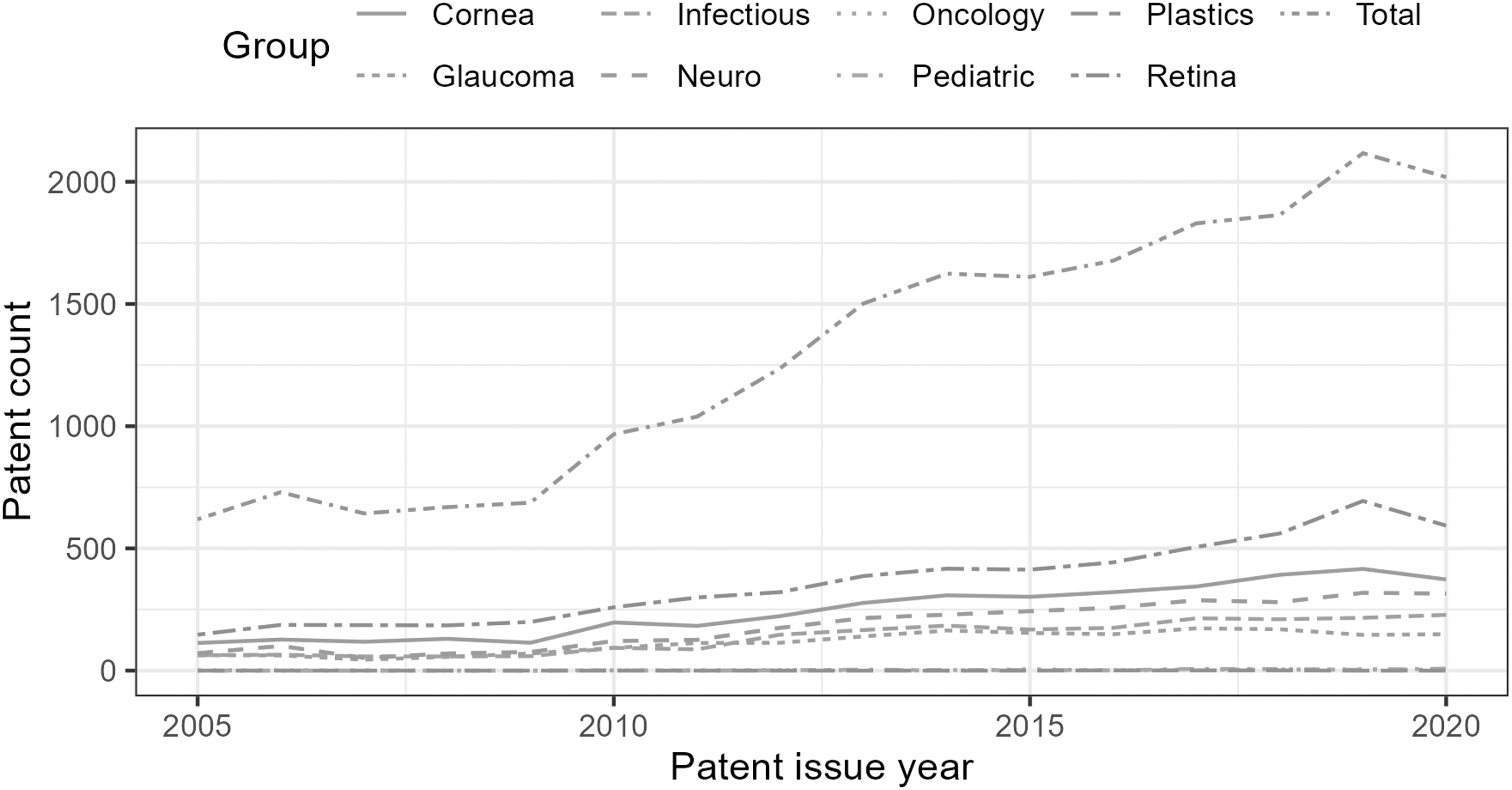
Annual measure of grouped ophthalmology patents granted in the United States. For each year, the number of patents related to each of the listed subgroups is plotted.

Time to patent grant after initial submission. All subgroups had a median evaluation time between 2 and 4 years before a patent being granted. y-Axis represents log base 2 (years) of delay between application year and issue year. Box plot indicates the median, and the edges of the box plot are the first and third quartile ranges. The length of the hinges indicates 1.5 × interquartile range (third quartile – first quartile) + first or third quartile, respectively.
These ophthalmic patents were filed by innovators within academia and the private sector. Within the private sector, Allergan (452 patents) was granted the most patents, followed by Carl Zeiss with 367 patents and Novartis with 360 patents (Supplementary Table S2). Within academia, the University of California system (174 patents) was granted the most patents, followed by Johns Hopkins University (84 patents) and California Institute of Technology with 64 patents (Supplementary Table S3). Nearly all organizations were granted fewer than 100 patents, and nearly all individuals were granted fewer than 50 patents (Fig. 4).

Patent property histograms. Top panel: distribution of patents per assignee, typically a corporate entity with at least partial ownership in a patent. Bottom panel: distribution of citations received by each patent from ophthalmology patents granted in the United States between 2005 and 2020.
Discussion
This analysis of trends in ophthalmology patenting provides a quantified perspective to the current understanding of ties between patenting and technological development in ophthalmology. There has been an overall increase in the number of ophthalmological patents from 2005 to 2020, and this has been reported across all ophthalmic subspecialties, except oculoplastics. This increase corresponds with the advances in patented technology in clinical and procedural practice that provide new options and enhanced quality of life for patients. It may also be related to patent law changes during the study period, such as the transition from first-to-invent to first-to-file, which may have incentivized inventors to prioritize patent filing to ascertain intellectual property protection over later inventors. Although ophthalmology patents comprised only 0.5% of the entire population of 4.5 million patents granted between 2005 and 2020, there has been a steadily increasing trend in the annual number of granted ophthalmology patents over time. For-profit institutions hold a greater number of assigned patents than academic institutions, with the greatest number of patents held by Allergan, Novartis, and Carl Zeiss. Within academia, patent holding is concentrated within large research institutions, with the greatest number held by the University of California. This is consistent with existing data from the National Center for Science and Engineering Statistics, which indicates that of the 309,000 patents awarded in 2018, 85% were given to industry, with only 4% contributed by academic institutions. 14
The overall increase in patent number, as well as the concentration of patents in the industrial sector, may be within the larger promotion of scientific innovation in the past few decades, instigated by policy like the University and Small Business Patent Procedures Act of 1980, also known as the Bayh-Dole Act. This legislation allows scientists, universities, and small businesses to patent and profit from innovations supported by federal funding, not only incentivizing discovery but also limiting scientific collaboration and increasing industry productivity by increasing the influence of monetary power and talent acquisition. 26
The database of ophthalmologic patents in the United States between 2005 and 2020 that was assessed in this study allows for the elucidation of insights on the advancement of eye-related technologies, treatments, and devices. Analysis of overall surgical patenting trends from 1993 to 2018 has been conducted using queries from the USPTO Full-Text and Image database. 27 More specific evaluation of trends in ophthalmologic innovation using patenting as a quantitative proxy has also previously been achieved through the creation of a patentome from the USPTO PAT-ENTSCOPE database. 28 Our work confirms and expands upon prior findings of an ∼60% growth in ophthalmology patents from 2005 to 2010, 28 although with differences in patent raw numbers, as we report 425 patents issued in 2005 and 625 patents in 2010, which is greater than the 250 patents in 2005 and 400 patents in 2010 that Mucke et al. reported. This difference is owing to variations in definition of the patent population, because Mucke et al. identified only patents pertaining to ocular drugs, gene therapies, and tissue-based technologies. However, the dataset utilized in our study comprised a comprehensive sample of ophthalmology-related patents from the population of patents granted in the United States from 2005 to 2020, which allows for macroscopic trends in patent development in various ophthalmological subspecialties to be concluded from a more wide-ranging and extensive data collection.
The trends elucidated in this study are reflective of actual patterns in ophthalmological innovation and serve to summarize development in the field and highlight rapidly growing fields of research that may continue to be areas of focus in future efforts to further the field of ophthalmology. Our current dataset is also highly granular, allowing for more precise analysis detailed to the level of patent assignees and inventors. The ability to profile individual patterns of patent invention facilitates assessment of leading institutions and individual pioneers in the field. Furthermore, this dataset is manually curated by the USPTO, which reduces the potential for errors committed by an automated system of classifying and approving patents. Manual curation is certainly not impermeable to fallacy, but large patterns of errors are more effectively prevented in a manual classification system than in an automated one.
A critical component of this study is the assessment of trends in annual measures of patenting within subspecialties of ophthalmology to determine rates of technological development in various field subspecialties. Patent granting and development has increased in 7 of 8 ophthalmologic subspecialties, with retina and cornea subspecialties being the fastest growing areas of patent development and producing the highest patent quantities. The growth of retinal research is related to increased need: as the population ages, prevalence of retinal diagnoses like age-related macular degeneration and diabetic retinopathy are projected to at least double by 2050, driving the need for better therapeutic strategies.29,30 The advent of retinal innovation interplays with the rapid growth of the retinal health market, which is expected to reach 24.22 billion USD by 2030 at a growth rate of 7.01% from 2022 to 2030. 31 Altogether, current innovative outpacing in retina compared with other ophthalmological subspecialties is a predictor of patenting trends in the foreseeable future. The most commonly cited patents propose technologies pertaining to intraocular implants and novel ocular drug delivery devices, highlighting these topics as hotspots of ophthalmologic research in the past two decades. Indeed, the advent of the intraocular lens utilized in small incision phacoemulsification has greatly improved the visual outcomes and quality of life of cataract patients. 9 In a similar vein, advances in research on biomaterials and nanotechnology has led to the development novel methods of drug delivery to the posterior eye through devices such as intravitreal implants, hydrogel delivery, and microneedles, which has significantly reduced patient burden while providing therapeutically effective sustained-release treatment of chronic retinal diseases. 32 The accumulation of patented inventions in these two areas of ophthalmologic innovation does not preclude the need for further innovation, whether it be optimization or adaptation of novel technologies to improve clinical safety and adaptability, or moving from finding novel methods of treating established disease toward addressing more fundamental questions in the pathogenesis of eye conditions to prevent or slow disease progression.
Consistent across all subspecialties is a median evaluation time of 2 to 4 years before a patent being granted, which highlights the need for more rapid administrative processing to facilitate clinical delivery and accessibility of ophthalmologic innovations, as the patenting process can currently take up to 6 years. 13 Of interest, high-profile research in ophthalmologic applications of telemedicine and AI-based technologies was not reflected in patent trends over the study period, which also suggests a disconnect between scientific discovery and timely translation into accessible clinical tools. This area of research is especially promising in solving public health challenges like resource allocation and accessibility to care, which will become more severe as the general population ages and the number of individuals requiring eye care increases. 33
Initial exploration of the application of telemedicine for the detection of glaucoma, retinopathy of prematurity, and diabetic retinopathy has revealed improvements in ocular and general health outcomes compared with standard diagnostics, but concerns about patient privacy and clinical equivalence to in-person examination remain. 34 Re-evaluation of patenting trends over the next few decades will be necessary to assess whether these technologies can be fine-tuned to further benefit ophthalmology patients.
Further limitations of the current analysis include the current classification of data via keywords that are likely not exhaustive and have incomplete sensitivity and specificity, which could result in the erroneous exclusion of certain patents or double-counting of patents that can be characterized by multiple keywords or pertain to multiple specialties, that is, intersubspecialty or interdisciplinary patents. Our data search also did not include optometry patents, which could filter out other innovative contributions from a field that shares significant common ground with ophthalmology. Owing to the size of our database analysis, it was also not possible to accurately identify the individual impact of each patent in filling research gaps in its field. Furthermore, the current analysis excludes patents that were filed but not yet issued at the time of data collection, which could further skew observed patent trends. It was also difficult to analyze the type of patent (medical, surgical, genetic, imaging-related, etc.), which would be a valuable future direction of investigation.
Manual curation of the dataset could also pose challenges in consistency of data classification: as science progresses and cutting-edge research methodologies and analytical models become integrated into mainstream ophthalmological innovation, the classification of patents utilizing these models may change in manual curation, but would be consistently classified by an automated algorithm. Future investigations can build on our existing methodological framework to expand beyond the scope of this study.
This study characterizes recent trends in ophthalmologic innovation via analysis of publicly available patent data from the USPTO. Overall, the number of awarded patents has increased in nearly all ophthalmologic subspecialties, with the greatest growth in retina and cornea, transforming therapies in these areas. They also underscore the relationship between patenting and the future of ophthalmic therapeutics, exploring the optimization of therapeutic efficacy and clinical safety of current drugs and devices and the advancement of novel strategies to increase ease and accessibility of eye care. These future directions pave the way for the next generation of ophthalmology-related patents.
Footnotes
Acknowledgments
The authors thank their respective institutions for their support, along with the Cleveland Eye Bank Foundation.
Authors' Contributions
Conceptualization: A.Z., C.R., J.Y., R.R.W., J.H.L. Data curation: C.R., J.Y., A.Z., S.A., R.R.W. Formal analysis: C.R., J.Y., A.Z., R.R.W. Investigation: A.Z., C.R., R.R.W., S.A., J.H.L. Methodology: C.R., J.Y., A.Z., S.A., R.R.W. Software: C.R., J.Y., A.Z., S.A., R.R.W. Project administration: C.R., A.Z., J.H.L. Resources: C.R., A.Z., J.H.L. Supervision: C.R., J.H.L. Validation: C.R., A.Z., J.H.L. Visualization: A.Z., C.R., R.R.W. Writing—original draft: A.Z., C.R., S.A., R.R.W. Writing—reviewing and editing: A.Z., C.R., S.A., J.Y., J.H.L. All authors reviewed and approved the final version of this article for publication.
Author Disclosure Statement
J.H.L. is a voluntary, unpaid member of the Eversight Board of Directors. The authors have no other conflicts of interest, financial or otherwise.
Funding Information
This was a no-cost, unfunded study.

References
Supplementary Material
Please find the following supplemental material available below.
For Open Access articles published under a Creative Commons License, all supplemental material carries the same license as the article it is associated with.
For non-Open Access articles published, all supplemental material carries a non-exclusive license, and permission requests for re-use of supplemental material or any part of supplemental material shall be sent directly to the copyright owner as specified in the copyright notice associated with the article.
