




Abstract
Purpose:
Benzalkonium chloride (BAK) is a commonly used preservative to maintain sterility for multiuse eye drops such as latanoprost. One option to minimize the deleterious effects of BAK in eye drops may be to reduce the volume administered. The aim of this study was to assess the response of cells from the ocular surface to latanoprost+BAK administered by the Optejet technology, which dispenses a microdose (∼8 µL) ophthalmical spray.
Methods:
Cultured human conjunctival epithelial cells were exposed to the following treatments: (1) no treatment, (2) drop form of latanoprost without BAK (∼35 µL), (3) drop form of latanoprost with 0.01% BAK (∼35 µL), (4) ophthalmical spray form of latanoprost with 0.01% BAK delivered by the Optejet technology (∼8 µL). After 5 h, cells were assessed for changes in cytotoxicity, morphology, and inflammatory marker expression.
Results:
Latanoprost+BAK delivered by a drop induced cytotoxicity, cytoplasmic shrinkage, and loss of cell-cell contact, and expression of chemokine (C-C motif) ligand 2 and interleukin-6. In contrast, latanoprost+BAK delivered by the Optejet technology was both well tolerated and similar to no treatment controls and BAK-free latanoprost treatment.
Conclusions:
A microdose of latanoprost+BAK ophthalmical spray administered with the Optejet technology prevented the cytotoxicity associated with larger volumes found in eye drops. Precision dosing by the Optejet technology has the potential to decrease ocular surface disorder typically associated with eye drops containing preservatives.
Introduction
Topical eye drop medications for glaucoma can effectively lower intraocular pressure, 1 but almost all contain an antimicrobial preservative to maintain sterility. 2 Indeed, more than 70% of formulations, including the most commonly prescribed prostaglandin analogs such as latanoprost, 3 contain the preservative benzalkonium chloride (BAK). 2 It is long known and well established that BAK can cause significant damage to ocular tissues; BAK is inflammatory, neurotoxic, cytotoxic, and injurious to corneal, conjunctival, trabecular meshwork, and ciliary epithelial cells, and leads to disruption of the corneal epithelial barrier, mitochondrial dysfunction and inhibition of adenosine triphosphate (ATP) synthesis, damage to DNA, apoptosis, and tear film instability.2,4–7 The main clinical implication of BAK-induced cellular damage is an increase in ocular surface disease with associated pain and discomfort for patients.2,6
One possible option to minimize the deleterious effects of preservatives is to reduce the volume of eye drop administered. Due to advances in technology, this approach may be applied to medications for glaucoma. For example, using piezoelectric microdose array print technology, the Optejet® device (
Given that glaucoma requires chronic use of topical medication, including constant exposure to BAK and therefore possible development of ocular surface disease, the aim of this in vitro study was to assess the response of cultured conjunctival cells (by cytotoxicity profile, cell morphology, and expression of inflammatory cytokines) from the ocular surface to latanoprost with preservative (BAK) administered by the Optejet technology.
Materials and Methods
Optejet technology
The key features of the Optejet technology are presented in Figure 1. The Optejet is a novel drug delivery device that administers a metered, columnar, ophthalmical spray with volume-controlled touchless administration designed using a human-centric approach. The device consists of 2 main components: a cartridge and base. The cartridge contains the drug vial, fluid pump, and ejector, and is replaceable when the medication solution has been used. When the user pushes the fill button, a precise volume of ∼8 µL is loaded into the microreservoir, and the remaining medication is separated to both eliminate evaporation and prevent contamination. To administer the ophthalmical spray, the user pushes the mist button and a proprietary piezoelectric ejector is activated to vibrate and eject the spray through a micronozzle that contains 109 precisely laser-drilled holes—this creates an aerosolized spray that is columnar and has a pattern similar to the surface of the cornea. The spray feels like a gentle mist as it is delivered in 1-ms microbursts within a total delivery time of 85 ms, which is faster than the mean involuntary blink response of ∼100 ms. 17 The base contains the electronics that power delivery components and the software. The Optejet device delivers an ophthalmical spray with 1 touch of a button and can be used with the patient lying down or standing/sitting.
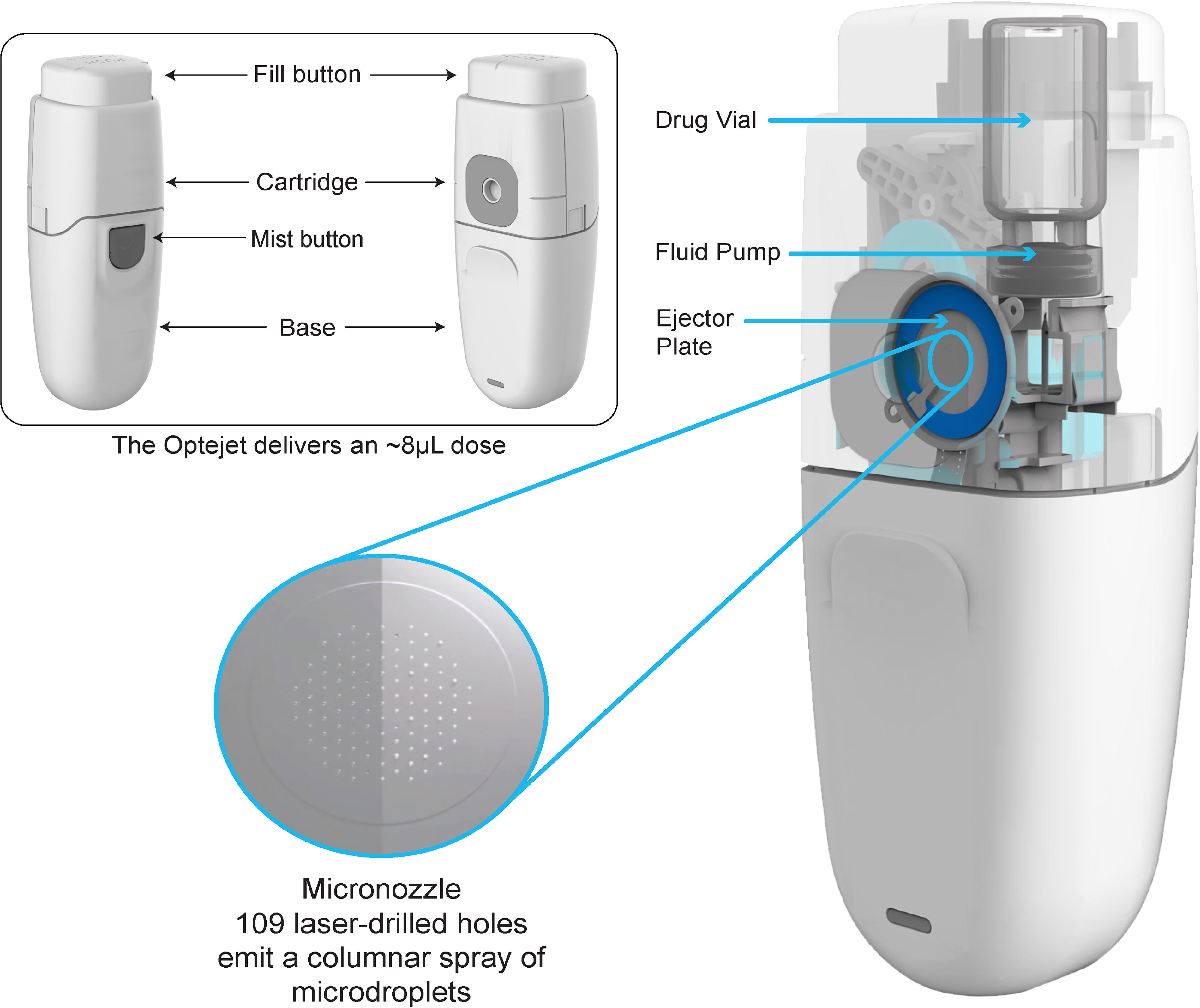
Technology of the Optejet device.
Treatments
To assess response of cells in the ocular surface, a human conjunctival epithelial cell line [Wong-Kilbourne derivative (D) of Chang conjunctiva, Clone 1-5c-4, ATCC #CL-20.2, Manassas, VA] was selected based on previous studies 18 and cultured with complete media as per manufacturer’s instructions (Medium 199 [Thermofisher #11150067] with 10% BCS and 100 IU/mL penicillin and 100 µg/mL streptomycin; 37°C, 5% CO2). Once confluent, the conjunctival cells were subcultured into an appropriate size plate depending on the assay. Cells were cultured at a seeding density of 60,000 cells/mL and were incubated for 3 days before experiments were conducted when cells were at 80%–90% confluence.
Cells were exposed to 1 of the following 4 treatments:
No treatment (Control) Drop form of latanoprost without BAK, ∼35 µL (Drop Control) Drop form of latanoprost with 0.01% BAK, ∼35 µL (Drop BAK) Optejet technology form of latanoprost with 0.01% BAK, ∼8 µL (Optejet)
Additional control groups of Optejet technology form of latanoprost without BAK or 8 uL of latanoprost with BAK by nanodrop were not included as they are not commercially available for use in the clinic. To ensure consistent volume and no disturbance of the cells with the gravity force of the drops, the drop form of latanoprost was delivered to the cells with a micropipette (rather than an eyedrop bottle where volume may be dependent on the squeeze force). The Optejet technology form of latanoprost was delivered to the cells by the device. Latanoprost without BAK was obtained from Sun Ophthalmics (Princeton, NJ) and Latanoprost with 0.01% BAK was obtained from Somerset Pharma, LLC (Somerset, NJ).
Based on previous studies, 19 cells were treated for 15 min, washed twice with complete media (Dulbecco minimum essential medium [DMEM, Gibco, Thermofisher Scientific, Waltham, MA] supplemented with 10% BCS, 1% glutamine [200 mM stock solution], and 100 IU/mL penicillin and 100 IU/mL streptomycin without calcium or magnesium), and washed twice with PBS followed by a 5-h recovery period in complete media (to assess the impact of BAK) 19 then processed.
Assays
Cytoxicity profile
Cell viability, cytotoxicity, and apoptosis were assessed using the ApoTox-Glo Triplex Assay (Promega, Madison, WI; #G6320). The number of viable cells in culture was based on quantitation of the ATP present (an indicator of metabolically active cells) as determined by CellTiter-Glo Luminescent Cell Viability Assay (Promega, #G7570). For these assays, cells were plated in a 96-well plate and each well (area 0.32 cm2) received either 1 drop (final concentration BAK 0.01%) or 1 Optejet spray (final concentration BAK 0.002%) to a final volume of 0.1 mL.
Cell morphology
To assess whether the morphology of the conjunctival epithelial cell line was maintained or altered after treatment, phase contrast brightfield microscopy images were obtained 5 h post-recovery with a Lionheart FX microscope (Agilent Technologies, Santa Clara, CA). For this assay, cells were plated in a 24-well plate and each well (area 1.9 cm2) received either 5 drops (final concentration BAK 0.01%) or 5 Optejet sprays (final concentration BAK 0.002%) to a final volume of 0.5 mL. Each treatment was completed in triplicate and representative images for each group were selected.
Expression of inflammatory cytokines
Real-time quantitative PCR (RT-qPCR) was used to assess expression of inflammatory cytokines. RNA was extracted via SingleShot Cell Lysis (Bio-Rad Laboratories, Hercules, CA). cDNA was synthetized using iScript cDNA synthesis kit (Bio-Rad Labs). RT-qPCR was carried out in triplicate using a Bio-rad CFX Connect Real-Time PCR machine and reagents from iTaq Universal SYBR Green (Bio-Rad Labs) (19 ng cDNA plus 15 uL TaqMan Universal PCR Master Mix [Applied Biosystems] and the following primers (Integrated DNA Technologies, Coralville, IA; to a final volume of 20 µL) for chemokine (C-C motif) ligand 2 (CCL2): AGAATCACCAGCAGCAAGTGTCC (forward), TCCTGAACCCACTTCTGCTTGG (reverse); interleukin-6 (IL-6): CCATCTTTGGAAGGTTCAGGTTG (forward), ACTCACCTCTTCAGAACGAATTG (reverse); macrophage migration inhibitory factor (MIF): GAACAACTCCACCTTCGCCT (forward), CCGTTTATTTCTCCCCACCA (reverse). Relative fold changes are reported using delta-delta cycle threshold method. For these assays, cells were plated in a 96-well plate and each well (area 0.32 cm2) received either 1 drop (final concentration BAK 0.01%) or 1 Optejet spray (final concentration BAK 0.002%) to a final volume of 0.1 mL.
In addition, protein expression of IL-6 was assessed by ELISA. Media was collected from the conjunctival cells 5 h post recovery filtered with Filtropur S 0.2 syringe filters (Sarstedt) and assayed for IL-6 (DuoSet ELISA Development Systems, R&D Systems, Minneapolis, MN). Absorbance was read using a Synergy H1 microplate reader (Bioteck, Winooski, VT). For this assay, cells were plated in a 48-well plate and each well (area 1.1 cm2) received either 2 drops (final concentration BAK 0.01%) or 2 Optejet sprays (final concentration BAK 0.002%) to a final volume of 0.21 mL.
Results
Cytotoxicity profile
The latanoprost+BAK decreased cell viability (by 1.89-fold compared with no treatment control) and metabolically active cells (by ATP level; by 4.55-fold compared with no treatment control) and increased cell cytotoxicity (by 6.25-fold compared with no treatment control) and apoptosis (by 3.32-fold compared with no treatment control) when administered by mimicking the traditional drop method (Fig. 2). However, when latanoprost+BAK was administered by the Optejet technology, the cytotoxicity profile matched that of latanoprost without BAK administered as a drop and was significantly different to latanoprost+BAK administered as a drop (P = 0.0054, P = 0.0009, and P = 0.0005 for cytotoxicity, apoptosis, and ATP, respectively) (Fig. 2). In addition, cell viability, cell cytotoxicity, apoptosis, and metabolically active cells for the Optejet group were maintained at levels similar to the no treatment control group.

Cytotoxicity profile of conjunctival epithelial cells treated with latanoprost ± the preservative BAK administered by drop or Optejet:
Cell morphology
The addition of the preservative BAK to a latanoprost drop resulted in cytoplasmic shrinkage and loss of cell-cell contact in cultured human conjunctival epithelial cells compared with the normal morphology observed with no treatment controls and a latanoprost drop without BAK (Fig. 3). In contrast, the addition of latanoprost+BAK administered by the Optejet technology did not alter cell morphology and was similar to no treatment control and latanoprost drop without BAK (Fig. 3).
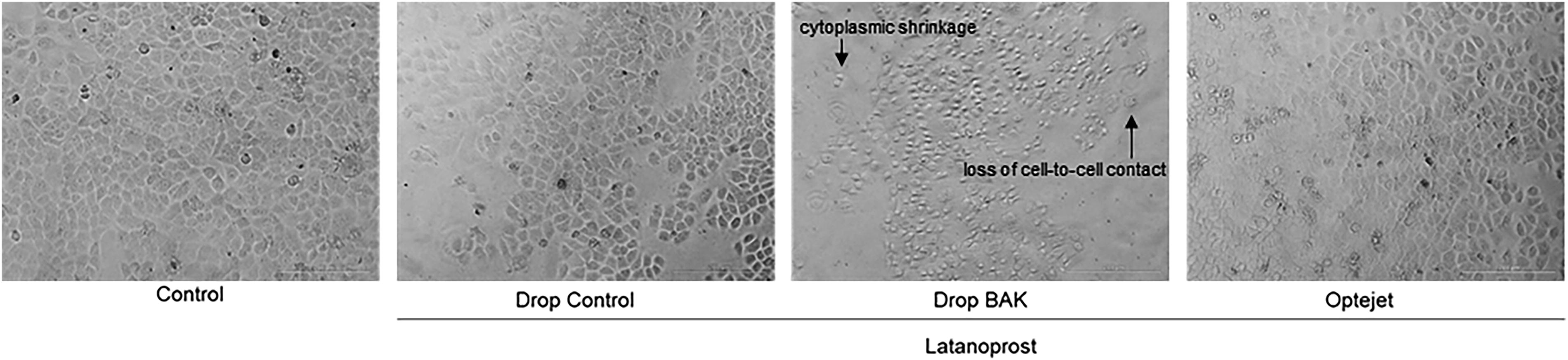
Representative phase contrast microscopic images of cultured human conjunctival epithelial cells treated with latanoprost ± the preservative BAK administered by drop or Optejet. Scale bar = 200 µm. BAK, benzalkonium chloride.
Expression of inflammatory cytokines
The addition of the preservative BAK to a latanoprost drop increased mRNA expression of CCL2 (by 155.64-fold compared with no treatment control) (Fig. 4A) and IL-6 (by 6.35-fold compared with no treatment control) (Fig. 4C), but not MIF (Fig. 4B). The application of latanoprost with BAK using the Optejet technology instead of a standard drop volume reduced expression of CCL2 and IL-6 compared with drop administration, and was similar to no treatment control (Fig. 4A and Fig. 4C). Protein expression of IL-6 presented a different pattern, with lowest levels of expression for the no treatment control and increasing expression with drop administration of latanoprost (without BAK), latanoprost+BAK by Optejet technology, and latanoprost+BAK by drop (Fig. 4D). However, mRNA and protein expression may not be compatible as cells were cultured on different plates and, as more cells were needed for the protein assay, the plates received a different number of drops/sprays to reach the final concentration of treatment.

mRNA expression or protein expression of inflammatory cytokines in conjunctival epithelial cells treated with latanoprost ± the preservative BAK administered by drop or Optejet:
Discussion and Conclusions
To our knowledge, this is the first study to investigate the impact of a microdose ophthalmical spray of latanoprost with preservative (BAK) on ocular surface cells. We found delivery of a microvolume of latanoprost+BAK using the Optejet technology was well tolerated by cultured human conjunctival epithelial cells, with a cytotoxicity profile, cell morphology, and expression of inflammatory cytokines similar to no treatment controls and, importantly, similar to preservative-free latanoprost treatment. Therefore, our findings suggest that the deleterious effects of the preservative BAK on ocular surface cells may be avoided by administration of a microdose of ophthalmical spray. Furthermore, given the lack of cellular morphological changes following delivery of latanoprost+BAK using the Optejet technology, we can hypothesize that microdosing may have a potential protective effect, however, this requires further investigation. Overall, the Optejet technology provides an opportunity to deliver precision dosing of topical ophthalmical medications plus preservatives without the increased risk of the associated inflammation. In this case, the Optejet device delivered a microdose volume of latanoprost+BAK, which can effectively reduce intraocular pressure, 16 and which therefore may be beneficial to many patients with glaucoma who are currently prescribed this medication by topical eye drop and who may develop ocular surface disease.
The ocular manifestations caused by prostaglandin analogs such as latanoprost with BAK include cystoid macular edema 20 and ocular surface disease, which may induce skin pigmentation, dermatitis, eyelash bristles, decreased central corneal thickness, pseudodendritic sterile keratitis, and ectropion. 21 Patients with ocular surface disease may have reduced quality of life, especially when it coexists with glaucoma, 22 and this can affect medication compliance and treatment outcomes. 23 In a Canadian survey, almost all glaucoma specialists (97%) agreed that improving ocular surface disease would enhance both quality of life and glaucoma outcomes, 24 and this is supported by clinical findings. 6 The Optejet technology may overcome these issues as this device not only mimics preservative-free medication, and delivers a precise microdose specifically to the cornea, but also has a human-centric design that is easy to use and therefore may benefit quality of life and compliance.
Administration of conventional eye drops is often less than optimal. Early studies reported that, for patients with glaucoma, self-administration of eye drops is often inaccurate, 25 which increases the number of drops used (average 1.8 drops) 26 and can lead to contamination of drops and hence the need for preservatives in multiuse bottles. 27 In addition, given the relatively large volume and slow delivery speed of eye drops, the drop can cause reflex blinking and tearing thus leading to drug dilution and washout, and overflow can irritate the surrounding skin and eyelids. Furthermore, prostaglandin analogs like latanoprost are associated with a range of mild to moderate ocular and periocular adverse events. 28 Delivery of medication for glaucoma by the Optejet technology may help avoid these issues, as a microvolume is delivered accurately, is focused on the ocular surface, and is associated with minimal initial adverse events.12–14
Given BAK has a dose-dependent cytotoxic effect on corneal epithelial cells in vitro, 29 decreasing the amount of BAK an eye receives would likely be beneficial. In addition, apart from reducing the volume of eye drop administered, there may be other options to minimize the deleterious effects of BAK preservative. Potential options include use of alternative preservatives (eg, detergents such as Polyquad, ionic buffers such as SofZia, oxidizing agents such as Purite), addition of vehicles, addition of lubrication, or cationic emulsions,2,4,5,30 but these have yet to be consistently adopted into clinical practice and thus their long-term impact on ocular surface disease is unknown. Novel biomaterial drug delivery systems are also in development,31,32 but these are often more invasive. The most obvious solution is to administer preservative-free latanoprost, but given contamination concerns this requires single-dose disposable vials that are costly and can be difficult to use 2 and environmentally unfriendly. By use of microdosing, the Optejet technology would lower the amount of BAK the eye receives, while simultaneously protecting the medication solution from contamination by including BAK and also physically separating the reservoir of solution from the dispenser and dispensed dose.
Our study is inherently limited by the in vitro nature of the experiments (including differences between assays), the lack of additional volume control groups of Optejet technology form of latanoprost without BAK or a nanodrop (although these control groups would not reflect real-world clinical practice), and the lack of ability to assess concurrent efficacy of latanoprost. Studies on the clinical efficacy of long-term latanoprost for patients with glaucoma delivered by the Optejet technology may be conducted in the future, but in the meantime this study provides valuable information on the potential benefit of microdosing for glaucoma.
In conclusion, in our in vitro conjunctival epithelial cell model a microdose of latanoprost+BAK using the Optejet technology prevented the cytotoxicity associated with larger volumes found in eye drops. Therefore, precision dosing using the Optejet technology has the potential to minimize ocular surface disorder and accompanying discomfort typically associated with chronic use of latanoprost eye drops containing BAK preservative. Furthermore, the Optejet device has a human-centric design, and the next generation includes tracking capabilities (remote monitoring and dosage reminders), all of which might help improve compliance, thus further benefiting patients with glaucoma.
Footnotes
Authors’ Contributions
A.S. and D.L.H. developed the methods and completed analysis and investigation. P.L., J.W., and P.H. conceptualized the study. All authors were responsible for the interpretation of data, and review and approval of the article.
Author Disclosure Statement
A.S. and D.L.H. have nothing to disclose. P.L. and J.W. are employees of and shareholders in Eyenovia, Inc. P.H. served on an advisory board for Eyenovia, Inc.
Funding Information
Study funding was provided by Eyenovia Inc., New York, NY, developer of the Optejet technology. Eyenovia Inc., was not involved in any aspects of the experiments reported in the article. Medical writing assistance was provided by Janelle Keys, PhD, CMPP of Envision Pharma Group, and was funded by Eyenovia. Envision’s services complied with international guidelines for Good Publication Practice.