




Abstract
Abstract
Linear scleroderma is a rare type of autoimmune connective-tissue disorder and is one of five known types of localized, nonsystemic scleroderma. This type of localized scleroderma affects the skin and subcutaneous tissues and induces extensive fibrosis and atrophy of the affected limbs. The disease is, characteristically, a unilateral phenomenon and usually affects the lower extremities. Due to its underlying pathophysiology, linear scleroderma is rarely associated with morbid obesity. This article documents the case of a 45-year-old female with a 35-year history of unilateral linear scleroderma, who subsequently developed morbid obesity of her contralateral side. Due to her linear scleroderma, she was unable to exercise effectively and developed hemiobesity associated with arthritis, lower back pain, and hypercholesterolemia. Based on her hemiobesity and associated comorbidities, she underwent a laparoscopic sleeve gastrectomy. Postoperatively, she has lost 20 kg or 75% of her excess weight, with a resolution of joint and back pain and hypercholesterolemia at 12-month follow-up. This article describes a unique application for a sleeve gastrectomy in the setting of linear scleroderma and hemiobesity.
Introduction
Linear scleroderma is a particular variant associated with pathologic changes, including atrophy of the dermis, subcutaneous tissue, and, sometimes, muscle and bone of the trunk and extremities. If the linear scleroderma is limited to the face and scalp, it is known as en coup de saber and describes a pock-marked facial appearance. The etiology of linear scleroderma is not well understood, and there has been little progress in terms of medical therapies for this rare disease. To date, surgical therapies for linear scleroderma or its associated complications have been relegated to sparse reports of cosmetic interventions.3,4
Morbid obesity associated with scleroderma is rare. Only one French study suggests the possibility that systemic scleroderma may be underdiagnosed in morbidly obese patients. 5 At this time, no case reports or series regarding weight loss surgery in the setting of linear scleroderma exist, from using Medline or PubMed searches. This article describes a patient with linear scleroderma and hemiobesity, who underwent a laparoscopic sleeve gastrectomy to resolve her obesity and associated comorbidities.
Case Report
A 45-year-old woman with a history of right-sided linear scleroderma presented with left-sided obesity and a body mass index (BMI) of 30.1. The patient developed atrophy of her right torso, buttock, thigh, and lower extremity over the last 35 years. Due to the extensive atrophy, she was unable to adequately exercise and slowly developed obesity and hypercholesterolemia. Her excess weight induced joint pain and early arthritis of her lower extremities. Over the intervening decades, she attempted numerous diets without success. Interestingly, she underwent a left-sided liposuction of the torso, buttock, and thigh approximately 10 years earlier. Unfortunately, this intervention did not provide a long-term solution, and she reaccumulated the fat in the same region. She denied any gastrointestinal complaints, such as dysphagia, regurgitation, nausea, vomiting, or bloating.
On examination, she was 1.63 m and 80.9 kg, for a BMI of 30. 1. The right side of her body showed extensive fat wasting from the torso distally to her toes (Fig. 1). Her right-lower extremity demonstrated contractures of the ankle and toes and no subcutaneous fat. Her right foot was one full size smaller than her left foot. She was grossly intact neurologically, but she had an offset gait due to the overt disparity in her legs. Proximally, her right buttock was significantly smaller versus the left buttock.
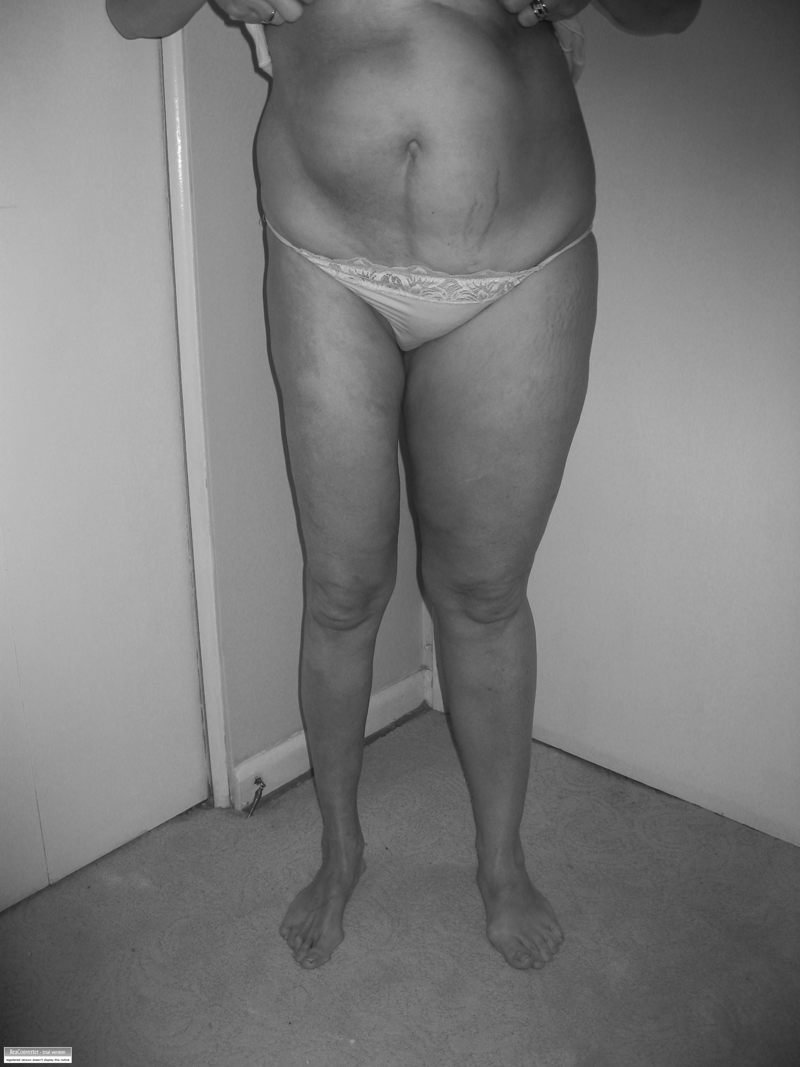
Preoperative picture of the patient, depicting hemiobesity with atrophy of the right-lower extremity. Note the muscle wasting along the dorsum of the right foot.
After extensive discussion with the patient regarding possible surgical options, she wished to proceed with a laparoscopic sleeve gastrectomy. Briefly, she was placed in a supine position with arms extended. She received 5000 units of subcutaneous heparin and antibiotics prior to the induction of general anesthesia. A six-port technique was utilized, and diagnostic laparoscopy showed a fatty liver. The greater curve of the stomach was mobilized with the Harmonic Scalpel (Ethicon, Inc., Cincinnati, OH) and started 5 cm proximal to the pylorus. The dissection proceeded proximally, with the division of the short gastric vessels to the gastroesophageal junction. Posteriorly, the gastropancreatic attachments were divided. A 38-F bougie was passed along the lesser curve of the stomach and through the pylorus. Laparoscopic staplers were then used along the bougie. Proximally, the last stapler was placed across the angle of His to completely exclude the fundus. The staple line was then oversewn, using a 2-0 silk suture. The staple line was then tested with methylene blue and air insufflation, without evidence of a leak. The gastric specimen was extracted through a 3-cm midline incision. The fascia and skin were then closed.
Postoperatively, the patient was admitted to the surgical ward and underwent an upper gastrointestinal study on postoperative day 1, with no evidence of extravasation. She was then advanced to a liquid diet without difficulty and was discharged from the hospital on postoperative day 2. She returned to the emergency department on postoperative day 4 with a fever, a sore throat, and back pain. Her abdomen showed well-healed incisions, and she was soft without guarding. Her bilateral flanks were tender, and she had an erythematous oropharynx. Her white blood cell count was elevated, and a urinalysis was consistent with pyelonephritis. Concurrently, she was diagnosed with Streptococcal pharyngitis. Abdominal radiographs showed only a nonspecific bowel-gas pattern, without evidence of free air. She was admitted to the hospital for intravenous fluids and antibiotics. Her white blood cell count returned to normal in 36 hours as her symptoms quickly dissipated. A computed tomogram was not obtained, as her signs and symptoms were not consistent with an abdominal leak. Further, her pain resolved quickly after instituting therapy. She was discharged home on postoperative day 6 with oral antibiotics for 10 days.
At 6-week follow-up in the outpatient clinic, she was asymptomatic and tolerating a postbariatric diet, including liquids and solid food. She had lost 12 kg and her BMI was 25.4. On examination, her surgical sites were well healed. At 12-month follow-up, she has lost 20 kg, for a current BMI of 23 (Fig. 2). Subjectively, her gait and arthritis are significantly improved, and the patient has discontinued her anti-inflammatory medications. From a nutritional standpoint, the patient's preoperative vitamin D was low. Otherwise, all of her other nutritional parameters were normal. Postoperatively, at 12 months, her vitamin D is normal, but she continues to take a daily multivitamin and vitamin D oral supplements once a week. Of note, she has returned to an exercise regimen.
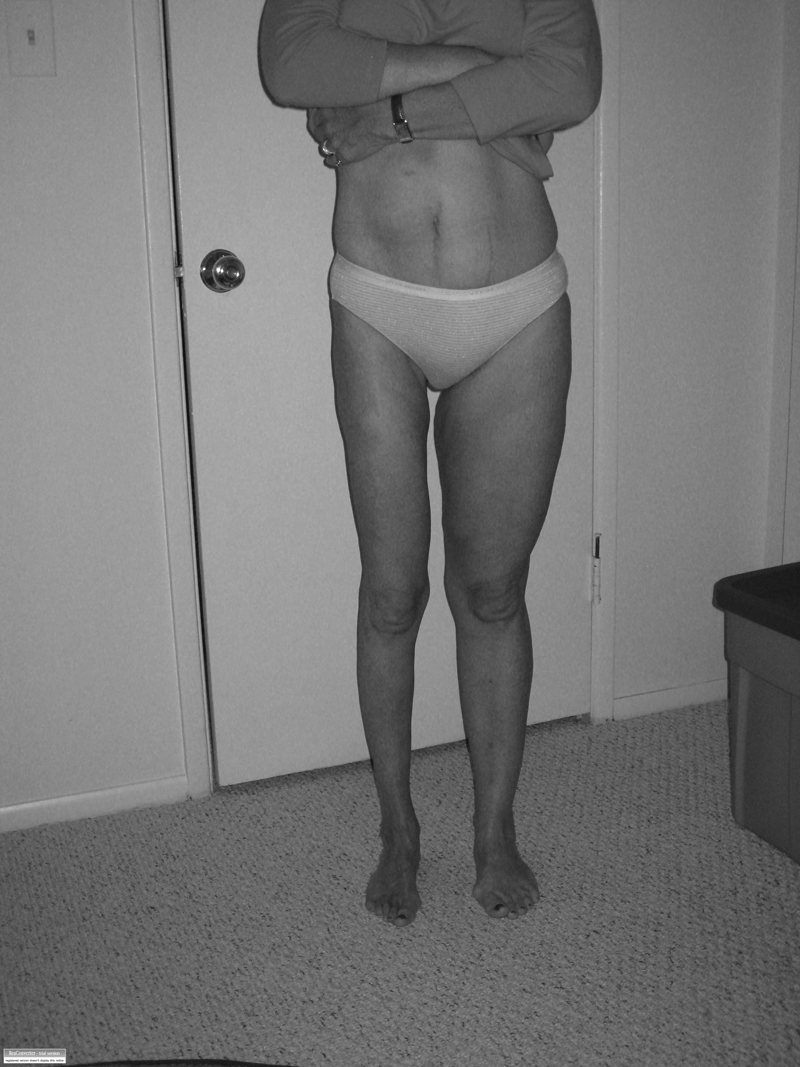
Postoperative picture of the patient at 12 months. Excess weight loss is most apparent in the abdominal region and left thigh.
Discussion
Systemic scleroderma is an autoimmune disorder that results in vasomotor disturbances and fibrosis, with cutaneous, pulmonary, cardiac, gastrointestinal, renal, rheumatologic, and neurologic involvement. It is a progressive, chronic disease characterized by excessive fibrosis due to stimulated fibroblasts, mast cells, T-lymphocytes, and macrophages. These cells secrete cytokines, which alter various collagen types, specifically, types I, III, V, and VII. A more localized, benign subtype includes linear scleroderma, in which the fibrosis is confined to the skin, subcutaneous tissue, and muscle. The subtype is usually limited to a single dermatome. The cutaneous fibrosis extends into the subcutaneous tissue and results in atrophy and sclerosis of adjacent fat, fascia, muscle, and, sometimes, bone. Usually, this subtype does not evolve into systemic scleroderma. Linear scleroderma primarily involves the lower extremities, but can include the arms, face, and scalp. Interestingly, 90% of patients with linear scleroderma exhibit unilateral involvement. 6 In children, arrest of bone growth may occur, with gait changes and compensatory scoliosis. Suggested etiologies for linear scleroderma include genetic, infectious, environmental, and drug-induced factors. 5
Based on the patient's BMI and scleroderma, a sleeve gastrectomy was offered. Due to the patient's connective-tissue disorder, her capacity to heal an anastomosis was unclear. Thus, a Roux-en-Y gastric bypass was not offered. Theoretically, the small-vessel disease associated with scleroderma may be associated with increased ischemia and an increased risk of an enteric leak at the two anastomoses. The potential increase in enteric leaks in patients with scleroderma has been documented in postesophagectomy patients with scleroderma. 7 Although the sleeve gastrectomy is associated with a long staple line, this anastomotic line could be secured with three rows of staples and buttressed completely with a silk suture. A laparoscopic gastric adjustable band was not offered because of the possibility of postoperative dysphagia. Although rare, patients with cutaneous scleroderma may develop systemic manifestations that may affect the esophagus.
First described by Marceau and Hess in 1990s, the sleeve gastrectomy was popularized by Gagner et al. as a first-stage procedure before a duodenal switch for supermorbidly obese patients. Technical complications of a laparoscopic gastric sleeve include staple-line leaks, and various studies have reported leak rates from 1 to 4.3%.7,8 Other complications include bleeding, gastric fistula, strictures, and gastric ischemia. 6 At this time, a sleeve gastrectomy provides excess weight loss that ranges from 33 to 83% over 1–2 years, while avoiding the malnutrition and procedural complexity of a Roux-en-Y gastric bypass.9,10
Although the patient in our study did not meet the strict 1991 National Institutes of Health bariatric consensus criteria for bariatric surgery, she suffered from the associated comorbidities of morbid obesity. While the linear scleroderma prohibited her from depositing fat on the right side of her body, it also prevented her from adequately exercising in order to lose weight. Ultimately, she may have qualified for bariatric surgery, based purely on BMI, after another decade of weight gain. Thus far, the patient has satisfactory results at 12 months, with a reduction of her BMI to 23 and clinical improvements with regard to her mobility and hypercholesterolemia. Although this report represents a single patient with 12-month follow-up, a sleeve gastrectomy appears to be a reasonable procedure for a patient suffering from linear scleroderma and hemiobesity.
Conclusions
Laparoscopic sleeve gastrectomy is a safe, effective procedure for treating hemiobesity secondary to linear scleroderma.
Footnotes
Disclosure Statement
No competing financial interests exist.