




Abstract
Abstract
A morbidly obese female with a body mass index of 39 and without a past medical history of skin or connective tissue disorders was taken to the operating room for a laparoscopic Roux-en-Y gastric bypass, utilizing the methylene blue leak test. On the following day, she developed significant blancheable bluish skin discoloration on her bilateral fingers and palms without sensory changes. The rest of her postoperative course was otherwise uneventful. In this article, we describe an unusual dermatologic change related to the use of methylene blue during bariatric surgery.
Introduction
Case Report
A 68-year-old female with a body mass index (BMI) of 39 was referred to our institution after failing multiple measures of nonoperative weight loss. Her past medical history was significant for obstructive sleep apnea, osteoarthritis, asthma, and gastroesophageal reflux. No vascular disease or skin and connective tissue disorders were identified. The patient denied any history of drug allergy. Following an appropriate preoperative evaluation, she was then taken to the operating room, where an uneventful LRYGB was performed. It is our routine to perform a GJ anastomotic leak test, utilizing 60 mL of methylene blue via a nasogastric tube prior to completion of the operation.
In the morning of postoperative day (POD) 1, she noticed significant blancheable bluish skin discoloration on her bilateral fingers and palms without sensory changes (Figs. 1 and 2). Palpation of both hands did not show any abnormal findings and neither were there signs of tissue inflammation. A gastrografin swallow study ruled out GJ anastomotic leak. The remainder of her postoperative recovery was unremarkable. She was discharged home on POD3 with persistent staining. During an office follow-up 2 weeks later, her hand discoloration had completely resolved.
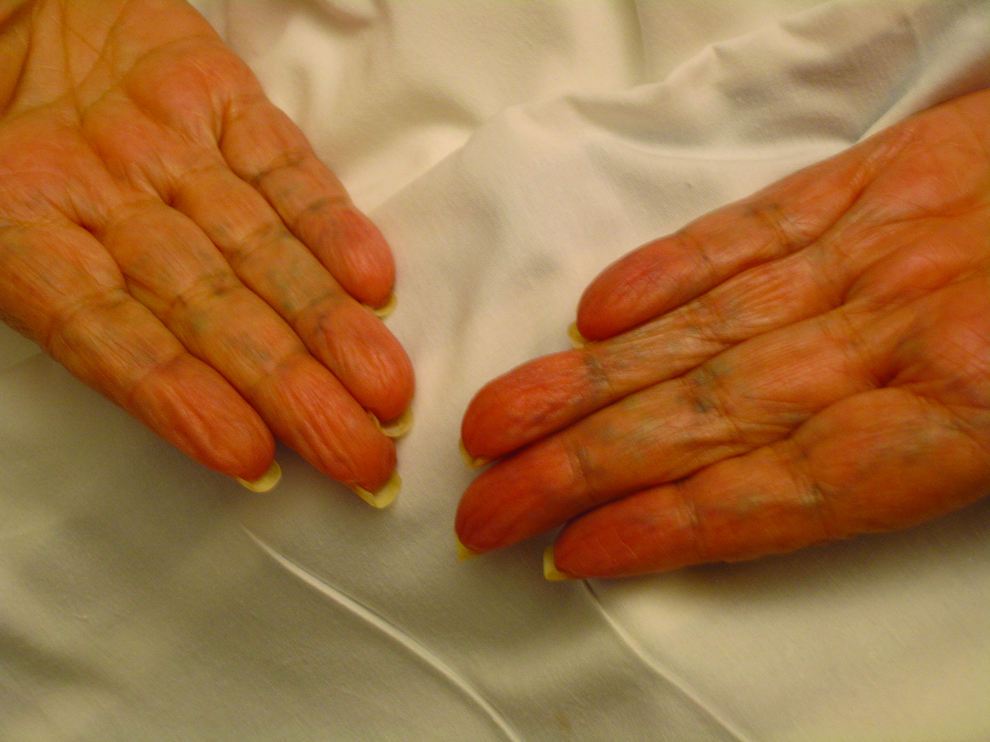
Bilateral skin discoloration following methylene blue leak test.
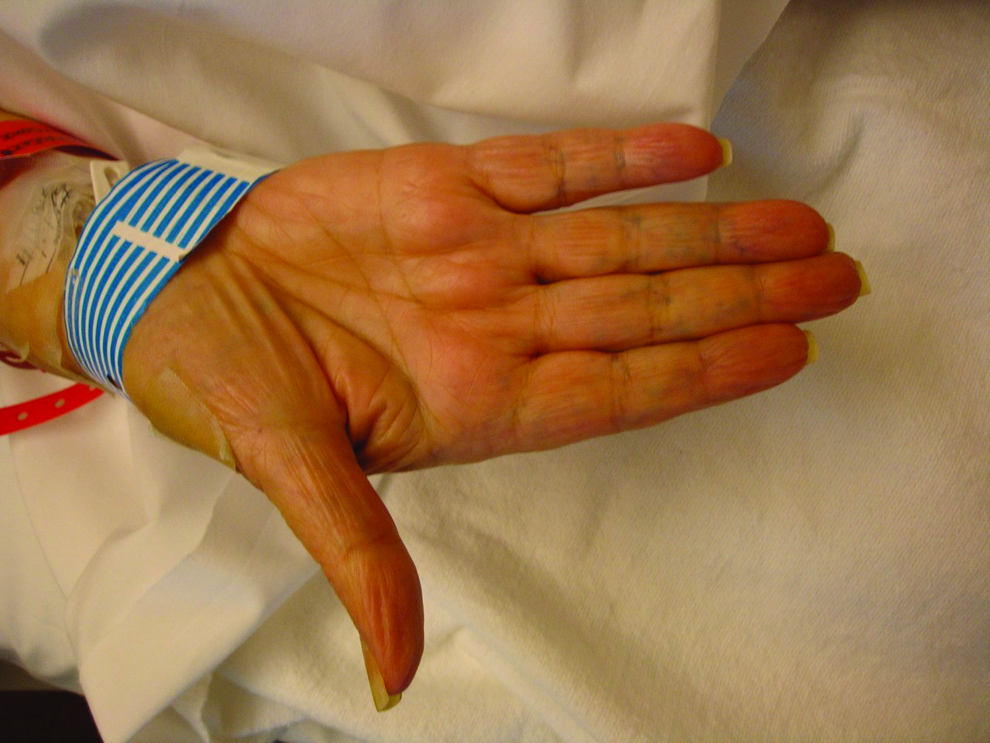
Another look of skin discoloration.
Discussion
Methylene blue is a heterocyclic aromatic chemical compound, which appears as a solid, odorless, dark green powder yielding a blue solution when dissolved in water. It is highly stable in the human body and resists the acidic environment of the stomach as well as hydrolytic enzymes of the gastrointestional tract following ingestion. Methylene blue is not metabolized by the liver; instead, it is quickly filtered out by the kidneys. 2 Blue-green urine and blue sclerae are two known reversible side effects of ingestion after it dissolves into the body's system.
In recent decades, methylene blue has been frequently used in salivary glands, and parathyroid and breast surgeries.3–7 In gastrointestinal surgery, it is widely utilized during endoscopic polypectomy as an adjunct to saline and epinephrine. Its blue stain allows the submucosal tissue plane to be identified after polyp removal, which is helpful in determining the resection margin when segmental enterectomy/colectomy is mandated after. From colorectal surgery practice, Yap and Chung 1 have previously reported urine discoloration after brief methylene blue rectal instillation to assess their newly created colorectal anastomosis.
In bariatric surgery, methylene blue is specifically used to identify technical leaks at the GJ anastomotic site. Direct laparoscopic visualization of blue material following methylene blue injection against manually occluded Roux limb confirmed the suspicion. In one published article from our institution, 8 the routine use of methylene blue dye to detect leaks at the newly created GJ anastomosis was described. A similar leak test has been adopted by many bariatric centers throughout the United States.
Conclusions
The appearance of blanchable bluish skin discoloration after LRYGB with intraoperative leak test, using methylene blue, is benign and self-limiting. Despite its temporary nature, skin discoloration creates significant concern for patients, since it theoretically may occur in cosmetically important areas. All gastrointestinal and endoscopic surgeons utilizing methylene blue dye should be aware of these potential consequences.
Footnotes
Disclosure Statement
No competing financial interests exist.