




Abstract
Abstract
Background:
Nightknife© is a novel reusable bipolar vessel sealing device. In the present study we analyzed its efficiency and quality of vessel sealing in comparison to a standard instrument (LigaSure™).
Materials and Methods:
Mesenteric veins and arteries of 5 Swabian-Hall pigs were sealed by means of Nightknife and LigaSure. Thermal performance of both devices was assessed by dynamic thermography. Analysis of the sealed vessels included the determination of seal failure rates and heat-associated macroscopic tissue appearance.
Results:
The overall sealing rate of Nightknife was significantly higher than that of LigaSure (95.8% versus 87.0%; P=.012). This was associated with a more pronounced thermal spread (8.22±0.13 versus 7.12±0.10 mm; P=.012) and tissue desiccation (2.15±0.06 versus 1.86±0.07; P=.003). Moreover, sealing time (12.30±0.17 versus 7.72±0.17 seconds; P=.038) and tissue temperature (93.73°C±0.69°C versus 66.71°C±2.18°C; P=.001) were significantly higher with the use of Nightknife. Logistic regression analysis revealed that the degree of tissue desiccation correlated with the overall sealing success.
Conclusion:
Nightknife is as appropriate as LigaSure for the successful sealing of mesenteric vessels despite significant differences in tissue alterations and sealing time between the two devices.
Introduction
Materials and Methods
Animal model
All experiments were approved by the governmental committee of animal care and adhered to the National Institutes of Health Guide for the Care and Use of Laboratory Animals. 15 Five Swabian-Hall pigs of both sexes with a mean body weight of 35.2±1.8 kg were used for the study. The animals were kept at a temperature of 21°C±1°C and a relative humidity of 62%±4% with natural illumination. The pigs were allowed free access to drinking water and a standard diet (Ein-Mast-Korn; Raiffeisen, Cologne, Germany). After a 5-day adaptation period, food but not water was withdrawn 24 hours before surgery.
After an intramuscular injection of ketamin hydrochloride (Ketavet; 30 mg/kg; Pfizer, Karlsruhe, Germany), xylazine hydrochloride (Rompun; 2.5 mg/kg; Bayer Schering AG, Leverkusen, Germany), and 1 mg atropine (Braun, Melsungen, Germany) for premedication, general anesthesia was induced by intravenous injection of etomidate (Etomidat-Lipuro; 1 mg/kg; Braun). Anesthesia was maintained by continuous intravenous administration of thiopental sodium (Trapanal; 2–4 mg/kg/hour; Altana Pharma Deutschland GmbH, Konstanz, Germany). Animals were orally intubated (7.5 ET Tube; Portex, Hythe, United Kingdom) and mechanically ventilated (Evita; Dräger, Lübeck, Germany) with a tidal volume of 10 mL/kg, an inspiratory oxygen concentration of 30% and a positive end-expiratory pressure of 2 cm H2O. Physiological saline was infused at a rate of 10 mL/kg/hour. A central venous catheter was inserted in open technique into the left internal jugular vein. For continuous arterial pressure monitoring, a PICCO®-catheter (PULSION Medical Sytems AG, Munich, Germany) was inserted into the left femoral artery in open technique.
After midline laparotomy, the two vessel sealing instruments, Nightknife and LigaSure, were applied randomly according to the manufacturers' settings, and each device was used for a minimum of 20 mesenteric vessel ligations per animal. Primary seal failure was defined as bleeding during application of electrothermal energy, whereas secondary seal failure included persistent blood flow through the vessel or bleeding after initial successful vessel sealing. According to a protocol of the U.S. Food and Drug Administration—previously used by our group1,2 and by others12,16—the seals were further analyzed by the following parameters: (a) instrument sticking (rating scale: 0, no sticking; 1, sticking, easy to remove the instrument; 2, sticking, difficult to remove the instrument), (b) seal demarcation (0, sealed tissue visually not to differentiate from normal tissue; 1, slightly different from normal tissue; 2, sharply different from normal tissue), (c) tissue charring (0, no charring; 1, few black spots; 2, confluent black spots; 3, completely black tissue area), (d) tissue clarity (0, not translucent; 1, slightly translucent; 2, moderate translucent; 3, fully translucent), (e) desiccation (0, wet; 1, slightly dried; 2, moderately dried; 3, fully dried), and (f) thermal spread (in mm). The vessel alterations were scored by 3 surgeons (J.S., J.Sp., and S.R.) independently from each other. The thermal spread proximal and distal to the clamping area along the blood vessel was defined as visually detectable changes of tissue color and consistency, measured as the length of affected blood vessel perpendicular to the clamp's application. Tissue clarity (translucency) indicated that the sealing procedure induced adequate desiccation without charring. The sealing time for each device was determined by the automated feedback control of the energy-supplying system. The thermal profile of the procedure was measured by dynamic thermography using an infrared camera (ThermaCam™ E45; FLIR Systems, Frankfurt, Germany) with an image frequency of 50 Hz. The tissue area with the highest temperature (maximal temperature) was detected automatically by a movable spot. At the end of each experimental series, the animals were euthanized with an overdose of pentobarbital (Narcoren; Merial GmbH, Hallbergmoos, Germany).
Statistical analysis
All values are expressed as mean±standard error of the mean. After proving the assumption of normality and homogeneity of variance across groups, differences between the groups were calculated using the Mann–Whitney U-test. Comparison between the two devices of categorical data was performed with the Fisher's exact test or the χ2 test. Overall statistical significance was set at P<.05. Statistics were performed using the SPSS 15© software package (SPSS, Chicago, IL).
Results
A total of 243 individual arterial and venous vessel sealings in the mesenterium were performed. No primary seal failure was observed using Nightknife (0/143), whereas vessel sealing with the LigaSure instrument was associated with 11% primary seal failures of (11/100). This difference, that is, the rate of primary seal failures, proved to be significant between the two devices (P<.001) (Table 1). The rate of secondary seal failures was similar in both groups (Nightknife 4.2% versus LigaSure 2.2%; P=.484). The calculation of the overall sealing rate (i.e., primary seal failures plus secondary seal failures) revealed a distinct superiority of the Nightknife device when compared with the LigaSure instrument (Table 1).
Values are given as mean±standard error of the mean.
Mean sealing time of the Nightknife was 12.3 versus 7.7 seconds with the LigaSure device. Ninety-eight percent of vessel seals with LigaSure were accomplished in <10 seconds, whereas only 16.2% of seals with Nightknife were performed in this time frame (χ2=157.01, P<.001), indicating a significantly shorter sealing time of LigaSure. Analysis of alterations in tissue morphology revealed a significantly more pronounced thermal spread in vessels after sealing with Nightknife compared with LigaSure (8.22±0.13 versus 7.12±0.10 mm, P=.012). Further, dynamic thermography showed significantly higher sealing temperatures for Nightknife (Fig. 1). Demarcation and tissue charring were similar for the two devices (Table 1). However, instrument Sticking was less pronounced with Nightknife compared with LigaSure.
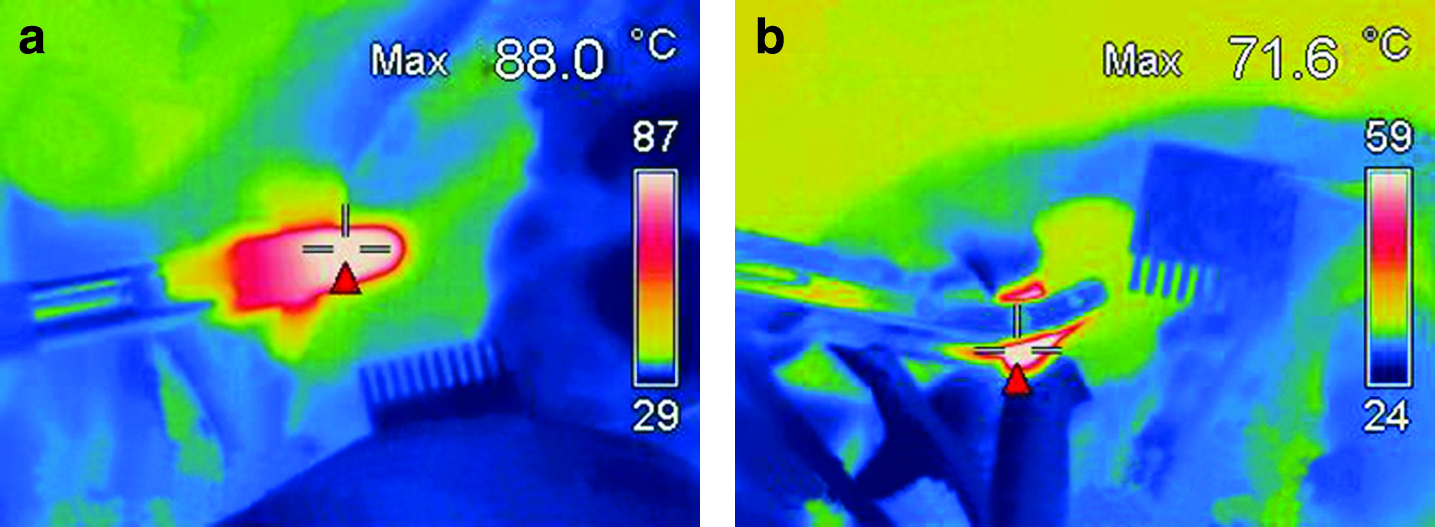
Dynamic thermography of the Nightknife
Univariate analysis revealed that overall sealing failure is associated with a significantly shorter sealing time, lower tissue charring, lower grade of desiccation, and lower sealing temperature (Table 2). Of interest, logistic regression analysis demonstrated that only the grade of tissue desiccation is a significant parameter in predicting the sealing success (Table 3).
Values are given as mean±standard error of the mean.
OR, odds ratio; CI, confidence interval.
Discussion
During the past few years, feedback-controlled bipolar vessel sealing systems have become an attractive tool to achieve hemostasis in gastrointestinal and thoracic surgery,3,7,17–20 proctology,4,21 urology, and gynecology,5,22 as well as hepatobiliary surgery.10,23–25 Vessel sealing can be performed successfully with reasonable safety, may reduce operation time, 9 and facilitates the operation by reducing lateral thermal spread compared with conventional monopolar diathermy. 26 The features of the LigaSure device are well documented in both experimental and clinical settings and can be regarded as a standard in bipolar vessel sealing.1,8,11,27 The Nightknife device is one of the newer reusable products available for laparoscopic bipolar vessel sealing.
From the surgeon's point of view, primary seal failures are easier to detect than secondary seal failures, which can occur with a delay, resulting in fulminant bleeding. Accordingly, overall sealing success should be seen as the most important factor in bipolar vessel sealing. The major finding of the current study is that the reusable Nightknife device is at least as efficient as LigaSure in terms of vessel sealing in mesenteric tissue. It showed a significantly lower rate of seal failures. In this context, it is important to mention that the overall sealing rate of the LigaSure device was comparable in the present study to previous published data using the same porcine model.2,13
Another important point is sealing time, as the surgeon's demand is not only a safe, but also a rapid procedure. Herein, the sealing time with the LigaSure device was significantly shorter than that with the Nightknife, which can be interpreted as a drawback of this novel device. However, although longer sealing times may prolong the overall operation time, they may provide a better safety of the seals.
As previously shown by our group1,2 and by others,12,16 a scoring system of tissue alterations in bipolar vessel sealing allows a comparison of different sealing devices. Our study was performed according to a validated protocol of the U.S. Food and Drug Administration. The vessel alterations of the LigaSure presented in this study are within the range of the results (sticking, charring, and desiccation) of previous studies dealing with the same topic1,2,12,16 so that a certain retest stability of the scoring system can be assumed.
In the present study, we further analyzed sealing temperature by means of dynamic thermography. In this context, it has to be considered that temperature generated by bipolar vessel sealing devices is strongly biased by instrument type, sealing time, and power settings of the generator. 26 Our results demonstrate that lateral thermal spread and sealing temperature were significantly higher using Nightknife. Thus, it may be speculated that LigaSure may be less harmful in terms of thermal tissue injury.
Conclusion
Taken together, we demonstrate in the present study that the reusable Nightknife represents a considerable alternative to the disposable LigaSure. In fact, using the Nightknife instrument it is possible to achieve sealing rates that are even higher compared with those of the LigaSure device reported here and by others. The main disadvantage of Nightknife seems to be the longer sealing times and the increased lateral thermal spread when compared with LigaSure. Critical to the successful use of these bipolar devices is a full understanding of their individual differences to obtain the required tissue effects. The next generation of the Nightknife device should provide less thermal spread to reduce the risk of thermal damage of the surrounding tissue.
Footnotes
Acknowledgments
We thank Elisabeth Gluding for excellent technical assistance.
Disclosure Statement
Grants were received from BOWA-electronic GmbH & Co. KG to support this study. Both devices (LigaSure and Nightknife) are not routinely used in our department. None of the authors has any conflicts of interest or received financial support (e.g., consultancies, stock ownership, equity interests, patent-licensing, and arrangements).