




Abstract
Abstract
Background:
During laparoscopic appendectomy, the standard technique in securing the base of the appendix is by endoloop ligatures or a stapler. We earlier demonstrated the possibility of the application of a double Hem-o-lok® clip in securing of the base of the appendix. The application of only one plastic clip would, however, lower the cost of the laparoscopic procedure even further and shorten the surgery time. The objective of this prospective study was to evaluate the possible advantages of securing of the base of the appendix using only one Hem-o-lok clip.
Patients and Methods:
The 90 patients with acute appendicitis were randomly divided into three groups: In the first group, the base of the appendix was secured using one endoloop ligature, in the second group using a 45-mm stapler, and in the third group using only one nonabsorbable Hem-o-lok clip. The data collected included age, gender, surgery time, time of endoloop/stapler/clip application, hospital stay, costs associated with these, and intra- and postoperative complications.
Results:
There were no significant differences in hospital stay among the three groups of patients; but the average time of the operation was significantly longer in the endoloop group than in the stapler group (P=.002), whereas the endoloop and Hem-o-lok groups were not statistically different (P=.22). The time of application of the endoloop was significantly longer than for the stapler (P<.0001) and Hem-o-lok (P<.0001) groups. The time of application of the stapler was significantly shorter than that of the Hem-o-lok (P<.0001). However, the price of one endoloop is €28.85, for the stapler is €230.7, and for one Hem-o-lok clip is €2.35.
Conclusion:
The use of one Hem-o-lok clip is as safe as an endoloop and/or stapler; however, the time of the laparoscopic procedure using the Hem-o-lok was shorter in comparison with the use of an endoloop, with the cost of the procedure being the lowest.
Introduction
Patients and Methods
This prospective study was conducted in the period from January 2010 to May 2011. The 90 patients with acute appendicitis were randomly divided into three groups: In the first group, the base of the appendix was secured using one endoloop ligature, in the second group using a 45-mm stapler, and in the third group using only one nonabsorbable Hem-o-lok clip. The data collected included age, gender, surgery time, time of application of endoloop, stapler, or Hem-o-lok clip, hospital stay, costs associated with these, and intra- and postoperative complications. The time of application is defined as the time from introducing the endoloop, stapler, or Hem-o-lok applier to the abdomen to the cut of the base of the appendix. Results are expressed as mean±SD values. Comparisons between the groups were made by analysis of variance and Scheffé's post hoc tests.
Technique
The surgical technique was performed as described previously, 4 with some modification regarding securing the base of the appendix. In brief, when the decision was made to perform appendectomy, the mesoappendix was mobilized and dissected using a harmonic scalpel in all three groups of patients (Ethicon Endosurgery, Cincinnati, OH). In the first group, the base of the appendix was secured using one endoloop (Fig. 1), and on the distal part, which would be removed, another endoloop was used. In the second group, the appendix was secured by a 45-mm stapler (Fig. 2) (Ethicon Endosurgery). In the third group, one Hem-o-lok clip, size XL, was placed on the base of the appendix (Fig. 3) by a special applicator for Hem-o-lok clips, and on the distal part, which would be removed, another clip was used.
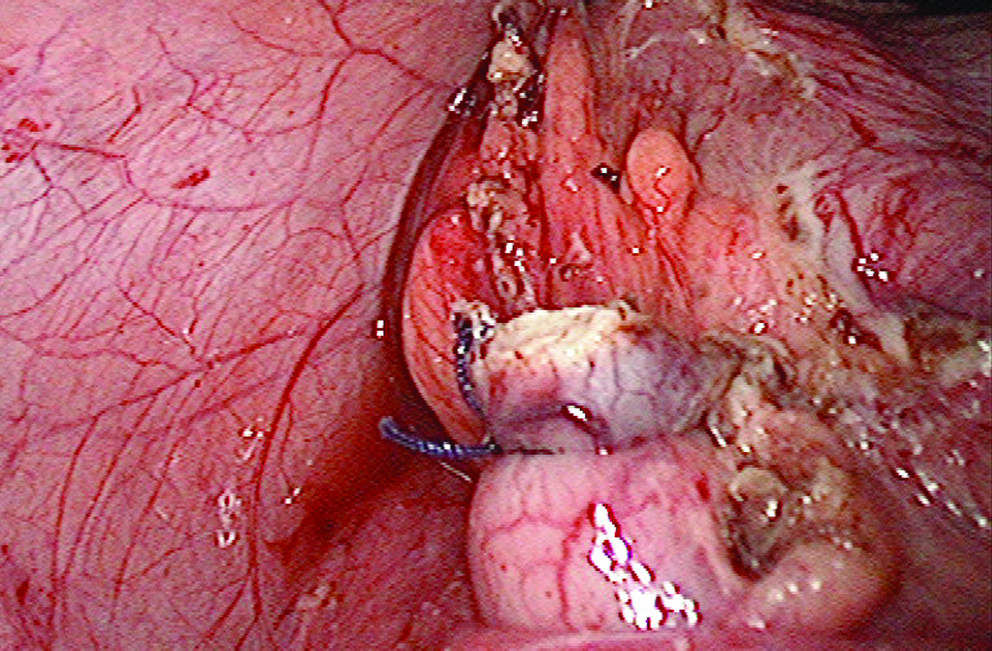
Endoloop on the base of the appendix.

Stapler line on the base of the appendix.
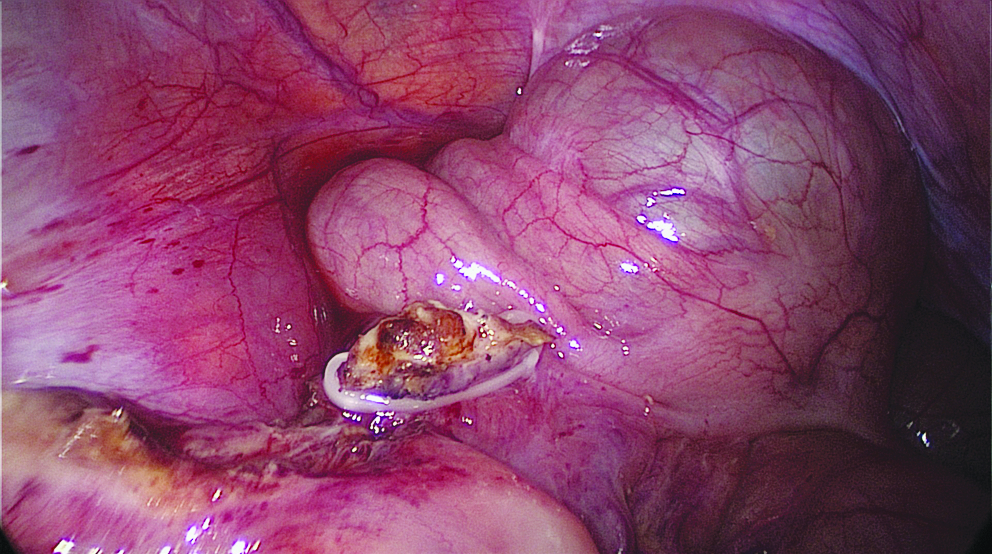
One Hem-o-lok clip on the base of the appendix.
Results
The mean age of all the patients was 27 years (range, 15–73 years). The ratio of men:women was 48: 42, respectively, with no significant differences in the average age between the two genders (F=.11, P=.9). Histopathological diagnosis was confirmed to be gangrenous or phlegmonous appendicitis, with the exception of two cases with perforated appendicitis in the endoloop group, four cases in the Hem-o-lok group, and four cases in the stapler group.
By the analysis of variance test, there were no significant differences found in the hospital stay among the three groups of patients (F=.05, P=.95), but the average time of the operation was significantly longer in the endoloop group than in the stapler group (P=.002), whereas the endoloop and Hem-o-lok groups were not statistically different (P=.22). There was no significant difference between the stapler and Hem-lok groups (P=.16). The post hoc test did not confirm any significant difference between the groups in pairs (P=.05).
There was a significant difference among the average time of application in these three groups (F=197.71, P=.0001). We tested with Scheffé's post hoc test the statistical significance of the difference of the means between each pair of groups. The time of application of the endoloop was significantly longer than of the stapler (P<.0001) and Hem-o-lok (P<.0001) groups. The time of application of the stapler was significantly shorter than of the Hem-o-lok (P<.0001).
However, looking at the price comparison among these three methods of securing the base of appendix, the price of just one endoloop was €28.85, one stapler with the load was €230.7, and one Hem-o-lok clip was €2.35.
In the stapler group, two intraoperative complications were observed, including bleeding from the stapler line and from the mesoappendix. In the Hem-o-lok group of patients, two intraoperative complications were observed as well, involving bleeding of the mesoappendix and the port site. These bleedings were controlled by applying a 12-mm titanium clip. No complications were observed in the endoloop group of patients. There were no postoperative complications in any of the three groups of patients (Table 1).
Operative time and average time of application of the stapler were significantly less than for the Hem-o-lok and endoloop, but the Hem-o-lok value was significantly less than the endoloop value (P=.0001).
The price of two endoloops and two Hem-o-lok clips, because on the distal part of the appendix, which would be removed, another endoloop or Hem-o-lok clip was used.
Discussion
The standard technique used in securing the base of the appendix is one endoloop ligature, if the base of the appendix is healthy.1,5 The stapling device offers a reliable stump closure for all forms of appendicitis, 6 and the clinical evidence favors routine use of endoscopic staplers. 7 The time of the laparoscopic procedure and time of application are significantly shorter in the stapler group, but the cost of the stapler is much higher than that of one Hem-o-lok clip or the endoloop ligature. However, our study shows that the use of one Hem-o-lok clip is as safe as an endoloop ligature or the stapler, with the time of the laparoscopic procedure with the Hem-o-lok clip being shorter than endoloop ligature application, and the cost being markedly lower with its use.
Intraoperative complications observed during surgical procedures did not affect the postoperative recovery. In a large number of patients there were no significant differences between the endoloop group and the stapler group with respect to other specific intraoperative and postoperative complications. 8
Differences between the degree of inflammation and foreign body reaction to different suture materials used in laparoscopic appendectomy favor the stapler and the Hem-o-lok clip. 9 Considering our previous work, it may be prudent to declare that titanium staples, which cause a milder tissue reaction, may be advantageous as a method of securing the base of the appendix in laparoscopic appendectomy. However, this is just one aspect of its use; Hem-o-lok nonabsorbable plastic clips also exhibited a mild reaction phenotype, while their price is dramatically lower.
We should emphasize the potential possibilities of the Hem-o-lok clip in further improvement of image quality, biocompatibility, and patient safety in medical magnetic resonance applications in relation to a titanium clip, which may the subject of future research.
Application of the Hem-o-lok clip is easier than placing an endoloop ligature. A Hem-o-lok clip can be applied by almost any surgeon without any previous training, whereas application of an endoloop ligature requires a certain degree of training. The maximum time of application is the longest in the endoloop group, as much as 478 seconds, because the thread sometimes cannot easily slide down a large inflammed appendix, whereas this is not a problem with a Hem-o-lok applicator. Sometimes, in the limited space of the abdomen it is very difficult to apply an endoloop, whereas the application of a Hem-o-lok is much easier. However, we did record just one case of a bulging appendix when an XL-sized clip could not encircle the base of the appendix in a secure way; therefore we had to use the stapler. Unfortunately, the manufacturer does not produce a larger, XXL size at present.
Overall, the costs, time of application, and the reaction of tissue to different materials used in securing the base of the appendix are some of the aspects considered regarding the use of materials in laparoscopic appendectomy. None of these methods affects the postoperative course. Certainly, almost every single one of them is acceptable, and the choice will depend on the course and the conditions of the surgical procedure itself. However, this study and similar ones are important in finding the optimal method(s) of securing the base of the appendix during laparoscopic appendectomy.
Footnotes
Disclosure Statement
No competing financial interests exist.