




Abstract
Abstract
Background:
Single-incision laparoscopic surgery is becoming a more widely accepted surgical approach. However, the feasibility and safety of single-incision laparoscopic cholecystectomy (SILC) are yet to be established. The present study compared outcomes following the use of SILC or conventional laparoscopic cholecystectomy (CLC) on patients with gallbladder disease.
Subjects and Methods:
The study involved 190 symptomatic gallbladder disease patients treated between March 2009 and February 2011. Ninety-six patients underwent SILC, and 94 patients underwent CLC. Clinical and surgical outcomes were compared.
Results:
The SILC and CLC groups were similar in terms of age, gender ratio, body mass index, and diagnoses. The two groups were also found to be similar in terms of postoperative clinical course and complications. The SILC group had a longer operation time, less postoperative pain, and a shorter hospital stay than the CLC group (P<.05 for all variables).
Conclusions:
SILC using the OCTO port system (Darim Corp., Korea) was as safe and feasible as CLC. Additionally, SILC is less invasive and more comfortable for patients than CLC.
Introduction
Single-incision laparoscopic surgery (SILS), including single-incision LC (SILC), is a new technique that has the potential to become an alternative to conventional multiport laparoscopy.2–4 The initial studies comparing LC with SILS reported conflicting findings.5–10 However, those studies differed in terms of methodology and used technically challenging procedures that failed to gain widespread acceptance. Recent studies using transumbilical incisions show that SILC is a feasible and safe procedure.11–13 Other recent studies have shown that SILS is an alternative method of performing LC.14–16 Indeed, the authors use SILS as the standard approach for treating elective patients with gallbladder disease. However, more clinical outcome studies are required before it can be established that SLIC is an alternative to conventional LC (CLC).
The present study compared clinical and surgical outcomes in gallbladder disease patients who underwent SILC or CLC. SILC was performed using flexible 5-mm laparoscopy and the OCTO port system (Darim Corp., Korea).
Patients and Methods
The study involved 190 symptomatic gallbladder disease patients treated between March 2009 and February 2011. Of those patients, 96 patients underwent SILC using the OCTO port system, and 94 patients underwent CLC. All procedures were performed by the same surgeon at the same institute.
We performed the two procedures as a non-randomized and alternative process. The analysis excluded the first 20 SILC patients with acute cholecystitis or who underwent upper abdominal surgery. However, those two types of patients were included in the analysis of the last 76 cases. We preferentially performed CLC on patients who had a body mass index >40 kg/m2 because SILC instruments are too short and the operating view is narrow.
Surgical procedure
Patients under routine general anesthesia were placed in a reverse 30° Trendelenburg position with the table titled downward to the patient's left and the surgeon on the left side of the patient. We everted the umbilicus using forceps or small clamps and then created a 2-cm transumbilical incision vertically within the umbilicus. The OCTO port consist of two components: the inner half is for wound protection and expansion, and the outer half consists of two 12-mm channels, one 5-mm channel, and two air-vents. The inner part of the OCTO port was inserted into the transumbilical incision (Fig. 1). We then connected the outer OCTO port part. We created a pneumoperitoneum using carbon dioxide and then inserted a 5-mm flexible endoscope (EndoEYE™; Olympus, Tokyo, Japan) to prevent “sword fighting.” Under the view of laparoscopy, a endograsper roticulator (Covidien, Norwalk, CT) was used to perform the inline view and triangulation, and then a straight standard dissector was inserted through the 12-mm channel of the OCTO port; these two instruments were crossed over in the abdomen (Fig. 2). During that procedure, we did not insert any traction sutures. Following the complete cholecystectomy, the gallbladder was pulled out through the single port without an endobag after the outer part of the OCTO port was disconnected The single incision site was closed in two layers including the subcuticular layer using absorbable sutures, and then the umbilicus was inverted. There was no visible scar postoperatively (Fig. 3).
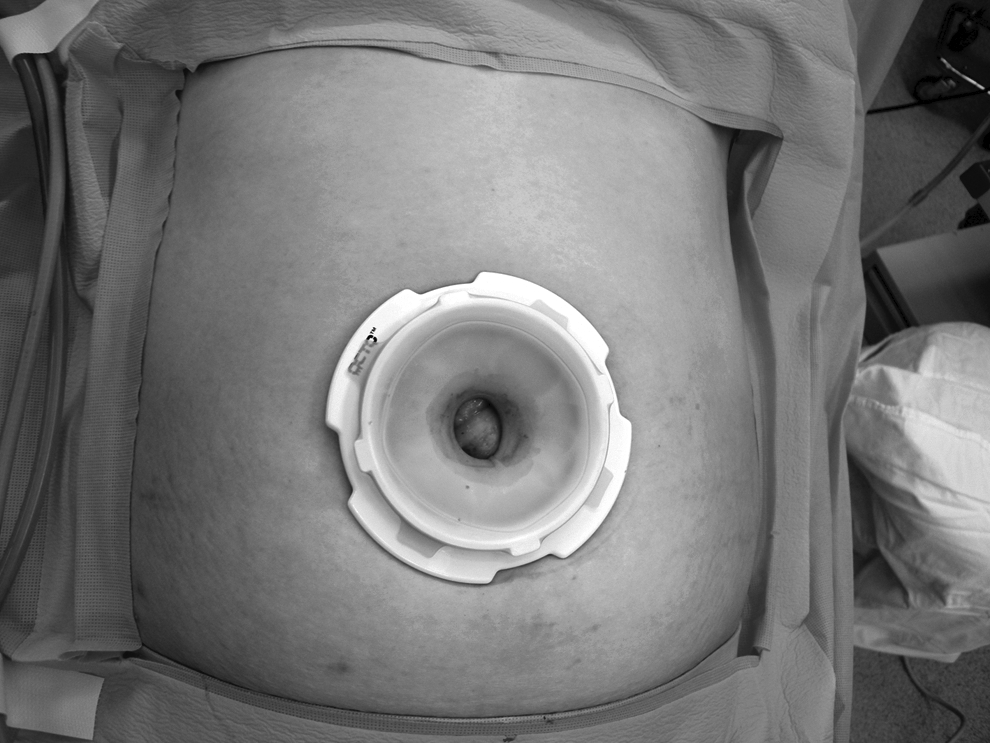
The small umbilical opening is shown following the insertion of the OCTO port (lower portion).
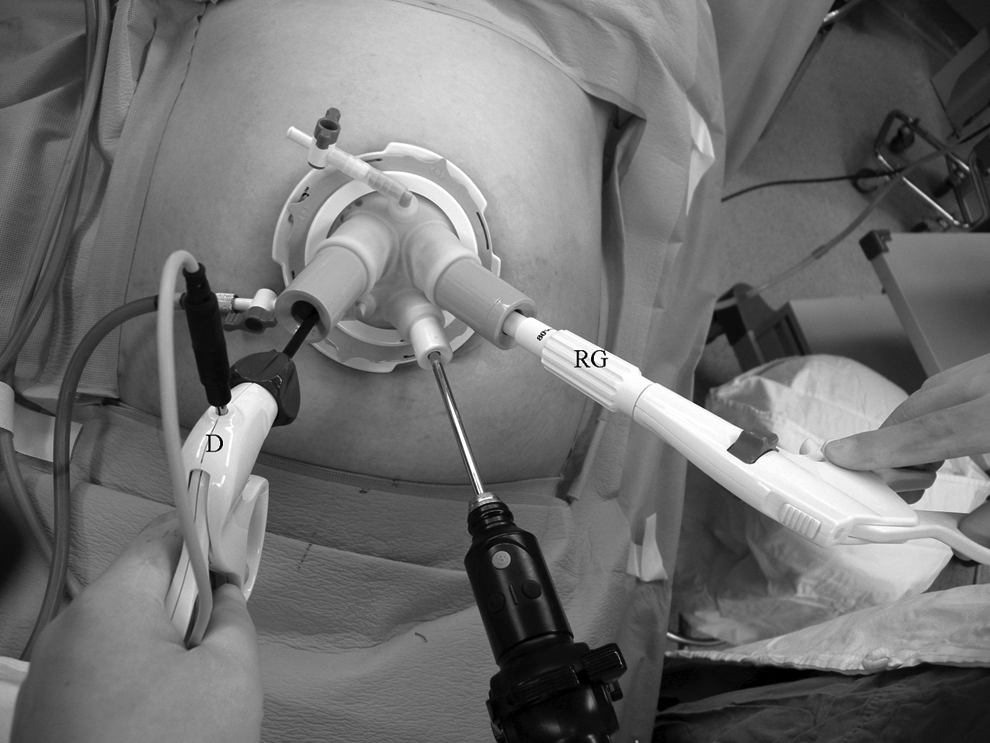
View of the operating procedure. Two instruments are crossed in the abdomen. D, endo-dissector; RG, roticulating endograsper.
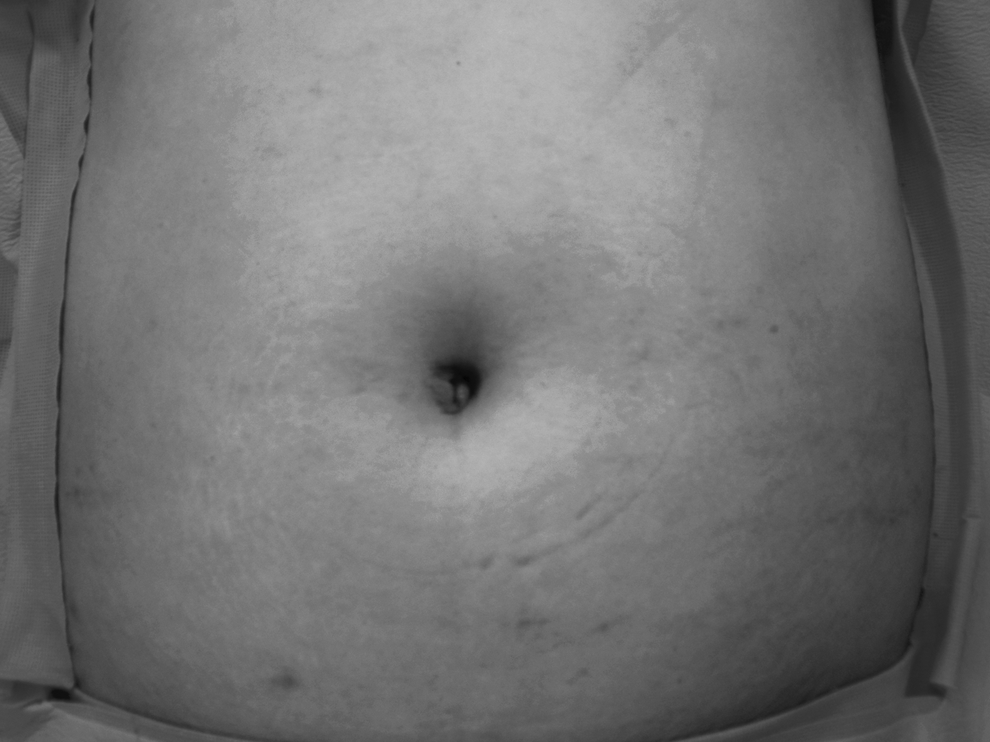
Postoperative view after single-incision laparoscopic cholecystectomy using the OCTO port. Note the minimal scarring.
For CLC, two 12-mm trocars were placed at the infraumbilical for laparoscope and epigastric area for the working port, and one or two 5-mm trocars were inserted at the right subcostal or right flank area. A 0° angled and rigid 10-mm laparoscope was used. After the complete LC, the gallbladder was pulled out through the infraumbilical or epigastric port filling in an endobag.
Evaluation of surgical outcomes
The following intraoperative outcomes were assessed: surgical time, conversion rate, rate of insertion of drain, and gallbladder perforation. The following postoperative complications were assessed: bleeding, bile leak, bile duct injury, and reoperation. Postoperative pain on the operative day and postoperative Days 1 and 2 was analyzed using a visual analog scale (VAS) for the postoperative day (score range, 0–10). This VAS had a 10-cm vertical score ranging from “no pain” (score of 0) to “worst possible pain” (score of 10).
Statistical analysis
Clinical characteristics, postoperative course, operation time, and surgical complications were compared between the SILC and CLC groups using chi-square and Student's t tests, as appropriate. A value of P<.05 was considered to indicate significance.
Results
Patient clinical characteristics are summarized in Table 1. There was no difference between the SILC and CLC groups in terms of age, gender ratio, body mass index, and diagnosis. The mean American Society of Anesthesiologists scores were 1.7±0.5 and 1.8±0.4, respectively (P≥.05). Three SILC patients and 3 CLC patients had a history of major upper abdominal surgery (P≥.05). Those 6 patients underwent bowel resection due to panperitonitis. This history of surgery is excluded for appendectomy, colorectal, and gynecologic surgery.
ASA, American Society of Anesthesiologists; BMI, body mass index; CLC, conventional laparoscopic cholecystectomy; SILS, single-incision laparoscopic cholecystectomy.
Surgical outcomes and postoperative clinical courses are summarized in Table 2. There was no significant difference between the two groups in terms of conversion rate and insertion of drains (P≥.05). Postoperative pain was lower in the SILC than the CLC group on the day of surgery and on postoperative Day 2 (P<.05). The hospital stay was shorter for the SILC group (P<.05). Open conversion was required for 1 SILC patient because of severe adhesions from previous major upper abdominal surgery. Open conversion was required in 2 CLC patients because of severe adhesions due to empyema and common bile duct injury. Any gallbladder perforations during surgery were resolved using irrigation or drain insertion. The mean operation time was longer in the SILC group than in the CLC group. However, when the first 20 SILC patients were excluded from that analysis, the operation times were the same for both groups.
GB, gallbladder; VAS, visual analog scale.
Postoperative complications and mortalities are summarized in Table 3. There was no postoperative death in either group. There were no significant differences between the two procedures in terms of complications (P≥.05). One patient who underwent SILC had a cystic duct leakage, and that resolved completely after a pigtail drain was inserted. We performed open conversion and hepaticojejunostomy immediately for 1 patient who had a common bile duct injury 8 days after CLC. One SILC patient had an incisional hernia (umbilicus), and that was treated with a primary repair.
CBD, common bile duct.
Discussion
Laparoscopic surgery including cholecystectomy is a well-established alternative to open surgery across many disciplines, and laparoscopic approaches generally have benefits in terms of postoperative pain, cosmetic outcomes, hospital stay length, and convalescence length. Surgeons continue to seek modifications that can reduce the invasiveness and improve cosmetic outcomes in minimally invasive procedures. Recently, two innovative techniques have emerged: SILS and natural orifice transluminal endoscopic surgery (NOTES). NOTES was introduced as a new surgical concept that leaves no scar and is associated with minimal or no pain.17–19 However, although NOTES may be considered an alternative procedure to laparoscopy, very few clinical trials using NOTES have been successful.16,20 Nevertheless, NOTES has the potential to be applied in a number of surgical settings.
SILS was first described in 1992 by Pelosi, 21 and new techniques and instruments have since been introduced. However, SILC continues to have a number of limitations. It is technically more difficult to perform SILC than a CLC. We found that the operation time was longer in the SILC group, although this difference was no longer present once greater experience with the SILC procedure was attained (after 20 cases). Another limitation is the anatomical restriction (the umbilicus) on the size of instruments that can be used. Furthermore, instruments are coaxial to visualization, and it is more difficult for surgeons to perform tissue manipulation and approximation. Furthermore, devices are becoming complex. A mini-laparotomy at the upper abdomen was required in initial reports of SILS.8,9,22 Some surgeons then performed the cholecystectomy using handmade ports with a surgical glove or performed LC via two transumbilical trocars.11–13,16 Recently, several studies using manufactured access ports, including a multiport device and a gel-type port, found that SILC was feasible and safe.16,23,24 Instrument triangulation is essential to allow proper tissue dissection and tissue retraction. Placing several parallel instruments makes triangulation more difficult. Using one flexible or curved instrument offsets the shaft sufficiently to accomplish some degree of triangulation. Retraction of the gallbladder using a mini-loop or sling sutures has proven useful in SILC.11,16 Suturing the lateral cut edge of the target organ to the lateral abdominal wall is another solution. Inline vision is another problem in SILS. However, the flexible-tip endoscope or laparoscope ameliorates this problem to some degree.14,25
Most new techniques and new devices or instruments are linked to higher financial costs. Several established single-port devices need an endobag to contain the gallbladder and need at least three trocars for instrument insertion into the abdomen. However, the use of the OCTO port obviates the need for trocars because the instruments are inserted via its channels. In addition, an endobag is not required because the gallbladder can be pulled out after the OCTO port's outer part (containing channels) is disconnected from the inner part. In terms of cost, a CLC procedure requires four trocars, which cost between $395 and $494 U.S., and an endobag, which cost $31 U.S., whereas an OCTO port costs $379 U.S. The fee for using a 5-mm flexible laparoscope and rigid 10-mm laparoscope were the same ($206 U.S.).
The present study had some limitations. The study involved a relatively small number of patients and was retrospective in design. Additionally, it did not involve a long-term follow-up. However, a strength was that the two surgical groups were similar in terms of age, gender, and body mass index.
In conclusion, we found that SILC using the OCTO port system was as safe and feasible as CLC. Additionally, SILC is less invasive and more comfortable for patients than CLC. However, prospective randomized clinical trials are required in order to establish the benefits of SILC over conventional LC.
Footnotes
Disclosure Statement
No competing financial interests exist.