




Abstract
Abstract
Background:
Improved cosmesis is widely recognized as the main benefit of single-port laparoscopy (SPL). Recently, some centers have started to perform SPL in infants and neonates. However, in our experience, the cosmetic result following traditional laparoscopic surgery in this age range is excellent. This study assessed infants' postoperative scars following traditional laparoscopic surgery.
Subjects and Methods:
Ten successive patients who previously underwent transperitoneal dismembered pyeloplasty were invited to attend for photographs of their abdominal wounds. All patients had had a 5-mm infra-umbilical port and two 3.5-mm ports (epigastrium and iliac fossa). Photographs were all taken in the hospital's medical photography studio by the same medical photographer. Life-size photographs were then shown to 10 junior doctors who were asked to identify any visible scars and rate the cosmetic result.
Results:
Six patients with a median age at surgery of 8 months (range, 4–15 months) attended for photographs a median of 13 months postoperatively (range, 8–19 months). None of the junior doctors was able to identify all three scars on any photo. No individual scar was identifiable by all reviewers. No scars were identified in over half (31) of the total of 60 photograph reviews. Of 180 scar reviews, only 37 (21%) were identified. The umbilical scars were least noticeable (3/60), followed by iliac fossa scars (11/60) and epigastric scars (23/60). Where any scars were correctly identified, the cosmetic result was always rated good (44%) or excellent (56%).
Conclusions:
Traditional laparoscopic surgery in infants can have an excellent cosmetic result with “invisible” scars. The cosmetic benefit and thus the role of SPL in infants are therefore questionable.
Introduction
However, in our experience, the cosmetic result from infants and neonates undergoing traditional laparoscopic surgery is excellent, with postoperative scars often difficult to find. Therefore, our aim was to objectively assess the postoperative scars of infants following traditional laparoscopic surgery.
Subjects and Methods
Ten successive patients who underwent transperitoneal laparoscopic dismembered pyeloplasty between August 2009 and December 2010 were invited to attend for photographs to be taken of their abdominal wounds. All patients had had surgery using a 5-mm infra-umbilical port, a 3.5-mm epigastric port, and a 3.5-mm iliac fossa port.
Standardized hospital consent forms were completed. Photographs were all taken in the hospital's medical photogaphy studio under controlled professional lighting conditions by the same medical photographer (Fig. 1 gives an example). Wounds were then circled with a skin marking pen, and a further photograph was taken as a record of the position of the scars and for use as a marking scheme (Fig. 2 gives an example).
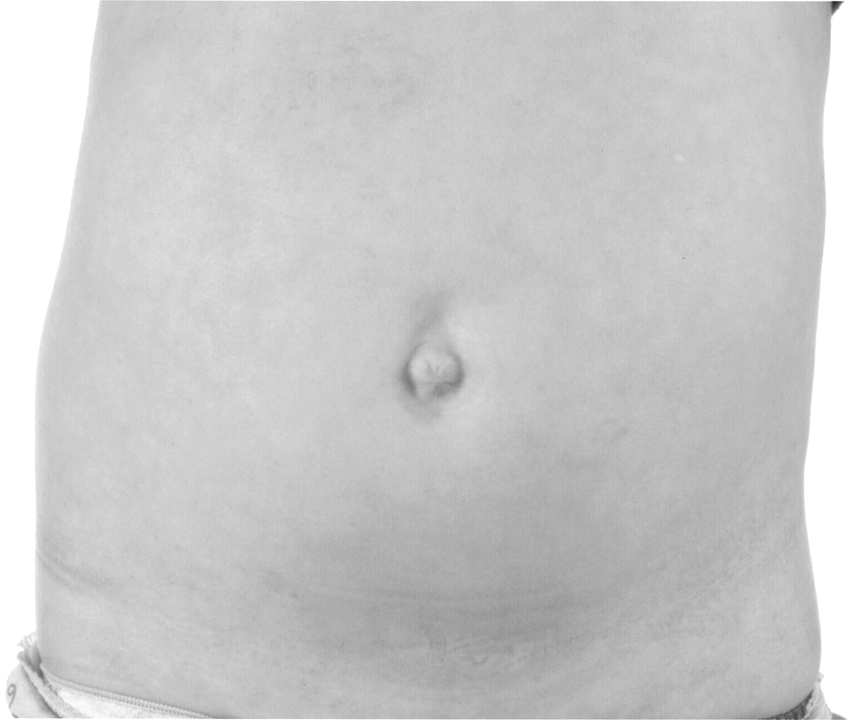
Unmarked photograph of abdominal wounds.
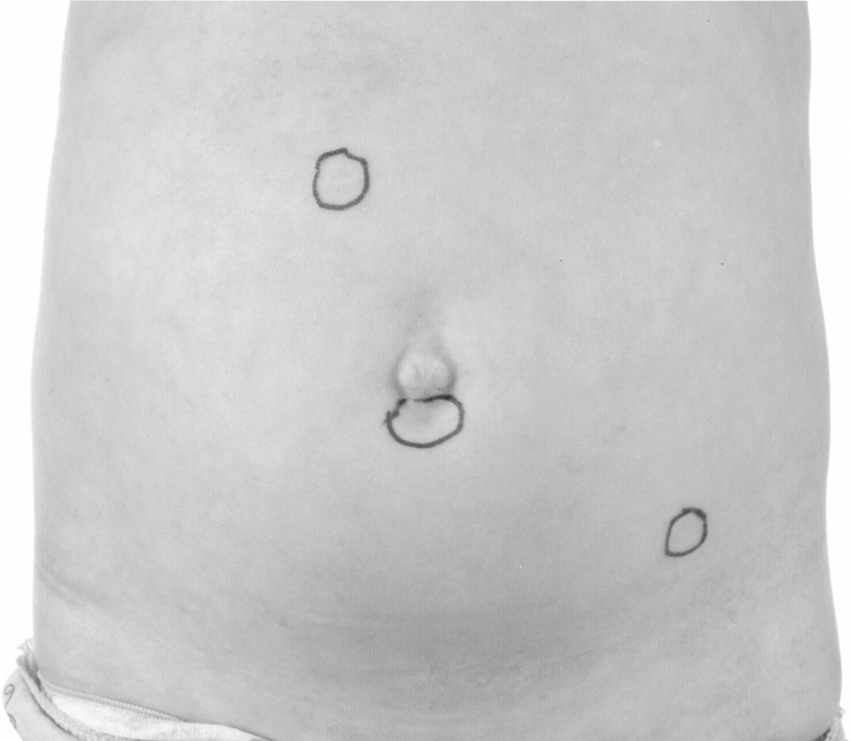
Marked photograph of abdominal wounds.
Unmarked photographs were then shown to 10 junior doctors. Reviewers were asked to identify and mark any visible scars (up to a maximum of three). They were then asked to rate the overall cosmetic result on a Likert scale of 1 to 5, where 1=poor, 2=prominent, 3=acceptable, 4=good, and 5=excellent. These results were then inputted to an Excel® (Microsoft) spreadsheet for analysis.
Results
Six patients have attended for clinical photographs a median of 13 months postoperatively (range, 8–19 months). Median age at time of surgery was 8 months (range, 4–15 months).
None of the junior doctors was able to identify all three scars on any of the photos. No individual scar was identifiable by all reviewers. Six of the 10 junior doctors could not identify any scars on four of the six photographs. Of the total of 60 photograph reviews, no scars were able to be identified in over half (31).
Of 180 scar reviews, only 37 (21%) were identified. The umbilical scars were least noticeable (3/60; 5%), followed by iliac fossa scars (11/60; 18%), with the epigastric scars being most noticeable (23/60; 38%).
Where any scars were correctly identified, the cosmetic result was always rated good (16/37; 44%) or excellent (21/37; 56%).
Discussion
The main drive toward increasing use of SPL seems to be based on potential for improved cosmesis with a single incision as evidence of reduced postoperative pain or complications seems to be lacking.1,7 However, there are reports of increased wound infection rates with SPL.8,9
Two of the better more recent adult studies provide contrasting answers. One of these was a retrospective case-controlled study comparing 165 SPL and 165 multiple-port laparoscopic colorectal procedures. 10 This study showed no significant difference in short-term outcomes (such as operative time and complications) between the two groups, except a difference of less than 1 point on postoperative Day 1 pain scoring (4.9 for single-port versus 5.6 for multiple-port). The other study was a randomized, controlled trial comparing 21 single-port cholecystectomies and 22 standard four-port cholecystectomies. 11 Operative time was almost double in the single-port group (88.5 versus 44.8 minutes, P<.05), and the single-port group also suffered more postoperative complications, with no difference in postoperative patient overall satisfaction or cosmetic satisfaction scores.
The best study from the pediatric literature so far was a prospective, randomized, controlled trial comparing 180 patients undergoing SPL appendicectomy with 180 patients undergoing standard three-port laparoscopic appendicectomy. 12 This study showed no difference in postoperative wound infection rates. It did, however, show a statistically significant increase in operative time (35.2 versus 29.8 minutes) and use of immediate postoperative analgesia (9.6 versus 8.5 doses) in the single-port group, although the clinical significance of this difference is unclear.
Although there is conflicting evidence on the risks and benefits of single-port surgery, the above studies mostly agree that single-port surgery is often more technically challenging and can take longer than traditional surgery, but the main benefit is thought to be invisibility of the single umbilical port-site scar. Conventional 5- and 10-mm port-site scars have good cosmesis but leave visible scars at sites other than the umbilicus. Our study, however, shows that using 3.5-mm ports can result in “invisible” scars: of 120 non-umbilical scar reviews, only 34 (28%) were visible. This raises the question of whether it is worth struggling to perform SPL procedures like pyloromyotomies or fundoplications in infants, putting them at risk of longer anesthetic times, when these operations can be safely performed by traditional laparoscopy with invisible scars also.
Ideally, all patients in the study would have attended for clinical photographs to be taken to ensure a good cosmetic result from all scars. Parents of all 10 patients from the study period reported being pleased with the cosmetic result of surgery; however, this was not formally assessed. Also, at the time of routine postoperative clinic reviews, all 10 patients' wounds are reported to have healed nicely, although again this is subjective.
Admittedly, reviewing photographs is not a perfect way to assess for the presence of postoperative scars; however, we tried to optimize the quality of the photographs in our series by using the same professional photographer in his professionally lit studio and by showing the reviewers life-size printed images.
Possible areas for further study would include a similar study with longer follow-up to assess final scar appearances or a comparative study between postoperative traditional laparoscopic and SPL scars.
As shown in this study, traditional laparoscopic surgery in infants can have an excellent cosmetic result with postoperative scars that are often “invisible.” In the majority of cases, most of the junior doctors were unable to identify any scars. The cosmetic benefit and thus the role of SPL in infants and neonates are therefore questionable.
Footnotes
Acknowledgments
We thank Steve Stanton for serving as medical photographer.
Disclosure Statement
No competing financial interests exist.