




Abstract
Abstract
Purpose:
We evaluated the effect of different suture materials in a laparoscopic preperitoneal ligation of the patent processus vaginalis in a rabbit survival model.
Materials and Methods:
New Zealand White rabbits underwent laparoscopic assisted preperitoneal ligation of the patent processus vaginalis. The processus vaginalis was closed with silk (n=10), polyglactin 910 (Vicryl®; Ethicon, a Johnson & Johnson Company, Somerville, NJ) (n=10), or polypropylene (Prolene®; Ethicon) (n=10). At necropsy, the suture was removed, and repair integrity was evaluated.
Results:
All rabbits survived to necropsy without complications. No suture material was identified during necropsy of the Vicryl group. Eight (80%) of the Vicryl closures failed, with six (60%) failing at initial inspection. Following removal of suture material, nine (90%) of the Prolene closures failed, and only one (10%) of the silk closures failed (P=.009).
Conclusions:
The silk suture resulted in an improved closure rate. Ligation with silk suture probably incited an increased inflammatory response that likely created a scar while persisting long enough for the scar to become established. In contrast, the Vicryl sutures probably failed because the sutures dissolved before a scar was able to fully develop. Finally, the Prolene closures were suture dependent as evidenced by failure when the suture was removed. Nonabsorbable braided suture may improve closure of pediatric indirect inguinal hernias during laparoscopic-assisted preperitoneal ligation.
Introduction
P
In their review of minimally invasive pediatric hernia repair, Saranga Bharathi et al. 7 elucidated the variability of suture use. They considered 22 studies. Eight of these used absorbable suture, and 16 used permanent suture. Several of the studies used both absorbable and/or permanent suture. A synthetic monofilament was most often the permanent suture of choice. 7 Proponents of a permanent monofilament suture refer to the ease of placing the suture circumferentially in the preperitoneal plane because such a suture is stiff and slides easily through the tissue. Others have criticized the use of monofilament because it fails to create an inflammatory response in the tissue. An alternative would be to use a braided suture to promote a more significant inflammatory reaction.
The aim of this study was to evaluate the role of suture choice in a laparoscopic preperitoneal ligation of a pediatric inguinal hernia. To accomplish this, we performed preperitoneal ligations of the internal ring in a living rabbit model using three commonly recognized suture types. Silk, polypropylene (Prolene®; Ethicon, a Johnson & Johnson Company, Somerville, NJ), and polyglactin 910 (Vicryl®; Ethicon) were chosen as representatives of the absorbable, permanent, monofilament, and braided suture types, respectively. This is the first study to prospectively evaluate the effect of suture choice on the closure of inguinal defects.
Materials and Methods
Animal model
Male New Zealand White rabbits have a congenital inguinal hernia similar to the patent processus vaginalis seen in infants. Unlike in humans, the rabbit's spermatic cord remains intraperitoneal and travels from the abdomen to the scrotum within the hernia sac. This allows the rabbit testicle to move freely between the scrotum and abdominal cavity. In contrast, the human spermatic cord travels through the internal ring as a retroperitoneal structure. To better replicate human anatomy, the rabbit testicle is internalized by retracting the testicle into the abdominal cavity and dividing/ligating the gubernaculum. This procedure is performed just prior to and as part of the same operation as the internal ring ligation described below.
Surgical technique
Fifteen rabbits were prepared and draped in sterile fashion. A 10-mm laparoscopic port was placed at the umbilicus, and two additional 5-mm laparoscopic ports were placed paramedially, one on each side. The abdominal cavity was insufflated. A 10-mm 30° laparoscope was inserted at the umbilical site. The testicles were internalized, and the gubernacula were divided and ligated (Fig. 1). Once hemostasis was assured, the two paramedian ports were occluded.
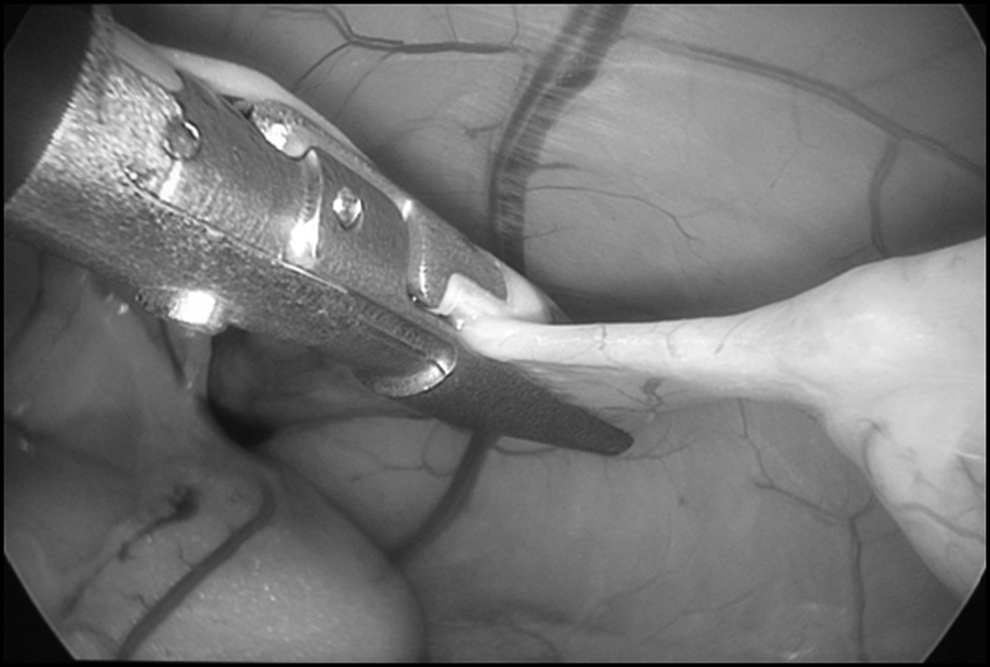
Ligating the rabbit's gubernaculum and internalizing the testicle.
The subcutaneous endoscopically assisted ligation technique was used for the ligation of the internal ring 6 (Figs. 2 and 3). In brief, a 5-mm 30° laparoscope is placed through the umbilical port. A stitch is placed extracorporeally in the groin, and the needle is guided in the preperitoneal plane around the internal ring under laparoscopic visualization. In humans, the spermatic cord travels in this preperitoneal plane, and the suture is brought into the peritoneal cavity in order to “skip” over the spermatic cord near the 6 o'clock position. The suture is then directed back into the preperitoneal plane. In the New Zealand White rabbit, there is a vein that runs in a similar location, and this was used as a proxy for the spermatic cord when placing the ligating suture. Once the internal ring is circumscribed, the needle tip is brought back through the skin. The swaged needle is then directed subcutaneously back through the initial needle puncture through the skin, and the suture is tied down. The fascia and skin at the three port sites were then sutured closed.
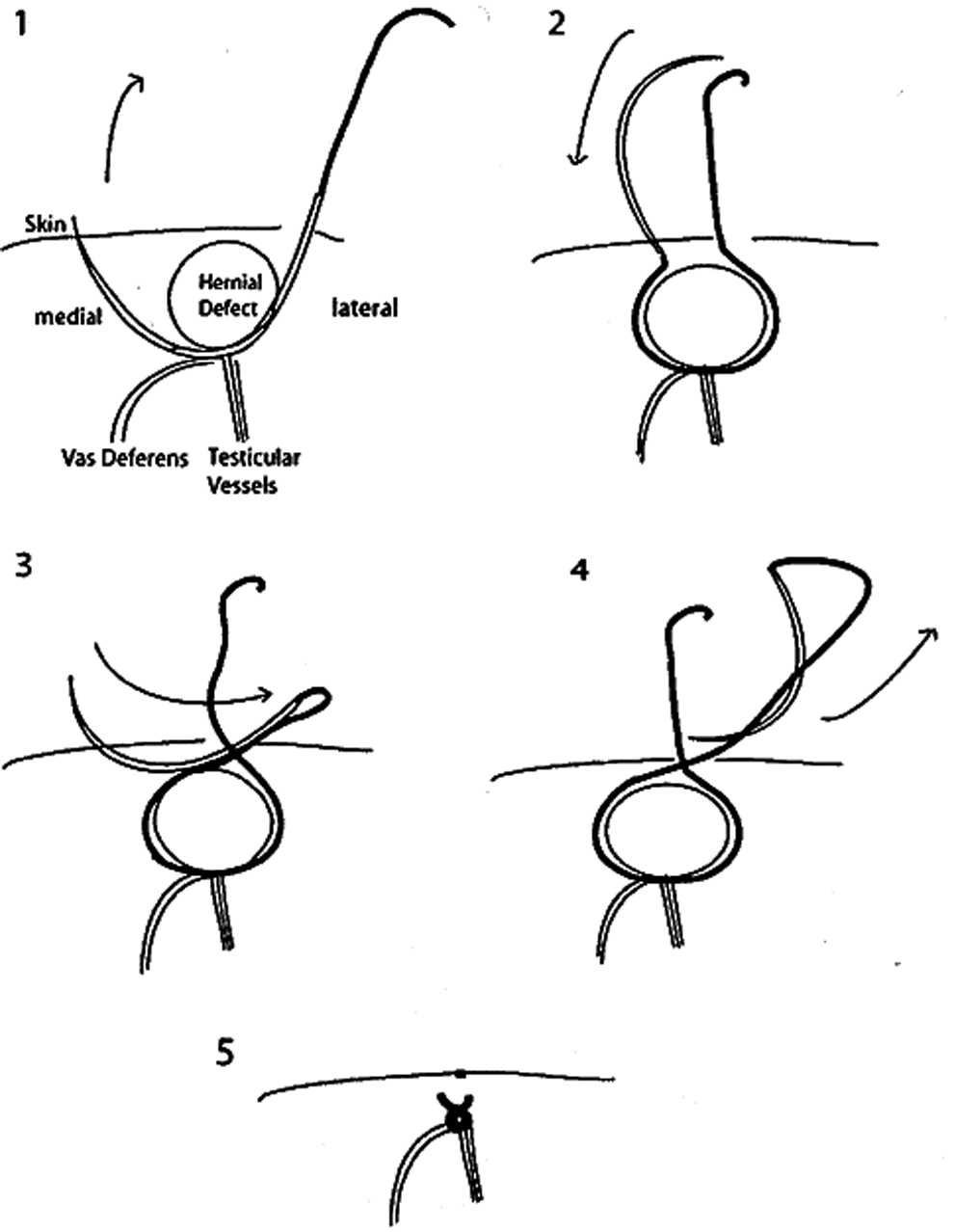
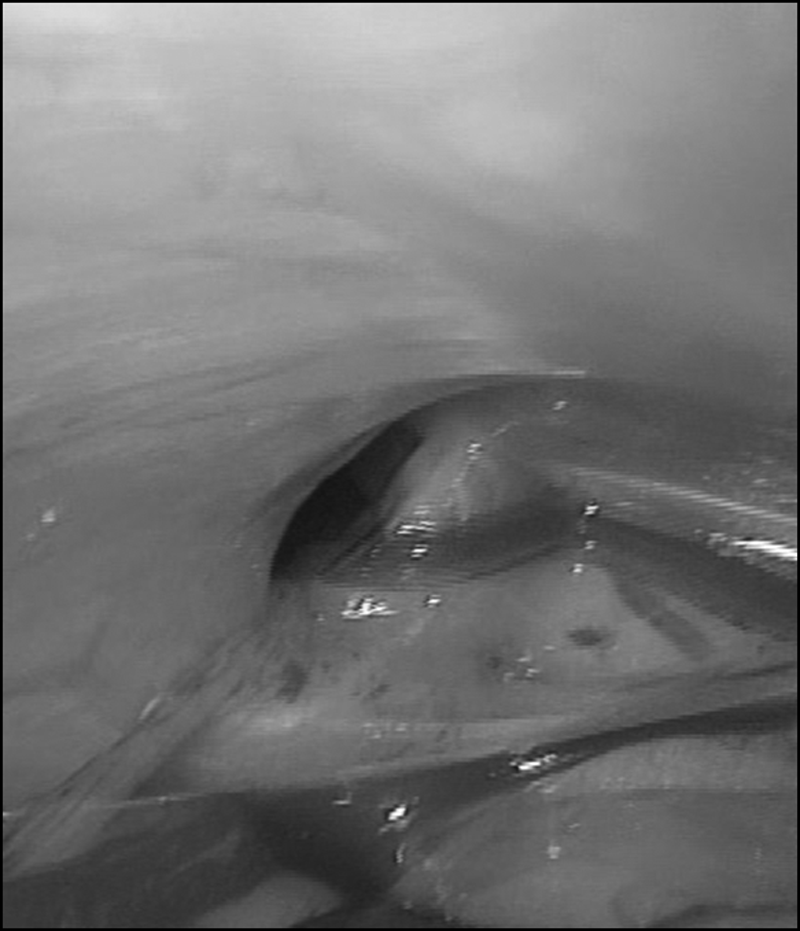
Intraoperative photograph of the subcutaneous endoscopically assisted ligation technique. The needle can just be seen in the preperitoneal plane.
Experimental design
Fifteen animals were used in this study. Each animal had both internal rings ligated for a total of 30 repairs; 4-0 silk suture, 4-0 Vicryl, and 4-0 Prolene sutures were used for 10 repairs each. The animals were allowed to survive to 6 weeks, and then necropsy was performed.
At necropsy, a 10-mm umbilical camera port and two paramedian working laparoscopic ports were placed. A 30° laparoscope was used for visualization. At minimal insufflation (4 mm Hg), the internal rings were examined for whether they were open or closed. Next, the ligating suture was identified, if present, at the skin level and removed. The internal rings were examined again for whether suture removal had an impact on the repair. Finally, the abdominal cavity was insufflated to a maximum of 34 mm Hg while whether the internal rings opened or remained closed was observed.
Experimental data were analyzed using the Yates chi-squared test. A P value of ≤.05 was considered significant.
This experimental design and protocol were approved by the Institutional Review Board and the Institutional Animal Care and Use Committee.
Results
During ligation of the internal ring, no intraoperative complications occurred. There were no postoperative complications, and all 15 rabbits survived to necropsy. At the time of necropsy, there were no signs of wound infection or stitch abscess. Upon initial inspection with 4 mm Hg insufflation, all of the silk and Prolene suture ligations were intact; however, six (60%) of the Vicryl ligations had failed (P=.005).
No Vicryl suture material was identified for removal during necropsies. After suture removal, six (60%) of the Prolene ligations failed. All of the silk ligations remained intact (P=.03). At maximal insufflation (34 mm Hg), one (10%) silk closure failed. An additional three Prolene closures failed, and two Vicryl closures failed. In total, eight (80%) of the Vicryl closures and nine (90%) of the Prolene closures failed. Only one (10%) of the silk closures failed (P=.009) (Fig. 4).

Total closure failures by suture type.
Discussion
In the first prospective animal study of suture choice in a preperitoneal ligation of the internal ring, the braided nonabsorbable suture (silk) had improved closure rates compared with a braided absorbable suture (Vicryl) and a monofilament nonabsorbable suture (Prolene). The differences in closure rates seen here may help to explain the variability of recurrence rates seen in retrospective studies of minimally invasive pediatric hernia repair.1–4
We did not perform histologic examinations of the tissues in this study. However, we hypothesize that ligation with a braided nonabsorbable suture (silk) incites an increased inflammatory response that likely creates a scar and improves closure while persisting long enough for the scar to become established.
In contrast, ligation with the Vicryl suture probably failed because the sutures dissolved before a scar was able to fully develop. In this study Vicryl suture failed in 80% of the internal ring ligations. However, Vicryl is commonly used to ligate the sac during an open pediatric hernia repair, and the recurrence rate in open repair is established as around 1%. 8 The success of an open high ligation of the sac is likely due to the associated trauma of the operation that causes inflammation and scar formation. The preperitoneal ligations performed in this study and the cited retrospective series are purposefully nontraumatic and are completely dependent on the suture in incite the necessary inflammation for a scar to form.
Finally, the monofilament (Prolene) closures did not seem to create an inflammatory scar like the braided suture. Thus, the Prolene closure was suture dependent rather than tissue dependent. This is evidenced by the failure of the ligation when the suture was removed.
Silk sutures have rarely been used in studies of minimally invasive pediatric hernia repair. This may be due to a perceived association of silk suture and stitch abscesses. Yet, in this study, none of the rabbits developed stitch abscesses or wound infections. Further investigation regarding suture choice and their associated postoperative complications and cosmesis is needed.
When performing a minimally invasive repair of a pediatric inguinal hernia, the surgeon should be cognizant of the suture material chosen. This animal study suggests that suture choice may have a large impact on the closure rate and therefore recurrence rates of pediatric inguinal hernias. The use of a braided nonabsorbable suture may improve closure of pediatric indirect inguinal hernias during laparoscopic-assisted preperitoneal ligation.
Footnotes
Disclosure Statement
No competing financial interests exist.