




Abstract
Abstract
Background:
Total proctocolectomy (TPC) and ileal pouch anal anastomosis (IPAA) have become the standard of care for patients with ulcerative colitis refractory to medical management. The purpose of our study is to show our single-site approach and to identify maneuvers that improve efficiency.
Materials and Methods:
We retrospectively reviewed patients who underwent single-site three-stage TPC-IPAA for ulcerative colitis at our institution. Primary outcomes included operative time, conversion from single site to standard laparoscopy, time to oral intake and stoma function, postoperative complications, and length of stay. The GelPOINT™ Advanced Access Platform (Applied Medical, Santa Margarita, CA) was used.
Results:
Eight patients were identified who had undergone single-site surgery with the GelPOINT platform. Six of the 8 patients underwent the first stage, total abdominal colectomy (TAC), and all 8 underwent the second stage (proctectomy/IPAA). The mean operating time for TAC was 242 ± 32 minutes. The mean time until tolerance of clear diet was 1.2 ± 0.4 days, and time until tolerance of regular diet was 3.3 ± 1.2 days. The mean time to stoma function was 1.5 ± 0.55 days, and that for postoperative opioid use was 4.0 ± 1.3 days. The median length of stay was 5 days (range, 3–10 days). There was one postoperative complication. The mean operating time for the proctectomy/IPAA was 283 ± 50 minutes. The mean time until tolerance of clear diet was 1.0 ± 0.5 days, and time until tolerance of regular diet was 3.3 ± 1.1 days. The mean time to stoma function was 1.6 days ± 0.52 days, and that for postoperative opioid use was 3.3 ± 1.4 days. Median length of stay was 4 days (range, 3–9 days). There was one postoperative complication. Technical adaptations that included extracorporeal mesenteric division, rectal eversion, and rotation of the GelPOINT device served to improve the ease and efficiency of the procedure.
Conclusions:
Single-site TPC-IPAA is both feasible and safe. Incorporation of adapted technical maneuvers can increase efficiency.
Introduction
T
Materials and Methods
After obtaining Institutional Review Board approval, we performed a retrospective analysis of all the patients at our institution who underwent the three-stage procedure from July 2012 to June 2014 for ulcerative colitis refractory to medical treatment. Patient demographics were recorded, as well as primary outcomes including conversion from single site to standard laparoscopy, operative time, time to oral intake, time to stoma function, postoperative surgical complications, and length of stay. Stoma function was defined as passage of gas and fluid into the stoma bag. All data were entered in an electronic spreadsheet in order to calculate statistics. Our results are expressed as either medians with ranges or means with standard deviations. Follow-up evaluation was performed in the standard fashion with scheduled appointments as well as phone and e-mail conversations.
Surgical technique
Total abdominal colectomy
With the patient in a supine position, the abdomen is entered through a 3.5-cm vertical skin incision in the navel undermining the fascia, and a single-site device is placed into position. We used the GelPOINT Advanced Access Platform for all single-site cases. Three trocars are placed into the device at the 3, 9, and 12 o'clock positions, and an additional radial dilating 12-mm trocar is placed at the future ileostomy site (Fig. 1). The right, left, and sigmoid portions of the colon are mobilized from the retroperitoneum, and the hepatic and splenic flexures are dissected using the 5-mm LigaSure™ device (Covidien, Mansfield, MA). Difficult angles are navigated by rotating the GelPOINT along its rotational axis and making adjustments to the operative table position to facilitate exposure of the operative site (i.e., Trendelenburg, right side down for access to sigmoid and left colon, reverse Trendelenburg, right side down for access to splenic flexure, etc.). The rectosigmoid colon is divided at the level of the sacral promontory using the laparoscopic medium/thick-load Endo GIA™ with Tri-Staple (Covidien), and the sigmoid mesentery is divided with the LigaSure. At this point, the GelPOINT cap is removed, and the sigmoid is exteriorized through the wound protector. This allows extracorporeal division of the colonic mesentery with the LigaSure (Fig. 2). An end ileostomy is then matured after widening the 12-mm trocar site, to avoid postoperative narrowing of the ileostomy.
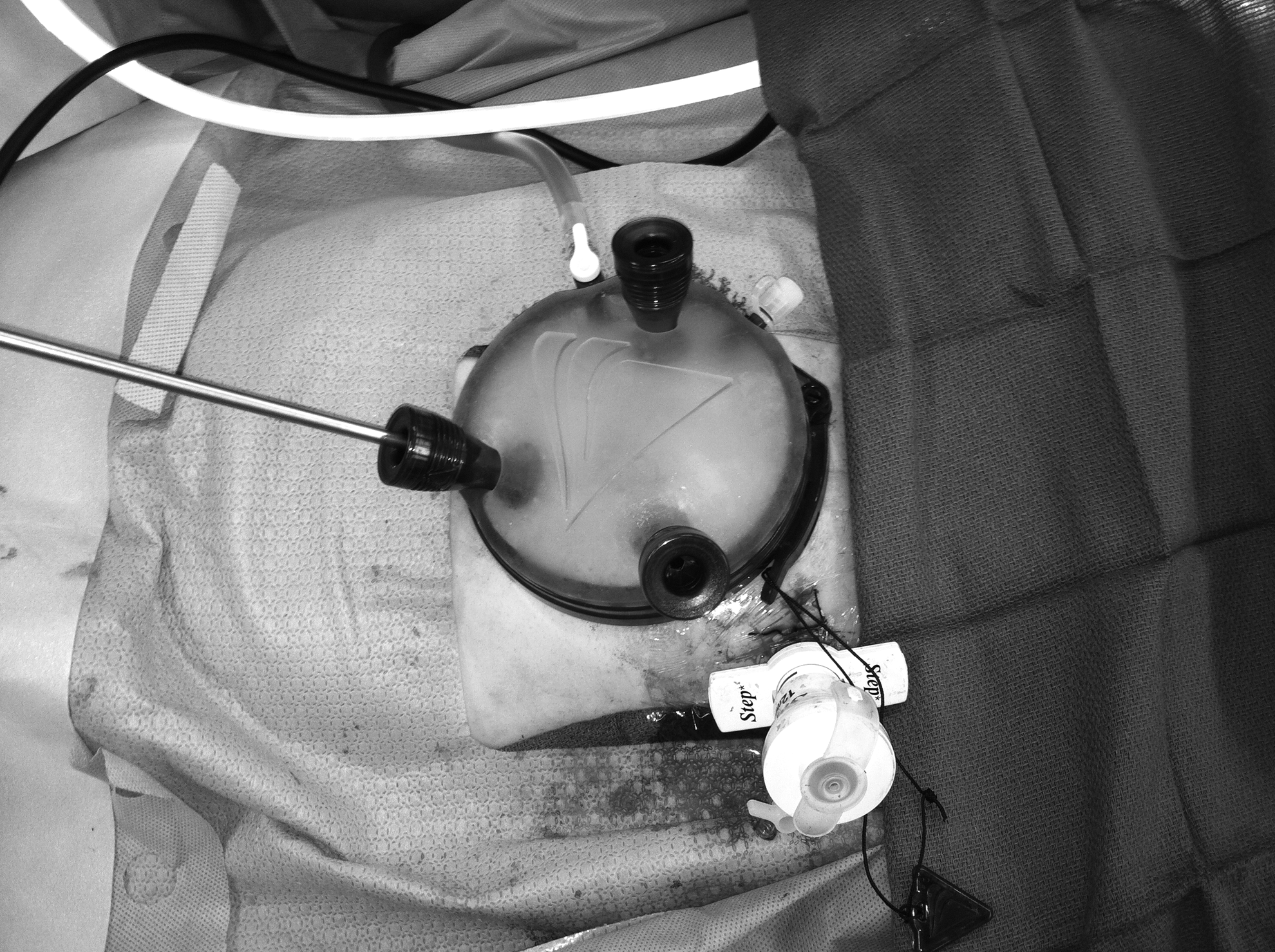
GelPOINT device and ileostomy trocar positioning (the head of the patient is to the left).
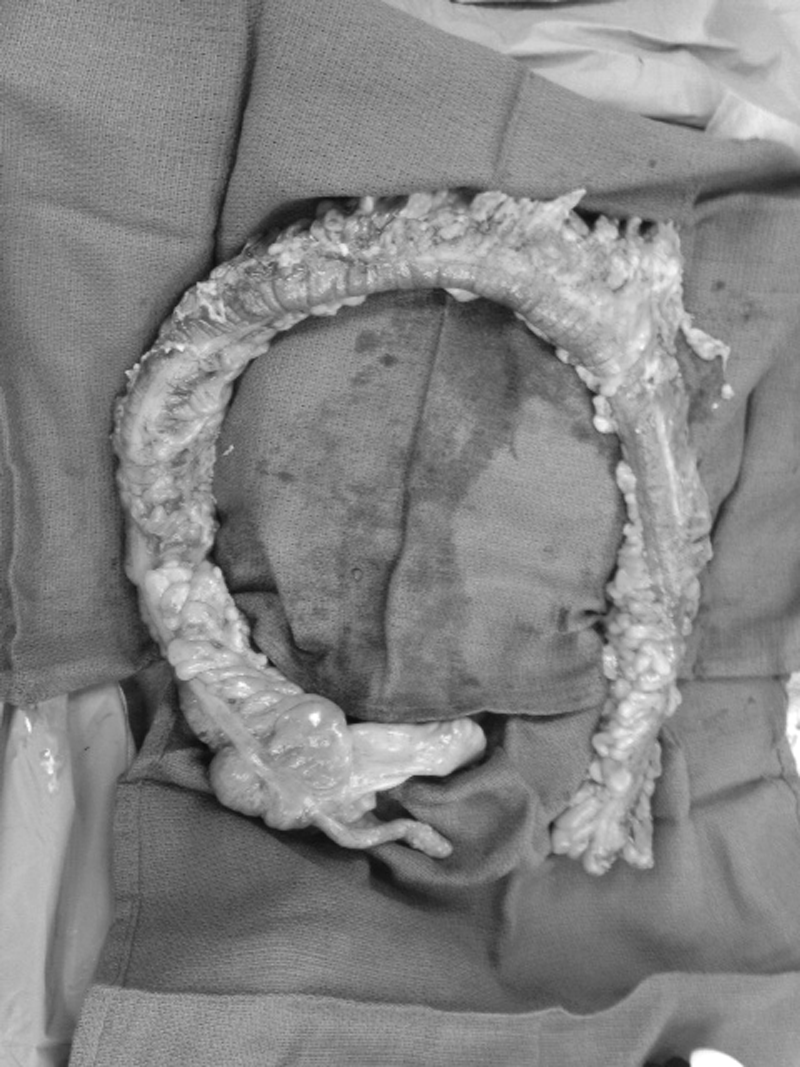
Resected colon.
Proctectomy and IPAA
In a lithotomy position, the ileostomy is taken down, and the GelPOINT device with three trocars is placed in the same manner as the total abdominal colectomy (TAC) procedure. A 12-mm trocar is placed after narrowing the ileostomy site to avoid gas leak. The camera is placed through the 12 o'clock port, and then the surgeon and assistant position their hands in a staggered fashion in order to optimize retraction and reduce crowding. The rectum is then mobilized circumferentially using the LigaSure device. As it is often difficult in a pediatric patient to determine the length of the remaining anal stump and to transect the distal rectum in the narrow pelvis using the laparoscopic stapler, the rectum is everted through the anus and divided 3–4 cm proximal to the dentate line (Fig. 3). The GelPOINT cap is removed, the ileum is exteriorized, the mesentery is lengthened, and a 10–12-cm J pouch is constructed with an extracorporeal linear stapler. An EEA™ stapler anvil (Covidien) is placed in the J pouch and purse-stringed closed. The EEA staple anastomosis is then performed under direct vision laparoscopically to the anal stump, and a loop ileostomy is constructed through the prior ileostomy site.

Everted rectum during ileal pouch anal anastomosis.
Results
In total, there were 8 patients who underwent the three-stage procedure at our institution. All of these patients were diagnosed with ulcerative colitis refractory to medical treatment. Six of these patients underwent single-site TAC, and all 8 underwent single-site proctectomy/IPAA. There were 5 females and 3 males. The median age at TAC was 14 years (range, 10–18 years), and the median weight before TAC was 49.7 kg (range, 26.6–80.2 kg). The median time between TAC and proctectomy/IPAA was 3.5 months (range, 2–15 months). The median time for follow-up after TAC was 14 months (range, 5–19 months). One patient had the additional comorbidity of primary sclerosing cholangitis.
Our end points for the TAC procedure are summarized in Table 1. Of note is that no patients required conversion to traditional laparoscopy. There was one surgical complication following the first stage where a patient developed small bowel obstruction due to fascial narrowing at the stoma site, which required an ostomy revision. The length of stay for this admission was 3 days.
Our end points for the proctectomy/IPAA using the single site are summarized in Table 2. Of note is that no patients required conversion to traditional laparoscopy. The single complication following proctectomy/IPAA involved a remaining mucosal bridge in the pouch staple line requiring surgical division. All patients underwent an evaluation under anesthesia with anal dilations at the time of their ileostomy closure.
Discussion
Despite the introduction of novel medical therapies for ulcerative colitis, significant numbers of patients remain refractory to medical management and ultimately require surgical intervention. 1 Medical treatment failure coupled with the known increased risk of colonic malignancy in these patients over time makes surgical treatment of ulcerative colitis an integral aspect of their management. 6
Although there are no randomized trials as of yet to compare the results of the single-site procedure with standard laparoscopy, single-site surgery has cosmetic benefit and potential improvement in pain control and reduction of hospital stay. 7 Our experience has demonstrated that these procedures can be accomplished in children with comparable complication rates and both reasonable and progressively improving operative times. 8 We reviewed our operating times from 2009 to 2010 for TAC and TPC-IPAA that were performed by traditional laparoscopic technique: our mean operating time for TAC was 262 ± 48.0 minutes, and our mean operating time for TPC/IPAA was 314 ± 70 minutes. Our results from the same procedures performed via standard laparoscopy demonstrate operating times similar to those of our single-site procedures.
The major obstacle of this approach remains an increase in operative time and technical difficulties including instrument crowding and suboptimal angles and exposure. Although our operative times for single-site and standard laparoscopy are higher than those in some adult studies, our times compare favorably with the other major pediatric surgery study 8 and our own traditional laparoscopic techniques. Over the course of our experience using an umbilical GelPOINT platform for single-site TPC-IPAA, we have adapted our technical approach with maneuvers to navigate the technical issues of crowding and angles, as well as a transition to extracorporeal mesenteric division, which improve our operative times. Review of operative notes indicates that lengthier operations are typically due to factors other than the operation, including obtaining correct instruments (stapler, cautery device), equipment malfunction, etc. It is useful to remember that the radially dilating port placed in the ileostomy site needs to be increased in size to a 2 finger-breadth width to avoid ileostomy dysfunction from stoma stenosis.
When performing the TAC, rotation of the GelPOINT along its rotational axis enables the trocars to be positioned on the same side of the platform and directed in the correct direction with the least amount of torque but nevertheless able to be rotated to dissect the lateral attachments in all four quadrants of the abdomen. Additionally, the 3.5-cm incision afforded by the umbilical GelPOINT allows for easy externalization and extracorporealized dissection of the colonic mesentery, which results in a dramatic decrease in our operative times. The use of the laparoscopic medium/thick-load Endo GIA with Tri-Staple enables improved closure of the edematous and inflamed colon, helping to solidify a potentially edematous staple line.
In the proctectomy/IPAA procedure, the staggered positioning of the surgeon and the assistant's hands greatly improves retraction and exposure and decreases problems with port crowding. Once again, externalizing the ileum through the umbilical GelPOINT incision allows for efficient construction of the J pouch and placement of the EEA anvil. Finally, eversion of the rectum through the anus enables us to easily create a reproducibly measured short rectal stump and avoids problems associated with operating in a narrow pediatric pelvis. We routinely left 3–4 cm of rectal stump in order to ensure better postoperative continence. Approximately another cm of rectal mucosa is removed with the stapling of the rectal stump to the J pouch. Because these patients will need scheduled surveillance regardless of the remaining stump, we feel that the impact on improved socially acceptable continence outweighs the marginal increase in risk for malignancy from an additional 1–2 cm of rectum. Although this area may still have medically refractory disease that warrants mucosectomy, most patients are easily controlled medically when the burden of disease is decreased to a short residual stump.
Conclusions
Single-site laparoscopic TPC and IPAA using an umbilical GelPOINT platform are both feasible and safe. They can be accomplished with comparable outcomes to the standard laparoscopic approach and an improved cosmetic result (Fig. 4). Technical adaptation to the technique has enabled enhanced efficiency. It is our expectation that further innovations will continue to reduce operative time.
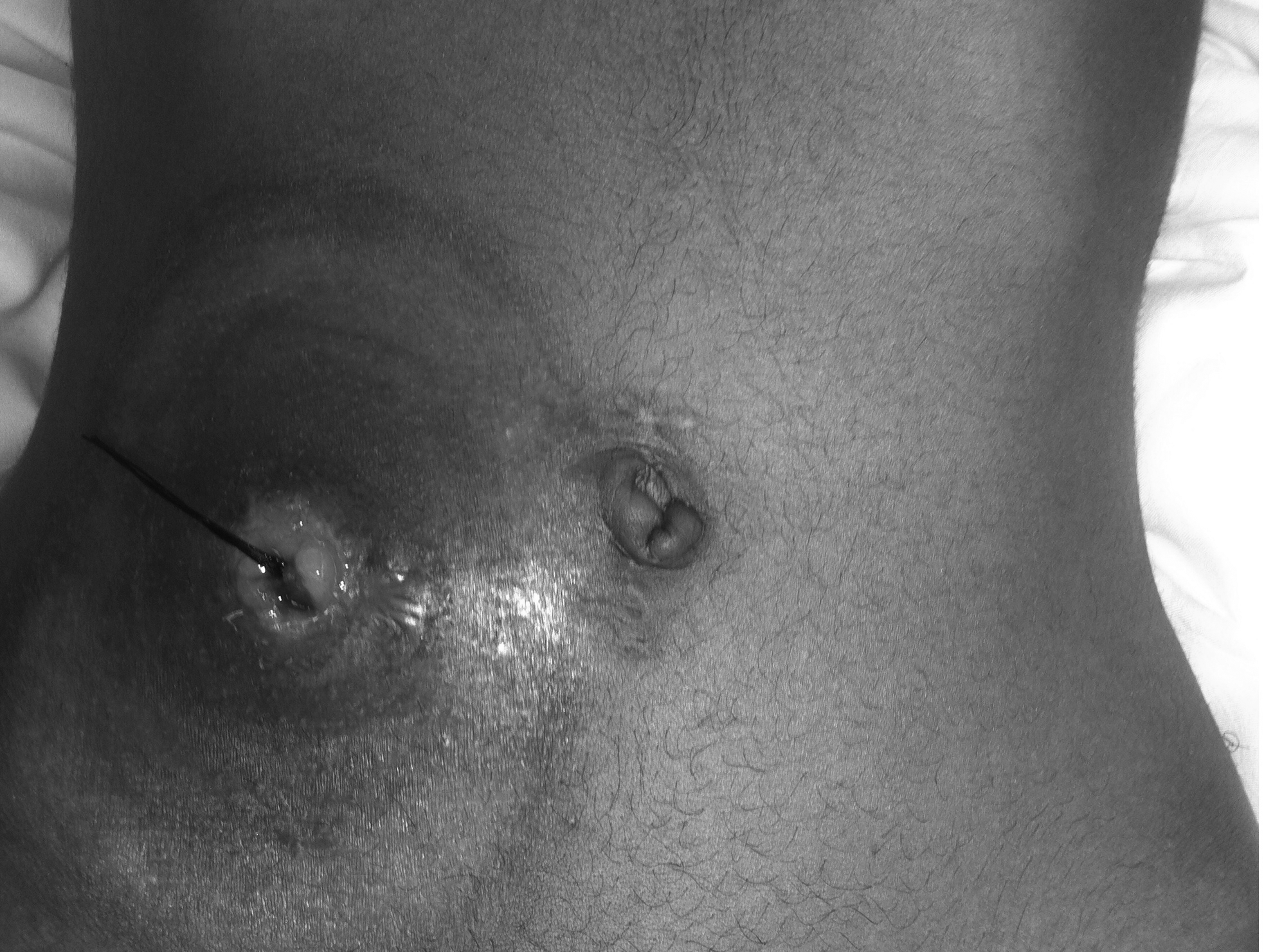
Photograph taken after total abdominal colectomy. Note the minimal scar at the umbilicus.
Footnotes
Disclosure Statement
No competing financial interests exist.