




Abstract
Abstract
Introduction:
Laparoscopic knot-tying is an advanced skill. The traditional square knot or surgeon's knot is often used at the end of a continuous suture line in laparoscopic surgery. The Aberdeen knot has been shown to be stronger and more secure than the surgeon's knot for ending a suture line but is rarely used in laparoscopic surgery. We have developed a new technique to make the Aberdeen knot laparoscopically.
Materials and Methods:
At the end of a continuous suture line, the needle-attached end of the suture is held with a right-handed instrument and passed through the instrument into the loop of the last suture. The left-handed instrument is passed through the triangle made by the inserted suture, the right-handed instrument, and the loop through which the suture is inserted. The suture held by the right-handed instrument is then pulled, closing that loop and creating a new one on the left-handed instrument. The right-handed instrument is passed into the loop, and the same technique is then repeated two or more times. To finish the knot, the needle-attached end is passed through the loop, and the knot is tied.
Discussion and Conclusions:
Laparoscopic suturing and knotting are difficult, particularly in single-port laparoscopic surgery, where the angle between working instruments is narrow. Furthermore, knotting the end of a continuous suture is difficult when the thread becomes short. In all of these situations, this technique is able to facilitate and simplify knot-tying. No special instruments are required to make a “laparoscopic Aberdeen knot.”
Introduction
L
Materials and Methods
We use this technique at the end of a continuous suture line for mesenteric closure in laparoscopic surgery. At the end of the continuous suture line, the suture end is held with the right-handed instrument near the needle and passed through the loop of the last suture (Figs. 1a–c and 2a and b). The left-handed instrument is passed through the triangle made by the inserted suture, the right-handed instrument, and the loop through which the suture is inserted (Figs. 1d and 2c). The suture held by the right-handed instrument is then pulled, closing that loop and creating a new one on the left-handed instrument (Figs. 1e and g and 2d–f). This procedure is repeated two or three times with the newly created loop (Fig. 1h–k). There are two ways to end this knot. The first involves passing the suture end through the loop with the right-handed instrument to be caught by the left-handed instrument and pulled, closing the loop to secure the knot (Figs. 1l–n and 3). The second involves passing the suture end to the left-handed instrument, which is used to pull the suture through the loop to secure the knot (Fig. 4).

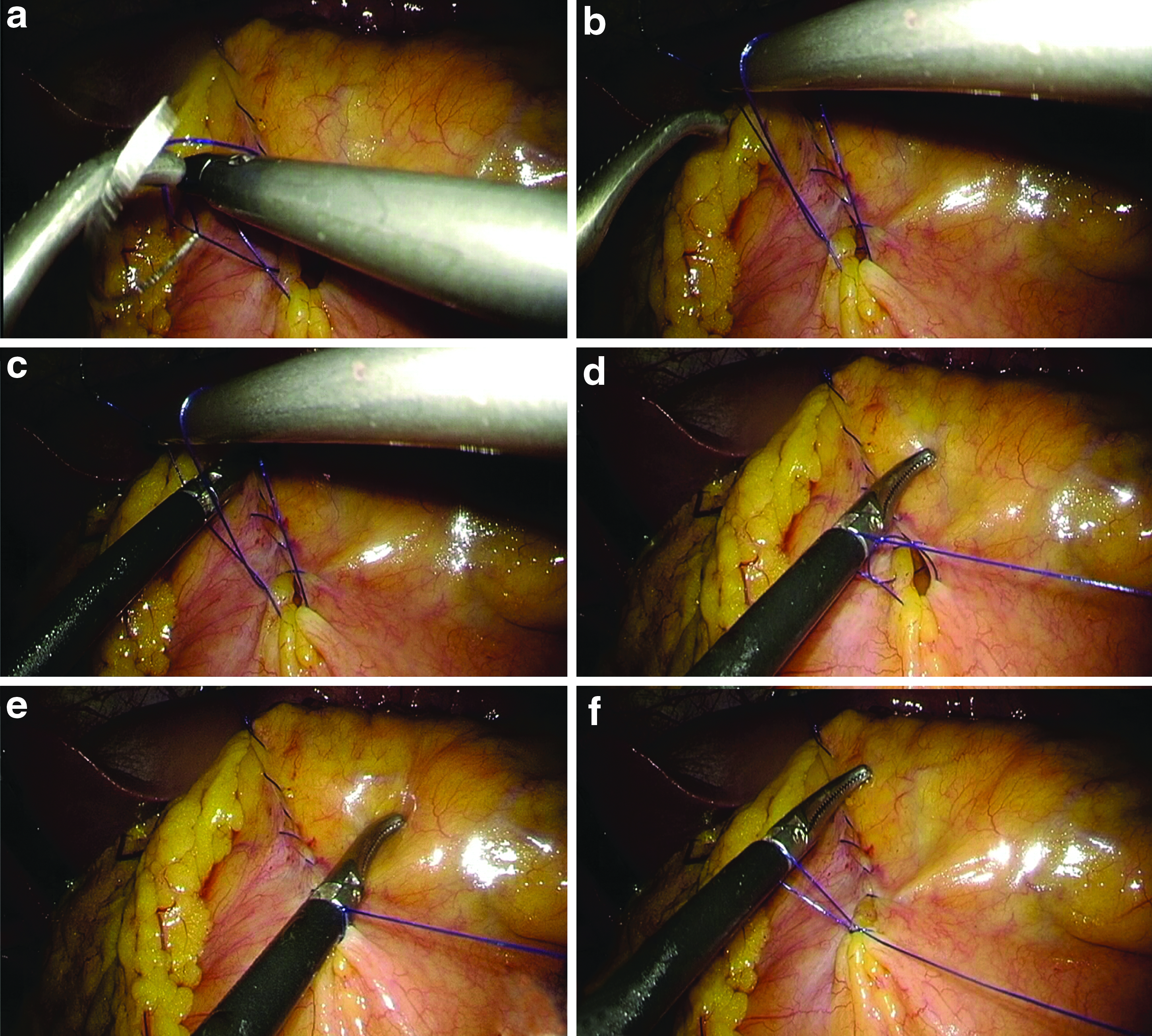
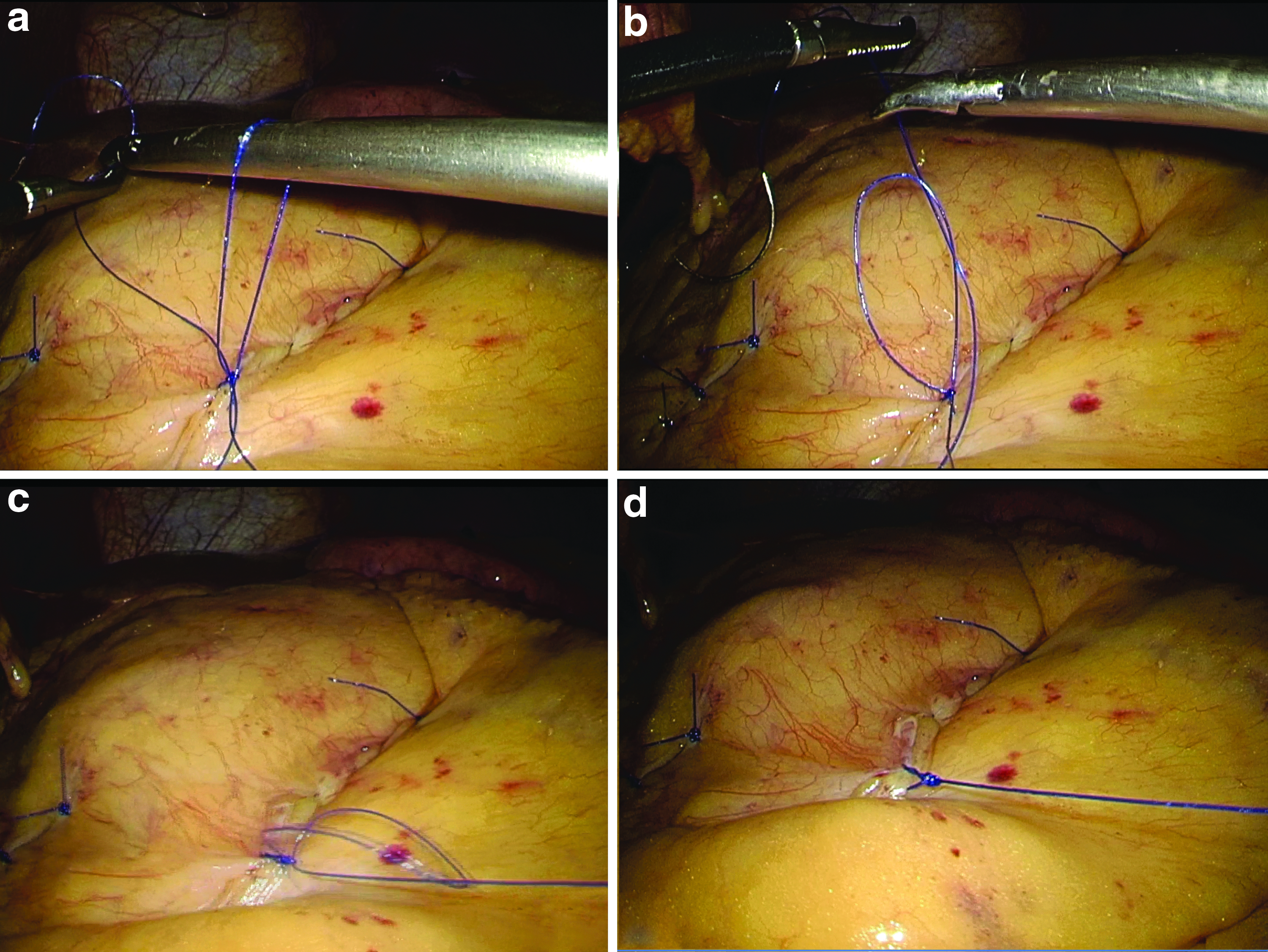
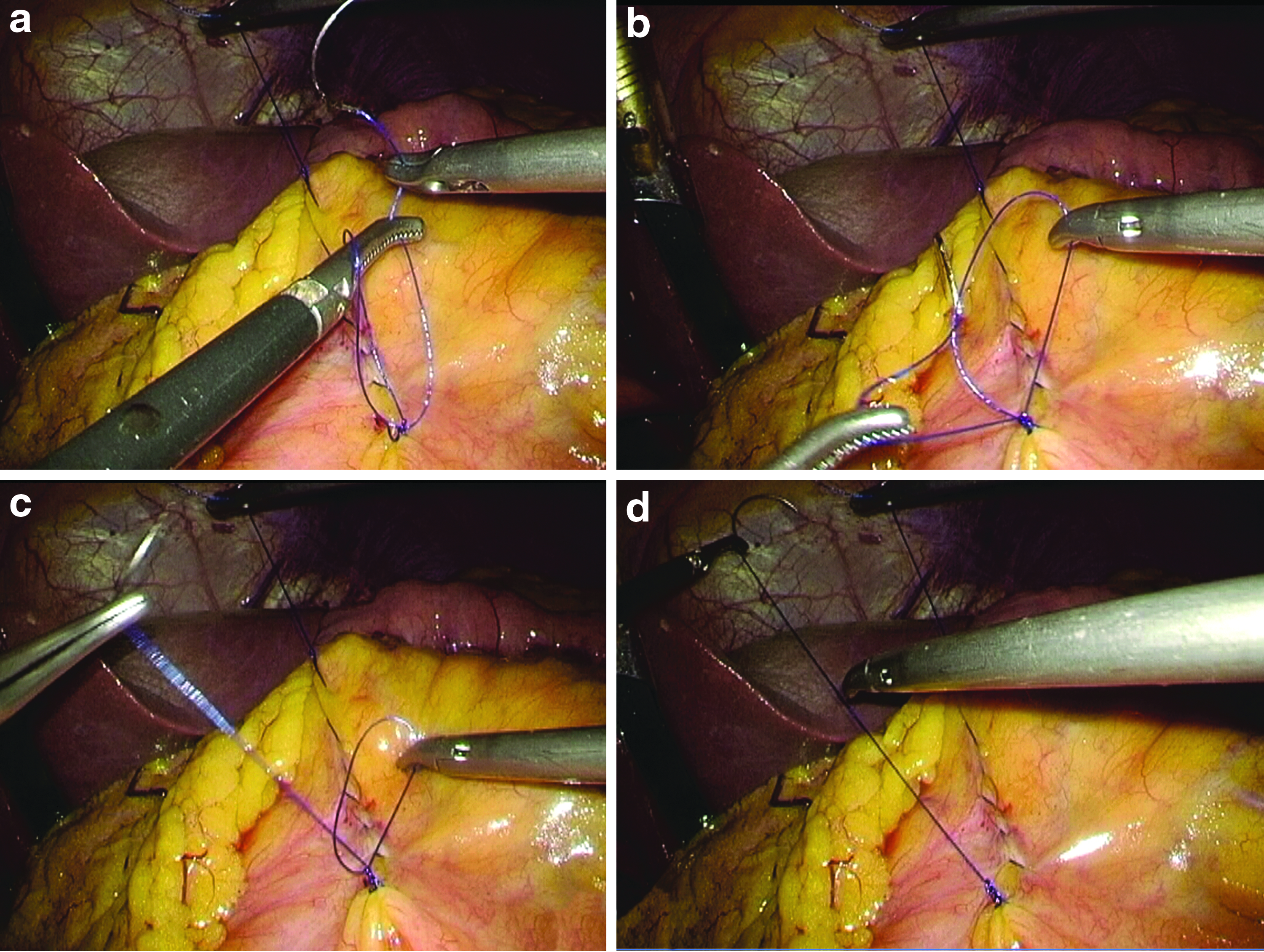
Only simple to-and-fro motions are required, making the technique suitable for single-port surgery.
Discussion
Laparoscopic suturing and knotting are difficult to perform. Even in standard laparoscopic surgery, knotting takes a long time and is a stressful part of the operation. Particularly during single-port laparoscopic surgery, the working instruments are very close and interfere with one another. The angle between them is very narrow, making it difficult to form the traditional square or surgeon's knot. Our technique requires only to-and-fro motions, a movement that is suitable when the working instruments are close and the angle between them is narrow. In other cases, knotting the end of the continuous suture is difficult when the thread is short. In all these situations, knot-tying using this technique simplifies and facilitates the process of knotting. In addition, the Aberdeen knot requires minimal thread and enables the surgeon to start new suturing without having to replace the needle. This also helps to reduce the costs of suturing. Furthermore, no special instruments are required for this method. For these reasons, we recommend this new method.
The combination of laparoscopic suturing and knot-tying is a complex but essential procedure in laparoscopic surgery, and it is time-consuming and stressful for most laparoscopic surgeons. During single-port laparoscopic surgery, the conflict of instruments due to the proximity of the working ports and the narrow angle between instruments makes the procedure for tying the traditional square knot or surgeon's knot even more challenging. In comparison, our technique only requires to-and-fro motions. This greatly reduces the conflict of instruments in single-port surgery.
Tying a knot at the end of a continuous suture also becomes more difficult when the thread becomes short. As the Aberdeen knot requires less suture material than traditional knots, even in these situations, knot-tying using our technique requires no extra effort. This also makes it possible to start a new line of suturing without having to replace the needle, reducing the cost of suturing. We do not require any special instruments to perform this procedure, which can be performed using instruments commonly found in the laparoscopic operation set. We thus feel that our new method has the potential to reduce the stress involved in laparoscopic knot-tying techniques.
Footnotes
Disclosure Statement
No competing financial interests exist.