




Abstract
Abstract
Introduction:
Laparoscopic percutaneous extraperitoneal closure (LPEC) in boys is more complex than in girls, because the vas deferens and testicular vessels must be separated from the peritoneum. We therefore developed a needle-shaped surgical instrument that enables blunt separation. Here, we report the effectiveness of this new device.
Surgical technique:
The new device is a ligature carrier consisting of (1) an inner tube (19-G blunt needle) through which slides a rod with a loop wire at its tip that can catch and release suture materials and (2) an outer tube (17-G needle) with a cutting edge. The blunt-structured inner tube enables blunt separation. All actions (stabbing, separation, and catching) in the LPEC procedure that are required to close the hernia orifice using a thread are facilitated through a simple small incision by switching between the inner and outer tubes.
Subjects and methods:
From January 2013 to September 2015, 73 boys with inguinal hernia or hydrocele underwent LPEC, and the new device was used in 45 of these cases. We compared surgical results between cases wherein the new (group A) and conventional devices (LPEC needle; group B) were used.
Results:
The mean surgery duration was 33.4 and 34.8 min for groups A and B, respectively. Neither group experienced complications during or after surgery.
Conclusion:
Our findings suggest that the newly developed needle device may improve the safety of the LPEC procedure for boys, although further investigation involving more cases and long-term follow-up is needed in the future.
Introduction
L
In this study, we developed a special needle-shaped surgical instrument that enables blunt separation, and can be used to safely separate the vas deferens and testicular vessels from the peritoneum. We report the effectiveness of this new device.
Materials and Methods
We developed a special needle-shaped surgical instrument in 2013, and we started to use the new device in patients who are 1 year or older. From January 2013 to September 2015, 73 boys aged 1 year or older with inguinal hernia or hydrocele underwent LPEC. Our novel needle-shaped surgical instrument was used in 45 of these patients, whereas an LPEC needle was used in the remaining 28 patients. Before surgery, the parents of all patients were informed about the risks of the procedure, and they provided parental consent. The diagnosis of inguinal hernia was confirmed during preoperative examination. The new needle device used in this study was approved by the institutional ethics review board. We compared surgical results between cases wherein the new needle device (group A) and conventional LPEC needle (group B) were used. The demographic and clinical features of the children were also reviewed retrospectively. For all patients, age at surgery, operative time, intra- and postoperative complications, and recurrence were analyzed. Lastly, all patients were scheduled for follow-up visits at 1 week and 1 month postoperatively.
New Needle Device
The novel needle-shaped surgical instrument used in this study is a ligature carrier consisting of (1) an inner tube (19-G blunt needle) through which slides a rod with a loop wire at its tip that can catch and release suture materials and (2) an outer tube (17-G needle) with a cutting edge. The blunt-structured inner tube enables blunt separation (Fig. 1). All actions in the LPEC method (stabbing, separation, and catching) that are required for closure of the hernia orifice using a thread are facilitated through a simple small incision by switching between the inner and outer tubes. Figure 2 shows the LPEC needle.
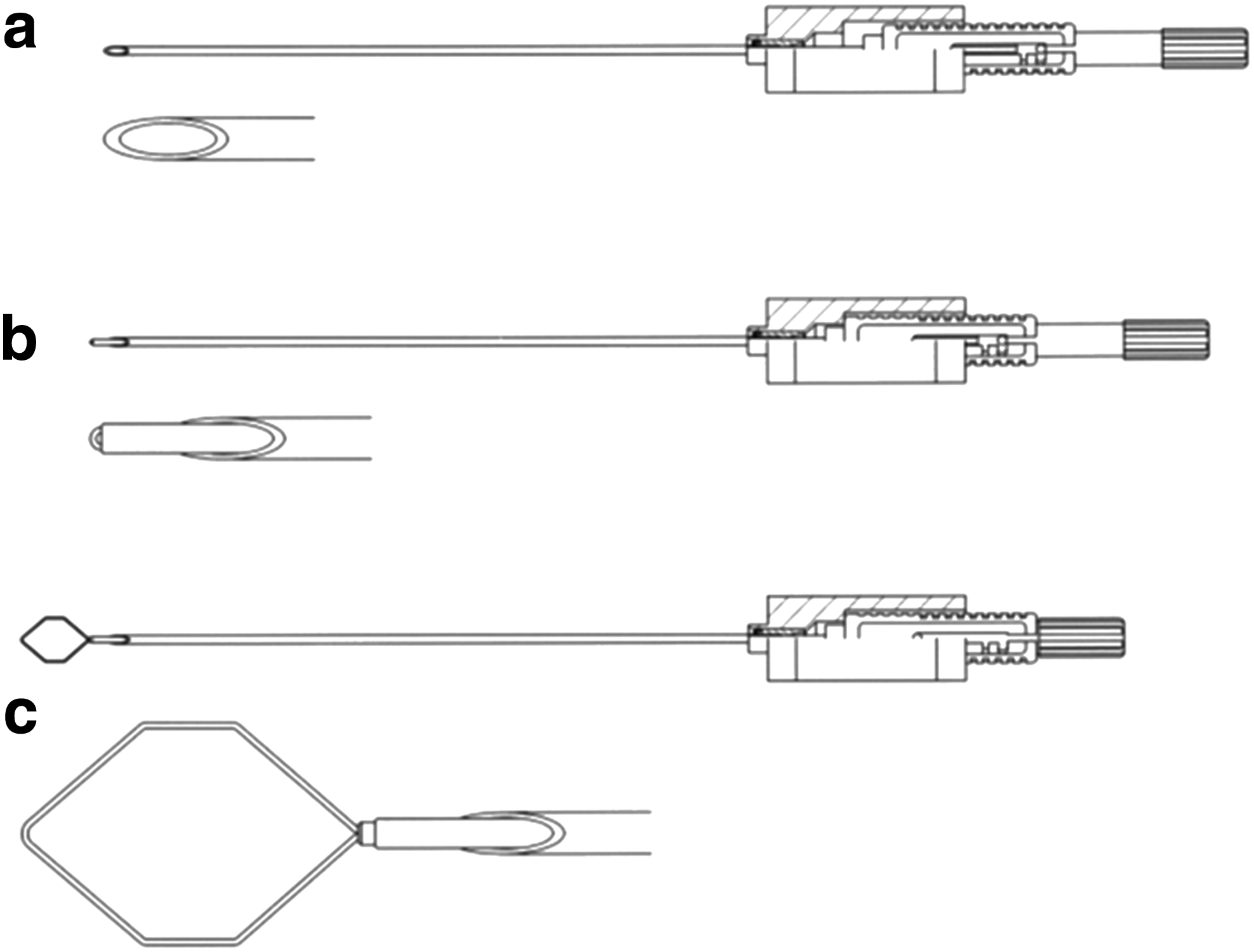
New needle device.
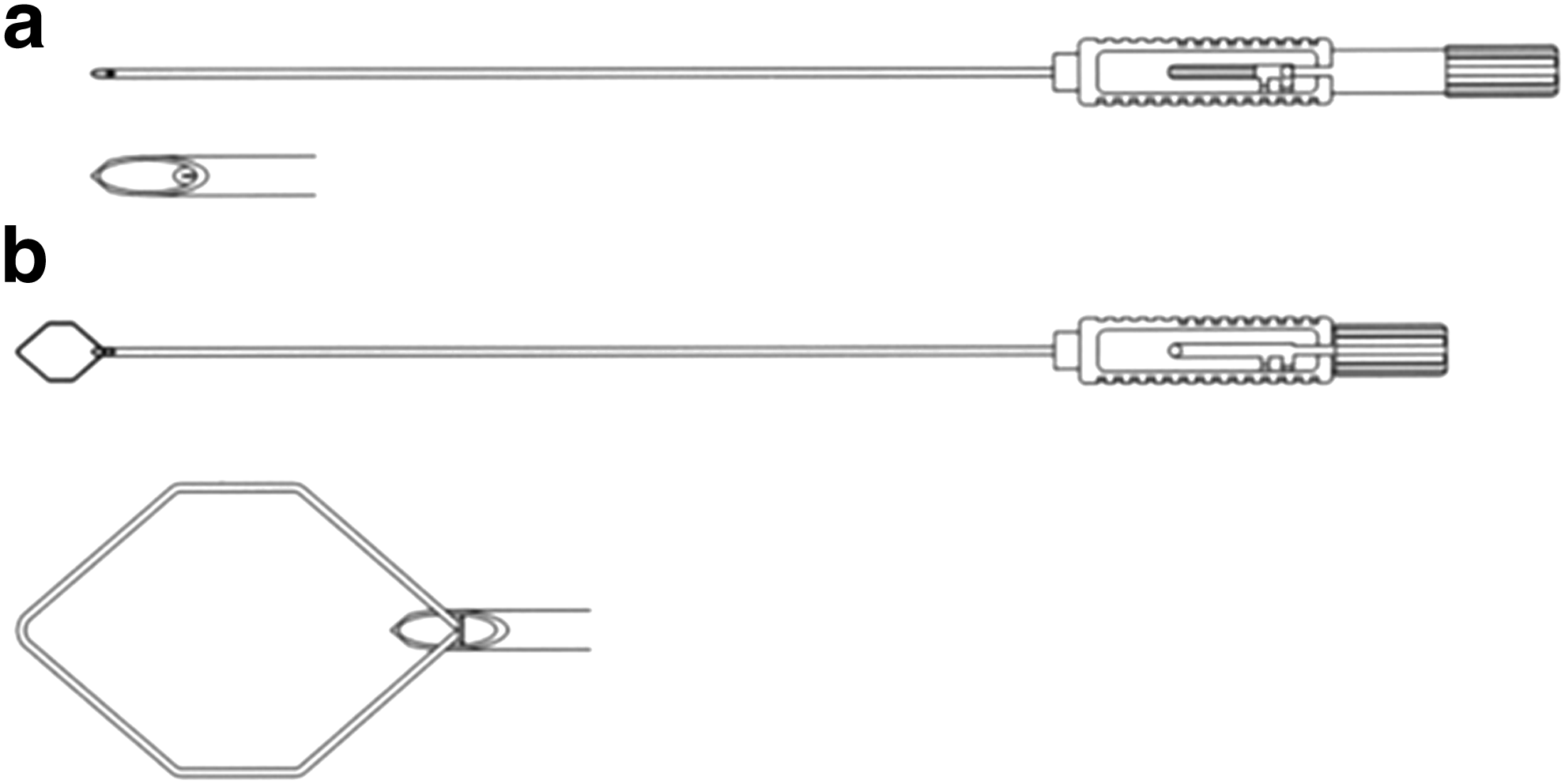
LPEC needle.
Surgical Procedure
All procedures were performed with the patients under general anesthesia administered through an endotracheal tube. Patients were placed in a slight Trendelenburg position. A 3.5-mm port for a 3-mm laparoscope was placed through a transumbilical incision. Pneumoperitoneum was established with CO2 insufflation at 8–10 mm Hg pressure. Subsequently, a 2 mm trocar into which a grasping forceps can be inserted was introduced on the left side of the umbilicus. The following steps were performed using the method developed by Takehara et al. 13 Under laparoscopic guidance, an LPEC needle or new needle device was inserted along with nonabsorbable suture material at the midpoint of the right or left inguinal line (Fig. 3). For conventional LPEC, the hernia sac was closed extraperitoneally by using the LPEC needle with the aid of forceps, with circuit suturing without any peritoneal gap. Care was taken to cross over the vas deferens and testicular vessels. During the modified LPEC method with the new needle device, blunt dissection of the extraperitoneal space was performed using the blunt-structured inner tube, with the needle instrument crossed over the vas deferens and testicular vessels (Fig. 4). Closure on both sides was performed if an asymptomatic contralateral patent processus vaginalis was observed.
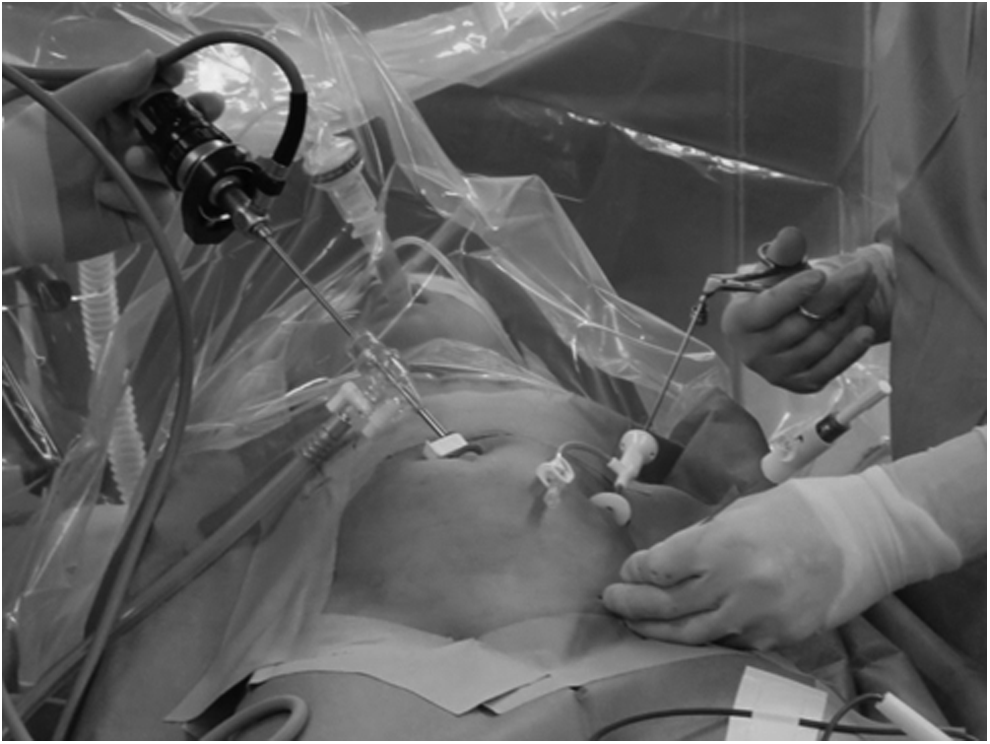
Port and needle device placement.
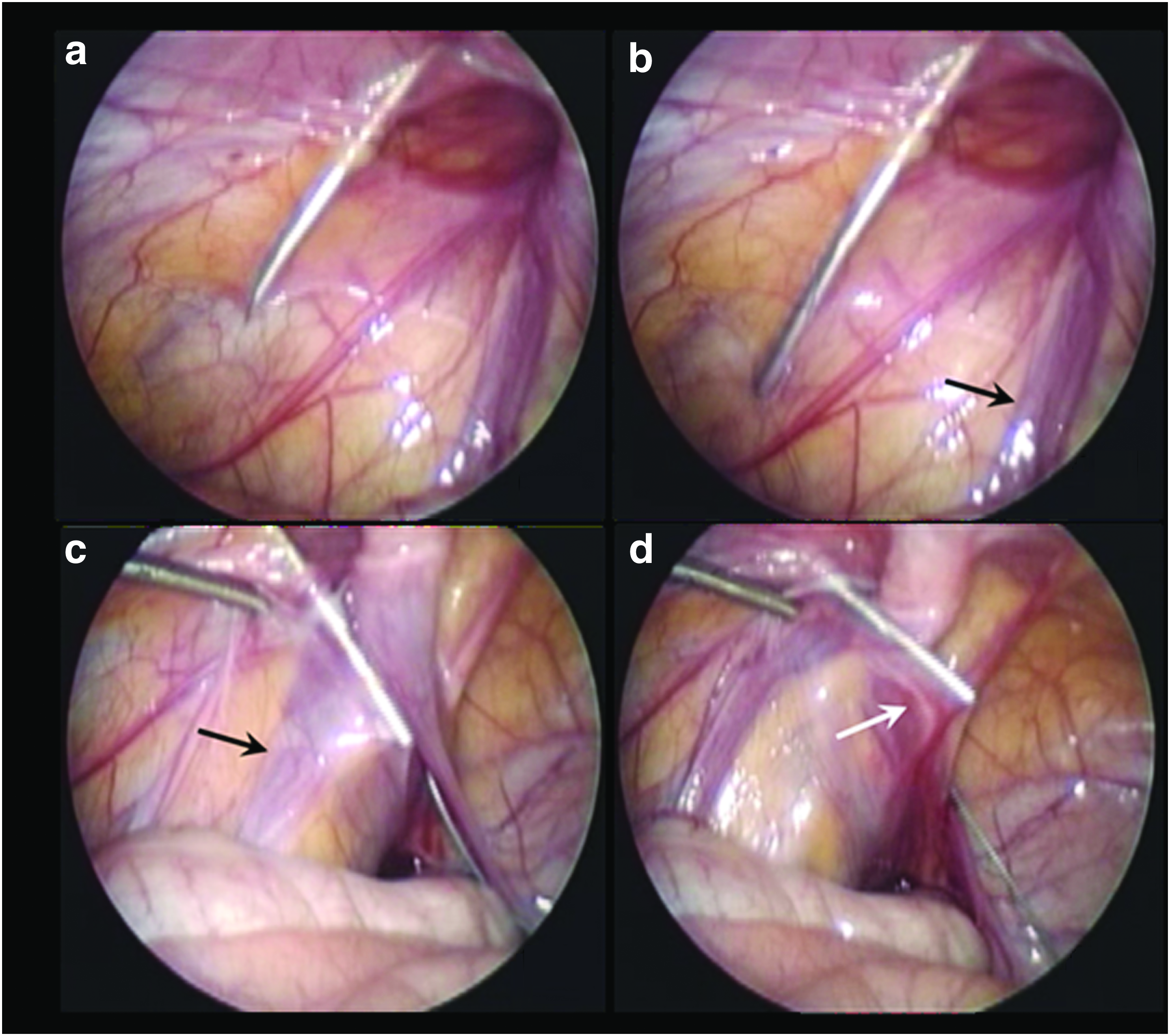
LPEC procedure using the new needle device. Circuit suturing was initiated by inserting the needle device with suture material through the medial side of the internal inguinal ring. Subsequently, circuit sutures were placed around the lateral half of the inguinal ring using the outer tube.
Results
Of the 73 boys included in this study, 93 internal inguinal rings were closed (53 unilaterally and 20 bilaterally). In the 45 patients in group A, 58 hernias were repaired, whereas 35 hernias were repaired in the 28 patients in group B. No significant differences were found between the groups for age, need for repair on both sides, and operating time (Table 1). No surgical complications or early recurrence was found in either group. Furthermore, no cases of hydrocele or testicular atrophy were found in either group.
Group A: LPEC performed using new needle device.
Group B: LPEC performed using a conventional LPEC needle.
LPEC, laparoscopic percutaneous extraperitoneal closure.
Discussion
Although many laparoscopic techniques for children have been described, no technique has been widely accepted yet. 1 As one of the most recently developed techniques, LPEC is simple, reliable, and easy to apply.3,13
LPEC for pediatric inguinal hernia involves placing a purse-string suture of nonabsorbable material extraperitoneally around the hernia orifice using an LPEC needle (Lapa-her-closure™). This method reportedly has a low recurrence rate and is generally adopted by pediatric surgeons worldwide,1,3,14 particularly in the Far East during the last decade.1,4,12,15 Since Takehara et al. first reported the LPEC technique, many modifications have been described, with various instruments replacing the LPEC needle, for example, Kirschner pins, angiocatheters, Reverdin needle, hooks, swaged needles, hypodermic needles, normal suture needles, and epidural needles.1,3,4,9,10,14,16,17 Meticulous manipulation of the needle-shaped instruments used for percutaneous closure during LPEC is vital. Particular care needs to be taken in the vicinity of the vital cord structure. To ensure this, we developed a needle-shaped surgical instrument that enables blunt separation. For closure of the hernia sac, we modified Takehara's technique 13 by using our new device. The risk of injury to the vas deferens and testicular vessels is low in this procedure, because it does not involve the use of any sharp instrument under the peritoneum. However, it is slightly more complex than conventional LPEC because of the additional handling required (switching between the inner and outer tubes around the vas deferens and the testicular vessels). Nonetheless, our comparison between groups A and B in this study showed no significant differences in the operation time. Therefore, a modified technique with the new LPEC device seems to be an alternative.
In conclusion, the novel needle device described in this study ensures safe dissection in the subperitoneal space because it does not use a sharp instrument around the vas deferens and the testicular vessels. Our findings suggest that this new device improves the safety of the LPEC procedure for laparoscopic inguinal hernia repair in boys, although further investigation with more cases and long-term follow-up is needed.
Footnotes
Disclosure Statement
No competing financial interests exist.