




Abstract
Abstract
Controlled ligation and division of the renal hilum are critical steps during laparoscopic living donor nephrectomy. Major hemorrhage from technical failure, although an infrequent occurrence, can cause significant, yet preventable, morbidity or death. Polymer-secured nontransfixion clips are used worldwide for renal pedicle control during laparoscopic nephrectomy, but their use is contraindicated for renal artery ligation during laparoscopic living donor nephrectomy. Laparoscopic staplers are reliable transfixion systems for controlling kidney pedicle. However, stapler malfunction is not negligible, reaching up to 1.7%. A new double shank (DS) titanium-secured nontransfixion clip can dodge legal concerns on polymer-secured clips, while maintaining most of their advantages, without technical failures that may be seen in laparoscopic staplers. New alternatives must be proposed and explored to reach an agreement of the urological community. The new DS-titanium-secured clips could be a step forward toward a safer surgery for kidney donors, at least equivalent to hand ties to occlude the renal artery.
Introduction
C
Patients and Methods
Hem-o-lok™ clips (Werck Closure Systems, Research Triangle Park, NC) are polymer-secured nontransfixion clips and are used worldwide for renal pedicle control during laparoscopic nephrectomy, but their use is contraindicated for renal artery ligation during laparoscopic donor nephrectomy. There is no concern about its use in renal vein control in this surgery. Several complications have been reported due to perioperative dislodgement, including emergency reconversion, massive hemorrhage, and donor death. 3 Many centers still use Hem-o-lok clips for renal artery control despite the explicit prohibition, relying on own expertise, some basic principles of clips placement, 4 and balancing some advantages, such as longer vascular length, easy to handle, and also cost and time reduction.5,6
Laparoscopic staplers are the only automatic and reliable transfixion systems for controlling kidney pedicle. However, stapler malfunction is not negligible; dysfunction is experienced in every day practice (after application, 66% laparoscopic surgeons had experienced a staple not releasing and 73% had suffered a stapler not firing). 7 Global malfunction rises up to 1.7%, 8 probably it is underestimated and will remain unknown. 9 Newer generations of endoscopic staplers are redesigned toward improved safety and effectiveness, but are not free of instrument malfunction. Laparoscopic staplers do not have specific indication in their brochure for artery ligation during laparoscopic living donor nephrectomy, but are the only acceptable alternative due to lack of legally supported options.
Discussion
A new device, the double shank (DS)-titanium ligation clips (B. Braun AESCULAP, Tuttlingen, Germany) (Fig. 1) can be an alternative for renal artery ligation during laparoscopic living donor nephrectomy. They are designed for endoscopic and open surgery for the ligation of blood vessels and hollow organs whenever clips are indicated. The DS-titanium-secured nontransfixion clips can dodge legal concerns of polymer-secured Hem-o-lok clips, maintaining most of their advantages. They are made of pure titanium, a proven biocompatible implant material that allows for a good adaptation to the tissue as well as a constant and high closing force. They are applied with a suitable applier for use in laparoscopic surgery, with a 360° rotatable shaft for accurate alignment of the clip.
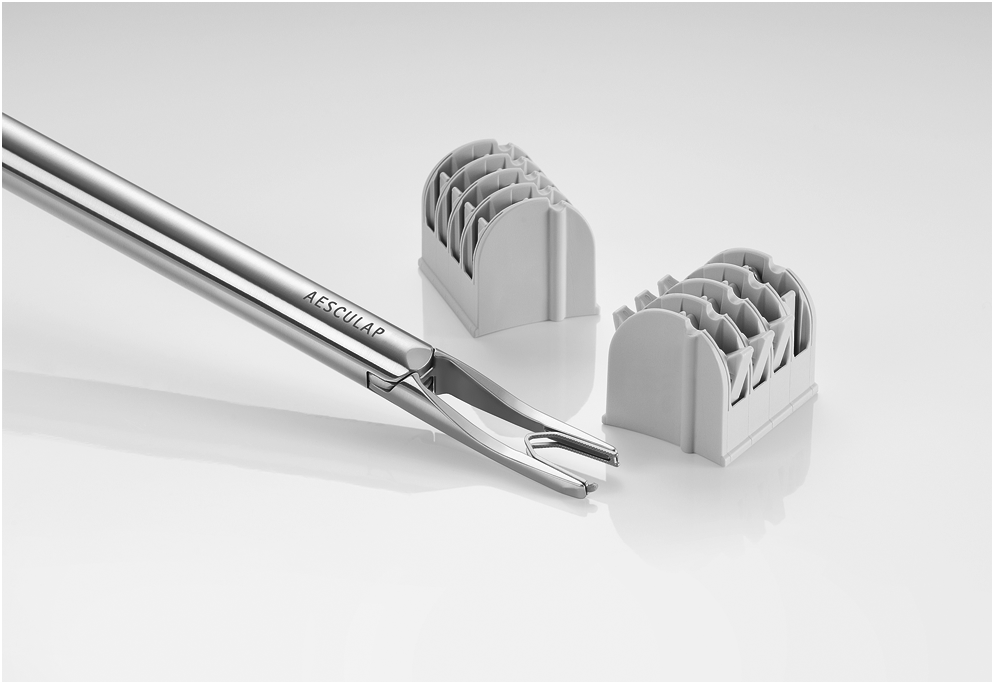
DS-titanium ligation clip and applier (AESCULAP©).
General recommendations for correct application of the Hem-o-lok clips 4 also applies to DS-titanium ligation clips. It has a distal-to-proximal closure to prevent pushing out tissue during closure. Two parallel and interconnected shanks characterize the design of the clip. In the resulting space between the shanks, the tissue is compressed during the closing process, providing extraprotection against axial displacement. The two shanks additionally prevent clip scissoring, known from single shank clips. The inner surface of the clips has a pyramid-shaped surface imprint that allows the tissue to sink in between the pyramid shapes and thereby increase the contact surface of the tissue, ensuring a strong grip. A latch at the tip of the clip further prevents tissue slippage. Placing two clips in the proximal arterial stump guarantees a firm hold on the tissue, preventing clip dislodgement. If transfixation technique is preferred to ensure the arterial stump, 10 the space between the shanks allows performing a suture. There is limited experience with DS-titanium ligation clips in everyday practice, only published in terms of safety and effectiveness with appendicular stump closure during laparoscopic appendectomy.11,12 To date, there is no prospective study supporting its specific use for arterial control in laparoscopic donor nephrectomy, beyond its own generic indication for ligation of blood vessels. A proper prospective randomized trial should be conducted to prove the real benefits of these clips: searching for new alternatives for artery control in living kidney donors may promote safer surgery.
Conclusion
In conclusion, an ideal device (“100% secure”) to control the renal artery does not exist, and major bleeding has been reported with either clips or with the laparoscopic staplers. New alternatives must be proposed and explored to reach an agreement in the urological community. The DS-titanium ligation clips could be a step forward toward a safer surgery for kidney donors, at least equivalent to hand ties to occlude a renal artery.
Footnotes
Disclosure Statement
None of the contributing authors have, at present day, any conflicts of interest, including specific financial interest, relationships, or affiliations relevant to the subject matter, figures or materials discussed.