




Abstract
Introduction:
Minimally invasive surgery (MIS) for inguinal hernia repair (IHR) in children has been reported for more than two decades. The International Pediatric Endosurgery Group (IPEG) Evidence-Based Review Committee chose MIS IHR as the inaugural topic for review and presentation at the 2016 IPEG annual meeting.
Materials and Methods:
English language articles published between January 1, 2009, and December 31, 2015, were reviewed and included in this evidence-based review after searching PubMed, Cochrane Reviews, ClinicalTrials.gov, Google Scholar, and EMBASE.
Results:
Level 1a and 1b evidence supports the recommendations that operative time for bilateral IHRs should be considered shorter and postoperative complications rates should be considered lower in MIS repair over open. Recurrence rates are similar between the two methods (level 1a and 1b evidence). No level 1 evidence exists to support one MIS technique over another or that operating on a detected contralateral patent processus vaginalis during laparoscopy makes any difference in long-term outcome to the patient.
Conclusions:
The advantages of lower postoperative complications and shorter operative times have been found in studies of surgeons experienced in MIS repair and differences were small. The evidence in this review supports that MIS repair is a safe, effective method of IHR with proper training and mentorship.
Introduction
The management of pediatric inguinal hernia forms a significant part of the workload for most pediatric surgeons. The minimal access approach to inguinal hernia repair (IHR) has been reported for more than two decades.1–3
Reported advantages of the laparoscopic repair include the following:
Improved postoperative pain Faster operative times for bilateral cases Reduced tissue trauma to the delicate inguinal cord structures Identification of a potential second hernia (metachronous) on the clinically unaffected opposite (contralateral) side Improved cosmesis
Reported disadvantages include the following:
Potentially higher recurrence rate Injury to testicular vessels during the suture closure resulting in testicular atrophy Injury to intra-abdominal structures as peritoneal cavity is breached Steep learning curve
Several “methods” of minimally invasive surgery (MIS) for the repair of pediatric inguinal hernia have been described and were recently summarized by Speck and Smith for the Society of American Gastrointestinal and Endoscopic Surgeons (SAGES). 4 The techniques vary somewhat but can be subclassified by the number of ports used to complete the procedure (single versus multiple) and by the method of closing the internal ring. This can be achieved either by performing intracorporeal suturing (Intracorporeal) or by making a small groin incision to pass a suture through the abdominal wall to ligate the patent processus vaginalis (PPV) in the pre-peritoneal plane (Extracorporeal). Intracorporeal techniques may involve transection of the sac or not, and closure of the processus may be by interrupted or purse-string suturing, or by looping of the sac. 4
Different controversies exist regarding MIS repair of inguinal hernia in children:
Are MIS approaches to IHR “better” than open surgery? Within this context, what defines “better”: lower recurrence, cosmesis, complications, speed? Is one method of MIS IHR superior to others? Can an MIS repair be done as well with one incision as it can with two, or three? Does the evidence support the need to evaluate for and repair a PPV at the contralateral internal ring?
The evidence in this area has increased in both volume and quality over the past decade, yet the above controversies remain. In 2015, the International Pediatric Endosurgery Group (IPEG) Evidence-Based Review Committee chose inguinal hernia as the inaugural MIS project for review and presentation at the 2016 IPEG Annual Meeting. The goal was to guide surgeons through the published literature and generate guidelines based on not just the evidence but also the quality of the evidence for the adoption of minimal access approaches to IHR in children.
These questions will guide this review to summarize the evidence for each and generate guidelines on the adoption of MIS for IHR in children.
Materials and Methods
To identify all relevant publications for evidence examining minimally invasive approaches to IHR, searches were carried out in the following repositories: PubMed, Cochrane Reviews, ClinicalTrials.gov, Google Scholar, and EMBASE. In 2010, the IPEG membership reviewed this topic and summarized the evidence up to 2009. 2 This evidence-based review included only the evidence published since January 1, 2009. All studies pertaining to minimally invasive IHR in children were reviewed by the authors and summarized.
Categorizing levels of evidence
The Oxford Centre for Evidence-Based Medicine classification for levels of evidence was used to review and assign levels of evidence to the identified literature (Table 1). 5 This classification then grades the strength of recommendations that can be made from the evidence. This was used to inform and generate the guidelines for the repair of pediatric inguinal hernias by minimally invasive techniques.
Oxford Centre of Evidence-Based Medicine Classification of Levels of Evidence and Grades of Recommendation
Source: El-Gohary. 1
CI, confidence interval; FU, follow-up; RCT, randomized control trial.
Results and Discussion
Are MIS approaches to IHR “better” than open surgery?
Since 2009, there have been four systematic reviews comparing MIS IHR to open.6–9 Feng et al. limited their meta-analysis to the randomized control trials (RCT) that have been published directly comparing laparoscopic herniorrhaphy (LH) to open herniorrhaphy (OH) and provided the only level 1a evidence in this area. 7 They included five randomized control studies (level 1b evidence).3,10–13 Their analysis found that the operative time for unilateral IHR was similar for OH and LH (−1.79 minutes, 95% CI −9.08 to 5.50). For bilateral IHR, results favored LH (−7.99 minutes, 95% CI −12.69 to −3.79). 7
Feng et al. also analyzed the total number of postoperative complications for children treated with MIS versus open IHR. 7 The common reported complications included the following: hydrocele, scrotal edema, erythema, testicular atrophy, iatrogenic ascent of the testis and recurrence. Again, LH was favored with respect to total postoperative complications (OR 0.45, 95% CI 0.24–0.86). Two of the five RCTs analyzed reported major complication rates in the male patients, defined as scrotal edema, iatrogenic ascent of the testis, and testicular atrophy.10,12 Again, the meta-analysis favored LH (OR 0.28, 95% CI 0.09–0.87). Since these complications are rare in both methods of repair, these effects were small. With respect to recurrence, Feng et al. found no difference when analyzing the pooled data (OR 0.71, 95% CI 0.12–3.24). 7
Other than the five randomized control trials included in the meta-analysis of Feng et al., no other level 1b evidence was identified in our review.3,7,10–13 In the systematic review, greater heterogeneity was seen in the analysis of operative time and minor complications. The studies had little heterogeneity when comparing major complications and recurrence (I2 = 0 and 2%, respectively). 7
On review of the individual randomized control trials, we gain further level 1b evidence on a number of metrics. Shalaby et al. randomized 250 patients with IH to either laparoscopic repair, using a Reverdin needle, or open repair (n = 125 and 125, respectively) and followed them for a mean of 24 months. 10 They found significant differences in cosmetic results with 5 parents (4%) reporting “ugly scars” after open repair and none after laparoscopic repair (P = .024). Pre- and postoperative testicular perfusion was assessed by ultrasound and no differences were seen following laparoscopic repair, but in the open repair group, 3 cases (3.3%) had significant reduction in testicular perfusion and size. 10
The randomized control study by Saranga Bharathi et al. compared 85 children undergoing either laparoscopic intracorporeal Z-suture repair or open repair following for a mean of 3.5 months. 12 Well-performed conventional herniotomy appeared to yield similar results to those of laparoscopic repair. Cosmesis and the ability to detect and simultaneously repair contralateral patent processus vaginalis (CPPV) were reported as the two main advantages of LH over OH. An overall conclusion was made that the open method was an equivocal alternative for those centers that did not have laparoscopic facilities.
Celebi et al. randomized 62 boys undergoing bilateral IHR. 13 Thirty-two patients underwent open repair and 30 underwent laparoscopic repair by intracorporeal purse-string suturing of the hernia sac. Postoperative pain scores were evaluated by the visual analog scale and were found to be higher in those undergoing open repair 1 hour following surgery (P = .05), but not at subsequent time periods (2, 4, 12, and 24 hours). Parent's opinions of wound appearance were significantly better following LH than open (P < .05).
Koivusalo et al. randomized 89 patients to either laparoscopic repair by intracorporeal z-suture technique or open repair (n = 47 and 42, respectively). 11 They found that recovery from surgery measured by return to normal daily activities was not significantly different between groups overall. Rescue analgesia was required more frequently following laparoscopic repair than open (79% and 42%, respectively, P = .05). Objective pain scores were also significantly higher at 30 minutes, 60 minutes, and postoperative days number 1, 2, and 3 following laparoscopic repairs. No testicular atrophy was noted and cosmesis scores were not different between groups.
Chan et al. compared 83 patients undergoing laparoscopic IRH either by intracorporeal purse-string suturing or open repair (n = 41 and 42, respectively). 3 Postoperative pain was evaluated by the total number of acetaminophen doses required. Patients undergoing open surgery required more doses than those undergoing LHR (1.05 versus 0.84 doses per patients, P = .032). Wound appearance was also perceived to be better by the parents of patients undergoing LHR. 3
Alzahem provided the only level 2a evidence comparing laparoscopic and open IHR. 6 They included only comparative studies and identified two randomized control trials, one clinical trial, and six cohort studies comparing 2699 children undergoing IHR.3,11,12,14–20 They reported a trend toward higher recurrence rates for LH, but this was not statistically significant (OR = 1.81, 95% CI 0.89–3.67, P = .10). Operative times were significantly longer for unilateral LH (weighted mean difference [WMD] = 10.23, 95% CI 8.82–11.64, P < .00001) compared to open. For bilateral IHRs, they reported a trend toward shorter operative time LH (WMD −4.54, 95% CI −11.63 to 2.55, P = .21) over open, but again this was not statistically significant. They did find a significant reduction in the development of metachronous hernias in the patients undergoing laparoscopic repairs (OR = 0.37, 95% CI 0.20–0.67, P = .001). 6
The two other systematic reviews identified in our search included both randomized control trials and other observational clinical studies directly comparing LH with OH (level 3a).8,9 Yang et al., included three RCTs and four comparative studies in their meta-analysis.3,11,12,14,15,17,18 They reported no difference in operative times for unilateral IRH between LH and open. LH was slightly favored for bilateral repairs (WMD −11.14, 95% CI −20.61 to −1.68). Hospital stay and return to full activity also showed no difference. Evaluation of the pooled data found no difference in recurrence rates between LH and OH. The common identified complications included hydrocele, wound infection, scrotal edema, erythema, testicular atrophy, and pain. No differences were found between LH and open for any of these complications.
Esposito et al. identified 53 studies that matched their inclusion criteria, including any studies that reported “outcomes” of OH or LH. 8 Thirty-nine were clinical trials, five RCTs, and nine multicenter studies resulting in a cumulative, 19,022 children (11,591 LH and 7400 OH). Analysis was limited to Fisher's exact tests between reported data. Thirty-six of the studies reported operative times and showed wide variations depending on technique and experience. No significant difference was shown between LH and OH for unilateral IHR. For bilateral inguinal hernias, OH was significantly longer than LH [40.1 minutes versus 30.9 minutes (P = .01)]. However, when the authors only examined the 11 studies comparing OH with LH, there was no significant difference in operative times for either unilateral or bilateral IHR. Conversion rates in the eight studies reporting this finding ranged between 0 for most and 1.7% in the highest. Recurrence was reported in 43 studies and ranged from 0% to 6% in OH and from 0% to 5.5% in LH. The mean rate of recurrence in the pooled data was 1.6% in OH (26 of 1539 open repairs) and 1.4% in LH (138 of 9605 repairs) (P = .66). The authors specifically examined recurrence rates in infants undergoing IHR and found that the data from the three studies reporting this, recurrence rates, and wound infections were higher after OH compared with LH. Other complications were reported in 22 other studies and included wound infection, hydrocele, iatrogenic cryptorchidism, and testicular atrophy and were found to be more common for OH (2.7%) than LH (0.9%) (P = .001). Twenty-five studies reported the coexistence of a CPPV during repair of apparent unilateral inguinal hernias. The incidence varied between 19.9% and 66% and appeared to be higher in the smaller infants. They did not mention the rate of metachronous hernia after open repairs. 8
The remaining studies comparing LH with OR identified in our review provide level 3b, 4, or 5 and will not be discussed in detail in this article. Overall, the evidence published to date examining OH versus LH supports that recurrence rates are similar between the two methods but that overall complications rates are higher in the open group (level 1a, 1b, and 3a evidence, Fig. 1). There may be an advantage in operative time for repair of bilateral hernias when performed laparoscopically (level 1a, 1b, and 3a evidence). The presence of a PPV on the contralateral side was documented but its significance was not examined. This specific topic will be discussed later in the article.
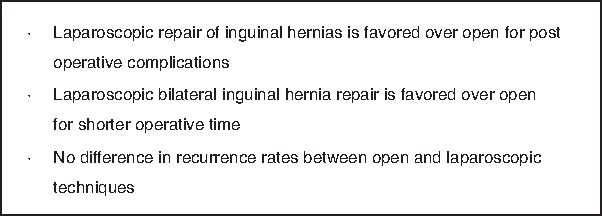
Key points from level 1a data on open versus laparoscopic inguinal hernia repair in children.
Is one method of MIS IHR superior to others?
Several methods for laparoscopic repair of inguinal hernia in children have been reported. 4 These can be summarized in various ways. For the purposes of this evidence-based review, we have chosen to classify the techniques as per Table 2, which is similar to the methods of closure elegantly presented on the Society of American Gastrointestinal and Endoscopic Surgery Wiki page by Speck and Smith. 4
Classification of Methods of Minimally Invasive Closure of Pediatric Inguinal Hernias
Source: Speck and Smith. 4
Essentially, intracorporeal methods, whether performed with single or multiple incisions, close the internal ring with intracorporeally placed sutures. These may or may not include dissection or division of the hernia sac. Extracorporeal methods utilize the preperitoneal plane via a groin incision. This plane can be used to place a suture around the PPV under laparoscopic visualization of the internal ring. This is either performed totally in the preperitoneal plane or the suture may be brought into the peritoneal cavity briefly to allow for the path around the processus be achieved more easily. Variations have been developed to improve the passage of this suture (hydrodissection, needle choice, Lasso, etc.) and more recently “traumatizing” the peritoneum has been described as a method of reducing recurrence by inciting inflammation and improving closure of the processus. 21
Other laparoscopic approaches to IHR in children have also been described. These include laparoscopic-assisted microincision and extraperitoneal division and ligation, and laparoscopic sac resection without closure.22,23 Evidence to support their benefit compared to other methods is minimal and therefore for the purposes of this guideline will not be explored further.
The vast majority of the evidence published to date specifically looking at the method of laparoscopic hernia repair are case series (level 4) describing the experience of a single surgeon or group. A few case–control studies (level 3b) and three single randomized control trials (level 1b) comparing laparoscopic repair techniques in children have been published.
Level 1b evidence comparing different methods of minimally invasive hernia repair in children
There have been three randomized control trials comparing different methods of minimally invasive hernia repair in children. 24 Borkar et al. randomized fifty children (n = 50) to compare two variations of intracorporeal, circumferential incision of the peritoneum and suture ligation of the neck. In Group 1 (n = 25), partial resection of the distal sac was performed. In Group 2 (n = 25) it was not. They found no statistical difference in mean operative time, time to discharge, or complications. After a mean of 12.4 months of follow-up (range 6–18 months), no recurrences were observed in either group. The authors concluded that sac resection might not be necessary during this method of closure. 24
Shalaby et al. randomized 150 children over a 3-year period, comparing intracorporeal and extracorporeal methods of minimally invasive hernia repair. In Group A (n = 75), intracorporeal purse-string suturing of the internal ring was performed with two needle holders. In Group B (n = 75), the purse-string suture was placed using a Reverdin needle and extracorporeal knotting. The operative time for the extracorporeal knotting method was significantly shorter and this was statistically significant for all categories of repairs (bilateral, unilateral recurrent, hernia in obese patients, incarcerated hernia). After a mean follow-up period of 24 months, the recurrence rate in Group A was 4% and in Group B was 1.3%, but this was not a statistically significant difference. The authors concluded that laparoscopic hernia repair with Reverdin needle was an effective method with marked reduction of operative time (Shalaby, 2010).
Chen et al. studied extracorporeal purse-string suturing with and without the addition of an umbilical ligament covering over the repair. Over 4 years, 428 children were randomized to Group A (n = 214) with laparoscopic extracorporeal closure of the internal hernia opening with the use of an Endoneedle or Group B (n = 214) with extracorporeal suturing followed by reinforcement with the umbilical ligament covering the repair. The mean follow-up time was 69.67 months. The recurrence rate was significantly lower in Group B (0.00% versus 4.18%, P < .05). There was no statistically significant difference in operative times or postoperative complications. The authors conclude that it is possible to achieve a near-zero recurrence rate with this modification (Chen 2011).
Level 3b evidence comparing different methods of minimally invasive hernia repair in children
There have been three case–control studies comparing different methods of minimally invasive IHR in children published to date (level 3b evidence).25,26 Li et al. compared results of extracorporeal percutaneous IHR using either a “single-hooked” (n = 63) or “two-hooked” (n = 72) core needle apparatus to pass the suture around the PPV. 25 They found that operative time was significantly improved with the “two-hooked” apparatus for both unilateral and bilateral IHR (P = .032 and .008, respectively). There was no difference in recurrence or complications between groups. Grimsby et al. compared using absorbable (2-0 polyglactin) versus nonabsorbable (2-0 polyester) suture material during laparoscopic IHR by the extracorporeal subcutaneous endoscopically assisted ligation method. 26 Ninety-four patients had 107 hernias repaired laparoscopically. Patients repaired with absorbable suture (n = 50) had a 26% chance of recurrence compared to those repaired with nonabsorbable suture (n = 47) whose risk was only 4% (P = .004). The authors concede that the 26% recurrence rate was higher than other studies and may be confounded by their learning curve while initially adopting the laparoscopic procedure. Finally, Uchida et al. compared laparoscopic percutaneous extraperitoneal closure (LPEC) to a single-incision approach (SILPEC), which moves the laparoscope and 3-mm grasper to the same transumbilical incision. During a 9-month period, 117 sequential LPEC repairs were performed in the first 5 months followed by 60 sequential SILPEC repairs in the next 4 months. There was no significant difference in operative times and no evidence of early recurrences in either group. Follow-up was only a mean of 1.4 months in the second group. The authors conclude that SILPEC IHR in children is safe and feasible (Uchida, 2010).
Level 4 evidence describing different methods of minimally invasive hernia repair in children
The majority of the published literature on MIS pediatric IHR are case series (level 4) describing single-center/surgeon experience with a single technique.22,25,27–37 While these inform the conversation, the ability to draw conclusions from their data is limited. The same can be said from the review articles (level 5) published to date. 21 This literature was reviewed but will not be discussed in detail in this guideline.
Does the evidence support the need to evaluate for and repair a PPV at the contralateral internal ring?
The question of whether contralateral groin exploration is warranted in children presenting with an apparent unilateral inguinal hernia is as old as hernia repairs themselves. Proponents site a possible missed opportunity to intervene before incarceration leads to complications or the avoidance of a second anesthetic. Opponents feel that since the incidence is low and the complications minimal, putting the other side at risk, particularly in male patients, is unwarranted.
The use of laparoscopy in pediatric IHR has the potential of eliminating the risk of a metachronous hernia developing since the contralateral side can be easily inspected for the presence of a PPV; if found, most advocate closure. However, the natural history of a PPV is not clear and many feel that only some will go on to become a true hernia. Unfortunately, the systematic review by Feng et al. did not address this question, and so, no level 1a evidence is available. 7 Three of the five randomized control trials comparing laparoscopic pediatric hernia repair to open attempted to address this issue (level 1b evidence).3,11,12 Chan et al. reported a 32.4% incidence of contralateral PPV during laparoscopic repairs, repaired at the time of operation. They found that 12.5% of patients undergoing unilateral open repair presented with a metachronous hernia within the follow-up period (mean 11.786 months). 3 Koivusalo et al. reported that 26% of patients undergoing laparoscopic repair (n = 47) had a PPV, which was not repaired at the initial operation if it had been asymptomatic preoperatively. 11 Five patients developed metachronous inguinal hernias between 1 and 2 years after the initial operation. Three of these had undergone laparoscopic repair and the PPV was observed at the initial operation. The other two had undergone open repair (n = 42). 11 Saranga Bharathi et al. identified 10 patients (20%) undergoing laparoscopic repair (n = 51) who had a contralateral PPV, which was repaired at the initial operation. 12 No metachronous hernias were reported in the patients who underwent open repair (n = 34) during the follow-up period (mean 3.5 months). 12 The systematic review by Yang et al. found no advantage to laparoscopic repair to prevent metachronous hernias (level 3a evidence); however, there was significant heterogeneity in the studies used (I2 52.8%). 9 With the removal of one of the studies, the heterogeneity was improved (I2 36.9%) and showed a slight advantage to laparoscopic repair.
It is difficult to draw conclusions from this evidence. Even the level 1b studies are not really randomizing whether there is an advantage to repairing an incidentally found PPV. From the evidence it is clear that overall, patients presenting with unilateral inguinal hernia have ∼20%–30% chance of having a contralateral PPV (level 1b evidence). It appears that about one-quarter of those may develop into a metachronous inguinal hernia. No studies have randomized incidentally found PPVs to closure or observation.
A recent systematic review containing a variety of studies evaluating this issue supports these conclusions. 38 Kokorowski et al. reported that the pooled incidence of metachronous hernia development after unilateral IHR was 7.3% (95% CI 6.5–8.1). Laparoscopic evaluation identified a contralateral PPV in 30% of patients. They conclude from their evidence that three asymptomatic PPVs would need to be closed to prevent one metachronous hernia from developing. Based on the currently available evidence, we cannot conclude that the risk to those patients, who would not have developed an inguinal hernia on that side, is worth it to prevent complications in those that would have. Certainly if this is shown in the future, laparoscopic IHR would be significantly advantageous over open to address any PPV.
Conclusions/Recommendations
Based on a decade of evidence in the pediatric surgical literature and using the Oxford classification of evidence-based medicine, the following conclusions can be made for pediatric minimally invasive hernia repair:
Operative time for bilateral IHRs should be considered shorter with the laparoscopic technique when compared to the open. Level 1a and 1b evidence Grade A recommendation Postoperative complication rates should be considered lower in laparoscopic inguinal hernia over open. Level 1a and 1b evidence Grade A recommendation Recurrence rates should be considered similar for either the laparoscopic or the open technique. Level 1a and 1b evidence Grade A recommendation Comparing different laparoscopic hernia techniques: No level 1 evidence exists to support one laparoscopic technique over another. Only Grade C recommendations can be made from the available evidence. The question of detection and management of a CPPV: No level 1 evidence exists to suggest that operating or not on a “detected contralateral PPV” during a laparoscopic procedure has any difference in long-term outcome to the patient. Only Grade C recommendations can be made from the available evidence.
It should be stated that the advantages of lower postoperative complications and shorter operative time have been found in studies of surgeons experienced in MIS repair. Any surgeon wishing to adopt minimally invasive techniques should undergo proper training and mentorship. Certainly, the benefits described above for MIS repair are not so great that we abandon open repair as a suitably safe and effective method of surgically managing a pediatric inguinal hernia. Currently, no recommendations can be made for one method of MIS IHR as direct comparisons are lacking. The current evidence does not definitively support or refute the need for repair of an incidentally found PPV during laparoscopic IHR. Further research directly examining these latter questions would be useful.
Footnotes
Acknowledgment
Funding: The International Pediatric Endosurgery Group (IPEG) Evidence-Based Review Committee.
Disclosure Statement
No competing financial interests exist.