




Abstract
Background:
Most commonly, volume measurements are used to evaluate the effect of lymphedema treatment, but as the accumulation of lymph fluid can be local, this method may not always be the best. Tissue dielectric constant (TDC) can be applied to identify local lymphedema changes, but has not been used before when evaluating treatment in mild arm lymphedema. Thus, the overall aim of this study was to examine if TDC and water displacement method (WDM) can measure changes in mild breast cancer-related lymphedema during the 6-month standard treatment. More specifically, we examined changes within and between three defined groups based on lymphedema thresholds of TDC and WDM at start of treatment, as well as changes of the highest TDC ratio and site.
Methods and Results:
Forty-six women with mild arm lymphedema, received treatment with compression sleeves, mostly ccl 1, and instructions about self-care. Local tissue water was measured by TDC at six defined sites and lymphedema relative volume (LRV) by WDM before treatment and at first, second, third, and sixth month. There was a significant decrease in the site with the highest TDC ratio, as well as LRV at all follow-up visits. At 6 months, TDC ratio had decreased mean 0.26 (p < 0.001) and LRV mean − 3.3% (p < 0.001). There was a significant difference between the groups in change of TDC ratio, but not in LRV. Sixty percent changed the overall highest TDC ratio to another site during 6 months.
Conclusion:
Both TDC and WDM could detect changes in mild arm lymphedema but should be interpreted separately.
Introduction
Breast cancer-related lymphedema (BCRL) is common and negatively affects functioning and quality of life. 1 Early diagnosis and treatment of arm lymphedema are important to prevent progression2–4 and to increase the chance of curing the disease. 5 The standard treatment in mild arm lymphedema includes prescription of a compression arm sleeve and information about self-care. 6
The effectiveness of treatment is traditionally evaluated by measuring either volume with the water displacement method (WDM) or measuring the circumference. 7 However, in mild arm lymphedema, the accumulation of lymph fluid can be local, without increase in arm volume. 8 Also, due to volume differences in the dominant and nondominant arm 9 and in the absence of preoperative arm volume measurements, the WDM may not be sensitive enough to measure changes in mild arm lymphedema. Thus, tissue dielectric constant (TDC) measuring local tissue water in skin and subcutis can be applied to identify local lymphedema changes.
Only a few studies have evaluated lymphedema treatment with TDC. Tugral et al. evaluated complex decongestive physiotherapy in 17 patients with unilateral severe leg lymphedema and found a significant reduction in circumference and in skin tissue water. 10 Birkballe et al. compared 9 untreated patients with leg lymphedema with 10 patients treated with compression bandaging. They found that the treated patients had a lower TDC ratio compared with the untreated patients, indicating that it is possible to evaluate compression treatment with TDC. 11
Increased knowledge of changes in volume and local tissue water may help to determine the most effective individual treatment, particularly in cases of mild lymphedema. During treatment after BCRL, it is therefore of interest to examine if TDC and WDM can detect small changes and how TDC and WDM values change over time.
Karlsson et al. have used TDC and WDM in combination with skin palpation for diagnosis of mild arm lymphedema. They found that 45% of the women were diagnosed by TDC only, 26% by WDM only, and 29% by both. 8 It is therefore of interest to examine if there is a significant difference between the defined groups regarding change of TDC ratio, during treatment. To the best of our knowledge, TDC has not been used earlier to evaluate treatment in mild BCRL. Also, there are only a few studies that have evaluated treatment of mild arm lymphedema with WDM. Thus, the overall aim of this study was to examine if TDC and WDM can measure changes in mild BCRL over a 6-month period of standard treatment. More specifically, we examined changes within and between the three groups based on lymphedema thresholds of TDC and WDM at start of treatment, as well as changes of the highest TDC value and site.
Materials and Methods
Study design
This was a prospective longitudinal study. Data were collected from a larger project where women with BCRL were randomized to compression treatment or not and were followed during 12 months. In the present study, only measurements from participants receiving compression treatment are presented.
Participants
Women treated for unilateral breast cancer, with axillary node dissection, diagnosed with mild arm lymphedema and treated with compression, at the Lymphedema Unit, Skåne University Hospital, and at the Physiotherapy Cancer Unit, Karolinska University Hospital, were included. The women were excluded if they had recurrent cancer, concurrent diseases, cognitive disability, or unable to understand Swedish.
Ethical approval
Before taking part in the study, all participants received information, and provided written informed consent before inclusion. Data were collected from September 2014 to May 2019. The study was approved by the Regional Ethics Board, Lund University. Dnr: 2014/399.
Examinations and measurements
Increased skin and subcutis thickness
Palpation of increased skin and subcutaneous thickness was performed simultaneously in both arms at the medial, ventral, and lateral sites. An increased thickness in the affected arm compared with the nonaffected arm was noted. 12 Skin thickness has been shown to correlate with the degree of swelling 13 and dermal backflow. 14 Palpation combined with measurement of arm volume has previously been used to diagnose mild arm lymphedema.2,8,15
Local tissue water
Local lymphedema was measured by the MoistureMeterD and MoistureMeterD compact (MMDC) (Delfin Technologies Ltd., Finland) (Fig. 1). The device transmits a high-frequency electromagnetic wave at 300 Hz from the probe in contact with the skin, and calculates the complex permittivity of the composite tissue. The device allows measurements to a depth of 2.5 mm. In our model of the MMDC, the measurement values are given in the same TDC units as the multiprobe MoistureMeterD, presented as TDC values, corresponding to a maximum 78.5% of pure water content. Presented TDC ratios with our MMDC probe are approximately the same as presented with the new device MMDC, corresponding to a maximum 100% pure water content. 16 Mayrovitz et al. have reported a standard error of measurement, SEM, of 2.9% and a minimal detectable change, MMDC, of 8%. 17 Sensitivity and specificity of the TDC method for early diagnosis of BCRL are shown to be 65.8% and 83.9%, respectively. 15 Six points were measured once: 5 cm proximal and 5 cm distal to the antecubital fossa (medial, ventral, and lateral). 18 If lymphedema was palpated more proximally or distally in the arm, complementary measurements of 15 cm proximal or distal to the antecubital fossa were made.
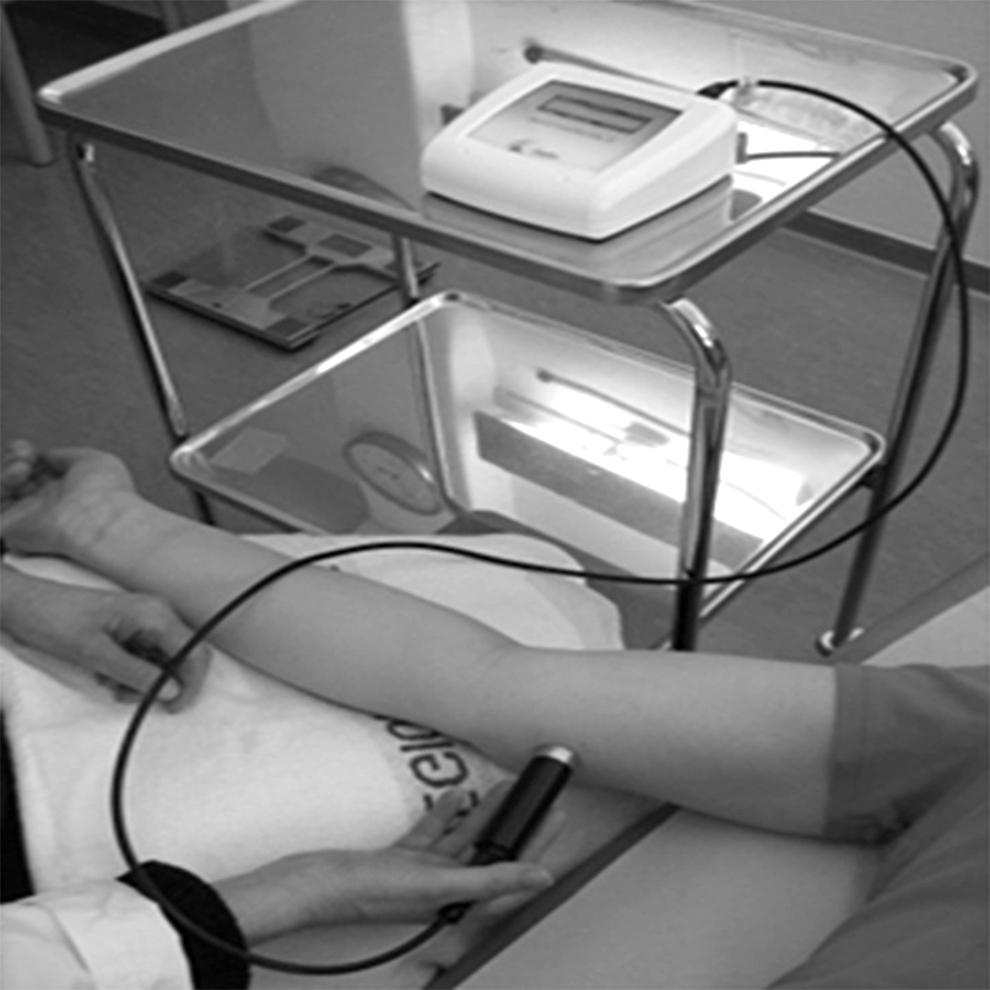
Measurement of local tissue water with MoistureMeterD (Delfin Technologies Ltd, Finland).
Arm volume
Each arm was submerged into a container filled with water, with the elbow extended and the hand placed with either the tip of the middle finger or the proximal phalanges on the bottom of the container. The contralateral arm was used as a control (Fig. 2). Lymphedema absolute volume in mL and lymphedema relative volume (LRV) in percent were obtained by calculating the difference in volume between the affected and the nonaffected side. The LRV was adjusted by −1.5/+1.5% if operated in the dominant/nondominant side. 19 The WDM is shown to be a reliable method, with intraclass correlation coefficient of 0.99 and LRV weighed mean SEM of 0.7%. 7
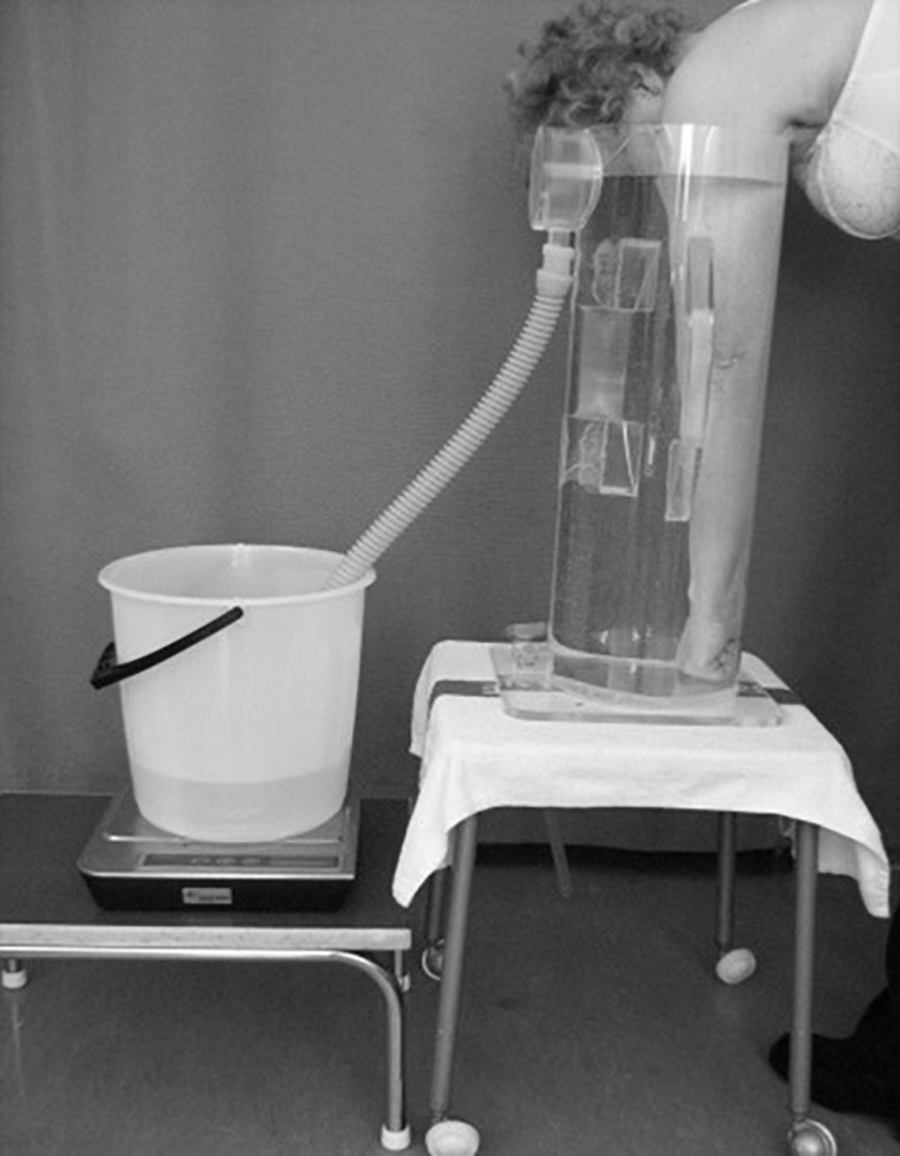
Measurement of arm volume with WDM. WDM, water displacement method.
Body mass index
Body mass index was calculated by weight (kg)/height (m2).
Compression sleeve pressure
The pressure under the arm sleeve in the upper arm was measured using an air-filled pressure transducer (Kikuhine; TT Meditade, Sörö, Denmark).
Definition of mild arm lymphedema
Mild arm lymphedema was defined as increased skin and subcutis thickness in the affected side, compared with the nonaffected side in addition with a threshold TDC ratio (≥1.45 in the upper arm and/or ≥1.3 in the forearm) 20 and/or LRV ≥5 to ≤8%. Women with mild lymphedema were divided into groups, defined by TDC (group A), both TDC and WDM (group B), or WDM (group C), at start of treatment.
Procedure
A total of 447 women were called for routine clinical follow-up visits 4 to 6 weeks after surgery and 3 to 4 months after completing radiotherapy, as recommended by Johansson et al. 21 They were also informed to notify edema between the visits. Ninety-six women were diagnosed with mild arm lymphedema. Seventy-five women agreed to participate and were randomized to compression versus no compression. Of these, 46 women were treated with compression and were followed over 6 months. Measurements with TDC, WDM, and weight were made at the start and every month for 3 months and at the sixth month. Medical data including surgical methods and adjuvant treatments were collected from medical records.
Standard treatment
The 46 women received standard circular knitted sleeves in compression class (ccl) 1 (15–21 mmHg) or, if not well fitted, flat knitted individually adjusted compression sleeves in ccl 2 for daily wearing for 6 months. All women were given routine information about the importance of physical activity and exercise, weight control, skin care, and instructions in simple lymphatic drainage. The examinations, information/advice, and prescription of compression sleeves were made by two of the authors (K.J., K.K.) and by two other experienced lymphedema therapists.
Statistical analysis
Descriptive statistics for continuous values are presented as mean ± SD and categorical variables as number and proportion. The WDM measurements were normally distributed, but not the TDC measurements. Changes of WDM measurements were presented as mean difference (CI) and calculated using the t-test. Changes of TDC measurements were presented as both median difference (min–max) and mean difference (CI), and calculated by the Wilcoxon signed-rank test. The analyses were carried out in IBM SPSS Statistics 26 and a significance level of p < 0.05 (two tailed) was chosen in the pairwise analyses. Changes of TDC and WDM measurements between the three groups (i.e., A, B, C) were presented as median differences (min–max), and calculated with the Kruskal–Wallis test. Thereafter, to reduce the risk of mass significance, the Mann–Whitney test with Dunn–Bonferroni correction for multiple tests was applied. The significance level was set to p < 0.01.
Results
All women were diagnosed early, and time from surgery to onset of lymphedema was on average 5.8 ± 5.6 months. Eighty-three percent had received chemotherapy, 74% had hormone therapy, and 91% had radiotherapy to the breast, axilla, and supraclavicular lymph nodes (Table 1). The duration of lymphedema until start of treatment was on average 1.7 ± 2.3 months (Table 1). Thirty-eight were treated with a ccl 1 compression sleeve and 8 women an individual-adjusted ccl 2 sleeve. In 12 women, the hand was also affected by lymphedema and a compression glove was therefore prescribed. The sleeve pressure, measured in the upper arm after 6 months of treatment, was on average 11.2 ± 2.8 mmHg.
Background Data for Women with Mild Breast Cancer-Related Arm Lymphedema, n = 46
ALND, axillary lymph node dissection; SD, standard deviation.
Changes in TDC ratio and WDM
TDC ratio
Among all six measuring sites 5 cm proximal and distal to the antecubital fossa (medial, ventral, and lateral), the highest TDC ratios at start were found in the upper arm medial (median 1.26) and the forearm medial (median 1.16) (Table 2). At 1 month, there was a significant decrease in the forearm medial (median difference −0.05, p = 0.021), and close to significant in the upper arm medial (median difference −0.03, p = 0.059) (Table 2). The other sites had lower median TDC ratios at start of treatment (range: 1.03–1.09) and maintained low median TDC ratios (range: 1.04–1.09) during 6 months. However, there was a significant increase of TDC ratio in the upper arm lateral (median difference +0.03, p = 0.048) at 1 month, and a significant decrease in the forearm ventral (median difference −0.06, p = 0.037) at the sixth month.
Tissue Dielectric Constant Measurements in Mild Arm Lymphedema During 6-Month Standard Treatment
TDC measured with MoistureMeterD and MoistureMeterD compact, corresponding to maximum 78.5% pure water content. Measuring sites: upper arm medial and forearm medial, 5 cm proximal and distal to the antecubital fossa, n = 46.
Wilcoxon signed-rank test, related samples, significant change p < 0.05 in bolded numbers.
Different numbers in the different calculations depending on the missing data.
TDC, tissue dielectric constant.
A significant decrease (p < 0.001) in the site with the highest TDC ratio was found at all follow-up visits (Table 3). The largest decrease was found at 1 month (median difference −0.19) and at 6 months (median difference −0.24), compared with start. Also, for the highest TDC ratio, a significant decrease was found at all follow-up visits (p < 0.05), compared with start (Table 3).
Changes in the Highest TDC Ratio at Start, the Same Site, and the Highest Ratio Followed by Any Site During 6-Month Standard Treatment, n = 46
Wilcoxon signed-rank test, related samples, significant change p < 0.05 in bolded numbers.
Different numbers in different calculations depending on the missing data.
TDC measured with MoistureMeterD and MoistureMeterD compact, corresponding to maximum 78.5% pure water content.
Water displacement method
There was a significant decrease (p ≤ 0.001) in LRV(%) at all follow up-visits, from 4.9% ± 3.4% at start to 1.7% ± 4.3% at 6 months with a mean difference (CI) of −3.3% (−4.5 to −2.1). The largest decrease in LRV(%) was seen at 1 month, mean difference (CI): −1.9% (−3.0 to −0.9) (p = 0.001) (Table 4).
Changes in Mild Arm Lymphedema, Measured by Water Displacement Method During 6-Month Standard Treatment, n = 46
LAV, difference between total arm volume affected side and total arm volume nonaffected side. LRV, absolute arm volume divided by the total arm volume nonaffected side × 100, adjusted for surgery in the dominant side with −1.5% and at nondominant side with +1.5%.
t-Test, related samples, significant change p < 0.05 in bolded numbers.
LAV, lymphedema absolute volume; LRV, lymphedema relative volume.
Differences between defined groups in changes of TDC ratio and WDM
TDC ratio
There was a significant difference in TDC ratio between the groups at start, 1 month, and second month (p < 0.001–0.004) (Table 5). At start, group A had the largest median TDC ratio (1.56), compared with group B (1.45) and group C (1.18) (p < 0.001) (Table 5). There was also a significant difference between the groups in change of TDC ratio, at the first and third month, when the highest TDC ratio at the same site was followed. At 3 months, group A had the largest decrease (median difference −0.47), compared with group B (median difference −0.25) and group C (median difference −0.06) (p = 0.003). Also, when the highest median TDC ratio by any site was followed, group A had the largest decrease at the second, third, and sixth month (p = 0.002–0.008). At 3 months of follow-up, group A had the largest decrease (median difference −0.31), compared with group B (median difference −0.21), and group C increased (median difference +0.02) (p = 0.002) (Table 5).
Changes in TDC Ratio and LRV in Mild Arm Lymphedema in Defined Groups During 6-Month Standard Treatment, n = 46
LRV = total arm volume affected side minus total arm volume nonaffected side, divided by the total arm volume nonaffected side × 100, adjusted for surgery in the dominant side with −1.5% and at nondominant side with +1.5%. TDC measured with MoistureMeterD and MoistureMeterD compact, corresponding to maximum 78.5% pure water content. Comparison between groups with mild arm lymphedema defined by TDC = group A, both TDC/WDM = group B, and WDM = group C at start of treatment. The highest TDC ratio at start, the same site, and the highest ratio by any site followed.
Kruskal–Wallis test, three independent groups.
significant difference between defined groups a, b, c, p < 0.01 marked in bolded numbers. Pairwise comparisons with Mann–Whitney. Correction for multiple tests with Dunn–Bonferroni.
Water displacement method
There was a significant difference in LRV(%) between the groups at all follow-up visits (range p < 0.001–0.007). Group A had the lowest median LRV(%) (1.8% at start and −1.4% at 6 months), followed by group B (6.3% at start and 2.0% at 6 months) and group C (7.4% at start and 4.2% at 6 months) (Table 5). There were no significant differences between the groups in change of LRV(%), at any of the follow-up visits. At the sixth month, group B had decreased (median difference −4.2%) compared with group A (median difference −2.9%) and group C (median difference −2.8%) (Table 5).
Change of highest TDC ratio and site
Among all six TDC measuring sites, 59.5% had changed the highest TDC ratio to another site, from start to 6 months. Of these, 52% had changed site from forearm to upper arm, 16% had changed site from upper arm to forearm, 20% had changed site in the forearm, and 12% had changed site in the upper arm. The results were similar also at 3 months.
Discussion
In the present study, we measured changes in mild BCRL by TDC and WDM during 6 months of standard treatment. The results showed that both TDC and WDM could detect a significant reduction in arm lymphedema, but should be interpreted separately because the methods may measure different aspects of lymphedema. Another important finding was that there was a significant difference between the defined groups in change of TDC ratio, but not in LRV. Also, the majority of the highest TDC ratios changed to another site during the intervention. These results show the importance of following several sites above thresholds at start of treatment. However, these sites were most frequently located at the medial sites in the upper arm and forearm.
The highest TDC ratio decreased significantly at all follow-up visits (Table 3), at 1 month, on average −0.18 (from 1.48 to 1.30), and at sixth months, on average −0.26 (from 1.48 to 1.23). In a previous study, Mayrovitz et al. measured the TDC ratio in the forearm in healthy women, and found a mean SEM of 0.029. 17 Also, De Vrieze et al. measured local tissue water in women with BCRL with an MMDC device, a single measurement, at five locations in the arm and found a water content ratio SEM between 0.07 and 0.17. 22 Thus, our results indicate that the TDC ratio decrease was larger than the normal measurement variability and that the TDC method could detect changes in local tissue water.
Furthermore, we found a significant decrease in LRV at all follow-up visits. The largest decrease (mean difference −1.9%) was seen already after 1 month (Table 4). In a systematic review, Hidding et al. presented a weighed LRV mean SEM of 0.7% (range 0.1%–2%), depending on different ways of measuring. 7 Karges et al. performed the measurements in a similar way as in the present study, with the ring and middle finger vertical at the bottom of the container and found an SEM of 0.1%. 22 Thus, our findings of a mean decrease in LRV of −3.3% were larger than that presented in the study by Karges et al. 23 Also, all women in the present study, regardless of the defined group at start of treatment, had a decrease in LRV. Therefore, we concluded that the WDM could be used to evaluate treatment in mild arm lymphedema.
Moreover, we found a significant difference between the defined groups in change of TDC ratio, but not in LRV, during the intervention (Table 5). Group A had the highest TDC ratio at start and largest decrease. Group B had the largest decrease in LRV, and group C had the smallest decrease both in TDC ratio and LRV. Therefore, it is important to follow both TDC and WDM values and interpret separately depending on which values are above thresholds at start of treatment. Surprisingly, both groups A and C had a similar decrease in LRV, despite the fact that women in group A had a very low LRV, on average 1.4%, at start of treatment. This shows that the women in group A also had the benefit of treatment. However, a limitation with our study is the relatively few women in each group. Therefore, the differences between the defined groups were calculated with a higher significant level (i.e., p < 0.01), but the results should in anyway be interpreted with caution.
There was a significant decrease in the highest TDC ratio, followed at the same site, and a significant but smaller reduction in TDC ratio when the highest TDC ratio at any site was followed. Also, the site with the highest TDC ratio changed to another site from start to 6 months in about 60% of the women. These results indicate that the total local tissue water had decreased during treatment but may in some cases have moved to other parts of the arm. This shows the importance of monitoring several sites when evaluating treatment. Interestingly, 52% changed the highest site from forearm to upper arm, which probably is an effect of the compression therapy. However, we do not know the normal variation in change of the site with the highest TDC value in the healthy arm, and so, the results must be interpreted with caution.
Among all the measured six TDC sites, the highest TDC ratios at start were found in the upper arm medial and forearm medial. At 1 month, there was also a significant decrease in the forearm medial and close to a significant decrease in the upper arm medial. Karlsson et al. also found the highest frequency of TDC ratio exceeding thresholds at the medial sites, in the upper arm and forearm at diagnosis of mild arm lymphedema. 8 The results in the present study confirm that the medial sites are appropriate to measure, not only to diagnose lymphedema but also to evaluate treatment.
Conclusion
There was a significant decrease in both local tissue water and LRV during 6 months of standard treatment. The results are of clinical importance and showed that both TDC and WDM could detect small changes during treatment, but should be interpreted separately. Also, the majority of the overall highest TDC ratio changed to another site during treatment, showing the importance of following several sites, above thresholds at start of treatment. However, these sites were most frequently located at the medial sites in the upper arm and forearm.
Footnotes
Acknowledgments
The authors thank the participants in this study, colleagues RPT Christina Snöbohm and Polymnia Nikolaidis who assisted in the examinations, Ebba Petersson, statistician, and RPT, PhD, and Michael Miller for language editing.
Authors' Contributions
K.K. and K.J. were responsible for the study's design and data collection. All authors were responsible for the analysis, critical revisions, and the drafting of the article.
Author Disclosure Statement
No competing financial interests exist.
Funding Information
This research was supported by the Swedish Cancer Foundation and the Swedish Breast Cancer Association (BRO).