




Abstract
SpiC protein, a member of Salmonella spp. type III secretion system (T3SS)-2, is necessary for the survival of Salmonella within macrophages, and it plays a vital role in Salmonella pathogenesis. To develop and test monoclonal antibodies (MAbs) against SpiC protein, two recombinant proteins, rHis-SpiC and rGST-SpiC, were expressed in vitro in the prokaryotic expression vectors pET-30(a) and pGEX-6p-1, respectively, and rHis-SpiC protein used to immunize mice. Hybridomas were generated from the splenocytes of these mice and the monoclonal antibodies produced by these cells were assessed using indirect enzyme-linked immunosorbent assay (ELISA) with rGST-SpiC as the coating antigen. An immunoblotting analysis indicated that all seven of the MAbs developed in this study could specifically recognize the SpiC protein. These MAbs will be very useful in the study of SpiC function and for use in the immunodiagnosis of Salmonella infection.
Introduction
T
In previous studies, spiC gene deletion caused attenuation of Salmonella pullorum, Salmonella gallinarum, and Salmonella enteritidis.(9–12) Additionally, the spiC gene is specific to Salmonella spp., and SpiC protein can induce antibodies against it in infected hosts. Therefore, SpiC could be useful as a specific biomarker that could be measured using enzyme-linked immunosorbent assay (ELISA) for immunodiagnosis.
In this study, seven hybridoma cell lines secreting MAbs against SpiC protein were established, and all the MAbs produced by these cell lines recognized the recombinant SpiC protein. These MAbs could be valuable tools for both the immunodiagnosis of Salmonella spp. and the study of the biological functions of SpiC protein during Salmonella infection.
Materials and Methods
Expression and purification of recombinant SpiC proteins
Recombinant E. coli BL21(pGEX-6p-1-spiC) and E. coli BL21(DE3)(pET-30(a)-spiC) cells and corresponding indirect ELISA to detect antibodies that recognize SpiC protein were developed in a previous study.(13) The production of recombinant proteins rGST-SpiC and rHis-SpiC was induced in E. coli BL21(pGEX-6p-1-spiC) and E. coli BL21(DE3)(pET-30(a)-spiC) cells, respectively, with 0.5 mM isopropyl-β-D-thiogalactopyranoside (IPTG) at 30°C. The induced bacteria, after being centrifuged at 12,000 g for 10 min at 4°C and washed twice with phosphate-buffered saline (PBS), were resuspended in PBS and lysed by sonication. The rGST-SpiC and rHis-SpiC proteins were purified with a glutathione–Sepharose column (GE Healthcare, Piscataway, NJ) and a Ni2+ Sepharose column (Novagen, Madison, WI), respectively. The purified proteins were collected and analyzed on a 12% SDS-PAGE gel stained with Coomassie brilliant blue.
Immunization of mice and establishment of hybridomas
Following a previously published protocol,14,15) 6-week-old female BALB/c mice were injected subcutaneously with 100 μg of purified rHis-SpiC protein mixed with an equal volume of Freund's complete adjuvant (Sigma-Aldrich, St. Louis, MO). Booster injections of the same antigen mixed with an equal volume of Freund's incomplete adjuvant (Sigma-Aldrich) were given twice subcutaneously at 2-week intervals, and a final intravenous injection was given exactly 3 days before harvesting splenocytes. At the same time, serum titers were detected with an indirect ELISA based on purified rGST-SpiC protein. The splenocytes were harvested and fused with SP2/0 myeloma cells following the lymphocyte hybridoma technique.
Purification of hybridoma cells and MAb production
The titers of the hybridoma culture supernatants were determined with indirect ELISA based on purified rGST-SpiC protein, and the results were used to evaluate the hybridoma cells. In this assay, a polyclonal antibody (serum from BALB/c mice immunized with rHis-SpiC) was used as the positive control, and the supernatant of SP2/0 myeloma cells was used as the negative control. Hybridoma cells that secreted MAbs directed against SpiC protein were subcloned by serial dilution. After three rounds of subcloning, 5 × 10⁵ purified hybridoma cells were intraperitoneally injected into BALB/c mice to induce ascites containing MAbs against SpiC protein.
Analysis of MAb isotypes and titers
The isotypes of the MAbs against SpiC were determined using mouse monoclonal antibody isotyping reagents (Sigma-Aldrich),(16) and the titers were determined by performing an indirect ELISA with purified rGST-SpiC protein, as previously described.(15) The ascites containing the MAbs were diluted in a range from 1:1000 to 1:16,384,000. The last dilution of the ascites at which the ratio of OD450 sample/OD450 control was ≥2.1 was deemed to be the MAb titer in the ascites.
Immunoblotting analysis
An immunoblotting analysis was performed as described previously.(16) In brief, purified rHis-SpiC and rGST-SpiC proteins were run in a 12% SDS-PAGE and were then transferred onto a polyvinylidene difluoride membrane. The MAbs against SpiC from the hybridoma cell lines were used as the primary antibodies, and horseradish-peroxidase-conjugated goat anti-mouse IgG antibody was used as the secondary antibody. The protein bands were visualized with 3,3′-diaminobenzidine.
Results
Expression and purification of recombinant SpiC proteins
IPTG was used to induce the expression of the recombinant fusion proteins rGST-SpiC and rHis-SpiC, which were subsequently purified with a Ni2+ Sepharose column or a glutathione-Sepharose column, respectively. SDS-PAGE analysis confirmed the successful production and purification of rGST-SpiC protein from E. coli BL21(pGEX-6p-1-spiC) and of rHis-SpiC protein from E. coli BL21(pET30(a)-spiC) (Fig. 1). The sizes of protein bands were consistent with the predicted molecular weights of the recombinant proteins, which were 20 kDa for rHis-SpiC from pET30(a)-spiC and 40 kDa for rGST-SpiC from pGEX-6p-1-spiC.
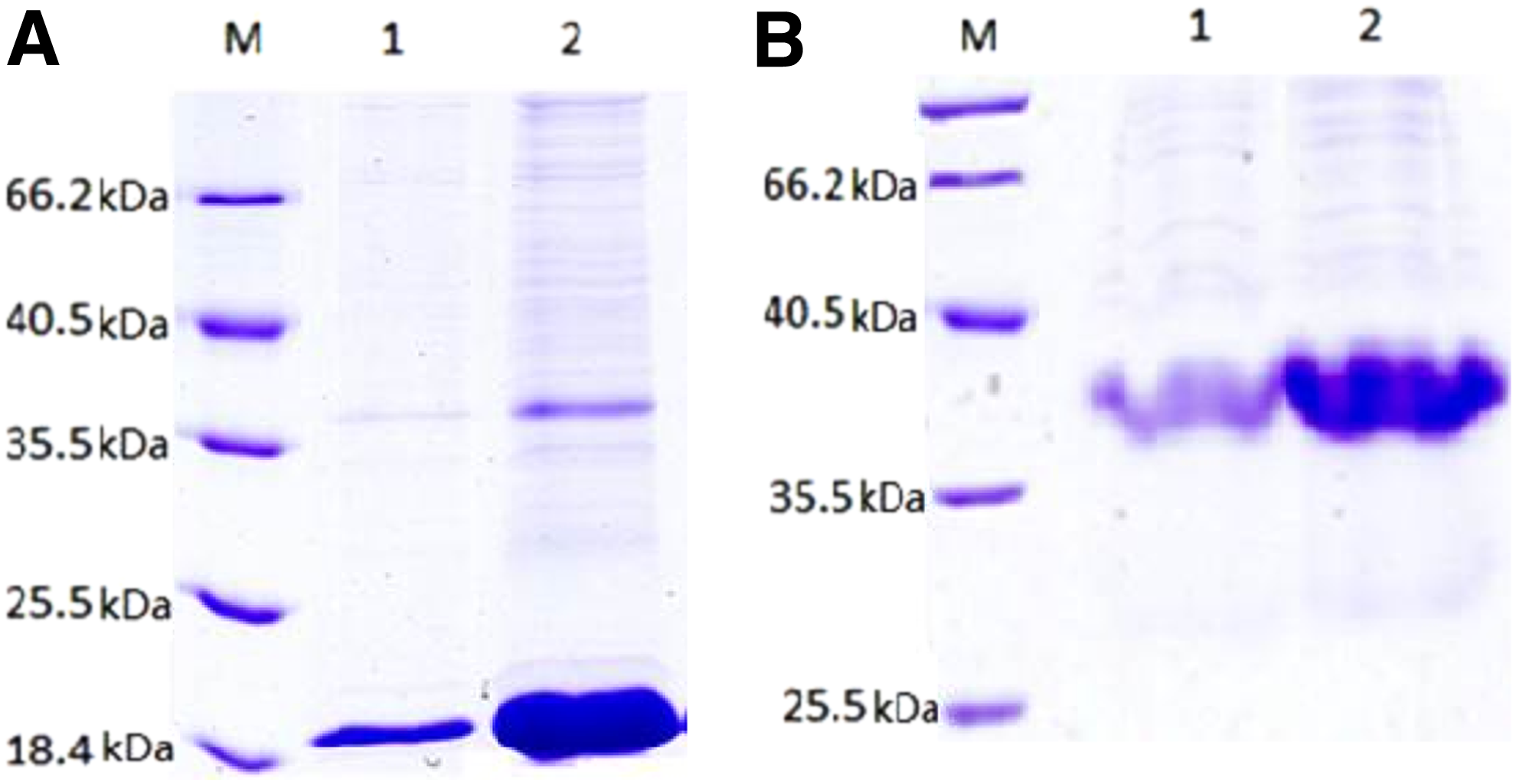
SDS-PAGE analysis of rHis-SpiC protein and rGST-SpiC. Representative gel images of rHis-SpiC protein (
Generation of MAbs against SpiC
An indirect ELISA was used to screen the positive hybridoma clones that secreted MAb against SpiC. After three rounds of subcloning and purification, seven hybridomas were established.
Isotypes and titers of MAbs
An isotype analysis of the seven MAbs against SpiC produced in mouse ascites revealed that they belonged to two isotypes, IgG1 (6B9, 3B2, 4D9, 5F8, and 3G9) and IgG2a (4F7 and 6H2) (Table 1). The results of the indirect ELISA assay showed that their titers ranged from 1 × 10⁵ to 1 × 10⁷ (Table 1).
MAbs recognize recombinant SpiC
To confirm whether all the MAbs recognized both the rHis-SpiC and rGST- SpiC proteins, the purified MAbs were tested in an immunoblotting assay. Both the expected 20 kDa and 40 kDa bands were detected in this assay (Fig. 2). The results confirmed that all seven MAbs bound to both the rHis-SpiC and rGST-SpiC proteins and did not react with the His and GST proteins from E. coli BL21(DE3)(pET) and E. coli BL21(pGEX-6p-l), respectively.

Western blot analyses of MAbs. Representative Western blots (right to left) using MAbs 3B2, 3G9, 4D9, 4F7, 5F8, 6B9, and 6H2 as primary antibodies. Lane 1, purified rHis-SpiC protein; lane 2, E. coli BL21(DE3)(pET) lysate; lane 3, purified rGST-SpiC protein; lane 4, E. coli BL21(pGEX-6p-l) lysate.
Discussion
SpiC protein, which was first found as an effector and translocator, is an SPI-2-encoded protein that helps Salmonella persist in macrophages.4,6) Although previous work revealed that SpiC has several functions, its main function was still not clear. Interestingly, our earlier study found that SpiC could induce antibody production in Salmonella-infected hosts.
MAbs against SpiC protein are needed for further basic study of this protein as well as for use in a novel diagnostic method for Salmonella spp. In this study, we used two previously established recombinant proteins: the purified rHis-SpiC protein was used as an immunizing antigen to generate MAbs against SpiC protein in mice, and the purified rGST-SpiC was used as the coating antigen in indirect ELISA to evaluate the MAb titers. This strategy of using differently tagged SpiC proteins helped to avoid the selection of false-positive hybridoma cells against the His-tag protein so that only hybridoma cells secreting MAbs against SpiC would be selected for further use.
In summary, murine B-lymphocyte hybridomas were generated, and seven hybridoma cell lines stably secreting MAbs against SpiC protein were established. The results from indirect ELISA and immunoblotting analyses confirmed that all seven MAbs could specifically recognize the recombinant SpiC proteins and did not recognize either His or GST protein. These MAbs will be valuable for studying the mechanisms of Salmonella infection and should help improve diagnostic methods for Salmonella.
Footnotes
Acknowledgments
This work was supported by the Natural Science Foundation of China (31230070), 863 Program (2011AA10A212), the China Postdoctoral Fund (2014M551670), Jiangsu Province Postdoctoral Fund (1302067C), and the Natural Science Foundation of Jiangsu Province of China (BK20151306).
Author Disclosure Statement
The authors have no financial interests to disclose.