




Abstract
Podoplanin, a type I transmembrane protein, is expressed in lymphatic endothelial cells. Although we previously developed an anticanine podoplanin monoclonal antibody (mAb), PMab-38, immunohistochemistry (IHC) showed that it did not react with canine lymphatic endothelial cells. Here, we determined whether PMab-38 recognizes canine podoplanin of squamous cell carcinomas (SCCs) and clarified its epitope. In IHC, PMab-38 reacted with 83% of SCCs (15/18 cases). Flow cytometry showed that the epitope of PMab-38 was different from that of the platelet aggregation-stimulating domain of the N-terminus, which was detected by almost all antipodoplanin mAbs such as D2–40 or NZ-1. PMab-38 is expected to be useful for investigating the function of podoplanin in canine tumors.
P
Here, we determined whether PMab-38 can recognize podoplanin of canine SCCs because human podoplanin is highly expressed in these cells and is involved in tumor malignancy.(9) We first checked the PMab-38 reactivity against SCCs (8 oral SCCs and 10 skin SCCs) in IHC. (Fig. 1 and Supplementary Fig. S1). Among them, only case 16 (1/18; 5.6%) was detected by PMab-38 in >50% of tumor cells. In total, tumor cells in 15 out of 18 cases (83%) were stained with PMab-38 in a membrane-staining pattern. Similarly, cancer-associated fibroblasts in 14 out of 18 cases (78%) were detected by PMab-38. Human podoplanin expression in several cancers contributes to poor prognosis(19); therefore, PMab-38 might be useful for investigating the pathological function of canine podoplanin in the tumor microenvironment.
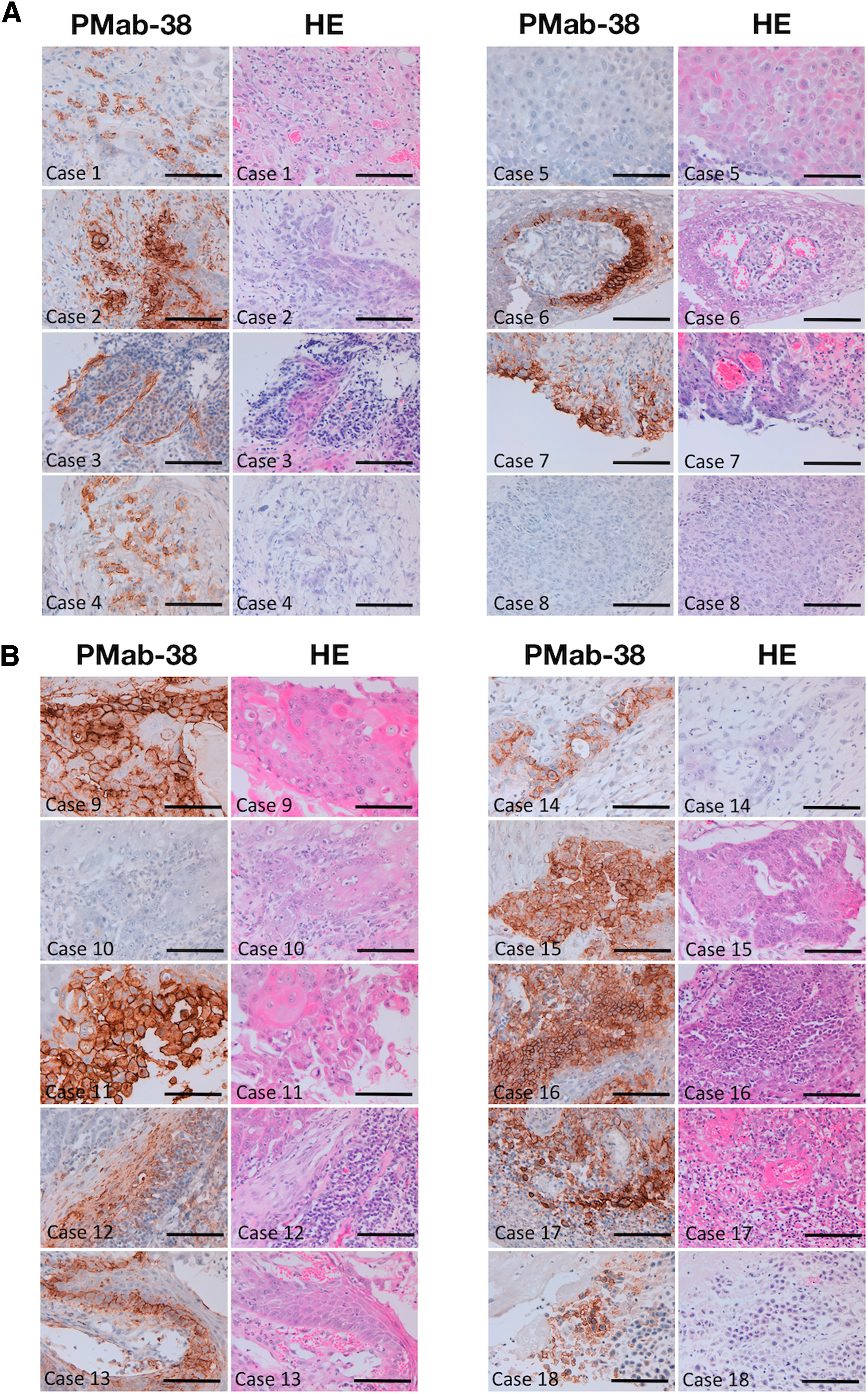
Immunohistochemical analysis against canine SCCs by PMab-38. Canine tissues
Next, we investigated the epitope of PMab-38 using flow cytometry. To this end, we produced several deletion mutants of canine podoplanin, which are expressed in CHO-K1 cells, including dN23 (corresponding to 23–169 amino acids [aa]), dN40 (corresponding to 40–169 aa), dN60 (corresponding to 60–169 aa), dN80 (corresponding to 80–169 aa), and dN100 (corresponding to 100–169 aa). Antipodoplanin mAbs usually detect the platelet aggregation-inducing (PLAG) domain, particularly PLAG1–PLAG3 (corresponding to 36–61 aa) near the N-terminus(20); in contrast, PMab-38 reacted with dN23, dN40, dN60, and dN80. When antipodoplanin mAbs reacted with the PLAG domain, they could not react with dN60, dN80, and dN100, indicating that the PMab-38 epitope is far from PLAG1–PLAG3 (Fig. 2). Previously, we produced an antihuman podoplanin mAb, LpMab-7, the epitope of which is Arg79-Leu83 of human podoplanin,(17) which corresponds to His88-Gly90 of canine podoplanin. LpMab-7 demonstrated high sensitivity compared with other antihuman podoplanin mAbs,(21) suggesting that mAbs against these epitopes have high sensitivity and specificity against not only human podoplanin but also canine podoplanin.
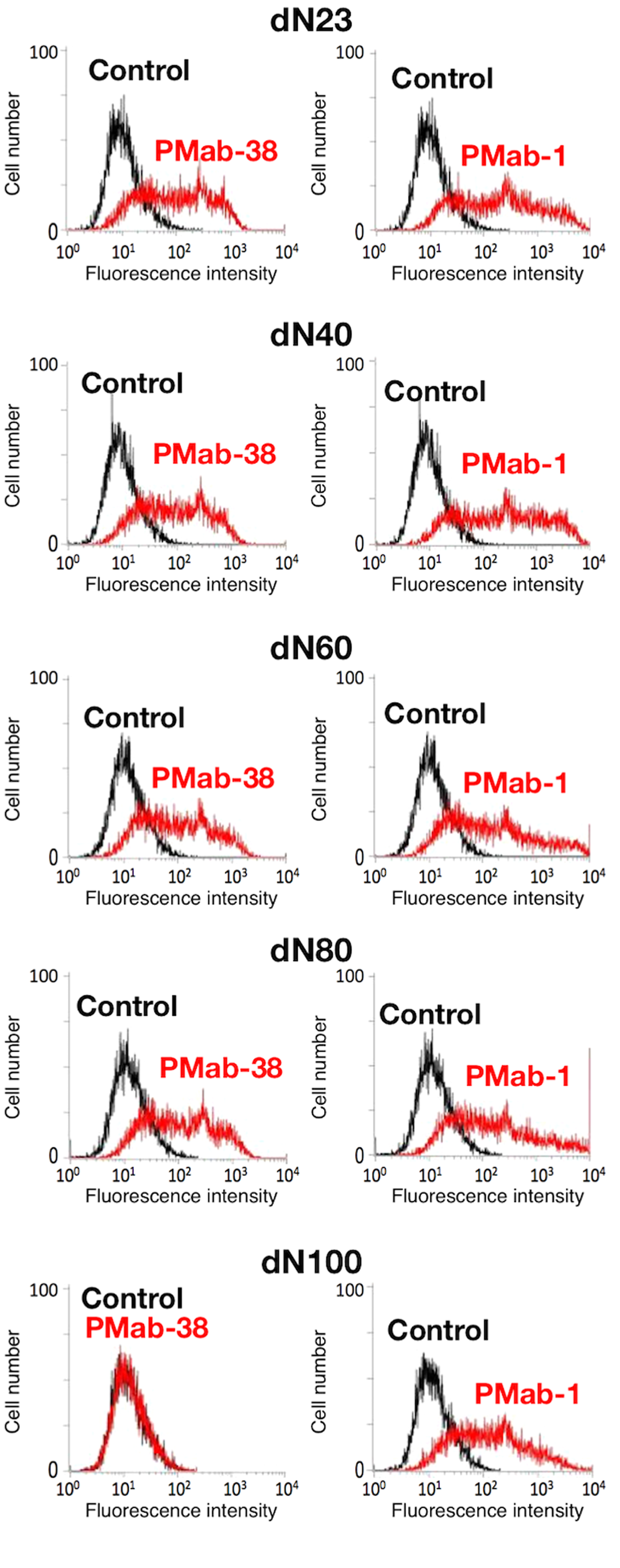
Epitope mapping of PMab-38. Amplified canine podoplanin cDNA was subcloned into a pCAG vector (Wako) with an MAP tag, which was added to the N-terminus. MAP tag is a peptide: GDGMVPPGIEDK, which is derived from mouse podoplanin. The signal sequence of IL-2 was inserted into the N-terminus. Deletion mutants of canine podoplanin were generated using sense primers and an antisense primer for dN23, dN40, dN60, dN80, and dN100, as summarized in Supplementary Table S1. CHO-K1 cells were transfected with the plasmids using electroporation. Each deletion mutant of CHO/canine podoplanin was cultured in RPMI 1640 medium (Nacalai Tesque, Inc., Kyoto, Japan) supplemented with 10% heat-inactivated fetal bovine serum (Thermo Fisher Scientific Inc., Waltham, MA) at 37°C in a humidified atmosphere of 5% CO2 and 95% air. Each cell was treated with PMab-38 or PMab-1 (anti-MAP tag) at a concentration of 1 μg/mL for 30 minutes at 4°C followed by treatment with Oregon green-conjugated antimouse IgG or antirat IgG (1:1000 diluted; Thermo). Fluorescence data were collected using a Cell Analyzer EC800 (Sony Corp., Tokyo, Japan).
Taken together, these data show that PMab-38 could be useful for uncovering the pathophysiological function of podoplanin in canine tumors. PMab-38 did not react with the lymphatic endothelium in our previous study(18); therefore, the PMab-38 epitope might be involved in cancer specificity of canine podoplanin.
Footnotes
Acknowledgments
We thank Kanae Yoshida for their excellent technical assistance. This work was performed, in part, under the Cooperative Research Program of Institute for Protein Research, Osaka University, CR-16-05. This work was supported, in part, by the Regional Innovation Strategy Support Program from the Ministry of Education, Culture, Sports, Science and Technology (MEXT) of Japan (Y.K.), by JSPS KAKENHI Grant Number 26440019 (M.K.K.) and 16K10748 (Y.K.), by the Platform for Drug Discovery, Informatics, and Structural Life Science (PDIS) from Japan Agency for Medical Research and development, AMED (Y.K.), and by the Basic Science and Platform Technology Program for Innovative Biological Medicine from AMED (Y.K.).
Author Disclosure Statement
No competing financial interests exist.
References
Supplementary Material
Please find the following supplemental material available below.
For Open Access articles published under a Creative Commons License, all supplemental material carries the same license as the article it is associated with.
For non-Open Access articles published, all supplemental material carries a non-exclusive license, and permission requests for re-use of supplemental material or any part of supplemental material shall be sent directly to the copyright owner as specified in the copyright notice associated with the article.
