




Abstract
Human podoplanin (hPDPN), the ligand of C-type lectin-like receptor-2, is involved in cancer metastasis. Until now, many monoclonal antibodies (mAbs) have been established against hPDPN. However, it is still difficult to develop a cancer-specific mAb (CasMab) against hPDPN because the protein sequence of hPDPN expressed in cancer cells is the same as that in normal cells. Herein, we report LpMab-23 of the mouse IgG1 subclass, a novel CasMab against hPDPN. In an immunohistochemical analysis, LpMab-23 reacted with tumor cells of human oral cancer, but did not react with normal cells such as lymphatic endothelial cells (LECs). In contrast, LpMab-17, another anti-hPDPN mAb, reacted with both tumor cells and LECs. Furthermore, flow cytometric analysis revealed that LpMab-23 reacted with hPDPN-expressing cancer cell lines (LN319, RERF-LC-AI/hPDPN, Y-MESO-14/hPDPN, and HSC3/hPDPN) but showed little reaction with normal cells (LECs and HEK-293T), although another anti-hPDPN mAb, LpMab-7, reacted with both hPDPN-expressing cancer cells and normal cells, indicating that LpMab-23 is a CasMab against hPDPN.
Introduction
H
Although many anti-hPDPN mAbs have been reported, almost all the mAbs such as D2-40 and NZ-1 react with the peptides of hPDPN.(4,18–22) In contrast, we have used our original technology to produce anti-glycopeptide mAbs (GpMabs) against hPDPN.(23) One of these GpMabs, LpMab-2, was shown to be a cancer-specific mAb (CasMab). LpMab-2 recognizes both an aberrant O-glycosylation and a Thr55-Leu64 peptide from hPDPN. Because LpMab-2 reacts with hPDPN-expressing cancer cells but not with normal cells, as shown by flow cytometry and immunohistochemistry, it is expected to be useful for molecular targeting therapy against hPDPN-expressing cancers. Nevertheless, LpMab-2 is not very useful in immunohistochemical analysis; therefore, another CasMab against hPDPN is necessary. In this study, we report LpMab-23, the second CasMab against hPDPN, which is very useful in immunohistochemistry.
Materials and Methods
Hybridoma production
Female BALB/c mice (4 weeks old) were purchased from CLEA Japan (Tokyo, Japan). Animals were housed in a specific pathogen-free environment. The Animal Care and Use Committee of Tohoku University approved the animal experiments described herein. BALB/c mice were immunized by intraperitoneal (i.p.) injection of 1 × 10⁸ LN229/hPDPN cells together with Imject Alum (Thermo Fisher Scientific, Inc., Waltham, MA). LN229/hPDPN cells were produced previously.(23) After several additional immunizations, a booster injection was given i.p. 2 days before spleen cells were harvested. The spleen cells were fused with P3U1 cells (ATCC, Manassas, VA) using PEG1500 (Roche Diagnostics, Indianapolis, IN). The hybridomas were grown in the RPMI medium (Wako Pure Chemical Industries, Ltd., Osaka, Japan) with hypoxanthine, aminopterin, and thymidine selection medium supplement (Thermo Fisher Scientific, Inc.). Using enzyme-linked immunosorbent assay (ELISA), the culture supernatants were screened for binding to recombinant hPDPN purified from LN229/hPDPN cells.
Immunohistochemical analyses
This study examined oral cancer patients who underwent surgery at the Sendai Medical Center as described previously.(24) Informed consent for obtaining samples and for subsequent data analyses was obtained from patients or the patient's guardian, and 4-μm-thick histologic sections were deparaffinized in xylene and rehydrated. After antigen retrieval using the Envision FLEX system (high pH; Dako, Glostrup, Denmark), sections were incubated with 10 μg/mL of LpMab-23 or 1 μg/mL of LpMab-17 for 1 hour at room temperature followed by treatment with Envision+ kit (Dako) for 30 minutes. Color was developed using 3, 3-diaminobenzidine tetrahydrochloride (DAB; Dako) for 2 minutes; subsequently, the sections were counterstained with hematoxylin (Wako Pure Chemical Industries Ltd.).
Flow cytometry
Cell lines in this study (LN319 of glioblastoma, RERF-LC-AI/hPDPN of lung cancer, Y-MESO-14/hPDPN of mesothelioma, HSC3/hPDPN of oral cancer, lymphatic endothelial cell (LEC), and HEK-293T of renal epithelial cell) were cultured as described previously.(23) Cell lines were harvested by brief exposure to 0.25% trypsin/1 mM EDTA (Nacalai Tesque, Inc., Kyoto, Japan). After washing, the cells were treated with LpMab-23 or LpMab-7 (1 μg/mL) for 30 minutes at 4°C, followed by treatment with Oregon Green 488 goat anti-mouse IgG (Thermo Fisher Scientific, Inc.). Fluorescence data were collected using a Cell Analyzer EC800 (Sony Corp., Tokyo, Japan).
Results and Discussion
We immunized one mouse with the LN229/hPDPN, and the harvested spleen cells were fused with P3U1. ELISA screening was performed with supernatants from 960 hybridomas. Among 135 ELISA-positive wells, 19 wells reacted with LN229/hPDPN, but not with LN229 in flow cytometry (data not shown). We performed single-cell cloning for 19 wells by limiting dilution and could obtain 14 hybridomas. Until now, six clones have been reported, including LpMab-10, LpMab-12, LpMab-13, LpMab-17, LpMab-19, and LpMab-21.(23–33) In this study, we report the new clone, LpMab-23 (IgG1, kappa).
To investigate whether LpMab-23 is a CasMab, we performed immunohistochemical analyses using oral cancers. As shown in Figure 1A and B, LpMab-23 reacted with tumor cells, which were also detected by another anti-hPDPN mAb, LpMab-17 (Fig. 1D, E).(24) In contrast, LpMab-23 showed little reaction with LECs (Fig. 1A, C), which were recognized by LpMab-17 (Fig. 1D, F). We further performed immunohistochemical analysis using 10 cases of oral cancers and obtained the same results (data not shown), indicating that LpMab-23 is a CasMab against hPDPN.

Immunohistochemical analysis using anti-hPDPN mAbs to detect the expression of hPDPN in oral cancers. Tissue sections were prepared from the oral squamous cell carcinoma. Sections were incubated with LpMab-23
Flow cytometric analysis showed that LpMab-23 reacted with hPDPN-expressing cancer cell lines (LN319 of glioblastoma, RERF-LC-AI/hPDPN of lung cancer, Y-MESO-14/hPDPN of mesothelioma, and HSC3/hPDPN of oral cancer) but showed little reaction with normal cells (LECs and HEK-293T of a renal epithelial cell) (Fig. 2). In contrast, an anti-hPDPN mAb, LpMab-7, reacted with both hPDPN-expressing cancer cells and normal cells, indicating that LpMab-23 is cancer specific.
Taken together, these results show that LpMab-23 might be useful for antibody therapy against hPDPN-expressing cancers. Reports have indicated that hPDPN is expressed in many normal cells(34,35); therefore, anti-hPDPN mAbs might trigger unexpected side effects. To ensure the safety and efficacy of anti-hPDPN mAbs, CasMabs such as LpMab-23 should be applied clinically to cancer patients.
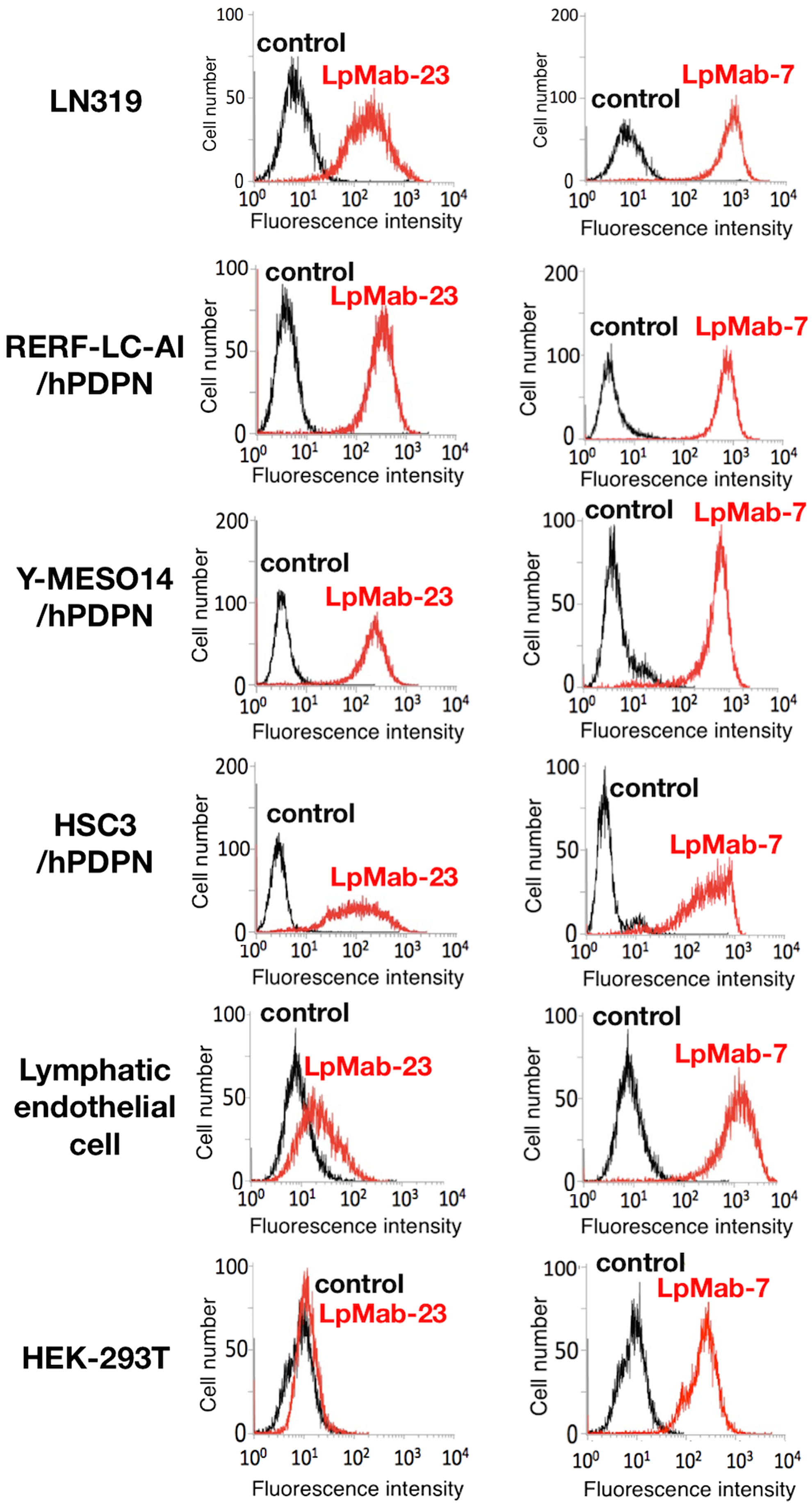
Flow cytometric analysis by anti-hPDPN mAbs. Cells were treated with LpMab-23, LpMab-7 (1 μg/mL; red), or control phosphate-buffered saline (black) for 30 minutes at 4°C, followed by treatment with anti-mouse IgG-Oregon green. Fluorescence data were collected using a Cell Analyzer EC800.
Footnotes
Acknowledgments
We thank Takuro Nakamura, Miyuki Yanaka, Noriko Saidoh, and Kanae Yoshida for their excellent technical assistance. We also thank Yuki Fujii, Hiroaki Uchida, and Hideaki Tahara for their specialized advice. This work was supported, in part, by the Basic Science and Platform Technology Program for Innovative Biological Medicine from Japan Agency for Medical Research and development, AMED (Y.K.), by the Translational Research Network Program from AMED (Y.K.), by Project for utilizing glycans in the development of innovative drug discovery technologies from AMED (Y.K.), by the Platform for Drug Discovery, Informatics, and Structural Life Science (PDIS) from AMED (Y.K.), by JSPS KAKENHI Grant No. 26440019 (M.K.K.) and 16K10748 (Y.K.), and by the Regional Innovation Strategy Support Program from the Ministry of Education, Culture, Sports, Science and Technology (MEXT) of Japan (Y.K.). This work was performed, in part, under the Cooperative Research Program of Institute for Protein Research, Osaka University, CR-16-05 and by the Grant for Joint Research Project of the Institute of Medical Science, the University of Tokyo. We thank Enago (
Author Disclosure Statement
No competing financial interests exist.