




Abstract
In vivo targeting an immunogen to the CD40 receptor expressed on professional antigen-presenting cells (APCs) dramatically enhances speed, magnitude, and quality of the immune response. Our previous evaluation of this strategy in poultry was limited to immunogenicity studies using CD40-targeted synthetic peptides, which demonstrated significant antigen-specific serum IgG and tracheal IgA levels <1 week after primary administration. In this study, this antibody-guided immunization strategy was modified to permit incorporation of inactivated highly pathogenic avian influenza virions (in lieu of short synthetic peptides) as the immunogen by simply mixing a bispecific antibody complex (anti-CD40/M2e) with crude inactivated virus before injection. Adjuvated avian influenza virus (AIV) induced significant hemagglutination inhibition titers up to 6 weeks postimmunization. In efficacy studies, administration of a single vaccine dose yielded 56%–64% survival against challenge with highly pathogenic H5N1, and 100% protection was achieved upon boosting. These results represent a feasible strategy to effectively target whole inactivated influenza A virus to chicken APCs, regardless of AIV clade and without phenotyping or purifying the virus from crude allantoic fluid. The data represent proof of principle for the unique prophylactic efficacy and versatility of a CD40-targeting adjuvation strategy that can in principle also be harnessed in other poultry vaccines.
Introduction
T
Agonistic anti-CD40 antibodies can act as a surrogate helper T cell costimulatory signal and physically connect antigens to the anti-CD40 antibody. This permits enhanced delivery of the immunogen to the APC, thereby dramatically reducing the lag time of a typical primary immune response.(4) Because of their capacity to induce more robust immune responses in a shortened time period, antibody-guided immunization methods have grown in popularity.(5,6) This strategy has been the most extensively studied in human and murine systems,(7–9) but is also gaining interest in agriculturally important species. The option to use the same antibody for different mammalian species enhances the versatility of agonistic anti-CD40 antibodies for potential use in multiple agricultural animal species.(10)
Previous research using CD40-targeted complexes for immunization in poultry has shown a surge in immunogenicity by inducing both systemic IgG and mucosal IgA responses after a single administration.(11,12) This is particularly important for respiratory diseases, as secretory IgA is the main element protecting birds during mucosal infection(13,14) and the CD40 activation pathway is the only mechanism capable of inducing immunoglobulin isotype switching in birds.(15)
Although avian influenza virus (AIV) is not endemic to poultry within the United States, AIV remains an important threat to the poultry industry in other countries and a near-constant biosecurity issue within the United States, as emphasized by the recent 2014–2015 highly pathogenic avian influenza (HPAI) outbreak that caused an estimated loss of ∼48 million birds and the 2016 Indiana outbreak that resulted in a loss of >400,000 birds.(16) Although vaccination against AIV is not standard practice in the United States, current AIV vaccines designed for emergency use or used in AIV endemic regions center their programs on development of protective antibodies against the virus' hemagglutinin (HA) protein.(17–19) An effective protective response correlates with sufficient antibody titer against the HA protein, resulting in inhibition of viral entry and infection. This is a constant challenge as there are 16 different subtypes of HA, requiring vaccine propagation and reformulation as different outbreaks occur.(20)
In contrast, the M2 ion channel's extracellular (M2e) region of AIV has been identified as a highly conserved epitope among most type A influenza strains and many attempts have been made to use this domain for development of a universal vaccine, but with variable results.(21–23) Some vaccines against highly pathogenic AIV have proven to be only partially protective due to mismatched immunogen properties compared with the field virus and due to lack of long-term efficacy, leading to the need to investigate potential vaccine efficacy enhancers.(24–27)
In this study, a bispecific antibody-guided adjuvant system targeting both the chicken CD40 receptor and AIV M2e was tested for enhanced delivery of inactivated HPAI virus and conferred functional protection upon homologous challenge in chickens. The approach builds upon previous in vivo CD40-targeting experiments in poultry using synthetic peptides,(11,12) but uses an anti-M2e AIV-capturing monoclonal antibody in lieu of a biotinylated synthetic peptide (Fig. 1).
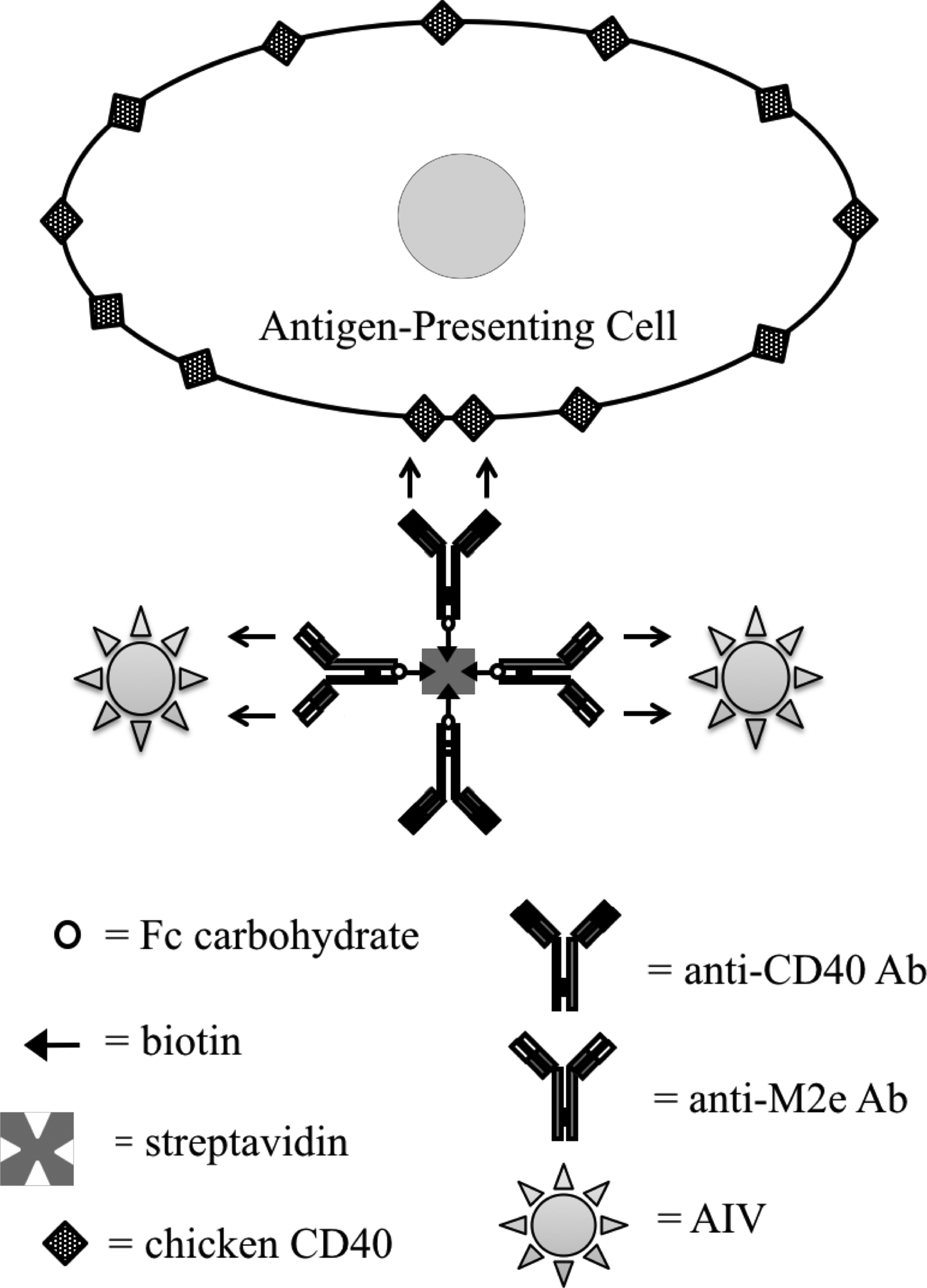
Bispecific adjuvant complex schematic. Anti-cCD40 monoclonal antibodies and anti-AIV M2e monoclonal antibodies were directionally biotinylated on their carbohydrate moieties and attached to a streptavidin scaffold at a ratio of 2 anti-CD40: 1 streptavidin: 2 anti-M2e. The resulting complex was mixed with 384 hemagglutination units of iAIV, which incorporates the virus into the vaccine complex. This complex was used for immunization in chickens. iAIV, inactivated avian influenza virus; M2e, M2 ion channel's extracellular.
This modified complex has the potential to bind inactivated AIV (iAIV), regardless of HA type and to then direct the virions to the CD40 receptor of the bird's APCs. Theoretically, this approach has the potential to overcome the weak response and short-term protection issues of some AIV vaccines.(28,29) The use of anti-M2e antibodies to universally incorporate whole AIV into the targeting complex will permit the use of this strategy regardless of the subtype of the circulating virus and without purifying and chemically conjugating the virus.
Materials and Methods
Viruses
Inactivated A/Turkey/Virginia/158512/2002 H7N2 low pathogenic avian influenza (LPAI) virus was used to coat enzyme-linked immunosorbent assay (ELISA) plates during anti-M2e monoclonal antibody screening. A/Egret/Hong Kong/757.2/2002 H5N1 HPAI was used for initial in vivo testing of three different anti-M2e monoclonal antibody candidates on modified bispecific antibody-guided complex. Immunogenicity trials used inactivated A/Turkey/Wisconsin/1968/H5N9 LPAI virus. The challenge trial also used Egret/02 H5N1 HPAI virus. All viruses were propagated in chicken embryo allantoic fluid. Viruses utilized for vaccination or hemagglutination inhibition (HI) assays were beta-propiolactone inactivated.(30) Vaccines were formulated to contain 384 hemagglutination units (HAU) of virus per dose. HI assays were performed with the identical virus used during corresponding immunization.
Anti-M2e monoclonal antibodies
Monoclonal antibodies were produced against the extracellular domain of AIV’ M2 ion channel protein. Hybridomas were created with Sp2/0 mouse myeloma cells using standard electrofusion protocols.(31) Splenocytes were harvested from mice hyperimmunized against synthetically produced peptide conjugated to keyhole limpet hemocyanin (GenScript, Piscataway, NJ) containing the M2e amino acid protein sequence (EVETPTRN). The M2e peptide sequence selected had 100% consensus with >50 different strains of avian influenza in the GenBank protein sequence database. Mouse work procedures were carried out in accordance with permit 2014–0013, as approved by the Texas A&M University Institute of Animal Care and Use Committee. Hybridomas were screened and selected based on production of IgG antibodies specific against the synthetic M2e peptide as well as against whole inactivated Turkey/02 H7N2 LPAI virus(29) through ELISA.
From the original 15 double positive (against peptide as well as whole virus) parent hybridomas, 3 parents were selected for further subcloning. Subclones were screened again against the peptide and whole AIV. From the pool of hybridoma subclones that remained double positive against both the M2e peptide and the Turkey/02 H7N2 LPAI virus, one subclone from each parent was selected (creating a panel of three potential candidates that were designated as clones A, B, and C) for further screening and use in downstream adjuvant complex formation and trials.
Anti-M2e monoclonal selection
Upon cloning by limiting dilution, three anti-M2e hybridomas were selected as candidates for use in the bispecific adjuvant complex formulation, tentatively designated as clones A, B, and C. The respective monoclonal antibodies were incorporated into the CD40-targeting complex as previously described,(11) but with substitution of biotinylated anti-M2e monoclonal antibodies for the previously used biotinylated peptides. This created a complex stoichiometrically comprising four biotinylated monoclonal antibodies (two against the chicken CD40 receptor and two against AIV M2e, Fig. 1) on a central streptavidin scaffold molecule. This bispecific adjuvant complex was then mixed with a fixed 384 HAU of iAIV.
Confirmation of this formation was verified by ELISA. Recombinant chicken CD40 protein was coated on the plate at 100 μL/well at 5 μg/mL and the plate blocked with 5% BSA. The AIV-loaded bispecific complex was applied at 100 μL/well at 5 μg/mL, the AIV detected with chicken anti-HA antibodies (Sigma-Aldrich, St. Louis, MO), and peroxidase-conjugated rabbit antichicken IgY (Bethyl Laboratories, Montgomery, TX) secondary antibody used for detection.
The in vivo testing and selection of the anti-M2e candidate monoclonal (A, B, or C) included dosage testing of a range of virion to bispecific complex unit incorporation ratios. These tested dosages included 250, 500, 1000, 2000, 4000, 8000, and 16,000 times bispecific complex to virion ratios (n = 20 birds per dosage per candidate monoclonal) to ensure adequate coverage of the complex onto virus. Each vaccine dose consistently contained 384 HAU of inactivated Egret/02 H5N1 HPAI virus, propagated in allantoic fluid. The resulting adjuvant complex was mixed 1:1 v/v with sterile saline containing 5% (v/v) squalene and 0.4% (v/v) Tween 80 for subcutaneous (s.c.) administration. Virion-loaded complex was administered to 2-week-old layers obtained from Medion Vaccine Company (Bandung, Indonesia). Serum was collected 1 week postimmunization to measure serum HI titers against homologous iAIV. This study was carried out in accordance with the Indonesian government's biosafety level 3 animal use regulations.
Vaccine preparation
Further adjuvant complex studies were performed using clone C anti-AIV M2e monoclonal antibodies. This vaccine was mixed with iAIV at a 1000× bispecific complex to virion ratio, with each vaccine dose containing 384 HAU of iAIV, as previously tested. CD40-targeted virus was administered through either s.c., oral, or eye drop (oculonasal) routes, depending on the trial. Subcutaneously administered bispecific complex was prepared as previously stated, whereas the orally administered complex was alginate encapsulated in sterile saline before administration as previously described.(12) Eye drop administered complex was used directly without any additional preparation. A control group received 384 HAU of iAIV without adjuvant and was used as a reference control during the final challenge trial.
Immunogenicity optimization
Male Leghorn chickens (n = 10 birds per group) were either s.c., orally, or through eye drop vaccinated at 2 weeks of age (details shown in Fig. 2). The negative control group remained unvaccinated. Beta-propiolactone-inactivated Turkey/68 H5N9 LPAI virus was used for immunization as well as downstream HI assays. Preimmune sera were collected at the start of the study and postimmunization sera were collected for up to 4 weeks after boost. Serum samples were used in HI assays against the same iAIV used during immunization.
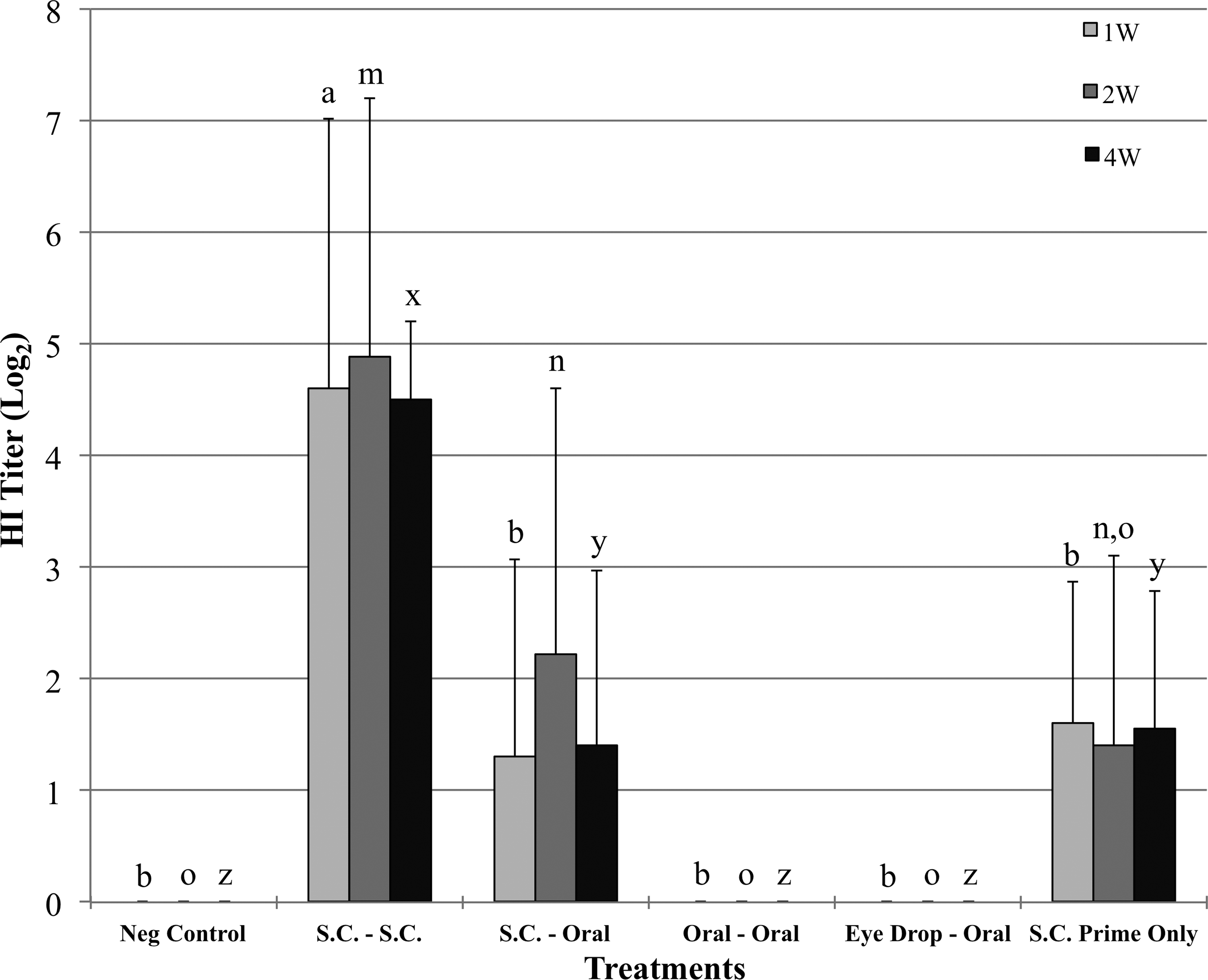
s.c. Administration of complex-adjuvated crude LPAI virus induces the highest immune response postboost. Immunogenicity trials tested s.c.), oral, or eye drop administration of the vaccine complex (primed at 2 weeks of age and boosted at 4 weeks of age) using H5N9 LPAI (n = 25/group). The negative control group remained unvaccinated. Serum HI titers were measured at 1, 2, and 4 weeks postboost and reported as group means (with standard deviation bars overlaid). Significantly different (P ≤ 0.05) HI titers between groups at each time point indicated with nonmatching letters (“a–b” for 1 week postboost, “m–o” for 2 weeks postboost, and “x–z” for 4 weeks postboost). Results show that s.c. administration is required to induce a robust response. Birds primed and boosted subcutaneously had significantly higher HI titers than birds receiving only one s.c. injection. No response was observed in birds in the other treatment groups. HI, hemagglutination inhibition; LPAI, low pathogenic avian influenza; s.c., subcutaneous.
The HI assays were performed as follows: a twofold serial dilution of the serum samples was mixed 1:1 v/v with 8 HAU of the iAIV used in formulation of the adjuvant complex, followed by the addition of 5% red blood cells. Reciprocal of the highest serum dilution capable of HI was considered the final HI titer; these HI titers were converted to Log2 values and used for statistical analysis. Analysis of variance (ANOVA) and post hoc Turkey honestly significant difference (HSD) analysis were performed using JMP statistical software, version 12. P-values ≤0.05 were considered statistically different. Bird procedures followed standard practices set by the University of Arkansas Institutional Animal Care and Use Committee.
Challenge trial
Specific pathogen-free Leghorn chickens were obtained from Medion Vaccine Company (Bandung, Indonesia) for use in this study and animal care and procedures conducted in accordance with the Indonesian government biosafety level 3 animal regulations. Inactivated Egret/03 H5N1 HPAI virus was used for vaccine preparation and the live virus was used during challenge. Birds were immunized with CD40-targeted inactivated H5N1 HPAI virus using the bispecific adjuvant complex at a 1000 times bispecific complex to virus ratio, final volume 0.5 mL, at 2 weeks of age, either subcutaneously at the nape of the neck or orally (n = 25 birds per group). Groups were boosted at 4 weeks of age. One group received virus alone and served as a point of reference for the experimental groups. All groups were challenged with 200 μL of 1 × 10 6 EID50/mL homologous HPAI through the intranasal route at 5 weeks of age, except for the nonchallenge control group.
Percentage of group survival after 4 days postchallenge was calculated and used as an indicator for protective efficacy, as the standard mortality rate of HPAI challenge in birds is 75%–100% within 4 days.(32) ANOVA and post hoc Tukey HSD analysis on categorical data were performed using JMP statistical software, version 12. P-values <0.05 were considered statistically different.
Results
s.c Administration is required for induction of robust HI titers against AIV
Each candidate anti-M2e monoclonal antibody was used to construct a CD40-targeting bispecific complex (two anti-M2e antibodies along with two anti-cCD40 antibodies onto a central streptavidin scaffold molecule). Each candidate adjuvant complex was mixed with 384 HAU of inactivated virus and administered to birds for immunogenicity comparison. Monoclonal antibody from clone C induced threefold higher HI titers than clones A and B 1 week postimmunization; no dose–response differences between different complex:virion ratios was observed. Hence, all further testing used clone C in combination with an estimated 1000 copies of targeting anti-CD40/anti-M2e bispecific antibody complex per virion.
Optimization of the route of vaccination consisted of administering inactivated Turkey/68 H5N9 LPAI using a combination of s.c., oral, or eye drop routes in a 2-week interval prime/boost schedule. Based on HI titers of sera collected 1, 2, and 4 weeks postboost (Fig. 2), an s.c. priming injection is required to induce significant antibody production and produced statistically higher HI titers than non-s.c. counterparts. Birds from groups receiving only oral/eye drop (mucosal) vaccine complex did not produce detectable HI titers against the virus. The group receiving both s.c. prime and boost injections mounted the largest antibody response, with HI titers being threefold higher than all other groups (P < 0.0001) at 4 weeks postboost. Large standard deviations were observed within treatment groups, but this was to be expected as outbred birds were used in this study.
Interestingly, the group receiving a single s.c. prime only (no boost received) retained measurable HI titers up until the latest serum collection time point, that is, 6 weeks postimmunization for this group. This is the longest time in which functional antibodies have been measured using this immunization system, as previous immunogenicity studies only measured up to 2 weeks after immunization. This 6-week time span is particularly interesting as 6 weeks is the typical full lifespan of a broiler chicken.
Subcutaneously administered CD40-targeted bispecific complex protects birds against lethal HPAI challenge
CD40-targeted vaccine was able to confer protective immunity after lethal H5N1 HPAI challenge when birds were immunized subcutaneously, as judged by survival 4 days postchallenge with the homologous Egret/03 H5N1 HPAI (Table 1). The group immunized subcutaneously with both prime and boost yielded a 100% survival rate after challenge. Groups receiving only one s.c. administration demonstrated partial protection with 56%–64% survival after challenge, depending on the group. This was expected based on the lower HI responses observed in previous immunogenicity testing reported in Figure 2. Groups receiving only oral administration of the complex did not acquire any protective immunity against the HPAI challenge, which also matched previously recorded immunogenicity data. As expected, no survival was obtained in the sham vaccinated control group. Taken together, CD40-targeted inactivated virus complex was shown to confer protection against lethal HPAI challenge chickens.
Crude Highly Pathogenic Avian Influenza Adjuvated with Bispecific CD40-Targeting Antibody Complex: Challenge Trial Treatment Groups and Survival Data
Birds were immunized (n = 25/group) with CD40-targeted Egret/02 H5N1 HPAI virus either subcutaneously or orally. Prime occurred at 14 days of age and boosts were administered at 28 days of age. A group received inactivated virus without adjuvant to serve as a comparison. Birds were challenged at 35 days of age with homologous AIV. Percentage survival was calculated after 4 days postchallenge. Significantly different (P ≤ 0.05) percentage survivals are indicated with nonmatching letters (“a–c”).
HPAI, highly pathogenic avian influenza; iAIV, inactivated avian influenza virus; s.c., subcutaneous.
Discussion
In this study, we report that in vivo targeting CD40 can be harnessed to dramatically enhance the immunogenicity and efficacy of inactivated whole AIV by capturing it through its highly conserved AIV M2e region as a strategy to incorporate the virus into the targeting complex. The ensuing immune response was initially evaluated by HI assay, which primarily measures antibodies blocking the viral HA. Use of anti-M2e antibody to incorporate the virus into the immune complex did not interfere with anti-HA antibody production, and dramatically extended the persistence of HI titers. Notably, HI titers were still detected 6 weeks after a single prime injection (Fig. 2, s.c. prime only). Previous immunogenicity studies using this method had not measured sustained response beyond 2 weeks postimmunization.(11)
These data not only prove that this adjuvating strategy is capable of inducing a sustained antibody response, but also that the antibodies maintain their hemagglutination inhibiting capacity. One week after a boost injection, the bispecific CD40-targeting antibody complex was able to confer 100% protective efficacy against challenge with a highly pathogenic AI in chickens. This is the first report of highly efficacious in vivo CD40-targeted vaccination in chickens.
Many adjuvant studies have been conducted in an effort to enhance AI vaccine immunogenicity, either by expressing HA proteins on a recombinant vector,(33) by the addition of immunopotentiators to the formulation,(34) or switching to a DNA vaccine platform.(35) These studies have reported varying results, ranging from only slightly increased immunogenicity to reduction of viral shedding, and from partial to full protection, but none of these vaccine candidates have been implemented in systematic vaccination regimens. Although CD40-mediated enhancement of anti-influenza A immune responses has been reported by Hatzifoti and Heath(28) in mice, their approach involved extensive bioconjugation chemistry of highly purified virus that would be impractical and cost prohibitive in the context of the poultry industry.(28)
By contrast, the innovative use of a bispecific antibody-based adjuvant circumvents the need for allantoic fluid purification and sophisticated chemistry. Because the complex is based on anti-M2e antibodies, a conserved region on all type A AI viruses for which sequence data are publicly available, the bispecific adjuvant can be mass produced and stockpiled before use, to then be mixed with crude allantoic fluid containing any iAIV before vaccine administration. The complex used in this study was tested with both LPAI and HPAI viruses, both of which demonstrated robust immune responses (immunogenicity measured by HI titer and/or protection against challenge).
In countries that only allow the use of vaccination as an emergency program in the event of a highly pathogenic AI outbreak, induction of a rapid immune response is crucial to preventing mortality, and the bispecific adjuvant has the theoretical potential to accommodate this need. In countries with endemic AI implementing a vaccination program, the bispecific anti-CD40/M2e complex has the potential to complement existing vaccine practices or to replace the initial priming immunization, which would allow for prolonged efficacy and reduced induction time.
In its current incarnation, mass production of the bispecific antibody complex would be cost prohibitive for use in large-scale poultry vaccination programs. However, it can be argued that for high value birds such as broiler breeder stock, even the prototype vaccine we describe would be cost effective. Without question, further research addressing the translation of classical monoclonal antibodies to a recombinant antibody production platform (such as a plant-based expression system) is needed.
Once optimized, production of the bispecific antibody complex would arguably be less expensive than the propagation of AI virus, even under the form of crude allantoic fluid. Therefore, dosage studies aiming at reducing the number of inactivated viruses while maintaining efficacy are needed, since cost per dose is a decisive factor for an industry that maintains billions of birds. Furthermore, a mode of mass vaccination (for instance by spray application to day-old chicks) would obviate the need of s.c. immunization requiring handling individual birds, which is cost prohibitive in the modern poultry industry—although it is not an unusual practice in low wage developing countries. Finally, time course studies are needed to monitor lasting protection beyond initial immunization. This study monitored antibody titers up to 6 weeks after a single injection, but the extent of time the birds are protected beyond this period would be a very important consideration to gauge effectiveness and to schedule a booster immunization program in longer living birds, such as layers or breeders.
Footnotes
Acknowledgments
We thank the research staff for providing husbandry and care of animals.
Author Disclosure Statement
Initial research on development of targeting complex was funded by USDA NRI (Grant No.: 2008-35204-04554) as well as Trust agreement (58-6612-3-009F [DRK]) with Pacific GeneTech. Research described in this article was financially supported by Pacific GeneTech, Ltd. with headquarters in Hong Kong. The funder was not involved in the study design, data collection, analysis, or interpretation of the data. A Patent Cooperation Treaty application with International Patent Publication No. WO2015/187969 has been filed. Collaborator Melina Jonas is an employee of Medion Vaccine Company, the location in which HPAI studies was performed. Results presented in the article have been previously presented at the 2017 Poultry Science Association annual meeting.